SilverStar500 . com

Attaining True Salvation
(A.T.S. - An Amazing Book!)
Copyright 2010 Michael H. Malan All Rights Reserved
D E D I C A T I O N
This book is dedicated to the countless unseen angels
who, under divine direction, continue to make so many things
in the lives of God's faithful children that seem impossible,
possible.
L I S T O F C H A P T E R S
1. The Prophesied Christian Apostasy and Restoration of Christ's Church
2. Torch Bearers of Truth
3. The Amazing missionary Work of Jesus' Ordained Disciples
4. True and False Christians
5. The Nicene Creed vs. the True Nature of God
6. What is Mariology?
7. The True Nature of Salvation
8. The Significance of Baptism
9. Our Eternal Father's Perfect Plan of Happiness
10. Why a Tree of Forbidden Fruit?
11. Christ's Magnificent Atonement
12. Kingdoms of Salvation Revealed
13. Achieving the Higher Salvation
14. The Three Lineages of Spiritual Merit
15. A Journey with Our Savior
16. Elijah's Cup and Salvation
17. Herod's Resplendent Temple
18. Herod's Temple Alter and the Passover Sacrifices
19. Christ's Sacrifice Begins at Gethsemane
20. Jesus is Betrayed and Tried
21. Christ's Terrible Crucifixion
22. The Savior's Amazing Resurrection
23. Events After the Lord's Resurrection
24. Christ's Nature and Perfection
25. Rediscovering Our Noble Heritage
26. The Seven Feasts of Israel
27. Sacrifices From the Heart
28. Events Preceding Christ's Millennial Reign
29. The Zion of the Rocky Mountains
30. The Saints Relocate to Missouri
31. Recognizing a Truly Faithful Saint
Following the last chapter is a SELECTED BIBLIOGRAPHY
P R E F A C E
This Christian book's pages are purposely not numbered. Each successive chapter builds upon the previous chapter and also upon all chapters previously read. This is done to allow you to read chapters consecutively in a manner that invites an intense and much more complete understanding of the true doctrine and gospel salvation taught by our beloved heavenly Gods, Jesus Christ our Savior, and God, His Father, Who is also our actual spiritual Father in Heaven -- the creating Father of our spirits. Yes, you probably agree that we do have non-physical "spirit bodies" too, sometimes called "souls"!
In the early spring of the year 1820, something very astonishing happened. Kneeling in a remote grove of trees in response to regular Bible study which developed unwavering faith in God and resolute prayerful supplication, Joseph Smith, a young farm boy living in Manchester, New York, was visited by God the Father and his son Jesus Christ!
Both Gods appeared before Joseph in magnificent glory! Joseph later stated that the brilliant whiteness of their appearance was intense, their glory even above the brightness of the sun. "Neither could I imagine anything that could be that white," he exclaimed. Standing in the air above him, the Father called Joseph by name, and then, pointing His hand toward His Son, Jesus Christ, spoke to Joseph, saying, "This is my beloved Son, hear Him! During that heavenly visit, Jesus Christ responded kindly to Joseph's inquiring question, "Which of all the sects is right ... and which should I join?" telling Joseph that he should join none of them.
Little did Joseph know at that time, that before being born into this world, due to Joseph's extremely faithful spiritual life in heaven, God was to prepare him to become another of His earthly prophets. Joseph was destined to re-establish His true gospel in our latter times of the world as prophesied biblically by Christ's apostle John.
Previous to this miraculous visitation, Joseph did not realize that God the Father and His Son were separate individual personage Gods, and that each had a magnificent glorified human body! The Christian Bible confirms this identity (i.e."And God said, Let us make man in Our image ... male and female created He them" -- read biblical Genesis 1:26-27). Joseph had immediately discovered that, remarkably, "God" was not an invisible tri-god essence as taught by all of the orthodox "Christian churches" of that day as well as presently.
Via Joseph, who was a boy of only fourteen years of age at the time of that heavenly visitation, Christ's primitive church was eventually restored back to earth as prophesied biblically (see Revelations 14:6). The Savior was still its Chief Cornerstone, complete with keys of priesthood authority enabling the performance of divinely commissioned sacred ordinances of salvation as also endowed by Christ anciently.
In this book, "Achieving True Salvation," the author highlights the truth of the reality of God, who is the Father of our spirits as well as the organizer of our mortal bodies which He created in His own image, and of His beloved son Jesus Christ, our Redeemer. Some salvation doctrine of the true ancient gospel of Jesus Christ, later purposely obscured and altered -- parts deliberately left out of early hand-copied biblical canon by egregious "Christian" authority --- are brought back into light and clearly defined. By revelation, the restored "Church of Jesus Christ of Latter-day Saints" is the name given by Christ himself as the name of His true modern-day church. Text within this book mentioning "the Church" refers to this church.
God's latter-day promise is that sincere repentance coupled with earnest prayerful study will verify this remarkably astonishing assertion of the true restoration of His church, inviting a divine witness by the power of the Holy Ghost. This promise is available to all of God's children on earth who earnestly desire to know the truth that they may be saved by compliance to the true gospel of our Lord Jesus and its divine ordinances promising untold happiness, peace, and fulfillment.
This publication is an endeavor to accurately present vital truth relative to the salvation of God's children. However, it is not to be accepted as approved or official doctrine of the Church. Historical comment is presented from information believed to be the most likely and accurate in the author's opinion. The "story journey" events depicted, in particular those after Christ's resurrection, are the author's own interpretations based upon researched information and scripture. New findings may alter or super-cede some historical data that is considered valid at the time of this writing. Any inadvertent errors either historic or doctrinal must be attributed to the author and not to the Church.
The following abbreviations found in this book are explained:
D&C- (The Doctrine and Covenants) A scriptural compilation of revelations directing and establishing Church policy and doctrine received by latter-day prophets of the Church of Jesus Christ of Latter-day Saints covering a time period from 1823 to 1978.
B of M- (The Book of Mormon) A scriptural and historical work of the Church compiled by prophets who lived in the ancient Americas (about 600 BC to about 421 AD) which supports much of biblical scripture and history by testifying of Jesus Christ and by clarifying his ordinances and teachings in greater depth.
P of GP- (The Pearl of Great Price) The prophet Joseph Smith's more in depth inspired version of the "Book of Moses" (found in biblical Genesis) plus "The Book of Abraham," a translation of Egyptian papyri by Joseph Smith in the year 1835 containing writings of the the great biblical prophet Abraham. In addition, this volume contains "Joseph Smith -- Matthew," an inspired translation of biblical Matthew, and excerpts of Joseph Smith's own written testimony and history, "Joseph Smith -- History." Finally included are Joseph Smith's own statements taken from one of his letters addressed to a newspaper editor, statements now adopted as "Articles of Faith," summarizing some fundamental doctrinal tenets of the Church.
JST- (Joseph Smith Translation" An inspiring clarifying revision of some parts of the King James Bible began by Joseph Smith in the year 1830 and unfinished due to his martyrdom.
HC- (History of the Church) A history authorized by the Church prophets and many other witnesses of events. It documents the opening of the "Dispensation of the Fullness of Times" and the origin, development, doctrinal revelations, joys, and severe trials of the Church from its legal organization in 1830 to August of 1844, with explanatory footnotes.
Biblical books referenced are from the King James Bible version of scripture which are easily recognized inasmuch as they have no preceding abbreviation letters to identify them.
Comments in brackets are additional scriptural references, cross references, or explanatory comments by the author.
A T T A I N I N G T R U E S A L V A T I O N
CHAPTER 1
The Prophesied Christian Apostasy and Restoration of Christ's Church
This paper journey is an invitation to enter into a transcendent spiritual reality similar to that which the young biblical prophet Daniel and his faithful companions experienced — namely, a force of faith sufficient to even assure divine protection! (to read about this, go to the biblical Book of Daniel, Chapter 3).
Although you will obviously not face King Nebuchadnezzar’s physically hot fiery furnace, you may nevertheless — through obedience to God, honest prayer, and His grace — gain the extraordinary faith that brings a powerful witness of the Holy Spirit. This is an experience that some who sincerely seek to know the truth about their salvation describe as a spiritual light or burning sensation felt within the soul that confirms eternal truth unquestionably. This witness from heaven, sent to us directly from God, our Heavenly Father, is, of course, the key to gaining a spiritual understanding of the true principles of salvation. It is the glorious enlightening vital truth from God which, when understood, is amazing comforting truth about salvation that you will undoubtedly desire to share with friends and loved ones.
To understand what eternal salvation means and how it applies to us as God’s children, first of all it is essential that our spirits are in harmony with the Spirit of God. Please take a moment now to ask God in prayer for spiritual enlightenment to understand the profound truth within His celestial laws and eminent principles of salvation. His beloved Son has beckoned all, regardless of age, class, race, or creed, who wholeheartedly seek to learn more about our Heavenly Father and the salvation He offers to His children, by giving us this loving invitation:
“Ask, and it shall be given you; seek and ye shall find; knock, and it shall be opened unto you: for every one that asketh receiveth; and he that seeketh findeth; and to him that knocketh it shall be opened. Or what man is there of you, whom if his son ask bread, will he give him a stone? Or if he ask a fish, will he give him a serpent? If ye then, being evil [better translation: "being unholy"] , know how to give good gifts unto your children, how much more shall your Father which is in heaven give good things to them that ask Him?”
Matthew 7:7-11 [see also B of M– 2 Nephi 26:23-33]
There are those who, in flagrant disregard of the recorded writings of many witnesses —especially including the biblical witnesses of His divinity as the Son of God as recorded by His most intimate disciples — acknowledge Jesus to be a great teacher. Yet, they do not believe in the many astonishing miracles He performed as testified of by His ordained apostles and even acknowledged by some of his enemies, nor do they accept Him as the literal Son of God. They not only reject the numerous biblical testimonies of ancient as well as modern witnesses, but these unbelievers are also unwilling to humble themselves sufficiently to receive the words in scripture spoken by Jesus Himself. Instead, they indulge themselves in knowledge which is derived from traditional indoctrinated philosophies and the so-called wisdom of mortal men. [John 7: 14-18; Luke 6:47-49]
Seven hundred years before Christ’s advent in the flesh, the great Jerusalem prophet, Isaiah, saw down through the ages even as far as into our own time. He viewed in vision the disbelief and selfish nature of many who would cunningly replace the true salvation teachings of God with the corrupted and false teachings of man:
“Wherefore the Lord said, For as much as this people draw near me with their mouth, and with their lips do honor me, but have removed their heart far from me, and their fear toward me is taught by the precept of men: Therefore, behold, I will proceed to do a marvelous work among this people, even a marvelous work and a wonder: for the wisdom of their wise men shall perish and the understanding of their prudent men shall be hid.” Isaiah 29:13-14
Isaiah’s revelations pertaining to the latter days enabled Isaiah to recognize an eventual restoration of the true Christian gospel which was lost from the earth after the death of Christ and His apostles — a restoration in our time which would eventually expose and discredit the vain teachings of man that became promoted as salvation truth.
The zealous Pharisee, Paul, also known as Saul, once went about severely persecuting Christians thinking that he was thereby performing chivalrous service to God. One day when traveling with his supportive persecuting companions to another city, he and his friends were suddenly surrounded with a bright shining light. They were all amazed! In sudden shock, Paul fell to the earth. Paul then heard the voice of Jesus Christ. Calling Paul by name, Christ asked, "Why do you persecute Me?" Trembling, Paul replied, "Who art thou, Lord?" "I am Jesus whom thou persecutest." Astonished, Paul became blind when he stood up from the ground and was then led by his companions back to Damascus.
Three days later, the Lord showed Paul in a dream that the prophet Ananias would visit him and restore his sight. The Lord then gave directions to Ananias, and told him to go to Paul and to heal him. Paul was soon after taught more gospel principles and baptized, becoming a humble spiritually changed missionary who would henceforth adamantly desire to share the true gospel of Christ! [see Paul's amazing conversion, Acts, chapter 9]
Paul later taught many others in a powerful manner how truth from God can be known. Just as the emotions, such as love, hate, sympathy, jealousy, etc. that exist primarily in a spiritual non-physical realm are not easily measured and quantified with certainty by science, the spiritual truths about our salvation are proven as valid truth to us only through a spiritual witness provided directly from God.
Our Eternal Father is always spiritually aware of each one of us and of all of the problems and events in our lives. He wants us to seek spiritual assistance. Through our faith, which is a belief strong enough that it leads us into action impelling us to study about and to follow the teachings given to us through His Son, Jesus Christ, we can also learn to actually love God deeply — as the first commandment invites — with all of our heart, might, mind, and strength. Then, with such strong faith we can come to know spiritual truth unquestionably by the power of the Holy Ghost.
After coming to understand the spiritual method of learning spiritual truth, Paul passionately taught this vital concept. Unfortunately, there are many in our day who have never before recognized the profound spiritual wisdom in the apostle Paul’s explanation. Paul discovered the difference between worldly physical truth proven by science and the heavenly spiritual truth proven to us by the Holy Ghost. Notice how apostle Paul explained this later on to the saints of Christ’s Church in Corinth:
“But as it is written, Eye hath not seen, nor ear heard, neither have entered into the heart of man, the things which God hath prepared for them that love Him. [Here Paul quotes commonly recognized religious scripture that was known in his time, but has been lost from the biblical books we now have!] But God hath revealed them to us by His Spirit: for the Spirit searcheth all things, yea, the deep things of God. For what man knoweth the things of a man, save the spirit of man which is in him? Even so the things of God knoweth no man, but the Spirit of God. Now we have received, not the spirit of the world, but the spirit which is of God; that we might know the things that are freely given to us of God. Which things also we speak, not in the words which man’s wisdom teacheth [physical science for teaching the physical man], but which the Holy Ghost teacheth [spiritual science for teaching the spiritual man]; comparing spiritual things with spiritual. But the natural man receiveth not the things of the Spirit of God: for they are foolishness unto him: neither can he know them, because they are spiritually discerned.”
1 Corinthians 2:9-14 [see also D&C-50:17-24; 29:34-35]
Fortunately, there are those who have learned to believe in the words of our Savior through the spirit, and they endeavor to follow His teachings with true faith. A few have discovered for themselves by the unmistakable spiritual power of the Holy Ghost — the Spirit Personage of the Godhead who witnesses of all truth to each of God’s children who earnestly desire to know it —that Jesus Christ truly is God’s Son. However, after achieving a limited degree of glorious spiritual knowledge, for some, the quest for further gospel enlightenment wanes due to an abundance of Christian doctrine found in the churches of today that has been formulated anciently by the science of rational wisdom, and passed down through many generations along with rites and traditions of man’s own innovation. In a further chapter, the most fundamental of these man conceived, but false innovations adopted over the centuries and still held as truth in most of today’s Christian churches will be refuted in light of scripture.
In general, Christians of today are led to follow many fallacious doctrines of a Christian pseudo-gospel anciently fabricated by evil self-serving men — often emperors, kings, popes, and churchmen — who, craving political power or prestige or to enrich themselves, and sometimes for all three of these reasons, perverted much of the word of God and changed His sacred ordinances. This is a bold statement, but true, as will be revealed in succeeding chapters. This obtuse meddling with God’s true gospel directives is also mentioned specifically in scripture. [Isaiah 24:4-5; Malachi 2:5-10; D&C– 1:14-16; B of M– 1 Nephi 13:1-9 & Mormon 8:27-37; 9:7-20]
As is the case in our modern times, the conventional religions promoted in Christ’s day were also founded upon religious philosophies foisted upon the people as being valid for achieving salvation. However, Christ refuted many of these corrupted teachings unequivocally. [see Matthew, Chapter 23] For most, the response to such correction of their perverted gospels of salvation was not one of thankful appreciation and new found enlightenment in honor of this Man of Miracles filled with light and truth, but instead a bitter narrow-minded response of defensive anger:
“And He [Christ] entered again into the synagogue; and there was a man there which had a withered hand. And they watched Him, whether He would heal him on the Sabbath Day; that they might accuse Him. And He saith unto the man which had the withered hand, Stand forth. And He saith unto them, Is it lawful to do good on the Sabbath days, or to do evil? To save life, or to kill? But they held their peace. And when He had looked round about on them with anger, being grieved for the hardness of their hearts, He saith unto the man. Stretch forth thy hand. And he stretched it out: and his hand was restored whole as the other. And the Pharisees went forth, and straightway took council with the Herodians against Him, how they might destroy Him.” Mark 3:1-6 [see also B of M– 2 Nephi 28:24-32]
From the beginning of His ministry, and even after countless miraculous healings of almost every description, Jesus was not only hated by the self-righteous for condemning their perverted teachings of God’s laws, but even threatened with death for upsetting their closely held traditions which were essentially promoted for their own personal rewards of prestige and monetary gain. [Luke 4:16-30, 5:21 to 6:11; Matthew 21:24-27, 6:1-8]
Is it any wonder that proclaiming the restoration of His true gospel by a true prophet in our modern times might also result in ungrateful resistance from the orthodox church indoctrinated Christians of today, many of whom are anxious to label any supposed conflicting doctrinal claims — even enlightening ones revealing the gross errors of long held religious beliefs and doctrines — as blasphemous heresy?
On one occasion, Christ was even accused by pious men saying that His power to cast out devils came from the devil himself! Can you believe that highly educated religionists would use this faulty premise to condemn a man who preaches love of God, eschews all evil, and who performs countless healing miracles? Christ replied to them with reason that even these learned religious scholars could not refute:
“Every kingdom divided against itself is brought to desolation. . . . And if Satan cast out Satan, he is divided against himself; how shall then his kingdom stand? . . . But if I cast out devils by the Spirit of God, then the kingdom of God is come unto you.” [see Matthew 12:25-28]
The raging, vile, and deceptive kingdom of Satan and his dark angels promote selfishness, hatred, and anger -- a meanness that stirs up religious conflict and promotes confusion. But God’s kingdom is one of love and peace, promoting meekness, humility, kindness, and service among mankind.
“For God is not the author of confusion, but of peace, as in all churches of the saints [members of Christ’s true primitive Church].” 1 Corinthians 14:33
It is obvious that our Eternal Father is not an author of conflicting doctrines that cause confusion, but is a God who establishes peace and order, and whose doctrine and Church is one only; that two contradictory organizations with doctrine in disharmony one with the other cannot both have origin in Him. Otherwise God would be divided against Himself!
“One Lord, one faith, one baptism. . . . That we henceforth be no more children, tossed to and fro, and carried about with every wind of doctrine, by the sleight of men, and cunning craftiness, whereby they lie in wait to deceive.” Ephesians 4:5, 14
Jesus lived among people who witnessed His countless miraculous healings. Hundreds witnessed miracles as He cast out evil spirits, restored sight to the blind, hearing to the deaf, and commanded all manner of ailments, ranging from crippling maladies to leprosy, to leave the bodies of those afflicted. Jesus’ teachings confounded the self-righteous Pharisees and
religious scholars with a revolutionary doctrine of love, which, because of their own jealous and hardened hearts, they never seemed to grasp. Is it not puzzling that relatively very few who heard His words were willing to act upon His teachings which included accepting baptism under the priesthood authority of His chosen ordained disciples [D&C– 138:25-26], thereby covenanting with God to abide in truth and to live perpetually as faithful saints?
Yet, strangely, after rejecting and crucifying the Son of God, the unrepentant self-willed nature of the generally evil element of the inhabitants of Israel kindled a persecution that finally dealt unmerciful death to His righteous apostles and eventually eradicated all seven main branches of Christ's Church of loyal saints. Not surprisingly, due to such a monumental rejection of light and salvation truth, Christ, His apostles, and even a prophet of an earlier generation were inspired to foretell of an equally monumental era of spiritual darkness — a prophesied apostasy — especially grievous during that period of earth’s history that, in retrospect, can be labeled appropriately as the dark ages:
”For the time will come when they will not endure sound doctrine; but after their own lusts shall they heap to themselves teachers, having itching ears; and they shall turn away their ears from the truth, and shall be turned unto fables.” 2 Timothy 4:3-4
“Behold, the days come, saith the Lord God, that I will send a famine in the land, not a famine of bread, nor a thirst for water, but of hearing the words of the Lord: And they shall wander from sea to sea, and from the north even to the east, they shall run to and fro to seek the word of the Lord, and shall not find it.” Amos 8:11-12
In response to His apostles’ inquiry as to their immediate future and of the future conditions of the world, Jesus Himself foretold that corrupt men would not allow the ordained truth He taught
and established to continue in its essential purity:
“Take heed that no man deceive you, for many shall come in My name. . . . All these are the beginning of sorrows . . . they [shall] deliver you up to be afflicted, and shall kill you . . .”
see Matthew 24:4, 8-9
When this severe persecution of Christ’s loyal Church members became a reality, faithful saints suffered much from the wrath and murder inflicted upon them by religious zealots blinded by their own pious pride, corrupt doctrine, and outright wickedness. For a few decades, under the protective hand of God many of Jesus’ apostles and missionary disciples were able to spread His gospel message and establish small branches of His Church throughout most of the known world. However, when the more intense persecution and prophesied murders became manifest within the nations, many of the faithful servants of God suffered death as martyrs.
Promised by the Lord that his life would be preserved, the apostle John became a prisoner banished to the remote island of Patmos. Although in exile far away from a scattering flock of saints, God would continue to speak to John and would miraculously allow him to soon be released to return back to his home in Ephesus where he would compile his own witness of Jesus and His teachings. In the book we now know as the biblical Book of Revelation, apostle John wrote some of the events shown to him by God in a number of elaborate visions of the latter periods of the earth’s existence. In one of these visions John saw Satan’s mighty reign over the people of earth, represented by a strange and terrible all-powerful beast. According to John’s prophesy, with the exception of the faithful whose names have been entered into Christ’s Book of Life, this Satanic beast shall eventually deceive nearly all of the inhabitants of earth — his strong delusions leading them all to deceptively worship him!
“. . . and power was given him [the beast] over all kindreds, and tongues, and nations. And all that dwell upon the earth shall worship him whose names are not written in the book of life of the Lamb slain from the foundation of the world.” Revelation 13:7-8
In another vision of earth’s latter times, John described angels acting for God in heaven in relation to our earth. Then John wrote:
“And I saw another angel fly in the midst of heaven, having the everlasting gospel to preach unto them that dwell on the earth, and to every nation, and kindred, and tongue, and people.”
Revelation 14:6 [See also Latter-day revelation, D&C 133:36-37]
If, contrary to Jesus’ own prophesies of apostolic persecution and death resulting in disintegration of His Church, Christ’s true gospel had remained to continue on earth as some prominent Christian doctrines have claimed for centuries, why would John’s visions of the future include an angel coming to restore it? In order for such a mighty angelic heavenly restoration of Christ’s true gospel to take place, it is obvious that the His true gospel had to first be taken away and lost from the earth.
Due to the deceptive nature of traditional Christian indoctrination passed down through the centuries, this gospel restoration prophesy is scripture doctrine that few Christian church clergy or membership ever analyze. If they did, they would come to recognize that the Christian churches of today, as good as some of their moral teachings may be, must be performing ordinances without divine priesthood authority. They must also be proclaiming many changed and false doctrines that have been conceived by man, and are not from God or His prophets. They would be watching for the heavenly restoration of Christ’s true gospel as the apostle John had prophesied, and, if God’s angelic restoration actually occurred, they would come to recognize the heavenly truth of that restoration by prayerful investigation and by seeking the confirming powerful witness of the Holy Spirit.
I can solemnly affirm along with millions of other converted saints now found in dozens of nations throughout the world that this gospel restoration by Jesus Christ through God’s prophet actually has taken place. Today, all of God’s righteous seeking children worldwide who are searching for the real truth about their salvation are invited to become members of Christ’s true Church — the Church of Jesus Christ of Latter-day Saints — the name given to Christ’s latter-day Church through a revelation directly from Him. They can enter into His sacred covenants and promises through baptism and ordinances performed with valid priesthood authority as existed in Christ’s primitive Church and enjoy the true Christian fellowship found again among His faithful saints! They can participate in sacred temple ordinances performed by priesthood authority in any of more than one hundred magnificent temples now found in dozens of nations throughout the world. Tens of thousands of full time missionaries are now teaching this gospel message to many faithful souls worldwide in accordance with Jesus Christ’s latter-day directives to again spread His true gospel in preparation for His Second Coming in great power and glory.
The purpose of this book is to offer the reader a transcendent spiritual journey leading to a true understanding of salvation. As earlier mentioned in this beginning chapter, this quest, to be a valid one, requires that the salvation doctrine presented is considered prayerfully relative to a spiritual witness of its truth directly from the Holy Ghost. As revealed in the words that we earlier read which the apostle Paul plainly taught, this Spirit to spirit search for truth is the only valid way to know the real truth about God and true salvation. Otherwise, professed Christians are left captive to many varying and different church doctrines and interpretations of scripture, each individually claiming that their church’s Bible interpretations, rites, and ordinances truly represent God’s will and guarantee valid salvation.
Lost by wickedness, the true gospel rites and priesthood keys of our Lord have been returned to the earth in these latter times by heavenly messengers. In light of other latter-day scripture, John’s vision of the angel flying in heaven clearly appears to refer to the mighty angel named Moroni who was ordained to restore much of Christ’s lost gospel truth under the directive of God to His latter-day prophet, Joseph Smith. Moroni initiated his assignment from God by first appearing as a glorious angel to Joseph in young Joseph’s loft bedroom to speak with and reveal important gospel truth to Joseph. This marvelous event occurred in the Smith family’s log home in the small farming community of Manchester, Ontario County, New York, in the year 1823.
With hundreds of different so-called “Christian churches” claiming differing doctrinal beliefs, is it any wonder that in our day the Savior explained to Joseph at His very first glorious appearance to the young boy of fourteen years who was to become His first latter-day prophet, that “they were all wrong”? Joseph’s purpose in confidently entering into a secluded grove in the woods and kneeling before God in prayer was to discover which of the many different churches that he had earnestly investigated was the true one, inasmuch as each claimed theirs to be the true church, but each had differing doctrine.
Even for faithful souls seeking Christian truth who are unaware of the biblical prophesies of the great apostasy following the loss of Christ’s true primitive church, this falling away from Christ’s teachings of moral truth and the need for a pure restoration of them is not a novel idea. Indeed, motivated by a passionate pursuit for moral truth, history has preserved the writings of no small number of notable God fearing intellectuals, most of whom clearly recognized the bitter shriveled fruits of Christian apostasy.
In fulfillment of Christ’s prophesy of universal apostasy, this ancient falling away of the evolving so-called orthodox Christian churches from Christ’s pure teachings of emphasizing heartfelt charity and brotherly kindness clearly did occur. The loss of apostolic priesthood authority and the discontinuation of God’s directives through His chosen prophets by reason of their martyrdoms inevitably led to furthering the general corruption of Christianity and the subsequent need for intense moral reform that will next be addressed.
Torch Bearers of Truth
Such religious reformers as God saw fit to move upon by His spirit from century to century did much to dispel the curses of religious darkness among mankind during the future times prophesied when fables would become the popular fundamental teachings of the so-called Christian churches that reigned during the dark ages and afterward. Fortunately, among the great intellects of mankind, some honest faith endowed leaders would prepare the Christian world for a much needed return to pure fundamental Christian truth.
Listed with their birth dates, a few of the most noteworthy of these spiritual forerunners of truth who claim to have been inspired and assisted by God include: Joan of Arc, 1412; John Wickliffe, 1324; John Hus, 1371; Girolamo Savonarola, 1452; Desiderius Erasmusa, 1466; Martin Luther, 1483; William Tyndale, 1494; Giordano Bruno, 1548; Roger Williams, 1599; George Fox, 1624; and John Bunyan, 1625. The reader may have his or her own esteemed spiritual pioneers to add to this list. However, due to the sheer volume of pages needed — even in condensed versions — to effectively relate the marvelous contributions made by these God inspired religious reformers, the focus in this work will be reduced to three among the foremost: Desiderius Erasmusa, 1466; Roger Williams, 1599; and George Fox, 1624.
So that we may understand their contributions to religious truth and appreciate the spiritual groundwork that took place in great measure due to the dedication of these visionaries in redressing religious wrongs to prepare the world for the prophesied return of Christ’s true gospel on earth [see Revelation 14:6], let us look more closely into the lives of these three uncommonly noble men.
Desiderius Erasmusa — Critic of Orthodox Churches
A brilliant man of truth, Desiderius [pronounced: des uh dearie us ("des" as in destination)] Erasmusa was a moral philosopher and pacifist who fervently sought to uncover historical truth with a penetrating mind and sharp wit. Even today, Desiderius Erasmusa is considered by many historians as the greatest scholar not only of his own generation, but of both the century before and the one after him!
Born in 1466, Desiderius’ youth was spent in the Netherlands, probably in Rotterdam. When his parents both died, his guardians insisted that even at his young age he join a monastery, be educated in its nearby college — the Augustinian college of Stein near Gouda (close to Rotterdam, Holland) — and study to become a monk. Desiderius later wrote that he considered this experience an intellectually stifling and morally vacillating lifestyle that was abhorrent for him.
Fortunately, after enduring six years of monistic life he was rescued from his plight by a prominent bishop who recognized Desiderius’ keen mind and delivered him from the convent by requesting that he become his personal secretary, a prestigious position that opened to Desiderius intimate inside views of the Roman Catholic Church as well as new horizons for study and travel.
His intellectual prowess soon merited him leave to further his studies for a few years in Paris at the prestigious Collège Montaigu, where, after graduating, he continued as a teacher. In time, his brilliant lectures bonded him in friendship with an admiring student, Lord Mountjoy 1, of English royalty. Mountjoy invited Desiderius to live in England to associate closely with the royal family where Desiderius also quickly gained the favor of newly ascended King Henry V111 and took enviable positions at Cambridge as professor of Divinity and professor of Greek.
With the dark ages drawing to a close as marked by our era’s reckoning of the invention of movable printing type allowing rapid and prolific duplicative printing, Desiderius’ prolific writings soon made his name a household word throughout most of the literate world. Religious reformers intent on relieving the gross injustices and corrupt oppression spread throughout Europe — primarily seeded by the dominant state controlling Church of Rome — were now compelled, in spite of the Church’s firm opposition, to make the biblical word of God in its truest translation available to the common people.
Desiderius’ skills were welcomed for this translation challenge. From hundreds of ancient original New Testament manuscripts, Desiderius narrowed his search to nine of the best existing including Greek, Syrian, and an old Latin Waldensian Bible. From these he furnished a marvelously accurate first translation of the complete New Testament in Greek, finally enabling tens of thousands throughout the known world to read it.
Although he had acrid critics even among those whose ideas he sometimes agreed with (such as emerging reformist Martin Luther whose passionate religious convictions supporting predestination mostly opposed his own views of free will), genius allowed Desiderius an uncanny ability to remain neutral in most of the bitter religious controversies that were stirring up the reformation. Inasmuch as he opposed violence and war in every form and actively encouraged bringing about moral enlightenment and positive social change solely by peaceful means, he often appeared in writing to support one side or the other depending upon which side his moral publications and comments were interpreted to denounce or favor.
Throughout his long career, he vigorously condemned abuses and moral decay within all religions, Christian and pagan alike, scourging religious bigotry and follies with cutting humor especially within the Roman Catholic Church. Yet, in spite of all his witty criticism of both kings and churchmen, the underlying truth and wisdom in his voluminous writings and books endeared him throughout Europe, even to high ranking Cardinals. In spite of his exposing insults of its wicked corruption, the powerful Church of Rome feared to oppose his fame and brilliant mind. After all, the evil that flourished in high places had little chance of defense against Desiderius' skillful pen and the mass publication power of the printing press. To ease the scorn, Pope Paul 111 even offered to ordain Desiderius a Cardinal, but, of course, Desiderius declined that high prestigious church office.
Desiderius Erasmusa was classified philosophically as a humanist, and is erringly thought by some scholars to be of that school today. However, while today’s humanism is now officially recognized as belief that the universe, or nature, is all that exists or is real —- dismissing all supernatural powers including a Christian God and all other religious gods as well — it is vital to recognize that in Desiderius’ lifetime humanists were defined differently. Many, including Desiderius, subscribed to a firm belief in God, particularly the Christian based Father, Son, and Holy Ghost.
Desiderius adamantly emphasized and maintained that the scholasticism dating from the fall of Christ’s primitive Church (which Church was essentially eradicated by about 100 A.D.) became a perverse influence causing the new emerging Christianity to lose its evangelical spirit. He pointed out that the Christian religion had become a form of that Phariseeism clearly condemned by Christ which based righteousness upon monistic sanctity and ceremonials beneath whose weight the Christian spirit was oppressed and plain moral truth strangled.
Desiderius’ writings reveal his obvious rejection of much of the Creed of Nicene. He continued to maintain that three separate Gods compose the Godhead who should be identified as one only in their unified eternal purposes. He asserted that human beings, having been created in the image of God [Genesis 1:26-27], are like God because they also think and speak. He also firmly accepted Jesus Christ’s resurrection as well as of the future resurrection of all mankind. His view on baptism supported the biblical baptism of immersion adopted by Christians that found no biblical basis for infant baptism, some of whom therefore became labeled Anabaptists, recognizing the need for “another baptism”— one requiring faith, personal acceptance, and commitment.
It was obvious that Desiderius Erasmusa held many religious views that were in direct conflict with the doctrine of the Roman Church. Although as a young man he was ordained a priest in the Roman Catholic Church (yet never acting in that office), near the end of his life in failing health Desiderius composed a well received treatise detailing the responsibilities of the office of priest. It universally addressed both Catholic and Protestant clergy and offered specific training for effective preaching. He insisted that scripture be interpreted in its truest sense within a background of accurate history as well as with metaphorical understanding, and that its purpose was mainly to bring peace to the soul through understanding the truth of God and adopting Christ’s teachings in day to day living. “If elephants can be trained to dance, lions to play, and leopards to hunt,” he concluded with his characteristic wit, “surely, priests can be taught to preach.”
Shortly after contracting dysentery in his later years, Desiderius died in calm composure with an adamant trust in God, refusing the last rite Catholic sacrament offered at his deathbed. He maintained to the end that, after Christ, Christian organized religion soon corrupted from the simple and pure moral teachings of Jesus and his apostles, and therefore all Christian church rites were perverted and invalid.
In the year 1559, twenty-three years after Desiderius’ death, understandably, Pope Paul IV added Erasmusa’s universally popular and brilliant writings (which had become a thorn in the side of the Catholic Church due to Desiderius’ genius in elucidating and making fun of ongoing religious abuses relative to moral Christian truth) to the index of hundreds of books and authors forbidden to be read by Roman Catholics. Some publications on the Roman Church’s forbidden-to-read list were immoral literature, but many of the banned works encouraged independent thinking, freedom of thought, and moral reforms.
Included in bans were not merely some, but all of the prolific brilliant works of Desiderius; classic works of Voltaire; the great French poet and playwright Victor Hugo; and works of religious reformers such as Calvin, Luther, and Milton. The long list included even Copernicus, Bruno, and Galileo’s writings on planetary motions which correctly showed that the planets, including the earth, revolved around the sun — views decried as heresy by the politically all-powerful Church if asserted in print. Bruno, you may recall, preferred to endure burning at the stake rather than to renounce his convictions of planetary truth along with certain of his other adamant non-Catholic beliefs.
Most of these Roman Church banned writings, including Desiderius’ brilliant works, continued to be banned down through the centuries, and were even included on the Catholic Church’s updated 1948 list, known as the Index Librorum Prohibitorum. Finally, in 1966, apparently to relieve the Church’s increasing discomfort in trying to defend their position relative to many of these classic works, the highly controversial list of banned books and authors — some dating back many centuries — was at last abolished entirely under the reign of Pope Paul VI.
The penetrating depth of Desiderius’ mind is impossible to phantom without being introduced to at least a fraction of his prolific volumes of writing. One of Desiderius’ most popular works, entitled “Praise of Folly,” is satire that among other things exposed the great Christian apostasy, pointing out some of the major changes in an evolved greedy clergy — that monks were beggars and that the pope had no resemblance to the apostles of Christ. I quote a sample of his writings here to provide the reader a small taste of Desiderius’ genius:
Excerpts from a modern day English translation:
“The Praise of Folly” by Desiderius Erasmusa, 1509:
“Perhaps it would be wise to pass over the theologians in silence. That short-tempered and supercilious crew is unpleasant to deal with. . . . They will proclaim me a heretic. With this thunderbolt they terrify the people they don't like. Their opinion of is so great that they behave as if they were already in heaven; they look down pityingly on other men as so many worms. A wall of imposing definitions, conclusions, corollaries, and explicit and implicit propositions protects them. They are full of big words and newly-invented terms. . . . Next to the theologians in happiness are those who commonly call themselves the religious and monks. Both are complete misnomers, since most of them stay as far away from religion as possible, and no people are seen more often in public. They are so detested that it is considered bad luck if one crosses your path, and yet they are highly pleased with themselves. They cannot read, and so they consider it the height of piety to have no contact with literature. . . . Most of them capitalize on their dirt and poverty by whining for food from door to door. . . . These smooth fellows simply explain that by their very filth, ignorance, boorishness, and insolence they enact the lives of the apostles for us. It is amusing to see how they do everything by rule, almost mathematically. Any slip is sacrilege. each shoe string must have so many knots and must be of a certain color. . . . They even condemn each other, these professors of apostolic charity, making an extraordinary stir if a habit is belted incorrectly or if its color is a shade too dark. . . . The monks of certain orders recoil in horror from money, as if it were poison, but not from wine or women. They take extreme pains, not in order to be like Christ, but to be unlike each other. Most of them consider one heaven an inadequate reward for their devotion to ceremony and traditional details. They forget that Christ will condemn all of this and will call for a reckoning of that which he has prescribed, namely, charity.”
“Three Prayers from the *Precationes” by Desiderius Erasmusa
[Excerpts from a translation to English by Chris Cudabac]
*Precationes: Referring to those who sincerely pray from the heart as
opposed to prayers pre-written by priests or church pre-sanctioned:
“Thou, best Father, hast desired that thy will be known and delivered to us through the divine scriptures. But none is capable of fulfilling thy commands, except thou dost grant it, and by thy ineffable mercy wilt thou be mindful of how clumsy we are to do good. . . . feed thou our hearts with spiritual food, whether the need be of milk for the weak in spirit, or of solid food for the stouter hearts. . . . But the bread of life is bestowed through the study of thy holy scriptures and the grace of thy spirit, through which, by daily virtuous progress approaching our inward selves, we increase in thee, until we mature into the strength and measure of the fullness of thine only-begotten Son Jesus Christ.”
Roger Williams Champion of Religious Truth
Born in Wales in 1559, Roger Williams was of penetrating intellect and particularly adept at learning languages, having mastered Latin, Greek, French, and Dutch well before he had reached the age of twenty-five. So skilled was he that John Milton (later to rise as perhaps the greatest English poet of that century — his most celebrated work being the epic “Paradise Lost”) received language lessons from Roger in Dutch in exchange for providing his own lessons to Roger in Hebrew. Their friendship may have been kindled at Cambridge where they discovered a mutual passion in defending civil and religious rights. After graduating from Cambridge at about age twenty, Roger married Mary Barnard, the daughter of a minister. All six of their children were to be born in the new colonies of America.
An unusually avid biblical and ministerial student, Roger was offered the coveted position of sole Chaplain for a wealthy family. His keen religious mind soon advanced him into pastoral significance under the Archbishop of Canterbury who was tied closely into the church controlling policies of England’s King Charles 1.
As time passed, Roger became labeled a separatist as his views came more into conformity with Puritan ideals — a reform movement threatening the relatively recent Protestant Church of England’s Anglican orthodoxy — a movement which was gathering momentum even within the Church of England itself. His insistence on allowing absolute freedom of conscience was increasingly in conflict with the proscribed religious and state edicts of the Church of England. With the printed Bible now opening Christ’s teachings to the minds of many of the populace who could read, Roger’s unorthodox views of preaching the reforms of a simpler more direct gospel of Christ threatened his own politically controlled ecclesial future and troubled his orthodox superiors. Foreseeing that Roger’s passionate ministry would soon add fuel to the unwanted fires of church reform in England, Roger was offered to take the position of a teaching minister in New England’s young Massachusetts Bay Colony, about as far away from England as one could get.
However welcome it was to accept this new assignment along with the trials and adventure of crossing an ocean and moving into this new world, after settling with his wife in Salem, this opportunity to live his dream of true religious freedom was not so easily won. Roger found that England maintained strong ties to its foreign church affiliates, and the Puritans who welcomed his religious devotion were not so accepting of his ideas of complete freedom of worship either.
Roger’s passionate defense of worship according to one’s conscience regardless of religious belief, whether Christian or non-Christian, was too advanced even for most colony religionists. The Puritans were insisting on a theocracy set upon their own “perfect” ideals of religion. They were certain that God’s biblical law — as their Puritan religion interpreted it — was the only right answer to a successful colonial government.
Roger’s spiritually moving sermons of biblical purity endeared him to his congregations, but the colonists were not yet ready for the revolutionary concept of separation of church and state. The Puritan view was that Buddhists, Jews, and all other religions, including atheists and even the native Indians, would have to live by Puritan governing standards which overlapped into the Puritan religion if they were to reside within their governing colony domain.
This outlook and other discomforts of religious conscience forced Roger to move as a teacher from one colony to another in search of more religious tolerance. Although he personally upheld biblical Sabbath Day laws, he caused much offense because he denied that the colony magistrates had any religious right to inflict fines or punishment for Sabbath breaking or for a myriad of other specifically “lower court” offences of a purely religious nature.
In Plymouth Colony, Roger was finally accused of heresy when he came to believe and practice the doctrine of anabaptism ("another baptism"-- one based upon faith and repentance replacing invalid infant baptism). He had received his own anabaptism after which he baptized eleven others. For most religious colonists, this seemed too extreme a position for a man of his penetrating intellect. This, in spite of Anabaptism being held to be the only correct Christian baptism by many religious groups who were convinced that the baptism of infants was clearly a church instituted error. To qualify for anabaptism, believers were required to show true faith by living Christ’s gospel teachings and repenting of sin with a pledge to continue to do so perpetually. By holding to this “pure” mode of baptism and faithful gospel living, its Christian adherents reproached both Roman Catholic and Protestant churches for their non-biblical adoption of infant baptism. Remarkably enough, in Europe, discovered Anabaptists were tortured mercilessly and burned to death by Roman Church edict!
Later on, one or more Anabaptist groups in Rhode Island became known by the shortened name of Baptists. Baptists of today consider this first recorded anabaptism event in New England to be the origination of the first Baptist Church in America. These anabaptisms and others during this era, both in the colonies and in Europe, were typically performed by water sprinkling or pouring.
Baptisms by complete immersion were probably practiced by most of the earlier Christian groups who claimed direct links with Christ’s original Church. From the apostolic period to the fourth century baptism was administered by immersion except that some Christian churches allowed sprinkling “in cases of necessity.” The earliest documented evidence of baptism by immersion in America appears to be by the later Baptists, in 1641.
After his own anabaptism, Roger Williams remained as teacher of his little colony flock for only a few months. Subsequent biblical studies convinced him that inasmuch as the authority to perform church ordinances, including baptism as administered by those ordained under Christ’s authority in the primitive Church, was lost due to encroaching apostasy, this necessary authority could not be restored except by, in his words, “a divine commission.” This observation led him to question even the validity of his own anabaptism.
From that time Roger Williams changed his outlook of teacher to one of what he termed “seeker.” His emphasis now centered more on encouraging a following of the teachings of Christ as one’s own careful study and personal conscience taught them. Dismayed at the obvious absence of divine Christian church authority, he concluded, just as Desiderius Erasmusa had also vehemently maintained only a century earlier, that no organization of existing Christians, large or small, had all of the characteristics of Christ’s original church.
While Roger’s religious optimism had led him to find agreement with most church views of the Protestant religious communities that held closely to Bible teachings, such as the emerging Baptists, he maintained to the end that infant baptism was never a valid ordinance of Christ’s true gospel.
Within the year, Roger returned again to the Salem church, but scarcely got settled in when he startled the community by proclaiming that their Massachusetts Bay Colony Charter (which was granted by Charles 1 five years earlier, in 1629) was invalid. Roger insisted that this was so inasmuch as the land that the Colony had settled on belonged to the Indians and not to the King of England who had merely assumed the right to take it. To claim valid title to the land, Roger asserted, the Colony land had to be lawfully purchased from the Indians and not be merely taken over by force. Support for this moral view was lacking, however, as the colonists considered it the height of folly to provoke an ill relationship with England’s powerful king by confronting him with such a claim.
The next ten years saw Roger’s views on freedom of religion and moral integrity escalate to an even more pronounced level. Roger’s respect for American Indian rights, and for the Indians to be treated under the law equally as God’s children, bonded him in strong friendship with them. He learned their language fluently and protected them from outsiders and tradesmen who sought to take advantage of them. Roger was intrigued to discover some of the various Indian tribe’s customs and words that he claimed “held affinity with the Hebrew." He was surprised to discover that they anointed their heads, gave dowries for their wives, and, remarkably enough, even practiced health customs of the Jews. He also found language similarities with "Greeks and other nations." The origin of the American Indians was puzzling to Roger to say the least. These natives talked of “traditions” learned “in the southwest” that gave them their “corne and beans” and “told them where they would go when they die.” Roger also noted that this ancestral Indian tradition also spoke of "miracles amongst them and a man who walked upon the waters"!
By 1635, Roger Williams’ revolutionary views of religious and moral rights finally became an intolerable thorn in the side of a colony that insisted on continuing its focus on government with strict religious and state controls. After relocating back to Salem, Roger was suddenly arrested and put on trial for teaching his non-conforming ideas of free conscience which were finally seen as a threat to stable colonial government. This trial resulted in a decree banishing him from the Colonies. He was ordered to return to England, but instead, Roger escaped into the camp of his loyal friends, the Narragansett Indians, from whom he then purchased some undeveloped island land whereon he and some of his loyal followers could settle. There they built an emerging town which he named Providence. Eventually, supported by a growing group of loyal friends, he founded the Colony of Rhode Island, also purchased from the Indians with a generous monetary payment.
Not long after his banishment, Roger regained favor with the colonists when his skillful intervention and influence with the Indians broke up a frightening coalition of hostile Indian tribes that would have otherwise united together in war and probably obliterated most if not all of the Colonies’ inhabitants! Saved by their one time eccentric enemy, these colonists now found themselves in his debt for their very lives. Consequently they immediately reciprocated Roger by displaying a newfound tolerance toward him and revoking his legal banishment.
In 1643 Roger sailed to England where he was able to secure the charter for the Rhode Island and Providence settlements. At Roger’s insistence, this island colonial legal system would legally protect freedom of conscience. Roger also drafted colony provisions that assured complete separation of church and state. The governing charter incorporated an unprecedented and revolutionary principle of religious freedom which would later be passionately adopted into the independent United States legal system. His once fading dream of true religious freedom now held out the exciting possibility of becoming reality.
At length and after much persuasion, to Roger’s delight his charter was granted along with all of his adamantly defended governing conditions intact! Providence Rhode Island Colony was soon hailed as a safe haven for all people persecuted for their religious beliefs, as well as all others seeking to live under laws defending true freedom of conscience. Quakers, Jews, Anabaptists, and even those of non-Christian religions were welcomed and protected under its banner of equal rights!
Since his early twenties, Roger had produced a continuing flow of important writings and pamphlets that persuasively defended biblical and other moral truth and that skillfully exposed and demanded reforms for religious injustices and abuses in both church and state. Yet, as with a few other historical figures, Roger Williams’ forward thinking and moral genius went generally unrecognized and unappreciated in his own century; his name never received the honor of being perpetuated among notable colonizers. Today, however, his unwavering passion for fair governing ideals, deep personal religious commitment to moral values, and defense of free conscience have finally been recognized, earning him a reverent respect. Unquestionably, Roger Williams’ name stands out prominently in the minds of all lovers of truth who discover his accomplishments, and has, in the least, earned him a permanent high place among the greatest and most morally influential men of the seventeenth century.
George Fox, Powerful Proponent of Gospel Truth
George Fox inadvertently spawned a following of spiritually outstanding people who became known as the first Quakers.
Born in 1624, George Fox’s working class father was a weaver, and his mother “of the stock of the [true Christian] martyrs.” From his youth, his parents, although members of the Church of England, identified more closely with the Bible by teaching him of Christ and emphasizing a purity of moral behavior. All of this he readily accepted with much sensitivity, developing what he referred to as a personal relationship with the Lord. "When I came to eleven years of age," George wrote, "I knew pureness and righteousness; for, while I was a child, I was taught how to walk to be kept pure. The Lord taught me to be faithful, in all things, and to act faithfully two ways; viz., inwardly to God, and outwardly to man."
George Fox wrote that he spent much time “praying and listening to the Lord’s teachings.” George received no formal schooling, but was taught to read and write. He noted that unlike God’s prophets, clergymen became so only through schools of religion dictated by the ideas of mankind.
By age nineteen, George Fox had entered the vocation of leatherworker and shoemaker, but his heart still centered on his spiritual life and an overwhelming desire to overcome all sin and to separate himself from common worldliness that he might best please God. He writes that he often walked all night in prayer seeking to overcome his sins and to find meaning in his life. In time, he sought advice from family, priests, and friends who observed his melancholy spirit, asking them how he might live a purer life, but found their answers to be without spiritual merit.
George observed that the clergy performed their rites in a dutiful and unimpassioned manner, coveting the tithes they received to enjoy food, drink, and a life of social comforts, while prophets of old lived a very different life, usually one of poverty and spiritual sobriety. The prophets often suffered much persecution and were scorned and ridiculed by the rich and well educated.
George had friends who were "professors" (professed believers in Christ and the scriptures), but began to disassociate with them due to their popular behavior and excessive “drinking to healths” as they termed it, to make drinking appear healthy.
While walking alone one night, his journal states that he heard the Lord say, "You see how young people associate in vanity, and old people into the things of the world; but you must forsake all, young and old, keep out of all, and be as a stranger to all."
George had soon forsaken the orthodox priests, the “separate” preachers, and even those he esteemed as the most experienced and wise people, “. . . for I saw there was none among them all that could speak to my condition [spiritual desires]. And when all my hopes in them and in all men were gone, so that I had nothing outwardly to help me, nor could tell what to do, then, oh, then, I heard a voice which said, 'There is one, even Christ Jesus, that can speak to thy condition’; and when I heard it my heart did leap for joy. Then the Lord let me see why there was none upon the earth that could speak to my condition, the Lord showed me clearly that he did not dwell in these temples [costly steepled churches] which men had commanded and built, but in people's hearts. . . He [God] was to bring people off from all the world's religions which were in vain; and off from all the world's worships, to know the spirit of truth in the inward parts, and to be led thereby, that in it they might worship the Father of spirits, who seeks such to worship Him; those who do not worship in his spirit do not know what they worship. Per [words of] the Lord: 'that being educated at Oxford or Cambridge was not enough to fit and qualify men to be ministers of Christ; that it is Christ alone who educates His true ministers, be they men or women.’ ”
In his journal, George Fox further wrote: “Now the Lord God opened to me by His invisible power that every man was enlightened by the divine Light of Christ, and I saw it shine through all; and that they that believed in it came out of condemnation to the Light of life, and became the children of it; but they that hated it, and did not believe in it were condemned by it, though they made a profession of Christ. This I saw in the pure openings of the Light without the help of any man; neither did I then know where to find it in the Scriptures; though afterwards, searching the Scriptures, I found it. [for examples, see Matthew 7:13-23; Titus 1:15-16] For I saw, in that Light and Spirit which was before the Scriptures were given forth, and which led the holy men of God to give them forth. . . I was sent to turn people from darkness to the Light. . . I was to direct people to the Spirit that gave forth the Scriptures, by which they might be led into all truth, and up to Christ and God, as those had been who gave them forth."
While John the Baptist by divine authority had prepared the way for Christ by his preaching and baptisms, George Fox became an inspired spiritual forerunner destined to illuminate the dim ignorant satanic church abuses of the dark ages. George helped reintroduce the rare spiritual essence of original Christianity by adding substantially to the dawning light of the reformation. And like John the Baptist, who clothed himself with animal skins, George Fox, being a fine leatherworker by trade, discarded the popular garments of the time and instead wore strange homemade, but very practical suits of leather by which he was conspicuously recognized.
A T T A I N I N G T R U E S A L V A T I O N
CHAPTER 2


Before he stood to address his hearers, George Fox often waited patiently at some length until he felt sufficient inspiration to speak, as he termed it, by the power of the Holy Ghost; and his hearers frequently mentioned the spiritual power they felt as he spoke. As remarkable as it may seem, it was reported by many congregation members that they could actually feel some of the buildings where he preached tremble when he prayed. It was said among the numerous gatherings who heard his preaching that no other man seemed to pray with such simple, yet spiritually powerful words.
As a Christian reformer, George Fox, along with the groups of his followers that multiplied in numbers as the years passed, were often at odds with some of the corrupt state, church, and civil laws. Fox’s teachings were founded in non-violence, so he, along with many of his followers were often found suffering in prisons for holding an unwavering commitment to the biblical teachings of Christ as they understood them.
Altogether, George spent at least ten years in prisons. On one occasion he was confined with a small window open to the cold winter storms which he would block using his shirt until a strong blast would blow the storm-water soaked shirt back onto the floor. So, in this prison his bed was sometimes covered with snow. Incarcerated in another short term prison, the floor was ankle deep in rotting human waste — the stench almost unbearable. In still another, he could hardly breathe at times due to black smoke that frequently entered his prison room. The dense smoke was so intense that its black condensation dripped from the stone walls. Enduring all of this while barely surviving on periodic meager scraps of wormy bread and little water, George Fox willingly continued to suffer cruel confinement rather than to recant even one part of his Christ inspired teachings and beliefs, although such recanting of a single belief was often the only price required to avoid the awful confinement, or be granted a release if already suffering in prison.
As was the case in gleaning some inside views of Desiderius’ life, we must be furnished with at least a small sampling of George Fox’s own writings to understand the depth of his spiritual commitment and the sheer goodness and enduring purity of his character. His lengthy journal provides a plethora of evidence relative to his unwavering efforts to preach the true essence of the gospel of Christ as he claims God had taught him and would have him do, both in precept and by a faithful exemplary lifestyle.
Excerpts from the Journal of George Fox as recorded by him and divided into chapters:
Author’s Forward Note: “Friends” refers to the steadily growing organization of George Fox’s faithful followers, the “Society of Friends,” who adopted his admonitions to purify their lives by repentance and by earnest efforts to follow Christ’s gospel teachings. By so doing, George promised, God would bless them with a personal knowledge of how to live from day to day by the continuing manifest Spirit of the Holy Ghost.
Those called “Friends” by George were also known as “Quakers,” a label given them due to the fact that some who were present to witness George Fox’s preaching claim that they were so affected as to tremble and shake uncontrollably at times due to the powerful Spirit of God being manifest, and which George Fox himself experienced when he “spoke by the Spirit.” It was written that the very buildings, church houses, and cathedrals (or “steeple-houses” as George Fox often referred to them) where congregations assembled to hear him would sometimes also shake. For example, it was reported that during one of George Fox’s discourses, rival priests attending the meeting who became aware of the building’s unusual vibration suddenly fled the church-house followed by some members of the congregation for fear that parts of the ceiling would come loose and fall upon their heads!
George Fox Journal- CHAPTER XIII
In the First Year of King Charles, 1660:
. . . Passing into Derbyshire and Nottinghamshire, I came to Synderhill-Green, visiting Friends through all those parts in their meetings, and so on to Balby in Yorkshire, where our Yearly Meeting at that time was held in a great orchard of John Killam’s, where it was supposed some
thousands of people and Friends were gathered together.
In the morning I heard that a troop of horse was sent from York to break up our meeting, and that the militia, newly raised, was to join them. I went into the meeting, and stood up on a great stool, and after I had spoken some time two trumpeters came up, sounding their trumpets near me, and the captain of the troop cried, “Divide to the right and left, and make way.” Then they rode up to me.
I was declaring the everlasting Truth and Word of life in the mighty power of the Lord. The captain bade me come down, for he was come to disperse our meeting. After some time I told him they all knew we were a peaceable people, and used to have such great meetings; but if he apprehended that we met in a hostile way, I desired him to make search among us, and if he found either sword or pistol about any there, let such suffer.
He told me he must see us dispersed, for he came all night on purpose to disperse us. I asked him what honour it would be to him to ride with swords and pistols amongst so many unarmed men and women as there were. If he would be still and quiet our meeting probably might not continue above two or three hours; and when it was done, as we came peaceably together, so we should part; for he might perceive the meeting was so large, that all the country thereabouts could not entertain them, but that they intended to depart towards their homes at night. . . .
He said he would permit us an hour’s time, and left half a dozen soldiers with us. Then he went away with his troop, and Friends of the house gave the soldiers that stayed, and their horses, some meat.
When the captain was gone the soldiers that were left told us we might stay till night if we would. But we stayed but about three hours after, and had a glorious, powerful meeting; for the presence of the living God was manifest amongst us, and the Seed, Christ, was set over all. Friends were built upon Him, the foundation, and settled under His glorious, heavenly teaching.
After the meeting Friends passed away [dissembled] in peace, greatly refreshed with the presence of the Lord, and filled with joy and gladness that the Lord’s power had given them such dominion. Many of the militia-soldiers stayed also, much vexed that the captain and troopers had not broken up our meeting; and cursed the captain and his troopers. It was reported that they intended evil against us that day; but the troopers, instead of assisting them, were rather assistant to us, in he would let a dozen of his soldiers stay, and see the order and not joining them as they expected, but preventing them from doing the mischief they designed.
This captain was a desperate man; for it was he that said to me in Scotland that he would obey his superior’s commands; if it were to crucify Christ he would do it, or would execute the great Turk’s commands against the Christians if he were under him. So that it was an eminent power of the Lord which chained both him and his troopers, and those envious militia-soldiers also, who went away, not having power to hurt any of us, nor to break up our meeting.
. . . To this meeting [a later meeting] came many Friends out of most parts of the nation; for it was about business relating to the Church both in this nation and beyond the seas. Several years before, when I was in the north, I was moved to recommend to Friends the setting up of this meeting for that service; for many Friends had suffered in diverse parts of the nation, their goods were taken from them contrary to law, and they understood not how to help themselves, or where to seek redress. But after this meeting was set up, several Friends who had been magistrates, and others that understood something of the law, came thither, and were able to inform Friends, and to assist them in gathering up the sufferings, that they might be laid before the justices, judges, or Parliament.
This meeting had stood several years, and diverse justices and captains had come to break it up, but when they understood the business Friends met about, and saw their books and accounts of collections for relief of the poor, how we took care one county to help another, and to help our Friends beyond the seas, and provide for our poor, that none of them should be chargeable to their parishes, etc., the justices and officers confessed we did their work and passed away peaceably and lovingly, commending Friends’ practice.
Sometimes there would come two hundred of the poor of other people, and wait there till the meeting was done (for all the country knew we met about the poor), and after the meeting Friends would send to the bakers for bread, and give every one of these poor people a loaf, how many soever there were of them; for we were taught to “do good unto all; though especially to the household of faith.”
George Fox Journal- CHAPTER XVI A Year in Scarborough Castle Prison. 1665-1666:
. . .When we were come to Scarborough, they took me to an inn, and gave notice to the governor, who sent six soldiers to be my guard that night. Next day they conducted me into the castle, put me into a room, and set a sentry on me. As I was very weak, and subject to fainting, they sometimes let me go out into the air with the sentry. They soon removed me out of this room, and put me into an open one, where the rain came in, and which was exceedingly thick with smoke, which was very offensive to me.
[NOTE: Today, Scarborough Castle is so nearly demolished that it is now impossible to locate the rooms in which Fox was confined. The room in which George Fox was finally quartered was on the extreme seaside of the castle and has been entirely destroyed. This year of fearful imprisonment following the severe confinement at Lancaster nearly broke down his wonderfully robust bodily constitution. It appears that he never again had the same physical vigor and power, but note his healthy humor in the little joke with the Papist in the following paragraph.]
. . . One day the Governor, Sir John Crossland, came to see me, and brought with him Sir Francis Cobb. I desired the Governor to go into my room, and see what a place I had. I had got a little fire made in it, and it was so filled with smoke that when they were in they could hardly find their way out again; and he being a Papist, I told him that this was his Purgatory which they had put me into. I was forced to lay out about fifty shillings to stop out the rain, and keep the room from smoking so much.
When I had been at that charge, and made it tolerable, they removed me into a worse room, where I had neither chimney nor fire-hearth. This being towards the sea-side and lying much open, the wind drove in the rain forcibly so that the water came over my bed, and ran so about the room that I was fain to skim it up with a platter. When my clothes were wet, I had no fire to dry them; so that my body was benumbed with cold, and my fingers swelled so that one was grown as big as two.
Though I was at some charge in this room also, I could not keep out the wind and rain. Besides, they would suffer few Friends to come to me, and many times not any; no, not so much as to bring me a little food; but I was forced for the first quarter to hire one of another society to bring me necessaries. Sometimes the soldiers would take it from her, and she would scuffle with them for it.
Afterwards I hired a soldier to fetch me water and bread, and something to make a fire of, when I was in a room where a fire could be made. Commonly a threepenny loaf served me three weeks, and sometimes longer, and most of my drink was water with wormwood steeped or bruised in it.
One time the weather was very sharp, and I had taken great cold, I got a little elecampane beer. I heard one of the soldiers say to the other that they would play me a trick: they would send me up to the deputy-governor, and in the meantime drink my strong beer; and so they did. When I came back one of the soldiers came to me in a jeer, and asked me for some strong beer. I told him they had played their pretty trick; and so I took no further notice of it.
But inasmuch as they kept me so very strait, not giving liberty for Friends to come to me, I spoke to the keepers of the Castle to this effect: “I did not know till I was removed from Lancaster Castle, and brought prisoner to this Castle of Scarborough, that I was convicted of a praemunire; for the Judge did not give sentence upon me at the assizes in open court. But seeing I am now a prisoner here, if I may not have my liberty, let my friends and acquaintances have their liberty to come and visit me, as Paul’s friends had among the Romans, who were not Christians, but heathen.
For Paul’s friends had their liberty; all that would, might come to him, and he had his liberty to preach to them in his hired house. But I cannot have liberty to go into the town, nor for my friends to come to me here. So you that go under the name of Christians, are worse in this respect than those heathen were.” But though they would not let Friends come to me, they would often bring others, either to gaze upon me, or to contend with me.
One time a great company of Papists came to discourse with me. They affirmed that the Pope was infallible, and had stood infallible ever since Peter’s time. But I showed them the contrary by history; for one of the bishops of Rome (Marcellinus by name), denied the faith and sacrificed to idols; therefore he was not infallible. I told them that if they were in the infallible Spirit they need not have jails, swords, and staves, racks and tortures, fires and faggots, whips and gallows, to hold up their religion, and to destroy men’s lives about it; for if they were in the infallible Spirit they would preserve men’s lives, and use none but spiritual weapons about religion.
Another Papist who came to discourse with me said, “All the patriarchs were in hell from the creation till Christ came. When Christ suffered He went into hell, and the devil said to Him, What comest thou hither for? to break open our strongholds? And Christ said, To fetch them all out. So Christ was three days and three nights in hell to bring them out.”
I told him that that was false; for Christ said to the thief, “This day thou shalt be with me in paradise”; and Enoch and Elijah were translated into heaven; and Abraham was in heaven, for the Scripture saith that Lazarus was in his bosom; and Moses and Elias were with Christ upon the Mount, before He suffered. These instances stopped the Papist’s mouth, and put him to a stand.
Another time came Dr. Witty, who was esteemed a great doctor in physic, with Lord Falconbridge, the governor of Tinmouth Castle, and several knights. I being called to them, Witty undertook to discourse with me, and asked me what I was in prison for. I told him, “Because I would not disobey the command of Christ, and swear.” He said I ought to swear my allegiance to the King. He being a great Presbyterian, I asked him whether he had not sworn against the King and House of Lords, and taken the Scotch covenant? And had he not since sworn to the King? What, then, was his swearing good for? But my allegiance, I told him, did not consist in swearing, but in truth and faithfulness.
After some further discourse I was taken away to my prison again; and afterwards Dr. Witty boasted in the town amongst his patients that he had conquered me. When I heard of it, I told the Governor it was a small boast in him to say he had conquered a bondman. I desired to bid him come to me again when he came to the Castle.
He came again awhile after, with about sixteen or seventeen great persons, and then he ran himself worse on ground than before. For he affirmed before them all that Christ had not enlightened every man that cometh into the world; and that the grace of God, that bringeth salvation, had not appeared unto all men, and that Christ had not died for all men. I asked him what sort of men those were whom Christ had not enlightened? and whom His grace had not appeared to? and whom He had not died for? He said, “Christ did not die for adulterers, and idolaters, and wicked men.” I asked him whether adulterers and wicked men were not sinners. He said, “Yes.”
“Did not Christ die for sinners?” said I. “Did He not come to call sinners to repentance?”
“Yes,” said he.
“Then,” said I, “thou hast stopped thy own mouth.”
So I proved that the grace of God had appeared unto all men, though some turned from it into wantonness, and walked despitefully against it; and that Christ had enlightened all men, though some hated the light. Several of the people confessed it was true; but he went away in a great rage, and came no more to me.
Another time the Governor brought a priest; but his mouth was soon stopped. Not long after he brought two or three Parliament-men, who asked me whether I did own ministers and bishops. I told them, “Yes, such as Christ sent; such as had freely received and would freely give; such as were qualified, and were in the same power and Spirit the apostles were in. But such bishops and teachers as yours, that will go no farther than a great benefice, I do not own; for they are not like the apostles. Christ saith to his ministers, ‘Go ye into all nations, and preach the gospel’; but ye Parliament-men, who keep your priests and bishops in such great fat benefices, have spoiled them all. For do ye think they will go into all nations to preach; or any farther than a great fat benefice? Judge yourselves whether they will or not.”
There came another time the widow of old Lord Fairfax, and with her a great company, one of whom was a priest. I was moved to declare the truth to them, and the priest asked me why we said Thou and Thee to people, for he counted us but fools and idiots for speaking so. I asked him whether they that translated the Scriptures and that made the grammar and accidence, were fools and idiots, seeing they translated the Scriptures so, and made the grammar so, Thou to one, and You to more than one, and left it so to us. If they were fools and idiots, why had not he, and such as he, that looked upon themselves as wise men, and that could not bear Thou and Thee to a singular, altered the grammar, accidence, and Bible, and put the plural instead of the singular. But if they were wise men that had so translated the Bible, and had made the grammar and accidence so, I wished him to consider whether they were not fools and idiots themselves, that did not speak as their grammars and Bibles taught them; but were offended with us, and called us fools and idiots for speaking so.
Thus the priest’s mouth was stopped, and many of the company acknowledged the Truth, and were pretty loving and tender. Some of them would have given me money, but I would not receive it.
After this came Dr. Cradock, with three priests more, and the Governor and his lady (so called), and another that was called a lady, and a great company with them. Dr. Cradock asked me what I was in prison for. I told him, “For obeying the command of Christ and the apostle, in not swearing.” But if he, I said, being both a doctor and a justice of peace, could convince me that after Christ and the Apostle had forbidden swearing, they commanded Christians to swear, then I would swear. “Here is the Bible,” I told him, “thou mayest, if thou canst, show me any such command.”
He said, “It is written, ‘Ye shall swear in truth and righteousness.’”
“Ay,” said I, “it was so written in Jeremiah’s time; but that was many ages before Christ commanded not to swear at all; but where is it written so, since Christ forbade all swearing? I could bring as many instances out of the Old Testament for swearing as thou, and it may be more; but of what force are they to prove swearing lawful in the New Testament, since Christ and the Apostle forbade it? Besides,” said I, “in that text where it is written, Ye shall swear, what ‘ye’ was this? Was it ‘Ye Gentiles,’ or ‘Ye Jews’?”
To this he would not answer. But one of the priests that were with him answered, “It was to the Jews that this was spoken.” Then Dr. Cradock confessed it was so.
“Very well,” said I, “but where did God ever give a command to the Gentiles to swear? For thou knowest that we are Gentiles by nature.”
“Indeed,” said he, “in the gospel times everything was to be established out of the mouths of two or three witnesses; but there was to be no swearing then.”
“Why, then,” said I, “dost thou force oaths upon Christians, contrary to thy own knowledge, in the gospel-times? And why dost thou excommunicate my friends?” (For he had excommunicated abundance both in Yorkshire and Lancashire).
He said, “For not coming to church.” “Why,” said I, “ye left us above twenty years ago, when we were but young lads and lasses, to the Presbyterians, Independents, and Baptists, many of whom made spoil of our goods, and persecuted us because we would not follow them. We, being but young, knew little then of your principles. If ye had intended to keep your principles alive, that we might have known them, ye should either not have fled from us as ye did, or ye should have sent us your epistles, collects, homilies, and evening songs; for Paul wrote epistles to the saints, though he was in prison. But they and we might have turned Turks or Jews for any collects, homilies, or epistles we had from you all this while. And now thou hast excommunicated us, both young and old, and so have others of you done; that is, ye have put us out of your church before ye have got us into it, and before ye have brought us to know your principles. Is not this madness in you, to put us out before we were brought in? Indeed, if ye had brought us into your church, and when we had been in, if we had done some bad thing, that had been something like a ground for excommunication or putting out again.
But,” said I, “What dost thou call the Church?”
“Why,” said he, “that which you call the steeple-house.”
Then I asked him whether Christ shed His blood for the steeple-house, and purchased and sanctified the steeple-house with His blood. And seeing the Church is Christ’s bride and wife, and that He is the Head of the Church, dost thou think the steeple-house is Christ’s wife and bride, and that He is the head of that old house, or of His people?”
“No,” said he, “Christ is the head of His people, and they are the Church.”
“But,” said I, “You have given the title Church to an old house, which belongs to the people; and you have taught them to believe so.”
But as to Friends, I was as a man buried alive; for though many came far to see me, yet few were suffered to come to me; and when any Friend came into the Castle about business, if he looked towards me they would rage at him.
I asked him also why he persecuted Friends for not paying tithes; whether God ever commanded the Gentiles to pay tithes; whether Christ had not ended tithes when He ended the Levitical priesthood that took tithes; whether Christ, when He sent His disciples to preach, had not commanded them to preach freely as He had given them freely; and whether all the ministers of Christ are not bound to observe this command of Christ. He said he would not dispute that.
Neither did I find he was willing to stay on that subject; for he presently turned to another matter, and said, “You marry, but I know not how.”
I replied, “It may be so; but why dost thou not come and see?” Then he threatened that he would use his power against us, as he had done. I bade him take heed; for he was an old man. I asked him also where he read, from Genesis to Revelation, that ever any priest did [perform the rite to] marry any. I wished him to show me some instance thereof if he would have us come to them to be married; “for,” said I, “thou hast excommunicated one of my friends two years after he was dead, about his marriage. And why dost thou not excommunicate Isaac, and Jacob, and Boaz, and Ruth? for we do not read that they were ever married by the priests; but they took one another in the assemblies of the righteous, in the presence of God and His people; and so do we. So that we have all the holy men and women that the Scripture speaks of in this practice, on our side.”
Much discourse we had, but when he found he could get no advantage over me, he went away with his company. With such people I was much exercised while I was there; for most that came to the Castle would desire to speak with me, and great disputes I had with them. . .
. . . At last the Governor came under some trouble himself; for he having sent a privateer to sea, they took some ships that were not enemies’ ships, but their friends’; whereupon he was brought into trouble; after which he grew somewhat more friendly to me. For before I had a marshal set over me, on purpose to get money out of me; but I was not free to give him a farthing; and when they found they could get nothing off me, he was taken away again.
The officers often threatened that I should be hanged over the wall. Nay, the deputy-governor told me once that the King, knowing I had great interest in the people, had sent me thither, that if there should be any stirring in the nation, they should hang me over the wall to keep the people down.
There being, a while after, a marriage at a Baptist’s house, upon which occasion a great many of them were met together, they talked much then of hanging me. But I told them that if that was what they desired, and it was permitted them, I was ready, for I never feared death nor sufferings in my life; but I was known to be an innocent, peaceable man, free from all stirrings and plottings, and one that sought the good of all men.
Afterwards, the Governor growing kinder, I spoke to him when he was going to London to the Parliament, and desired him to speak to Esquire Marsh, Sir Francis Cobb, and some others; and let them know how long I had lain in prison, and for what; and he did so. When he came down again, he told me that Esquire Marsh said he would go a hundred miles barefoot for my liberty, he knew me so well; and several others, he said, spoke well of me. From which time the Governor was very loving to me.
There were, amongst the prisoners, two very bad men, that often sat drinking with the officers and soldiers; and because I would not sit and drink with them too, it made them the worse against me. One time when these two prisoners were drunk, one of them (whose name was William Wilkinson, a Presbyterian, who had been a captain), came to me and challenged me to fight with him.
Seeing what condition he was in, I got out of his way; and next morning, when he was more sober, showed him how unmanly it was in him to challenge a man to fight, whose principles, he knew, it was not to strike, but if he was stricken on one ear to turn the other. I told him, if he had a mind to fight, he should have challenged some soldiers that could have answered him in his own way.
But, however, seeing he had challenged me, I was now come to answer him with my hands in my pockets; and (reaching my head towards him), “Here,” said I, “here is my hair, here are my cheeks, here is my back.” With this he skipped away from me and went into another room; at which the soldiers fell a-laughing; and one of the officers said, “You are a happy man that can bear such things.” Thus he was conquered without a blow. After awhile he took the oath, gave bond, got out of prison; and not long after the Lord cut him off.
. . . There were great imprisonments in this and the former years, while I was prisoner at Lancaster and Scarborough. At London many Friends were crowded into Newgate, and other prisons, where the sickness [the London “plague” of 1665] was and many died in prison. Many also were banished, and several sent on ship-board by the King’s order.
Some masters of ships would not carry them [those sick with plague], but set them on shore again; yet some were sent to Barbadoes, Jamaica, and Nevis, and the Lord blessed them there.
One master of a ship was very wicked and cruel to Friends that were put on board his ship; for he kept them down under decks, though the sickness was amongst them; so that many died of it. But the Lord visited him for his wickedness; for he lost most of his seamen by the plague, and lay several months crossed with contrary winds, though other ships went on and made their voyages.
At last he came before Plymouth, where the Governor and magistrates would not suffer him nor any of his men to come ashore, though he wanted necessaries for his voyage; but Thomas Tower, Arthur Cotton, John Light, and other Friends, went to the ship’s side, and carried necessaries for the Friends that were prisoners on board.
The master, being thus crossed and vexed, cursed them that put him upon this freight, and said he hoped he should not go far before he was taken. And the vessel was but a little while gone out of sight of Plymouth before she was taken by a Dutch man-of-war, and carried into Holland. When they came into Holland, the States sent the banished Friends back to England, with a letter of passport, and a certificate that they had not made an escape, but were sent back by them. In time the Lord’s power wrought over this storm, and many of our persecutors were confounded and put to shame.
After I had lain prisoner above a year in Scarborough Castle, I sent a letter to the King, in which I gave him an account of my imprisonment, and the bad usage I had received in prison; and also that I was informed no man could deliver me but him. After this, John Whitehead being at London, and having acquaintance also with Esquire Marsh, he went to visit him, and spoke to him about me; and he undertook, if John Whitehead would get the state of my case drawn up, to deliver it to the master of requests, Sir John Birkenhead, who would endeavor to get a release for me.
So John Whitehead and Ellis Hookes drew up a relation of my imprisonment and sufferings, and carried it to Marsh; and he went with it to the master of requests, who procured an order from the King for my release. The substance of the order was that “the King, being certainly informed that I was a man principled against plotting and fighting, and had been ready at all times to discover plots, rather than to make any, etc., therefore his royal pleasure was that I should be discharged from my imprisonment,” etc.
As soon as this order was obtained, John Whitehead came to Scarborough with it, and delivered it to the Governor; who, upon receipt thereof, gathered the officers together, and, without requiring bond or sureties for my peaceable living, being satisfied that I was a man of a peaceable life, he discharged me freely, and gave me the following passport:
“Permit the bearer hereof, George Fox, late a prisoner here, and now discharged by His Majesty’s order, quietly to pass about his lawful occasions, without any molestation. Given under my hand at Scarborough Castle, this first day of September, 1666.
JORDAN CROSLANDS, Governor of Scarborough. Castle.”
After I was released, I would have made the Governor a present for the civility and kindness he had of late shown me; but he would not receive anything; saying that whatever good he could do for me and my friends he would do it, and never do them any hurt. And afterwards, if at any time the mayor of the town sent to him for soldiers to break up Friends’ meetings, if he sent any down he would privately give them a charge not to meddle. He continued loving to his dying day.
The officers also and the soldiers were mightily changed, and became very respectful to me, and when they had occasion to speak of me they would say, “He is as stiff as a tree, and as pure as a bell; for we could never bow him.”
The very next day after my release, the fire broke out in London, and the report of it came quickly down into the country. Then I saw the Lord God was true and just in His Word, which he had shown me before in Lancaster jail, when I saw the angel of the Lord with a glittering sword drawn southward, as before expressed.
The people of London were forewarned [by George and many other Friends] of this fire; yet few laid to heart, or believed it; but rather grew more wicked, and higher in pride. For a Friend was moved to come out of Huntingdonshire a little before the fire, to scatter his money, and turn his horse loose on the streets, to untie the knees of his trousers, let his stockings fall down, and to unbutton his doublet, and tell the people that so should they run up and down, scattering their money and their goods, half undressed, like mad people, as he was sign to them and so they did, when the city was burning. This was Thomas Ibbett, of Huntingdonshire.
Later, somewhat frenzied in mind, standing in Cheapside during the great fire, he tried to spiritually stop its progress with his outspread arms, so that he nearly perished in the flames. Thus hath the Lord exercised His prophets and servants by His power, shown them signs of His judgments, and sent them to forewarn the people; but, instead of repenting, they have beaten and cruelly entreated some, and some they have imprisoned, both in the former power’s days and since. But the Lord is just, and happy are they that obey His word.
Some have been moved to go naked in their streets, in the other power’s days and since, as signs of their [the unrepentant sinful citizens] nakedness; and have declared amongst them that God would strip them of their hypocritical professions, and make them as bare and naked as they [the prophesying Friends using a “type” to reveal the wickedness of the people, as in Old Testament times] were. But instead of considering it, they have many times whipped, or otherwise abused them, and sometimes imprisoned them.
Others have been moved to go in sackcloth, and to denounce the woes and vengeance of God against the pride and haughtiness of the people; but few regarded it. And in the other power’s days, the wicked, envious, and professing priests, put up several petitions both to Oliver and Richard, called Protectors, and to the Parliaments, judges and Justices, against us, full of lies, vilifying words and slanders; but we got copies of them, and, through the Lord’s assistance, answered them all, and cleared the Lord’s truth and ourselves of them.
But oh! the body of darkness that rose against the Truth in them that made lies their refuge! But the Lord swept them away; and in and with His power, truth, light, and life, hedged his lambs about, and preserved them as on eagles’ wings. Therefore we all had, and have, great encouragement to trust the Lord, who, we saw by His power and Spirit, overturned and brought to naught all the confederacies and counsels that were hatched in darkness against His Truth and people; and by the same truth gave His people dominion, that therein they might serve Him.
Indeed, I could not but take notice how the hand of the Lord turned against the persecutors who had been the cause of my imprisonment, or had been abusive or cruel to me in it. The officer that fetched me to Holker-Hall wasted his estate, and soon after fled into Ireland. Most of the justices that were upon the bench at the sessions when I was sent to prison, died in a while after; as old Thomas Preston, Rawlinson, Porter, and Matthew West, of Borwick. Justice Fleming’s wife died, and left him thirteen or fourteen motherless children.
Colonel Kirby never prospered after. The chief constable, Richard Dodgson, died soon after, and Mount, the petty constable, and the wife of the other petty constable, John Ashburnham, who railed at me in her house, died soon after. William Knipe, the witness they brought against me, died soon after also. Hunter, the jailer of Lancaster, who was very wicked to me while I was his prisoner, was cut off in his young days; and the under-sheriff that carried me from Lancaster prison towards Scarborough, lived not long after. And Joblin, the jailer of Durham, who was prisoner with me in Scarborough Castle, and had often incensed the Governor and soldiers against me, though he got out of prison, yet the Lord cut him off in his wickedness soon after.
When I came into that country again, most of those that dwelt in Lancashire were dead, and others ruined in their estates; so that, though I did not seek revenge upon them for their actings against me contrary to the law, yet the Lord had executed His judgments upon many of them.”
End of Quotes From George Fox’s Journal
Thus have we reviewed a small sampling of the lives of only three of many brilliant impassioned thinkers who were unafraid of demonstrating their uncompromising zeal for truth, namely Desiderius Erasmusa, Roger Williams, and George Fox.
Naturally, God fearing men such as these of noble moral courage became incensed when the corrupted religious teachings of greedy men hiding behind the glittering garb of church and state was promoted, and the real truth about man’s salvation as taught by Christ and His apostles was — due both to ignorance and wicked intrigues — greatly suppressed.
As prophesied, God’s true doctrines of salvation, having been lost from the earth, did indeed result in the formation of churches founded upon mans own interpretations. Such adaptations turned many from understanding true Christian teachings, and, instead of the truth, led them to believe and to follow a form of appealing Christianity filled with doctrinal fables.
Yet, during these spiritually darkened centuries, at least a handful of brilliant defenders of truth did much to set in place some of the moral reforms sorely needed within the politically powerful and oppressive so called Christian churches, in particular during the long blood-spilling reign of the universally powerful state controlling Church of Rome.
A T T A I N I N G T R U E S A L V A T I O N
CHAPTER 3
The Amazing Missionary Work of Jesus’ Ordained Disciples
Abusive religious powers emerged and flourished during the darkened generations that followed the era of the establishment of Christ’s true primitive Church. Over the coming centuries, pious self-righteous holy land religionists seeking earthly power and worldly rather than heavenly goodness became increasingly less tolerant of genuine “Christians” who were seen as a threat to destabilize the man-made and man-established religious and state hierarchies of worldly prestige and gain.
Jesus’ true vine branches biblically consisted largely of the seven main Church branches established in cities of the Roman province of Asia (now western Turkey) [see Revelation 1:4; JST– Revelation 1:4; Revelation 1:10-11], and obviously also those branches of His Church in Palestine which included His Jerusalem Church of saints. Yet, before Christ last ascended into heaven having completed His earthly mission, he commissioned His apostles with special authority to heal and to bless. He also commanded them to teach his gospel throughout the world, baptizing all who would hear and follow the true pathway to salvation. [Matthew 28:18-20; Mark 16:15-20; Luke 24:47-49]
This charge they truly adopted, establishing small branches of His Church not only in other parts of Palestine as they were first commanded, but soon after even exending the gospel message much further into the known world. We will now take a closer look into the individual lives of many of Jesus’ first century apostles, seventy, and other unusually faithful disciples who anxiously sought to honor and to obey Him by spreading this salvation truth of good news.
After Christ was crucified, his faithful saints would continue to face ongoing oppression including tortures, banishment, and even murder. In view of both ancient and current prophesies of persecution and apostasy, the Savior’s true organized church as led by the priesthood authority of its ordained apostles had little chance of long term survival:
“And at that time there was a great persecution against the church which was at Jerusalem; and they were all scattered abroad throughout the regions of Judea and Samaria, except the apostles.” Acts 8:1
After Christ’s final ascension, In spite of years of ongoing missionary work and the miraculous ongoing healings performed by the original apostles and by other faithful disciples ordained to join them in the ministry, the apostasy and evil that Christ warned them about [Chapter 1] began to gain momentum. The bitter opposition prophesied would now bring severe trials upon all of Christ’s valiant witnesses and missionaries dedicated to spread His true gospel message of salvation.
In about 34 A.D., faithful Stephen, the first martyr biblically mentioned after Christ’s crucifixion, was sentenced to death by the enraged jealousy of pious men congregating at an elitist anti-Christ synagogue. Enlightened by the Holy Ghost, Stephen had brilliantly confounded these religious scholars who were asserting incorrect religious claims. Stephen reminded them of similar errors made in Jewish history. Yet, instead of accepting the enlightening truth of Stephen’s wisdom, in anger they stubbornly and arrogantly rejected his reasoning, considering it an insult to their own presumed scholastic superiority. With hot revenge, they immediately took him before the Sanhedrin falsely charging him with blasphemy and sedition. Miraculously, even then, the power of the Holy Ghost witnessed of Stephen’s true teachings about God as well as of his own innocence relative to their false accusations:
“And all that sat in the council, looking steadfastly on him, saw his face as if it had been the face of an angel.” Acts 6:15
In spite of the undeniable witness of heavenly power and light seen in Stephen’s face by all present, spiritually darkened and hardened hearts also existed in the wicked Sanhedrin council. This Jewish High Court, supported by the added false witness of synagogue members, condemned Stephen and led him out of the city where they stoned him to death! [see Story of Stephen, Acts: Chapters 6 & 7]
Not long after this disgracefully dark event, wicked men — perhaps even some from this pious synagogue — emboldened by Stephan’s death, ferreted out and took the lives of about 2,000 saints. [Scripturally, saints are known as the loyal members of Christ’s true Church] This atrocity, ignored by Roman civil authorities, who, for political reasons sought to get along with the Jewish majority, seemed to quench the frenzied thirst of many anti-Christians longing to bathe their swords in the blood of Christ’s flock of sheep — at least it quenched their thirst for shedding blood temporarily.
Ten years later, in 44 A.D., a young Herod Agrippa was appointed governor of Judea. Anxious to ingratiate himself with the Jews, he thought it wise to subdue the growing Christian movement by eliminating some of their leaders. The leadership role of Christ’s apostles would disappear within the century beginning with Agrippa’s rage. Although some of the following history of the lives of Christ’s disciples is questionable — some ancient history being subject to conjecture and legend — to gain more appreciation for their exceedingly faithful lives, let us take a closer look at the unfolding scenario that finally resulted in the prophesied loss of apostolic authority from the earth due to the intolerance and plots of evil men who opposed the Church.
Christ's contemporary apostles and prophets were martyred
James [the name meaning “brave power” and “supplanter,” seems to refer to one who sought to bravely supplant or pattern his life closely after that of his Lord] and his brother John, were exuberant high spirited apostles. Filled with gospel zeal, you may recall that even in scripture Christ called them “sons of thunder”! [Mark 3:17] Agrippa wasted no time going after James. One ancient account (although lacking in historic corroboration) informs us that by the time James was being led calmly and willingly with extraordinary courage to his place of martyrdom by Agrippa’s accusing officer, James had convinced the officer of the truth of Christ’s gospel to the degree that the officer fell to his knees before James to ask his pardon, professing to be convinced of the gospel’s truth and resolving that the apostle would not die alone. Thus, this account states, in 44 A.D. both James and the officer were beheaded together! [see also Acts 12:1-2]
Philip [meaning “horse lover” which might betray this apostle’s especially deep love for both the gospel of Christ and for fine horses as well] was from Bethsaida (meaning “house of fish”). Peter and Andrew also grew up in Bethsaida, a fishing village built on a large slightly mounded section of land containing a spring of fresh water that flowed at length across it and into the Jordan river which in turn flowed into the nearby Sea of Galilee where the town’s fishing boats were docked. Philip’s name is often mentioned biblically in company with Christ. He assisted the Master at various times, so we can conclude that he was a loyal disciple. Yet, in
his aging years he was found among Christ’s Church members in the small city of Heliopolis, Phrygia (north-eastern Greece), a resort city famous for its remarkably abundant hot mineral springs of healing waters and temperate climate.
In earlier centuries, this city had become a Greek cultural center for astronomy and philosophy containing a prolific library. Later, a huge Greek pagan temple, known as the Pergamon Alter, was built there along with many other smaller Greek pagan temples. This huge marble Pergamon Temple depicting legends of the Greek gods in astonishingly excellent sculpture and marble friezes has survived even to our modern time in mostly undamaged condition. Amazingly, due to its breathtaking quality the massive pagan temple was disassembled and moved to Berlin, Germany, where it was reconstructed in the early 1900’s and can still be visited today!
Even in his old age it appears that Philip’s spiritually powerful testimony and persuasive teachings eventually became unbearable for the dominating pagan sun worshipers of the city. Apparently Philip was also eventually tried for blasphemy, scourged, suffered in prison for a time, and was then either hanged or crucified at Heliopolis in the year 54 A.D.
Matthew [Hebrew name, meaning “gift of the Lord”] was a Jewish Publican. Typically a Publican was a middle class Equestrian Roman — a Roman class identified by wearing a gold ring and a narrow black band on the tunic. Publicans were public contractors hired by Rome for various civic occupations. In Matthew’s case, being a Jew, he collected taxes primarily from his own Jewish people for the Roman government. It is probable that he was previously an outstanding merchant, mathematically proficient, and able to communicate well in at least the four common languages of Palestine — Greek, Aramaic, Latin, and Hebrew — to be chosen for such an important and well paying position. As he was later chosen by Christ as an apostle, it is possible that he was a man of exceptionally noble character and may have even sought out his employment as a tax collector in order that his countrymen would be taxed fairly. It is evident from the biblical book ascribed to Matthew that he was well suited for the job, being also acquainted with the geography of Palestine, with Jewish customs, classes of people, political events and intrigues, and even Jewish history. He was, of course, familiar with money and exchange values as his gospel book mentions some monetary terms and denominations that occur nowhere else in the Bible.
Whether Matthew continued as a tax collector after becoming an apostle is unclear, but his conversion and subsequent preaching of the true gospel of Jesus must have eventually invited threatening opposition. In addition to his gospel labors in Palestine, it is said that he performed missionary work in Parthia and Ethiopia. It is written historically that in about 60 A.D. Matthew was axed to death with a halberd (spear with a combination ax and spear point). As this battle spear was not in common use by the Romans, his martyrdom may have been instigated by a small pagan non-Roman military force of paid mercenaries.
Andrew [Greek, meaning “courageous”] was brother to Peter, Christ’s Chief Apostle. He is said to have preached the gospel in Asia and in Greece during the reign of Nero when thousands of Christians were being tortured and burned alive under Nero’s edicts because they would not deny their faith in Jesus Christ. One span of Andrew’s missionary work began in Edessa, Mesopotamia (today’s northwestern Turkey) continuing, city by city, until he reached Achaia, Greece. There apostle Andrew was seized under a former order of the Roman Governor Aegeas, severely scourged and tied onto an “X” shaped cross, possibly with his body upside down, where he hung two days until he died, around 60 A.D.
James, probably Jesus’ brother and biblically called “James the less” to distinguish him from the apostle James, held the office of bishop in Jerusalem. He wrote the biblical Epistle of James that emphasizes the necessity of combining faith with good works. Other than later overseeing and keeping order by his wise council relative to the Churches of Christ in Jerusalem and possibly elsewhere in Palestine, history is silent.
At age 94, he was brought before the Sanhedrin, condemned for his teachings of Christ, and ordered to loudly proclaim from the temple galleries that Jesus was not the Messiah. Instead, he climbed to the high pinnacle tower porch (possibly the same one where Satan took Christ when Jesus was preparing Himself for His ministry by fasting forty days, tempting Christ to throw Himself off and be saved by angels). This is also the tower porch and “Place of Trumpeting” where the beginning and closing of the Sabbath were announced each week by temple priests using a ram’s horn trumpet. Legend tells us that, instead, from this tower porch James shouted, “Jesus is the Son of God and judge of the world!” James was soon seized, probably by Jewish High Priests, and violently thrown from the pinnacle tower onto the stone pavement below, an estimated 170 foot drop.
But the fall did not take James’ life. Ignoring the miraculous nature of his survival, the Jews then stoned him. Yet, this stoning incident also failed to cause his death. Finally, James was then viciously beaten to death by clubs while praying to God to forgive his callous narrow-minded self-righteous attackers, his martyrdom occurring in about 62 A.D.
Jude [Hebrew, meaning “Praise to the Lord”] was also known biblically by his surname Thaddeus.
Simon [In Hebrew, “Simon” means “to harken” or “to listen”], also called “Simon the Zealot,” was Jude’s brother. Little is known about these two faithful apostles who are also believed to be the brothers of Jesus. Jude’s biblical epistle, (appearing in the Bible just before the Book of Revelation) is timely and powerful, but quite short. Legend has it that he grew up as a farmer, while his brother, Simon, who probably also farmed before becoming converted to Jesus’ gospel was once very active in the unpopular extremist sect called Zealots, who, sometimes by extreme and even unlawful means, engaged actively in religious and social reforms.
After becoming converted and chosen as apostles, Jude preached of Christ’s teachings much of the time accompanied by Simon. They preached in Judea, Samaria, Idumaea, Syria, Libya, and Mesopotamia, and are believed to have been the first who brought the truth of salvation into Armenia where the numbers they converted through their extraordinary faith were reported to be in the thousands. Jude is believed to have been martyred along with his brother, Simon, in Beirut, Lebanon in about 65 A.D.
Simon, who Christ named Peter. [“Simon” in Hebrew, as mentioned before, means “to harken” or “to listen.” Christ soon re-named Simon with the title of “Cephas” (Aramaic for “rock”). “Peter” (a Greek name, meaning “the rock”) was later used in the popular Greek Bible translation taken from the Hebrew version, and retained in the later English translation] Peter and his brother Andrew were, of course, Galilean fisherman.
No doubt Peter was married, as scripture tells us that Jesus was once called away from a synagogue where He was probably teaching, to come to Peter’s house in Capernaum, a city on the north side of the Sea of Galilee (also called Lake Gennesaret, and later re-named by Rome’s King Herod Antipas “The Sea of Tiberius” in honor of his famous Roman friend, Tiberius). In Capernaum, Peter’s mother-in-law was sick with a “great fever.” Immediately after coming to Peter’s house, Jesus rebuked the illness and the woman arose and ministered to them, perhaps preparing a meal for them. Jesus continued there for a time healing all manner of diseases among the people and casting out devils.
Andrew originally believed the teachings of John the Baptist, and when he heard this wilderness man, John, who dressed himself in animal skins, describe Jesus as the coming Messiah and Lamb of God prophesied of, Andrew was moved by the powerful Spirit that accompanied John’s words, and so he quickly sought out Jesus. Being further spiritually moved by Christ’s teachings, he immediately went to Peter, perhaps accompanied by a few others who believed in Jesus, and no doubt with much excitement, exclaiming, “We have found the Messiah!” This indicates that as brothers they were both aware of the scriptures telling of the coming of the Messiah and were anxiously awaiting this marvelous event. Peter immediately returned with Andrew to hear the teachings of the Son of God.
It is probable that it was not many days afterward when Peter and Andrew were washing their fishing nets that Jesus arrived on the scene followed by a large multitude anxious to listen to His preaching. In order to be best heard by the large assembly, Jesus obtained permission to enter onto the much higher deck of Peter’s ship which was docked along with the fishing boat of James and John who were fishing partners with Peter and Andrew. Jesus asked Peter to thrust his vessel out a little into the water so all the multitude could see and hear Him. Peter was happy to oblige.
After Jesus had finished speaking, he bid Peter to launch out into the deep water and to let down his nets for a draught [letting out and drawing in fish nets]. Peter replied that they had “just toiled all night and had taken nothing, but, nevertheless at Thy word I will let down the net.” Peter might have been thinking, “Jesus is the Messiah, and no doubt a good carpenter too, but He knows very little about fishing!” We can surmise this because the scripture reads that Peter let down “the net” which indicates he dropped only one of several nets that were usually all dropped when serious fishing was undertaken. Perhaps, the single net was dropped simply out of respect and politeness to humor Jesus. Nevertheless, Peter soon became amazed when the single net became so full of fish that it broke in at least one place as he and Andrew, probably along with Jesus’ help, all labored together to bring the huge catch onto the ship. James and John observed the situation, and quickly came in their ship to assist, and before long both fishing vessels were soon overflowing with fish almost to the point of sinking! Then, Peter fell to his knees before Jesus, saying, “Depart from me; for I am a sinful man, O Lord.” But Jesus replied to Peter, “Fear not; from henceforth thou shalt catch men.” And when they had brought their ships to land and had sold their impressive catch, or perhaps had placed the boatloads of fish under the care of Zebedee or his servants, the scriptures say “they forsook all, and followed Him.” [see Luke, Chapter 5]
Peter is mentioned in events throughout much of New Testament scripture. After Christ’s resurrection, He told faithful Peter plainly the manner of death that Peter would one day face, saying, “when thou shalt be old, thou shalt stretch forth thy hands (meaning in the vernacular of those days, crucifixion) and another shall gird thee, and carry thee whither thou wouldest not.” [John 21:18]
Apostle Peter, accompanied by apostle John were twice brought before the Sanhedrin (Jewish Religious High Court) in arraignment for teaching of Jesus. Yet, because of the many witnesses of the miraculous healings that they had performed by their apostolic priesthood authority, this powerful council felt helpless to censure or condemn their defiantly honest defense.
Peter did much to open missionary work to the Gentiles by protesting the further need of circumcision, as taught to him by revelation. [see Acts, Chapters 10 & 11] Biblically, his missionary journeys included Caesarea (a large elegant Romanesque coastal city with a huge port which was the official residence of Roman rulers of Palestine built by Herod the Great), and Lydda (a Greek colony city of the Roman Empire where a man by the name of Aeneas, bed-ridden for eight years with palsy, was immediately made whole by Peter’s administration, turning most of the inhabitants of that area to believe in Jesus! [Acts 9:35]) Peter also preached in Joppa (an important Jewish settled costal port and city located west of Caesarea, where, by prayer and his apostolic authority from Christ, Peter raised from death a woman by the name of Tabitha. [Acts 9:40] Paul, Barnabas, and other disciples also preached in Cyprus Isle, and Antioch. In ancient Europe, it was apparently in Antioch where the saints of Christ’s true Church were first called Christians [see Acts 11:26] Remarkably, Christ’s saints in the ancient Americas had also been labeled as Christians — in 73 B.C.! [B of M- Alma 46:13-15]
Sketchy history tells us that Peter and Paul were put to death around the same time by a Roman decree in about 66 A.D. This was done through the evil plots of the crazed Roman Emperor Nero who delighted in unspeakable tortures and slayings of all Christians whom he vigorously persecuted and later blamed as scapegoats for his own barbaric and insane burning of Rome. Unsubstantiated legend has it that Peter, like his brother Andrew, was crucified head down on an “X” shaped cross, a cross style which later became known in history as Saint Andrew’s Cross.
Paul [Latin, means “small” or “humble”] Paul was said to be dark haired and small in stature, but with piercing eyes. He was of the Israelite Tribe of Benjamin and born in the Roman city of Tarsus as a Roman citizen. Paul was a tentmaker by trade and continued to support himself with his skills in this occupation when necessary throughout his lifetime.
Paul first became a zealous Pharisee. Unlike most Pharisees who were severely condemned by Jesus for using their religion superficially and exalting themselves in pride, riches, and piety, Paul took the religious schooling very seriously and sought to became completely dedicated in pleasing God. Nevertheless, being much misguided by the exacting obsessive teachings of
the Pharisees, after Christ’s crucifixion, Paul became a fierce persecutor of the followers of Christ whom he considered only worthy of death and bonds for believing Jesus to be the long awaited Messiah. Christians promoted what he clearly viewed as a false gospel. Young Paul even stood by with satisfaction watching over the coats of those who stoned faithful Stephan.
Sometime after this martyrdom, as Paul was on his journey to Damascus to continue his relentless oppressive work of eliminating the Jesus following, he stopped abruptly when a brilliant heavenly light shone round about him and Jesus spoke with Paul from heaven about the error of his persecutions. Awestruck and physically blinded by this powerful spiritual experience, Paul was told by the Lord to take a journey into Damascus City where he would later be told what to do. Paul was led onward as a blind man to Damascus by those few other startled men accompanying him in his caravan.
After three days, the prophet Ananias, who had been visited by the Lord and told about Paul, was given directions to find Paul, and told to restore his sight and to invite him to join His true Church. After having his sight restored, Paul was blessed to learn much about the true gospel of salvation and was soon baptized.
Anxious to repair the evils he had done, Paul immediately began a vigorous effort to preach of Christ in the synagogues. Now having the gift of the Holy Ghost with him, Paul confounded all who opposed him, proving that Christ was indeed the very Son of God and astonishing those who knew he had once persecuted the Christian saints. However, back in Jerusalem Christ’s disciples were afraid of him, believing the news of his conversion was a trick to capture them. Finally, Barnabas, one who was with Paul during his journey to Damascus and had also seen the heavenly light and had also become converted, brought Paul with him to Jerusalem convincing the Church leaders of the reality of Paul’s heavenly experience with Jesus and of Paul’s faithful character. Barnabas would later accompany Paul as a faithful missionary companion as they preached the gospel in the cities of Asia and even in Barnabas’ own home city on Cyprus Island.
Paul’s brilliant missionary work found its greatest success among people he best related to—the Gentiles. His three major missionary travels alone encompassed more than fifteen years, and his imprisonments, beatings, severe trials, shipwrecks, and heavenly deliverances were manifold as described in abundant biblical narration found mainly in the book of Acts.
During his long missionary travels abroad, Paul wrote fourteen biblical epistles (letters) directed to specific church branches or persons in his constant efforts to keep the saints unified in the true teachings of Christ’s gospel.
His biblical epistles and proselyte adventures, many of which appear in the book of Acts, comprise about a third of the entire New Testament! Paul’s missionary work was filled with spiritual power. He healed many of various diseases and performed many miracles by the apostolic authority with which he was ordained long after Christ had been crucified and returned to the heavens, even restoring life to a young man who had died from falling from a third story window ledge [see Acts 20:9-12].
Late in his missionary life, Paul had converted close relatives of the infamous Nero — the Roman Emperor who had recently began his intense persecution of Christians, falsely blaming them for the great fire of Rome. Paul had also, by his priesthood authority, commanded blindness to come upon the evil sorcerer magician Elymas who had confronted Paul with his anti-Christ claims. [Acts 13:7-12] It is believed that these events infuriated the darkened mind of Nero who was a eager patron of Elymas’ sorcery. Afraid to bring Paul to trial before a tribunal because of Paul’s previous spiritual power to successfully defend himself and sometimes even to convert others during court arraignments and trials, Emperor Nero finally found a pretext to safely condemn him more covertly for his Christian teachings. As it is believed that Roman citizens of that era were exempt from crucifixion and torture, tradition tells us that Paul was discreetly captured and shortly afterwards beheaded with a sword at Rome by the command of Nero in about 66 A.D.
Luke [meaning “light” or “bringer of light”] was a native of Antioch, Turkey, and by profession a well educated physician. A Greek Gentile, Luke is not listed among the original twelve, but could have been a later ordained apostle. Or he may have been a member of the missionary seventy commissioned by Christ to preach the gospel throughout the world along with His apostles. Luke was probably both the author of the biblical book of Luke and the Acts of the Apostles, having traveled much of the time with Paul on some of Paul’s many missions. History suggests that he may have received his medical training at the famous school of Tarsus, which rivaled the prestigious schools of medicine in both Alexandria and Athens. His writings betray an unusual knowledge of the Mediterranean, so he may have spent time as a ship’s physician aboard some of the larger finer vessels that could afford that luxury. Paul obviously had high esteem for Luke as in scripture he referred to him as, “Luke, the beloved physician.” [Colossians 4:14] As a skilled physician, Luke could have undoubtedly enjoyed a luxurious lifestyle and much worldly acclaim. However, being converted and faithfully dedicated to the true gospel of Christ, instead he endured much hardship and persecution along with various other faithful missionaries he accompanied over many years of gospel work. It is only in Luke’s gospel writings that the story of the good Samaritan appears, and where Jesus’ parables are revealed showing favor toward Gentiles.
During Paul’s last difficult travels and sufferings, being deserted by a fellow missionary who was unwilling to continue to bear the severe persecutions and who therefore unfortunately
became apostate in the faith, Paul wrote to his son Timothy (once the first bishop of the Ephesians), asking him to travel soon to accompany him in his missionary work:
”Do thy diligence to come shortly unto me: for Demas hath forsaken me, having loved this present world, and is departed unto Thessalonica; Crescens to Galatia, Titus (Luke’s other son—either literally or in a gospel sense) unto Dalmatia. Only Luke is with me. Take Mark, and bring him with thee: for he is profitable to me for the ministry.” Timothy 4:9-12
It appears that the Gentile, Luke, was always supportive and loyal to Paul in spite of the ongoing severe difficulties that they continually faced. It is said that after Paul’s martyrdom, Luke preached the gospel in various cities along the Mediterranean seaboard and in Egypt. When and if Luke was martyred is uncertain. One tradition says he was hung as a martyr on an olive tree at age 84.
Mark [Hebrew, meaning “polite” and “shining”] was of wealthy Jewish heritage and well educated. Although not designated biblically as an apostle, Mark, who might have been ordained as an apostle or a seventy, deserves to be included in this list as he was a faithful and valiant disciple of Christ and undoubtedly much valued for his services in the Church. Mark was probably introduced to the gospel by Peter, whom he soon willingly assisted in the gospel work and under whose watchful care he later wrote the biblical book that bears his name. Traveling extensively in Asia, Mark also preached the gospel in Africa and to the inhabitants of Cyprus Island accompanied by Paul and native Cypriot Barnabas.
Tradition informs us that in 68 A.D. during a pagan festival celebration Mark was captured by merciless heathen zealots. He was tied to a rope, and dragged behind horses through the city streets and across rough terrain and rocks until his flesh was so torn and much detached that he finally died from this cruel ordeal and the subsequent loss of blood.
Thomas [Greek, meaning “Twin”] is found in one biblical scene as one of the disciple fishermen toiling for a living on the Sea of Galilee. Thomas is mentioned only in a few incidents biblically, so we know very little of him. He was obviously a realistic thinker not prone to being swayed by spectacular claims without sure evidence — whether the evidence was spiritual or physical. His unflinching loyalty to Christ is evident by his comment to the other apostles at the time when Christ’s impending arrest was thought to be imminent in Judea, the place where Christ said He must again soon return to visit:
“His disciples say unto Him, Master, the Jews of late sought to stone Thee; and goest Thou thither again?” John 11:8
“Then said Thomas, which is called Didymus, unto his fellow disciples, Let us also go, that we may die with Him.” John 11:16
“. . .for they feared lest the Jews should take Jesus and put Him to death, for as yet they did not understand the power of God.” JST– John 11:16
It is believed that Thomas did missionary work in Parthia (located east of the Caspian Sea —today’s Khorasan, Iran) and in India. The vast Kerala district of India historically had at least one, and probably more, small Christian communities. Even today, Kerala claims to have ancestral ties to the Christian teachings of the apostle Thomas. This unusually beautiful seaport area of pleasant seasons located on the Arabian Sea was a trade center for ivory and plantation crops including rubber. The unusually vast and versatile nature of this region even today continues to hold within its boarders a wide variety of locally produced spices, coconut, cashew nuts, sandalwood, tea, and rice. The nearby mountain regions are rich in timber, minerals, and fresh water.
Undoubtedly, this was a marvelous physical environment in which the apostle Thomas and his various missionary companions established the true Church of Christ, although historically the various communities of saints were a relatively small religious presence in proportion to the dominating Hindu population that persecuted them from time to time.
Legend has it that finally some pagan priests became outraged by his teachings of Christ in 72 A.D. and thrust Thomas through with a spear, martyring him at Mylapore near Madras (Chennai) — located close to the southern tip of India.
Matthias [Hebrew, meaning ”Gift of the Lord”] was an apostle chosen by lot to replace Judas Iscariot, the apostle who betrayed Jesus and then, later, in remorse, hanged himself.
History tells little of Matthias. It is said he preached the gospel for more than thirty years in Judea, Cappadocia (in eastern Asia minor, with some coastline on the Black Sea), Egypt, and even as far south as Ethiopia, Africa. Traditional accounts relate that in about 80 A.D. Matthias was stoned, and then beheaded at ancient Colchis (a city near Western Turkey which is in today’s Georgia-Armenia area).
Bartholomew [translation of a surname meaning “son of Talmai”] is also known in scripture by his first or given name Nathanael [meaning “Gift of God.”] Nathanael Bartholomew was introduced to Jesus by his close friend Philip who undoubtedly came to Nathanael enthusiastically proclaiming:
“We have found Him of whom Moses in the law, and the prophets, did write, Jesus of Nazareth, the son of Joseph [ !!! ]. And Nathanael said unto him, Can any good thing come out of Nazareth? [Nathanael was from Cana a small insignificant town in close proximity to Nazareth— a rival village which was considered of similar insignificance — and so it seems natural that Nathanael immediately voiced skeptic amazement that the Messiah might come from such a lowly unkempt place]. Philip saith unto him, Come and see. Jesus saw Nathanael coming to Him, and saith of him, Behold, an Israelite indeed, in whom is no guile [dishonesty]! Nathanael saith unto Him, Whence knowest Thou me? Jesus answered and said unto him, Before that Philip called thee, when thou wast under the fig tree, I saw thee.” John 1:45-48
Apparently, Jesus had referred to a simple but significant event in Nathanael’s life that had occurred while Nathanael was under a fig tree. It appears that this special life-changing or even prayerful experience was one that only a true God could have known about. [see also Witness from God, D&C 6:21-24] Nathanael’s response to Jesus apparently became the earliest phrase appearing in New Testament scripture after the announcements of John the Baptist, that testified of Jesus as the true Messiah. Nathanael’s reply to Jesus’ comment of seeing him under the fig tree was immediate and with certain spiritual conviction:
“Rabbi, Thou art the Son of God; Thou art the King of Israel.” [ !!! ]
John 1:49
Nathanael Bartholomew was obviously one who had carefully and faithfully studied the writings of the prophets and knew without doubt from a witness of the Holy Spirit that accompanied that first conversation with Jesus that He was indeed the long awaited Messiah and true Son of God!
Although little more is said about the apostle Nathanael Bartholomew (some biblically referring to him by his first and others by his last name), it is obvious that he was an honest man of exceptional integrity and great faith. He was also a fisherman, as he was among the seven disciples that were fishing when Christ visited them on the coast of the Sea of Tiberius —biblically speaking, Jesus’ third personal visit with His disciples after His resurrection. [John 21:2-3, 14]
Besides teaching in areas of the Holy Land, Nathanael is said to have been a missionary in Asia, mostly in the regions of present day Turkey, but also in Persia, Ethiopia, India, and finally in Armenia.
Traditional accounts accompanied by a number of ancient art works depicting Nathanael’s martyrdom indicate that he finally died an extremely sadistic death, possibly at age 55, in consequence of Nathanael’s miraculous priesthood healing of the daughter of the pagan Armenian King Polimia, after which she and her entire family soon converted to the true teachings of Christianity. The King’s brother, together with other pagan princes, became so enraged over this major conversion, which was considered an unforgivable insult to their idol gods, that they captured Nathanael and imposed upon him their most brutal and customary torture, that abhorrent inhumane act of removing his skin in one piece with sharp flaying knives— in other words, the ultimately horrifying act of skinning him alive. This was followed — believe it or not — by upside down crucifixion.
The huge Sistine Chapel, erected in Vatican City as a personal worship and formal ceremony chapel for the Roman Catholic popes, and dedicated to the “Virgin Mary” in 1483, contains on its entire eastern wall section the famous artwork by Michelangelo entitled “The Judgment.” This impressive fresco [water color paint applied into wet lime plaster for durability actually becoming part of the wall itself] covers the entire ceiling and wall sections above the rear alter. This painting displays an astonishing array of dozens of mini-scenes of people and noteworthy bible related events and the subject's various reactions upon the return of the Savior at His future Second Coming pending judgment of all earth's inhabitants. Near the central figure of Christ, positioned at Christ's lower right, the apostle Nathanael Bartholomew is portrayed appearing whole and well as if resurrected, but holding in one hand his own flayed skin that hangs at his side (thankfully, this is symbolic and without blood!). The distorted face of unspeakable misery on the hanging skin is actually a self-portrait of Michelangelo himself, which may be interpreted to reveal the intense personal affliction the great artist felt while painting it. This and other ancient paintings elsewhere depict Nathanael also holding a flaying knife, or knives, symbolic of his cruel death by these insensitive sadistic pagan enemies of the true Christian God.
John [A name form of “Nathan” or “Nathanael” which also means “Gift of God”], was an apostle and brother of the apostle James — brothers who were referred to as the “Sons of Thunder” by Jesus — the sons of Zebedee and Salome. Zebedee was a fisherman and probably quite well off, financially speaking, owning at least one good fishing ship and raising his sons in Bethsaida — a seacoast town meaning “House of Fish.” That his sons were also active in that trade is evident in scripture. For when Christ finally asked John and James to follow him, they were in their ship mending their nets ... “And straightway He called them: and they left their father Zebedee in the ship with the hired servants, and went after Him.” [Mark 1:20]
Zebedee’s wife, Salome, was among the faithful women who went to the tomb on the morning of Christ’s resurrection where they saw brightly shining angels and heard one angel’s explanation that Christ had risen and that the tomb was empty.
As the three forming the Presidency of Christ’s Church, John and his brother James were often found in company with Peter, Christ’s chief apostle. John is always spoken of last when biblically referring to him in company with Peter and James, and this may well have been intentional, as it appears that John may have easily been the youngest of the apostles, probably about age twenty-five at the time of Christ’s crucifixion. Known also as “John the beloved disciple,” John appears to have been one who was self-effacing, clearly without pride, and filled with a profound love for Jesus and for all mankind in general. It was John who sat next to Christ at the table of the Last Supper Passover meal and leaned upon His breast, and it is John’s gospel epistle wherein he illustrates with much emphasis the vital nature of love of neighbor in Christ’s life and teachings.
Acquainted with Caiaphas, it is likely that John was the disciple scripturally mentioned [John 18:15-16] who was able to gain entrance into the Jewish Supreme Court’s large hewn stone chamber to witness Christ’s sham trial before the Sanhedrin, where he then, in turn, allowed Peter entrance. Otherwise we may not have Jesus’ trial account as He stood in judgment
before the Herod Temple’s Chief High Priest, Caiaphas.
John was the disciple Jesus had confidently chosen to care for His own mother, Mary, while suffering on the cross. [John 19:26-27] Although in scripture John showed much exuberance at times due to his gospel zeal, he often places himself in relative obscurity, even anonymously, in his own epistle writings.
In his far reaching missionary labors John was instrumental in establishing the seven Church branches in Rome’s province of Asia, including the biblically classic cities of Pergamos, Sardis, Smyrna, Laodicea, Philadelphia, and Thyatira. He also supported and coordinated the Church’s work in the capitol city of Ephesus through his genuine faith and love for the saints. Ephesus appears to have also been a home base for John.
In the closing verses of John’s epistle, John writes that a saying went abroad among the brethren of the Church that he should not die, inasmuch as Jesus, while in the presence of some of the other apostles, had said to Peter, that “He [John] shall not die; but, If I will that he tarry till I come, what is that to thee?” [John 21:23] This indicated that Christ had promised John that he would not die in the usual due season of man, but remain on earth until Christ’s millennial Second Coming. This scripture was later verified to be true in latter times in a revelation to the prophet Joseph Smith, and also by further clarification in the Book of Mormon. These revelations inform us that an immortal change came upon John as well as several others of Christ’s disciples because of their intense desire not to die when they became old, but instead have their lives extended so that they could remain on earth to continue teaching truth and promoting good among God’s children. This righteous desire, expressed to Jesus and subsequently granted to these extremely dedicated apostles, truly did allow their physical bodies to continue life on earth without excessive aging and mortal death. These faithful disciples were blessed with special powers not only to show themselves to whomever they
desired anywhere on earth, but also to be able to remain anonymous among mankind. [see D&C, Section 7; B of M- 3 Nephi 28:1-32]
In later years, John’s teachings finally became too much of an irritation to Rome’s Emperor Domitian who saw the Christian movement a growing threat to his own political power. John, who was actively gaining converts and building up the Church in Ephesus, was captured and taken to Rome where historical evidence says he was sentenced to die by being thrown into a cauldron of boiling oil and pitch in front of Rome’s Porta Latin (Latin Gate). Legend has it that the power of God protected the apostle, and to the amazement of the many witnesses present at this proposed martyrdom site, when he was lowered into the boiling cauldron the liquid apparently became comfortably warm in spite of the hot flames surrounding it. Onlookers who could hardly see John through the flames heard him singing and enjoying a very pleasant bath. At some length, after the fire was nearly out, John climbed out of the cauldron refreshed and completely unharmed. Not a hair of his head was singed, and all of his clothing was intact. Yet, due to Emperor Domitian’s hardened heart and evil nature, Domitian still rejected the obvious truth of John’s gospel witness and message, attributing the entire episode to witchcraft. Bewildered and angry at John’s miraculous and even playful disregard of the boiling oil and pitch, but believing any further attempt to kill John would also fail, Emperor Domitian banished John to the stone quarries on the Roman penal Island of Patmos to keep him from further involvement in promoting Christianity.
While the banishment part of this history of John can be authenticated, later facts have been uncovered proving that the massive Latin Gate, still existing today, was a huge stone gate only because it was built into an extensive protective Roman wall which surrounded the city of Rome, and that wall — undoubtedly along with many other huge fortified castle-like gates leading out of the city of Rome — have been torn down or crumbled in ruins. However, the Latin Gate, was not built until the third century! So the legend-history of John’s ordeal with the boiling caldron of oil and pitch may be only partially true; or, perhaps, is not true at all.
The Greek Isle of Patmos, originally called Palmosa (meaning Island of the palms), a lush but small island only ten miles across at its widest point, was once covered in beautiful palm trees. For an unknown reason, the valuable palm trees disappeared, and the isle eventually eroded into desolate and rocky terrain covered in some places with thick thorny bushes. Rome quarried some rock from the isle, and then, later on, turned it into a prison from which no man banished to its harsh climes had any chance of escape.
In about 96 A.D., Emperor Domitian’s evil nature became so violent and intolerable that he was murdered by his own wife and court officials who acted only to prevent their own inevitable murders by the crazed ruler. In 97 A.D., Nerva became emperor. In his efforts to repair Domitian’s many injustices, he soon released all who Domitian had banished to Patmos, including John, who is considered to have been about age 97 at the time of his release, although, due to Christ’s promise to preserve his life until His Second Coming in glory, John’s physical body may have appeared to be much younger.
John returned to Ephesus where it is said that after evaluating and approving the three gospels of Mark, Luke, and Matthew, which had been carefully preserved by the apostles to keep them out of the hands of Christian enemies who would have altered or destroyed them, he then compiled his own gospel of John, possibly also using some journal notes and eye witness accounts he had preserved during the many previous years of his ministry.
At this time period John probably also wrote and compiled,from his own written revelations from God, the biblical book known as Revelation. We can safely assume that Revelation was written after John returned from Patmos inasmuch as in the first chapter of Revelation, John mentions that he “was” in the Isle called Patmos, referring to his exile in the past tense. Further, John may not have had the privilege of obtaining papyrus and writing anything at all while being held a prisoner in exile.
We cannot be certain as to when the three biblical epistles of First, Second, and Third John —also attributed to the hand of John — were composed. They could have been written before or after John’s Book of Revelation. After all, the true chronological order of the books of the Bible is not known as they were compiled and recompiled several times over many centuries. Over time, some books were added, and, perhaps, some considered of less importance were omitted, or were even lost from the total compilation of books that remain as the single bound volume now known as the Christian Bible.
Among the many apostles, seventy, and other valiant priesthood ordained missionaries and Church leaders of the first century, it appears that by reason of Christ’s promise to preserve John’s life from mortal death, John alone escaped the more relentless tortures and eradicating martyrdoms that were otherwise visited upon many other faithful disciple missionaries of Christ’s true Church as it was initially founded mainly in the Holy Land.
Tragically, due to the wicked element of political control that emerged which prevented Christ’s Church from spreading and thriving, the true gospel of salvation was essentially rooted out from among the nations. Thus, in fulfillment of the biblical prophesies of Christ and His faithful apostles clearly foretelling of this apostasy, Christ’s true Church, as led by divine revelation, finally became lost from the earth along with its priesthood authority by around 100 A.D.

A T T A I N I N G T R U E S A L V A T I O N
CHAPTER 4
True and False Christians
Due to increasing persecution, early congregational saints of the original Church of Christ were eventually forced to flee from their homes or to risk torture and death. The first body of exiles were Christians that — as members of the true Church of Jesus Christ — had formed original church congregations which were typically identified by a major city or a province location. Thus, they had referred to themselves as the "Church of Ephesus" or the "Church of Macedonia," etc. But now, due to religious oppression, these church members, some reduced to small fragmented congregational groups, were forced to relocate hundreds, and some, perhaps, even thousands of miles from their original church branch sites.
Secondly, were the Nazarenes of Jerusalem. These saints — many being Gentile converts to Christ’s gospel — did not follow after the strong Jewish traditions of the law of Moses, but practiced more closely the revolutionary higher law of the teachings of Jesus. These saints historically appear to have also been devout members of Christ’s original Church, but sometime after Herod’s Temple was destroyed by Roman Emperor Titus in 70 A.D., most were forced to flee from the dramatically changed Jerusalem that emerged from the rubble of Emperor Titus’ conquering forces and their burning of Herod’s Temple. They turned to living quiet, rather impoverished lives, most settling and rebuilding in the formerly destroyed town of Pella, in
Perea, beyond Jordan. Located seventeen miles south of Lake Gennesaret, this was rugged terrain consisting of two large hills and some valleys near a fresh water spring. Their religious views, although certainly not that of the emerging orthodox Christian mainstream, still, by reputation of their centuries old Nazarene name alone, were tolerated well enough for a majority to slowly spread from Pella after about 100 A.D. into many of the cities of Asia Minor by the fourth century.
Yet, both of these generally identified groups of saints mysteriously disappeared in the centuries following when the powerful state controlling Church of Rome passed a corrupt Sunday law throughout its vast world dominating empire which, shockingly enough, actually mandated physical work on a day that most Christians were honoring as the Sabbath! The Roman Church Fathers bristled at the thought of adopting any ancient Jewish traditions into their self-controlling and modified Roman form of Christianity, including the centuries old Jewish Saturday Sabbath observance. Moreover, their Church Councils had already popularized a gradual transition for Christians to accept “Sunday” as the their Christian “Lord’s Day.” “After all, the Jews crucified Christ,” was excuse enough for the Roman change. Ironically enough, Sunday (“Sun Day”) was already a weekly holiday honoring the pagan sun god, and also called “the Lord’s Day”! So this official Church authorized change was obviously a shrewd way to subdue some Christian and pagan religious animosity within the Roman Empire and unifying these worshipers by using a common worship day. However, in clear violation of the Bible described Sabbath law, the council also mixed truth and error in as much of an acceptable manner as they could by deviously declaring the Christian Sunday Sabbath to also be a day of both rest and work!:
“CHRISTIANS must not judaize by resting on the Sabbath, but must work on that day, rather honouring the Lord's Day; and, if they can, resting then as Christians. But if any shall be found to be judaizers, let them be anathema [given over to divine eternal condemnation] from Christ.” Canon 29- 364 A.D. Council of Laodicea
Keep in mind, the powerful Roman State Church needed to control and profit from all of its subjects, and this required that the governed populace remain ignorant of many true Christian laws that forbade such controls. Therefore, under penalty of death, the Bible (the historic writings of the prophets and laws of God) was forbidden by Rome’s Church to be owned or read!
This corrupt “Sunday Sabbath Church Canon” was a law deliberately legislated to expose all who considered themselves to be “true Christians.” True Christians would secretly read the Bible in spite of the severe law of the Roman Church forbidding it, and understandingly they secretly chose not to believe or adhere to the other Roman Catholic non-biblical doctrines and rites as well. Inasmuch as the Church claimed to act infallibly with the authority of God Himself, all non-Roman Church Christians were labeled by Rome as “unbelievers” and their discovery would be obvious after the mandatory work clause of this new Sabbath day law was put into effect. Many professing to have true faith in Christ insisted on keeping all of God’s commandments which would, of course, include keeping that day holy according to biblical Sabbath law. Refusing to work on the Sabbath promised easy detection and the consequence of extreme tortures and death as heretics by the state controlling Church!
By the sixth century, the Roman Church had slain, tortured, and burned many tens of thousands of Christians who would not conform to their corrupt self-defined Christian laws, and this burning and slaying would continue for ten more centuries! The popes entrenched infant baptism and the worship of Mary and other dead saints. They introduced mandatory mass, and an emphasis on mystic rites and veneration of relics such as worship of the cross, the “sign of the cross” rite, Latin chanting used in prayer and worship, and even kissing the pope’s foot!
The elaborate heathen-like rites and rote prayers including the mechanical Rosary, and the monetary support of this state Church through the infallible edicts of the popes were the emphasized requirements for salvation. This paved the way for gathering both pagan and Christian alike under the banner of a Christian organization estranged from the biblical gospel and which essentially became a world dominating Roman Empire. The Pope’s mandates often controlled Europe’s political power and its corrupt Christian religion squelched the true Christian’s desires to faithfully adopt and live Christian teachings as they were taught by Christ and outlined in the scriptures.
History cannot hide the fact that this Church became bent on torturing and murdering all who would not conform to their edicts of moral and religious corruption. When the bloody persecutions of so-called heretics by the Church of Rome would subside for a generation or so, Christian groups claiming original ties with the teachings of the apostles would come out of hiding — many emerging from their secreted caves and their secluded mountain strongholds —to live more openly as farmers and tradesmen in relief of the impoverished and harsh living conditions necessitated to avoid persecution for their non-Roman Christian beliefs. Yet, the periodic rekindling of persecution instituted by Roman Church soldiers and paid mercenaries that almost constantly combined in armored legions and armies to track down non-conforming Christians who secretly read the Church banned Bibles was ruthless.
The Church’s constant confiscation of properties, lands, and other goods, house-burnings, tortures, rapes, and murders were more than notoriously immoral. Many Christian slaying warriors were promised at least half of the spoils they took, the remainder becoming property of the Church. The numerous mercenary soldiers were spurred on by being given free indulgences — namely promises of full forgiveness of sins conditioned upon loyal and unmerciful participation in the persecutions! The ruthless and easily recruited armies — at times in the tens of thousands — included even the vilest of criminals and terrorized Europe’s anti-Rome Christians for centuries. Anxious for praise from Roman Church popes, they innovated the most horrifying of tortures and murders without conscience or pity. These persecutions enacted with vigor in the name of God and Christ against all non-conforming Christians, including their children and infants, were wicked, inhuman, and shockingly vile beyond belief — facts that an abundance of this appalling history cannot hide.
Some of these original targeted Christian groups — a few historically linked and intermixed one with another — were especially distinguished by secretly holding faithfully to the founding teachings of the apostles in spite of the severe consequences of being discovered and consequently tortured and killed. After all, their religious convictions based upon the caring love and service taught by Jesus impelled them to follow and defend their Christian convictions as best they could or risk loss of their own salvation. Most refused to join the Roman Church even as a pretense to escape persecution, but instead chose death (often preceded by unspeakable torture) with astonishing bravery and calm submission. Counting it an honor to suffer or die a martyr, they held firm in their faith and trust in God, unwilling to recant any of Christ’s true gospel teachings, often the only requirement necessary to fully escape their peril.
There were the Montanists (a title meaning “mountain dwellers”) which included the Vaudois (“valley dwellers”) and the Waldenese, these later becoming known as the valiant Huguenots (Gallic for “House fellows”—meaning friends who violated Roman Catholic Church law by secretly studying the Bible together). There were also the Tertullianists, Donatists, Lollards (followers of John Wickliffe), Paulicians, and Novatians, among others.
The Novatians, persecuted and driven from Rome in 413, were recognized by their pure manner of communion and worship. At first, they were called Puritans, differing in belief from George Fox’s Puritan followers, and from the later Puritans who held the somewhat differing religious views that had evolved into the sixteenth century New England Puritan colonies.
In the seventh century, the Paulicians (thought to be labeled such due to their close early ties with the apostle Paul and his teachings) escaped much persecution by relocating into remote areas of Asia Minor near the Euphrates River and in the mountains of Armenia.
One of these aforementioned groups, the Vaudois, or Waldenses, bear a colorful and valiant history. These Christians had maintained in their possession one the most accurate Latin New Testament manuscripts [it was among the choice manuscripts selected by Desiderius Erasmus to assist him in his first translation of the New Testament into Greek]. Tens of thousands of these industrious Christians were massacred over centuries as heretics and driven from their French towns to settle in the remote cliff fortified valleys and mountains of the Cottian Alps, found mostly in northern Italy where persecution continued upon them even there from time to time.
By the eleventh century, the Waldenesian Christians had established traces of religious presence in various small areas scattered over much of Europe. Perhaps this was largely due to their adamantly bold missionary work cleverly made possible even in some of the outlying territories which continually suffered under the foreboding oppression of the Church of Rome. Disguised as peddlers of various goods, some of which they sold to maintain their on-the-road missionary livelihood, they secretly preached what they held to be the pure Christian gospel teachings handed down biblically from their forefathers.
Always traveling in pairs, Waldenese missionary peddlers sowed seeds of Christian Bible religion throughout much of Europe, but most conspicuously in Italy, Switzerland, Germany, England, and Holland. Whether coincidental or not, the earliest surviving recorded baptisms by immersion in Europe were in Holland in 1619. This was probably due, at least in part, to the pure biblical teachings affirmed by the Waldenese, who, along with other Bible enlightened groups of that era, sought asylum in Holland to escape the increasing blood bathes of the state controlling Roman Church persecutions. These independent Christians rejected the proliferation of non-biblical church rites, infant baptism in particular, some therefore becoming labeled as Anabaptists.
Even today, continuing in the spiritual darkness of the prophesied apostasy from Christ’s true Church [see Chapter 1], most evolving Christian churches have changed the true form of biblically described baptism and transformed other teachings of Christ’s original Church into fables. [see prophesied fables, 2 Timothy 4:3-4]
Most orthodox Christian religionists still teach religious doctrine and rites laced with innovations and elaborations upon the pure biblical directives established by Jesus and taught by his apostles in his original Church. For example, all of the orthodox so-called Christian churches of today, and even some not so well known, have adopted creeds based upon the ancient Nicene Creed of 325 A.D. These creeds contain much non-biblical doctrine, or at least highly questionable doctrinal claims that are frequently based upon biased interpretations of scanty and isolated Bible scripture. Their so-called Christian doctrine has clearly evolved into that of man’s own varied tenets, and often the credibility for upholding such tenets is not that God has revealed them through one of His prophets, but that a hierarchy council, or hundreds of bishops and ecclesial authorities, by majority vote have endorsed them. Along with this, over the centuries Christian churches have assumed the right to change, replace, and add various Christian ministerial titles, ordinances, religious laws, and other rites with altered new and different ones.
Nowadays, many churches even have their own “modern“ Bible translations. These Bible “updates” are claimed to clarify old Bible language. In reality they are often biased to support their own church’s precepts. Some of these translations alter or omit certain biblical words and even passages to avoid scriptural conflicts that otherwise make obvious the incorrect nature of their man devised doctrine. Because of the many varying doctrinal interpretations found in so many different Christian churches — some translation interpretations dealing with the New Testament only — more than a hundred different Bible versions are available today in the English language alone!
The prolific and diverse doctrinal interpretations, additions, and evolved changes declared as early as the latter first century and continuing at an accelerated rate down through the centuries to our present day, are the obvious reason why church members and clergy have continually broken away to form so many different Christian churches. This also explains why many diverse churches, both ancient and modern, all calling themselves Christian, are now found throughout the world.
Still, in most Christian churches of today, a church creed is defined in a brief summary list of belief statements. These are often declared in what is called a catechism of that church’s fundamental doctrines held to be fundamental absolute truth. Christian church creeds may differ somewhat, of course, due to their individual views of what essential beliefs, duties, rites, etc., are deemed necessary for mankind to gain eternal life. Yet, almost without exception, the orthodox Christian churches of today have evolved one thing in common. It is this, that all of their individual church creeds endorse the fundamental doctrine defining the nature of God which originated in the single ancient Nicene Creed formulated in 325 A. D. under the auspices of the powerful Roman Emperor Constantine.
Obviously, it is vital to Christians — and to most other worshipers for that matter — to know the true nature of the God they claim to worship and to understand His ways of dealing with us, his children. Professed Christians need to understand the God of Heaven in order to trust Him and to have confidence and faith in him. Christ’s prayer to our Father in Heaven included these words:
“And this is life eternal, that they might know Thee the only true God and Jesus Christ whom Thou hast sent.” John 17:3
It is apparent that if we are to achieve eternal life, according to Jesus Christ, we must come to know the true nature of God. Through studying and adopting the teachings of His prophets in our lives, we can come to develop an abiding trust and love for Him — one so meaningful, that a person can say with conviction that he truly does love God with all of his “heart, might, mind and strength” as set forth in the first and great commandment which God gave to us anciently through his prophet Moses.
In this next chapter we shall look more closely at crucial biblical revelation offering insight into the true nature of Deity. We will compare some biblical scripture with the attributes of God as proclaimed in today’s orthodox Christian churches which stand firmly upon the evolved edicts of the Nicene Creed.

The Nicene Creed vs. the True Nature of God
What is the Nicene Creed and what does it proclaim? The Nicene Creed is an outgrowth of the doctrinal compromises of the religious Councils of Nicea. Held in 325 A.D. in the city of Nicea, in Rome’s Bithynia Province (now Iznik, a city in northwestern Turkey), this huge council involved more than three hundred bishops, esteemed and high ranking ecclesial, philosophers, and other dignitaries. The first assembly was gathered to settle controversial Christian doctrinal questions, especially including the troublesome Arian Controversy. This was a Christian doctrinal dilemma questioning the origin of the Son of God, i.e. "If the Father begat the Son [as is stated biblically], he that was begotten had a beginning of existence: and from this it is evident that there was a time when the Son was not.” Influenced mostly, if not entirely, by Constantine whose purpose was to increase his political power and territory by conquering and uniting Christians and pagans alike, the final compromise doctrine became known as the Nicene Creed of 325 A.D.
The irony that Roman Emperor Constantine called and controlled this council, and that all prevailing Christian creeds worldwide have evolved their creeds defining the nature of God mainly from the outcome this single ancient Nicene Creed council is more than perplexing to some Bible savvy Christians. Inasmuch as this ancient creed cannot be substantiated by any abundance of biblical passages — rather there is abundant scripture that stands in contradiction of many of the creed’s premises, as will soon be evidenced — the creed is seen by some scholars as simply a divisive political ploy convenient to those ancient times for Rome to strengthen its political power. Rome achieved more peaceful control within its dominions by forcing a religious doctrinal compromise that would do much to unite its warring pagan and Christian factions.
To those who recognize the necessary fulfillment of the prophesied apostasy resulting from the loss of Christ’s true Church from the earth within only a century of His crucifixion [Chapter 1], this creed might well be defined as the false framing of the identity of God Himself by an agnostic! After ten generations of imposing an altered Christian worship contrived by the priests and popes of pseudo-Christian churches that had altered the Christianity that Christ and his apostles established — worship that introduced the deceitful winds of doctrine prophesied by the apostle Paul — this newly evolved Christian world was primed for a political attack that established the most fundamentally appealing Christian deceits of all, and they would become entrenched as the Nicene Creed!
By using confusing and contrary terms to define God, such as “three separate Gods, yet they are one God;” three Gods indivisible; abstract, yet absolute; incomprehensible, yet definable; etc., the Constantine controlled council leaders could create a god mysteriously appealing to Christian as well as pagan! This was the ideal formula for realizing Constantine’s ambition to unite this religious dichotomy of his vast growing Roman empire under a similar religious type of worship.
Understanding the futility of defining God and His spiritual teachings based upon the philosophies and carnal wisdom of man, the apostle Paul gave this warning to the early Colossian saints:
“Beware lest any man spoil you through philosophy and vain deceit, after the tradition of men, after the rudiments of the world, and not after Christ. For in Him dwelleth all the fulness of the Godhead bodily.” Colossians 2:8-9
Christian church history plays down the fact that after establishing the mysterious Nicene Creed as the true definition of God, Constantine’s royal banner — as well as those banners which led his armies — prominently portrayed a Christian cross superimposed upon an equally prominent pagan sun god! Constantine paid a lot of Christian lip service, and was finally baptized a Christian on his death bed (to “cleanse him of all sin” just before inevitable death —another erroneous common practice of the ancient broken Christianity), but it is obvious that he retained his deep pagan roots. Constantine never did live the life of a Christian — not even a Roman Christian — because history makes it obvious that he never did believe in it.
The enduring Nicene Creed of today is summarized in creed statements which have undergone various modifying revisions as result of the lengthy debates of ecumenical councils — Roman Church councils that officially establish new doctrine, orders, and decrees held as late as the year 787. The Nicene Creed, which is supposed to be composed of statements of absolute Christian truth, has, nevertheless, for unexplainable reasons been altered in its specific definitions by subsequent councils over the past centuries. Yet, remarkably, even today the creed’s latest somewhat altered definition of God still remains fundamentally acceptable as absolute truth among all orthodox Catholic and — surprise! — even Protestant churches!
Defining a true Christian relative to the Nicene Creed
So ingrained into the Christian cross is the Nicene Creed proclamation of the true nature of God that many of our entire world’s Christian churches have arrogantly proclaimed in unanimity that any Christian church that does not hold to the fundamental Nicene Creed’s current interpretation of the nature of God is not to be recognized as a Christian church at all! Nor should such church members even be acknowledged as Christians! And this, in spite of any Christian ties and tenets which that church rejecting the Nicene Creed may proclaim, such as holding adamantly to the truth of the Bible, or to the teachings of Christ, or living life as a true Christian follower of Jesus Christ!
This is obviously a false, ignorance based, and religiously prejudiced definition of Christians. It even disagrees with the renowned Second Edition Webster Universal Unabridged Dictionary’s obvious definitions of what a Christian is, the foremost of which states:
“Christian: 1. a person professing belief in Jesus as the Christ, or in the religion based on the teachings of Jesus.”
Webster’s objective defining analysis also adds this alternate historical definition of “Christian”:
“In church history, a member of a sect which is the offshoot of three other churches, which rejects creeds, accepts the Bible literally, and believes in open communication and immersion.”
It is obvious that the true definition of a Christian has everything to do with a belief in Christ, and nothing to do with specific belief in the Nicene Creed. Other renowned dictionaries also support this foregoing definition. So we clearly see that most, if not all, of the orthodox so-called Christian churches of our day have ignorantly retained the uncharitable and selfish position of designating any Christian church unwilling to uphold this ancient Nicene Creed doctrine is a non-Christian church, even though such a church may be organized entirely upon what its members believe to be Christ’s true teachings!
How can these orthodox creed steeped churches — all being divided from one another by reason of their other differing doctrines, yet, still claiming to be the only genuine Christian churches in spite of this disunity — show such hypocritical love toward their fellowman who also seek faithfully to identify with Christ’s teachings? This is Christian hypocrisy at its worst, even contrary to the fundamental teachings of brotherly love taught by Christ Himself! In light of the definition that true Christians do not show hypocritical love toward their fellowman, who are the more genuine Christian churches? You decide!
Taking such a non-Christian position of elevating the Nicene Creed doctrine to such uncompromising heights is even more puzzling inasmuch as the final Trinity definitions (keep in mind that “Trinity” is a man-made non-biblical word itself) and other closely related definitions of the nature of Deity later adopted into the creed were not even officially set forth as doctrine by the Roman Church until the Council of Chalcedon in 451!
If we use the Roman Church’s own definition of “heretic”— which includes anyone who does not accept the Nicene Creed’s definition of “Trinity”— then all professed Christians who lived before the year 451 — the year when the Trinity doctrine was made official — (including, of course, all Roman Church popes, clergy, and other Roman Church members who lived before the year 451, none of whom could have yet known about this newly produced officially ratified just-off-the-press proclamation either, and therefore could not have previously embraced it) should also be classified as heretics!
Does this modern day narrow-mindedness not resemble the pious attitude of the Roman Catholic Church popes, during the centuries after the first Nicene Creed council of 325 A.D., asserting that anyone who did not believe in their so-called infallible doctrines (although many such tenets were non-biblical and some even clearly anti-Christian in spirit such as heartlessly torturing and murdering all who would not conform to their teachings) was simply not a Christian, but instead an “unbeliever” and “heretic” worthy only of property confiscation, unmerciful torture, and vengeful death? Why shouldn’t all who did not believe in the Roman Church’s orthodox definition of Christian religion simply be left alone to worship God as they personally believed and desired? Had that occurred, of course, Rome’s huge Church revenues would have soon dried up!
It doesn’t take much historical analysis to realize why a true understanding of the nature of God is vital to Christianity, and why huge reforms in the orthodox Christian churches were sorely needed anciently and now, even today. Our world’s populous dominating churches, by reason of their ingrained traditional indoctrination inviting an astonishing ignorance of vital scripture, have refused to adopt many true biblical commandments necessary for salvation as clearly outlined by Christ and His apostles — in particular, the fundamental Christian teachings of brotherly love! [see 1 Corinthians 6:9; Romans 13:8-10] Since the early prophesied apostasy, this vacuum of genuine brotherly love has sparked an alternative devotion in honest Christians that embraces the true enlightening spirit of Christ’s gospel — as in God’s foremost law of loving one’s neighbor as oneself.
Understanding the true nature of God
The true nature of God — who or what He is — is the most fundamental Christian truth necessary in order to worship Him! Without this foundational knowledge, how is one able to love God with all of his heart, might, mind, and strength — the first and great commandment —the law which Christ also proclaimed to be the “first and great” law upon which all of the other laws and prophets hang? The second great commandment, being “like unto the first, is to love one’s neighbor as one’s self” [see Matthew 22: 35-40], a law the Roman Church had set aside.
Let us look more closely at the make-up of this universal Christian creed established under Constantine’s political power. The Nicene Creed’s foundational doctrine on the nature of God states that God the Father, Jesus Christ, and the Holy Ghost (also called the Holy Spirit) are separate beings, yet, at the same time it states that they are one God, indivisible. It declares that Jesus Christ is part of “one God” born into this world to take upon the form of a man, then to be crucified and resurrected to regain heaven and to sit at the right hand of God the Father until our final judgment. Strangely enough, today’s somewhat differing orthodox Christian church creeds are all unanimous in adopting the Nicene Creed’s declaration that the Godhead consists of three beings, yet, at the same time, that these three beings are also one being, a phenomenon now commonly known throughout orthodox Christendom as the “mystery of the Trinity.”
The creeds proclaim God to be unknowable
How did such a mysterious unknowable God suddenly become a fundamental doctrine in the Nicene Creed? A closer look at the creed’s historical development explains this. The highly educated and influential philosophic element invited and encouraged to participate in the Nicene councils influenced by Constantine maintained that for God to be of absolute power, God had to be “apatheia” (impassable) — meaning God could not be subject to time or space. According to the esteemed Greek philosophers of that century, if God could be located in any one place, then God would be limited by location and was therefore not absolute. Using this reasoning also meant that God could not be corporeal (have a body) and in order for God to be just and objective (i.e. God is no respecter of persons [Romans 2:11]), God had to be without passions (feelings or emotions) as well.
Although Christ’s passion — in particular his atoning sacrifice of suffering on the cross — did not fit this philosophic theory endorsed by these astute philosophers and applauded by Constantine, the arguments against it were subsequently resolved by inventing the proposition that Christ had two natures, one human and one divine. This duality embraced the non-biblical Greek ideal of an “impassable God”— a God who — in order to be God — could not be subject to anything outside of his own essence. This proposal resolved that due to His duel nature, Christ’s human nature suffered on the cross, but his divine nature could not feel any pain; so, in reality, the human Jesus died for sinners, but the Son of God did not! This concept, as strange and unacceptable as it was to many council members, finally carried the majority vote of the predominate council ecclesial who, although many afterwards voiced regret for their approving vote, saw no other viable compromising alternative. This officially approved creed doctrine thus united — at least to some degree — both the ecclesial and the philosophic elements necessary to establish the acceptable creed doctrine that finally emerged. The unusual dictum, which was next proclaimed officially to be absolute and true, simultaneously promoted the idea that the teachings of Jesus and the apostles needed to be supplemented and defined only by the “divinely appointed” Roman Catholic Church fathers!
Of course, these new non-biblical “doctrines” were altered somewhat to form the official Nicene Creed statements of the council and were even modified in succeeding councils over the centuries, as well as clumsily adapted to various interpretations of biblical scripture where possible to gain further acceptance by clergy and other church membership.
The Nicene Creed’s confusing definition of God
The modern day Nicene Creed versions that have evolved from this history proclaim that God, the Father (although God is referred to biblically as “He” and clearly is a male father in gender), is a being, invisible, consubstantial (having the same substance or essential nature as Christ and the Holy Ghost), co-equal (one member of the Godhead is not before or after another, and none is greater or less than another, but all three persons without bodies are co-eternal together as three persons, yet, they are one person), and they are incomprehensible (cannot be known or understood). In other words, God the Father is a person, yet, according to these creeds, He has no body inasmuch as he is not one person, but three persons, and one being consisting of Father, Son, and Holy Ghost. Ask anyone of reasonable intellect who has not already been indoctrinated by the creed if this is not a confusing, contradictory, and illogical definition of the Christian God of scripture!
Christ sits at the right hand of God the Father who has no body?
If the premise of these universally accepted Christian creed statements defining God was true, and still is true, then why is it that, referring to Christ, the Nicene Creed also states, “On the third day he [meaning Christ] rose again in accordance with the scriptures; he ascended into heaven and is seated at the right hand of the Father.”? Does the Father, who, according to the creeds, is not corporeal (meaning that He has no body), actually have a body, as plainly made obvious in the scripture from which this part of the creed statement was derived? Also, note this scripture:
“. . .above, where Christ sitteth on the right hand of God.”
Colossians 3:1
[see other scripture containing the words “Sit Thou on My right hand”
see Matthew 22:44; Mark 12:36; Luke 20:42-43; Acts 2:34-35]
The creed defense of the orthodox churches relative to these many biblical references to a corporeal God the Father that will be sitting adjacent to a corporeal Son of God is that the scriptures are mostly allegorical, and are not to be interpreted literally! So we see that any “plain scripture” that is in obvious disagreement with and thereby makes plain the falsity of any part of the creed is easily deflected, at least in the eyes of the creed embracing orthodox church fathers, with the excuse or justification of using "far stretching" allegorical armor!
Creeds state that after Christ’s burial, he descended into hell
Let us inspect these creed proclamations even more closely. “Ascended into heaven,” and “is seated at the right hand” are statements very similar to those passed down through the centuries and which still appear in most all orthodox Christian creeds of today. For example, relative to this, a Roman Catholic creed proclaims: “. . . Christ] was crucified, died, and was buried; he descended into hell; the third day he rose again from the dead; He ascended into heaven, and sitteth on the right hand of God the Father Almighty. . .”
This creed wording just quoted declares that after Christ died and was buried, “He descended into hell.” The non-scriptural intimation is that he opened the gates of hell (or opened the gates of what one prominent orthodox church has named “Limbo” — a non-biblical term defining a separate place in hell where righteous spirits who were not baptized, or who are otherwise under certain other penalties considered to be sin, are supposedly imprisoned and must suffer for a time to pay for these sins inasmuch as they did not merit going to heaven — at least not quite yet). After opening the gates of hell, Christ then supposedly went into hell and rescued some of these now purged “righteous” spirits — perhaps many, perhaps even all who were suffering there — taking them out of hell and then into heaven accompanied with Him. “After all,” it is surmised by some who teach this doctrine, “was He not crucified for the sins of all mankind? And does not well known scripture state the following?
“For as in Adam all die, even so in Christ shall all be made alive.”
1 Corinthians 15
Some Christian churches have or still do believe to some degree in this rescue from hell by Christ immediately after His tomb burial in spite of scripture that does not support this man-devised doctrine, as will next be explained.
Being “caught up into Paradise” is not the same thing as “descending into hell”
It appears that one of the thieves being crucified on a cross beside Jesus, felt remorse for his sinful behavior and repented in his heart — for Jesus said to the thief, “Today shalt thou be with Me in Paradise.” [Luke 23:43] A careful scriptural analysis of Paradise reveals that Paradise is clearly not to be defined as the hell where the wicked dwell before or after their final judgment and resurrection as some churches teach in error. [NOTE: Paradise is explained in Chapter 12] Consider the following paragraphs that clarify this misconception.
The Gospel of Nicodemus was an anciently popular book once believed by many to be a lost biblical document. It emerged in a variety of differing scriptural forms around the fourth century, but was finally classified as a forgery due to evidence gleaned by historians centuries later. Therefore, it has undoubtedly been dropped as true scripture by all orthodox Christian churches of today. This fabled book is at least one source where the “descended into hell” words of this creed statement might have been adopted and perpetuated in doctrinal use. [For example, see George Fox refutes biblically the false teaching that Christ was in hell three days, (see George Fox Journal, Chapter 2). It defines “Paradise” ambiguously associated with hell, but with a more careful reading, even in this fake composition one can end up with much the same definition as found in the King James Bible version. Namely, that Paradise is separate from hell itself, in reality a realm of glory where Adam, his righteous children, and even holy patriarchs and prophets were brought to dwell. [see Hell, Paradise, in the ancient scripture forgery called “Gospel of Nicodemus” 6(22) to 10(26)]
In further support of searching out the true definition of “Paradise,” note that the apostle Paul wrote that he knew a man who was “caught up to the ‘third heaven.’ ” [2 Corinthians 12:2 &12:4] This appears in scripture to refer to being “caught up into Paradise.” Being caught up into a heavenly place of glory, of course, is quite the opposite of descending into hell. Paul speaks of “the third heaven,” clearly intimating that there is also at least a first and second heaven, as well, pertaining to God’s salvation work with his children. Most Christian churches typically speak only of one heaven and one hell in spite of this and further biblical scripture that states:
“Thus the heavens [note plural word] and the earth were finished. . . These are the generations of the heavens [plural word] and of the earth when they were created, in the day that the Lord God made the earth and the heavens [plural word].” Genesis 2:1 and 4
Incidentally, many creation details of our world and the creation of other worlds which was undertaken by Jesus Christ were not written about or at least not included by biblical prophets in the writings which were finally bound together to become known as our Bible. Jesus Christ was God the Father’s Son, before his birth on earth just as certainly as after his birth. The Bible tells us clearly that this creation work was performed by Christ, the Son of God the Father, when he was a Personage of Spirit before his birth on earth (just as we are also spirit sons and daughters of God the Father) long before Jesus came into our world to be born with a physical body to become our Savior, the Lord Jesus Christ. For example, the apostle Paul also wrote:
“God, who at sundry times and in divers manners spake in time past unto the fathers by the prophets, hath in these last days spoken unto us by His son, whom he hath appointed heir of all things, by whom [“whom” obviously referring to Jesus Christ before His mortal birth] also He made the worlds [note also plural word ‘worlds’].” Hebrews 1:1-2
Revelation to Christ’s restored Church verifies the existence of more than one heaven as well as describing three separate heavens, the place referred to biblically as Paradise, and the nature of these places or spheres of abode and of the spirits who experience mortal death and are then drawn into them. This has been revealed to latter-day prophets directly by our Savior for the salvation knowledge of his latter-day Church members. [see Chapter 12, “Kingdoms of Salvation Revealed,” explaining much about three heavens with differing glories named celestial, terrestrial and telestial, as also alluded to by the apostle Paul.]
The Bible tells us that Christ will deliver the spirits from hell at the time of his judgment of them, which is after His millennial reign. Moreover, relative to these heavens and hell, Christ’s first judgment is to take place at the first resurrection, when all who are celestial will resurrect and be caught up to meet Him in the clouds of heaven upon the day of his spectacular millennial second coming. [1 Thessalonians 4:16-17; Revelation 20:6-7]
Later, in the evening of that great day, all who are terrestrial in nature will resurrect. Both of these groups of God’s children will live on the renewed terrestrial earth with Christ as King during the thousand years of Christ’s millennial reign. However, none of this resurrection process involves any of those spirits who were not righteous enough to be a part of these two glorious resurrections. Those unworthy of these much more glorious resurrections are the remaining children of God who, due to their unrepentant wickedness were confined in a prison of hell to suffer for their sins.
Revelation, Chapter 20, explains that hell will give up her dead, but not until after Christ’s thousand year millennial reign! Only then, will hell deliver up its spirit inhabitants to be judged, which shall be “according to their works.” Then, after Christ’s judgment of hell’s spirit inhabitants, the redeemed of hell (meaning those who have suffered sufficiently at great length to pay for their own sins and have thereby been purged sufficiently from them), will be capable of a resurrection granted only by Christ’s atonement. They will enter into life eternal inheriting a lesser glory — that of a telestial glory. But the wicked who are unwilling or incapable of repenting of their evil nature shall be delivered back into the “everlasting fire of hell” [a definition of spiritual torment caused by unrepentant sin] to dwell with Satan and his angels eternally. This was also prophesied in similar language by Jesus Christ. [see Matthew 25: 31-46].
The idea that the righteous or semi-righteous or non-baptized infants are sent into hell or any sub-place in hell to suffer with the wicked is a man-made idea foreign to scripture. Only wicked unrepentant spirits are sent into hell, because it is a place of just torment prepared only for the wicked who must justly suffer there for deliberate unrepentant sin. Contrary to the Christ-descended-into-hell doctrine, the fact that the wicked who are drawn into hell upon their mortal death are not rescued or released from hell by Christ until the final judgment after his second coming, as earlier referenced in scripture, is also alluded to twice by the apostle Peter. [see 2 Peter 2:4 and 2:9]
During Christ’s three day tomb burial, where did His spirit body go?
We just observed that biblical scripture — further supported by latter-day revelation to Christ’s Church prophets — has verified that during His tomb burial, Christ did not descend into hell. Rather, Jesus ascended in his spirit body into Paradise where He preached His true gospel to those desirous to hear it while his mortal body remained on earth in the tomb.
In spite of being condemned to die as a thief, the man on the cross beside Jesus was still righteous enough to believe in Him and to be drawn into Paradise upon his death rather than being drawn into hell, because the Lord clearly told him, “Today shalt thou be with Me in Paradise.” Jesus, still a God, but being temporarily separated from his mortal body, entered Paradise as a personage of spirit, where, while his physical body was entombed on earth, He taught His gospel of salvation among the righteous there in Paradise who had not been able to hear His gospel message on earth for various reasons.
Paradise is the realm, or heaven, where all of the spirits of earth who are not wicked enter upon their mortal death. The spirits of the unrepentant wicked are drawn into hell, also called Sheol, at the time of their mortal death.
After preaching in Paradise, Jesus then returned back to earth to resurrect on the third day as He had earlier prophesied. He then spoke to and comforted weeping Mary and other faithful women near the Garden Tomb. [Matthew 28:9-10] Jesus, the Son of God, then experienced a glorious reunion with His father in heaven as the scriptures also testify:
”Jesus saith unto her [Mary], Touch Me not [meaning do not detain Me]; for I am not yet ascended to my Father: but go to My brethren and say unto them, I ascend unto my Father, and your Father: and to my God, and your God.” see John 20:12-17
Note in this scripture that Christ refers not to himself as God, but refers to the Father as a separate God, even His own God, and Father. This is obvious because Christ is literally the Son of God speaking of his Father to whom he also prayed on many occasions. It is contrary to reason, and does not make any sense, of course, for God to pray to Himself.
Our Savior had entered Paradise to further his role as Savior by initiating the preaching of His gospel of repentance and righteous obedience to the righteous seeking spirits who desired to hear it, and who, although not completely free from sin, were not of an evil unrepentant nature, and therefore, upon their mortal death were worthy to enter into Paradise — that blissful place within the “third heaven,” as Paul apparently referred to it — a realm of peace and rest where no evil spirit is present.
We should recognize that the salvation scripture, Corinthians 15:22, is often mistakenly interpreted as referring to abolition of sin for all mankind. Note that this scripture says nothing about sin, but refers to Adam’s transgression bringing mortal death into the world, and Christ’s atoning sacrifice granting resurrection for all mankind. All mankind means all people, whether wicked or righteous. The scripture obviously refers to resurrection, which is the physical salvation of all mankind — not the spiritual salvation of all mankind! This is clearly the case inasmuch as at the final judgment of all mankind, those gathered from heaven and standing on Christ’s right hand will be spiritually saved according to their good works to inherit an eternal kingdom prepared for them, and those gathered from hell who are on His left hand will not be saved spiritually, but, according to their evil works shall “go away into everlasting punishment.” [see Matthew 25:34-46] The Bible speaks of “salvation” and being “saved,” but unless we recognize that there are two different kinds of salvation — one being the physical salvation, which is resurrection; and the other being the spiritual salvation, which involves saving the spirit of man according to his works — we can assume some very incorrect things about “being saved.”
One of the most common and astonishing salvation errors in the orthodox Christen world is that of not being aware of both of these salvations, and therefore assuming that all salvation scripture always refers to man’s spiritual salvation! A salvation scripture given to us by Apostle Paul helps to clarify this: “For the wages of sin is [spiritual] death.” [Romans 6:23]
By quoting various biblical scriptures that actually refer to man’s physical salvation only, it is easy to erringly conclude that Christ’s atoning sacrifice will eventually save all mankind spiritually regardless of any individual good or evil works that they perform! Some are thereby led to accept isolated scriptures and erroneous scriptural interpretations leading them to proclaim that Christ saves all who “confess a mere "belief in Christ,” or who “accept Him as their Savior,” or who “call upon His name,” or who “merely accept Him into their heart,” etc. [This vital subject is addressed in more detail in Chapter 11, “Christ’s Magnificent Atonement”]
Other Nicene Creed proclamations proven false by scripture
Now, let us return to our further analysis of the Nicene Creed. Fortunately, many Bible believing Christians still hold to a plain and literal understanding of scripture. Therefore they find it difficult, or even impossible, to accept creed entrenched doctrine promoted by any church that simply dismisses all scripture that appears to be contrary to their own differing doctrine, or that claims that any scripture that opposes their creed doctrine is in reality purely allegorical.
In view of those Christians who still believe in a literal reading of the Bible, how does the Nicene Creed fare? For example, how, as the scriptures state, will God’s Son, Jesus Christ, sit at His Father’s right hand? Hands are a necessary part of a body. Or, will Christ — as absurd as much of the creed language is — sit down next to God’s hand only?— obviously a foolish irrational conclusion that is hardly allegorical! The hand is a body “part.” Additionally, thrones are obviously made to sit down upon. If God the Father has a throne, He must also have a body to be able to sit down on that throne, and to have Christ, his Son, sit on another throne at His right hand. If God the Father was a spirit essence without a body or form, what nonsense would it be for Him (or should we say “It”) to have a throne! Christ spoke of His own throne and also of thrones in heaven prepared for His faithful apostles. [Matthew 19:28] Yet, according to the conventional Christian creeds, God the Father still is a “He,” but is a “He” without a body! Certainly such a creed statement is plainly contrary in itself and to this scripture:
“And God said, Let us make man in our image, after our likeness. . . . So God created man in His own image, in the image of God created He him; male and female created He them.”
Genesis 1:26-27
The popular Athanasian Creed, another variation of the Nicene Creed, declares God’s absence of body even more emphatically by clearly stating that God is “without body, parts, or passions.”
As aforementioned, creeds say of the nature of God that He is incomprehensible (beyond understanding, unknowable). Yet, Christ taught plainly that to obtain the true salvation which is eternal life, his true followers must come to know Him and his Father! He clearly taught that He and His Father were not unknowable incomprehensible Gods. Surely this teaching cannot also be classified as allegorical and one to be easily dismissed. Prophesying to his faithful disciples about those wicked souls who would not listen to His precepts nor seek to follow Him and His true apostles, Christ told them:
They shall put you out of their synagogues: yea, the time cometh that whoever killeth you will think that he doeth God service. And these things will they do unto you, because they have not known the Father nor Me.” John 16:1-2
Anciently, the “infallible” Roman Catholic Church pope’s “bull” edicts — especially after the Nicene Creed modification Council of Chalcedon of 451 A.D. which officially updated and declared as absolute truth the duel nature of Christ — condemned anyone who did not believe this latest edict. This action resulted in hundreds of thousands of faithful Christians being labeled as heretics. And this, simply because their own differing religious convictions of true Christianity would not permit them to believe or conform to what they clearly viewed as corrupt and oppressive non-Christian Roman Catholic State doctrines. Such innocent men, women and children had their personal property, homes, and lands confiscated. They suffered horrific inhuman tortures and ominous deaths in clear fulfillment of this prophesy delivered by Christ.
If we, God’s children, are to gain eternal life, we are expected to know the truth about God’s nature — an otherwise unknowable and mysterious Deity according to all orthodox Christian church creeds both ancient and modern! Christ’s prayer to His Father on one occasion included these creed defying words:
“And this is life eternal, that they might know Thee the only true God and Jesus Christ whom Thou hast sent.” [Underline added for emphasis]
John 17:3 [see also 8:17-19]
The declarations of the nature of God set forth with much piety in the creeds of man are obviously inconsistent, confusing, contradictive, and mysterious, to say the least. The truth is that these creeds simply do not describe the true nature of God as defined either by sound reason or by the sayings and teachings of Christ Himself, preserved and made plain in the scripture as written by His ordained apostles and prophets.
Strangely enough, none of the original or evolved Nicene Creed doctrine is consistently biblical, and most of it, as in the many scripture examples that have been cited certainly contradicts Bible scripture that speaks authoritatively to the reality of the nature of God.
True, a sprinkling of isolated passages are erringly used to support the Creed. For example, the Creed states that God consists of a spirit essence, an invisible unknowable being that has no body. The claim is that the following scripture supports this:
“God is a spirit, and they that worship him must worship Him in spirit and in truth.” John 4:24
Yet, again, a closer evaluation of this above scripture tells us that God is a spirit, just as we, as His children are spirits. But just as we have gender, He also has gender and therefore must be a person because in biblical scripture He is frequently referred to as “our Father,” and “the Father.” That is obviously because He has a body and a spirit just as we, His children, do. If He were an “It”— an invisible substance — obviously He would have inspired His prophets to say so! Surely there would have been no reason for deceit. Why would God, who cannot lie, tell us that He is our Father, and that Christ is His Son, instead of telling us that He is a great powerful unknowable spirit without body, parts, and passions? — an “It,” rather than a mind confusing “He”?
“. . . I bow my knees unto the Father of Our Lord Jesus Christ, of whom the whole family in heaven and earth is named, that He would grant you, according to the riches of His glory, to be strengthened with might by His Spirit in the inner man.” Ephesians 3:14-15
This scripture refers to God’s Spirit as “His Spirit,” not to “God the Spirit.” It also relegates us, his children, to be identified as part of “the family” of God the Father, in heaven and on earth, as His children:
Jesus’ Father is often called “God the Father,” and “Father” or “My Father” by Christ. Jesus Christ is known biblically as the “Son of God” almost countless times, but never once as “God the Son.” Why? It is because, in reality, He is God’s Son, a separate God, and does not share an equal part of the Father’s so-called “essence,” as the creeds put it, nor even, as in creed wording, a “proceeding from” in describing the Holy Ghost, who is also a separate Spirit Personage member of the Godhead. Neither can there be found any scriptural reference using the term “God the Holy Ghost.” The Holy Ghost does not have a glorified resurrected physical body as do the Father and the Son. This is due to His unique spiritual mission as part of the Godhead to witness of spiritual truth by a powerfully direct Spirit to spirit influence to enlighten us as God’s children.
Here are further scriptures that by close analysis verify the separate natures of the Father and Son of the Godhead:
“. . .lest the light of Christ, who is the image of God, should shine unto them. . . To give the
light of the knowledge of the glory of God in the face of Jesus Christ.”
2 Corinthians 4:4 & 6
“. . .into the kingdom of His dear Son. . . who is the image of the invisible God, the Firstborn
of every creature.” Colossians 1:13 & 15
See especially Hebrews 1:1-5
“. . . For we are also His offspring. Forasmuch then as we are the offspring of God. . . " Acts 17:28-29
If God was an invisible essence without a body (or form) only, then it would be impossible for Him to have an image; therefore, Christ could not be the “image of the invisible God.” Therefore, we know that this scripture does not mean that God Himself is an invisible God with an image (obviously a meaningless statement of contradictory elements), but only that He is a God
ordinarily invisible to all of mankind, except when He reveals Himself to him, such as He has in scripture, as will also further be shown.
The above references tell us that Christ is “the image of God,” being “the express image of His Person.” Obviously, by reason of sound definition, one cannot be the image of another person and also be that actual person at the same time. Scripture tells us that all of God the Father’s children are also created in His image. [see earlier quoted scripture Genesis 1:26-27] This is another witness that He is a separate God, actually our Father, and we, including Jesus Christ, are His children whether identified by our individual spirit bodies only or as His children with added physical bodies born here on earth:
“Behold, what manner of love the Father hath bestowed upon us, that we should be called the sons of God: therefore the world knoweth us not, because it knew Him not. Beloved, now are we the sons of God, and it doth not yet appear what we shall be: but we know that, when He shall appear, we shall be like Him; for we shall see Him as He is.”
1 John 3:1-2
If God is invisible, He would not be able to appear and we, especially when resurrected, could certainly not appear to be like Him! Furthermore, we would not be able to see him as He is because He would then also have no image! The Bible contains many scriptures that can be cited (in addition to the three additional ones following) which are in contradiction to the Nicene Creed’s proclamation which states, “And in the Trinity none is before or after another; none is greater or less than another, but all three Persons are co-eternal together and co-equal.”
Unbiased Bible scholars find it incredibly naive that literally hundreds of ecclesial could vote on such a vital God defining statement that is so out-of-touch and contrary to biblical canon. The scriptures refute the Nicene Creed by plainly declaring the entirely separate identities and wills of the Father and the Son:
“. . . I seek not My own will, but the will of the Father which hath sent Me.” John 5:30
“O My Father, if it be possible, let this cup pass from Me: nevertheless not as I will, but as thou wilt.” Matthew 26:39
“But of that day and that hour knoweth no man, no, not the angels which are in heaven, neither the Son, but the Father.” Mark 13:32
The Apostle Paul evidenced to his son, Timothy, that the Father and Son are individual Gods, and not together, except in the sense that they are unified as one in their eternal purposes. [John 17:20-26]; consider also Desiderius Erasmusa’s conviction of God’s separate nature [in Chapter 2]. Further, Paul stated:
”For there is one God, and one mediator between God and men, the man Christ Jesus.” 1 Timothy 2:5
In this last quoted scripture, Christ continues to be recognized by Paul as a man or person even long after his resurrection. Moreover, if Christ were Himself part of an actual “essence” or unknowable invisible substance equal together in the Father as one God, it does not stand to reason that there would need to be a mediator God between God and man. The scripture also mentions two Gods separately — one God and one Jesus Christ.
Perhaps the most astonishing and conclusive proof deliberately avoided by indoctrinated Nicene Creed adherents, showing beyond all reasonable doubt that God the Father and His Son Jesus Christ are two distinctly separate Persons, is plainly set forth in the New Testament. The holy prophet Stephen saw and witnessed of the separate Personages of the Father and the Son just before his own martyrdom. Certainly, this scripture cannot be classified as allegoric:
“He [Stephen] being full of the Holy Ghost, looked up steadfastly into heaven, and saw the glory of God, and Jesus standing on the right hand of God, and said, Behold, I see the heavens opened, and the Son of man standing on the right hand of God.” Acts 7:55-56
The Father and His Son, Jesus Christ are glorified resurrected Persons. The Holy Ghost is a Personage of Spirit, who, to fulfill His special role of witnessing of the truth of God and of enlightening all mankind with truth [see Holy Ghost manifests all truth, B of M– Moroni 10:4-5] filled Stephen with the spiritual glory necessary to see the Father and Son in their glory. [see True nature of Deity, D&C– 130:22] Note also the following scripture showing that, contrary to orthodox Christian creeds, the Father is not “co-equal,” but is greater than the Son. Jesus Christ Himself was quoted as saying:
“. . .for my Father is greater than I.” John 14:28
If Christ was equal in His godhood to God the Father, and all three Gods of the so-called Trinity (by the way, the non-biblical word “Trinity” was coined as official Roman Church doctrine no earlier than the year 451 A.D.) were co-equal as the creeds claim, why would Christ clearly teach that His Father is greater? Also notice these two following scriptures:
“[Christ]. . . whom the Father hath sanctified and sent into the world. . .”
John 10:36
If the Father and Son were co-equal, as the creed states, why would God the Father need to sanctify the Son? Would the Son not already be of equal sanctification? And why would the Son, if He were co-equal, have to be “sent” by the Father into the world? If He were co-equal with the father, Christ would simply come of His own volition into the world without being sent by the Father (which, incidentally, would be the same irrational thing as being sent by Himself!).
“And Jesus said unto him, Why callest thou me good. None is good, save one, that is, God.” Luke 18:19
Again, if Jesus was co-equal with God the Father, why would he bother to point out that God (His Father) is “one” other (Person) than Himself, and actually even superior in glorified goodness to Himself? Christ explained that He sought after and learned all “good” from His perfectly good Father, so it is no wonder that He truthfully gave all of the honor of all goodness to His Father:
“. . .I do nothing of Myself, but as the Father hath taught Me, I speak these things.” John 8:28
Again, if Christ was co-equal with the Father, then He would not have had any need for the Father to teach Him anything, because His knowledge would always have been co-equal with that of the Father since, as the creed further states: “And in the Trinity none is before or after another; none is greater or less than another.”!
Yet, there is much more than this that proves in biblical scripture that God the Father is greater than Christ and that He has a body. For example, consider the abundance of scriptures that mention God’s body parts: God’s hand [Exodus 33:22; Deuteronomy 3:24; Luke 23:46; Hebrews 1:10], God’s finger [Exodus 31:18; Psalms 8:3; God’s voice [Genesis 3:8; Deuteronomy 5:24; Isaiah 6:8; John 12:28; 5:37-38; Matthew 3:17], God’s shape [John 5:37-38] God’s face [Genesis 32:30; Exodus 33:11; Numbers 14:14; Deuteronomy 31:17; 34:10; Daniel 10:6; Matthew 18:10, God’s eyes [Chronicles 16:9; Psalms 33:18; Hebrews 4:13; God’s mouth [Numbers 12:7-8; Matthew 4:4, God’s breath [Genesis 2:7; Job 33:4; God’s arm [Exodus 15:16; Job 40:9; Psalms 77:15, God’s feet [Exodus 24:10; Daniel 10:6], etc.
It is significant that many of these revelations about the nature of God — that “He” is a male and has a body — are mentioned in the Old Testament long before Christ’s birth! And, of course, this was long before mankind turned to believing "fables" about Jesus and His gospel, also foolishly creating the Nicene Creed!
All of this biblical evidence remains in view of the fact that conventional Christian creeds are still holding as absolute truth the ancient claim that Jesus Christ, our gloriously resurrected Lord, is part of one single unknowable God substance, a so-called Trinity God who is one person, yet, as the creeds state, at the same time He is three persons . . . without body, parts, or passions. Being a person (or three persons in one) without a body is without doubt a mysterious bizarre contradiction in itself!
Christ followed in the footsteps of His Father, saying that he could do nothing except that which He “seeth the Father do.” [John 5:19] If the Father — as proclaimed by the creeds — has no body, is invisible, and without passions, how is it that He not only loves the Son, but He also shows Him all things that He Himself does, and He will show His Son even greater works?
“. . . for the Father loveth the Son and showeth Him all things that Himself doeth, and He will show Him greater works than these, that ye may marvel.” John 5:20
Previously quoted scripture told us of Stephen’s witness of seeing God with Christ in glory standing on God’s right hand. Are we truly to believe that this creed defined body-less God (who is for some unknown reason spoken of almost endlessly throughout scripture to actually have body parts — obviously vital parts of His body -- inasmuch as He is also a Person!) is perfect in His truth, majesty, and judgments and yet is somehow void of passions, as at least one well accepted universal form of the Nicene Creed clearly claims? If Christ, being a God who is perfect, is an indivisible part of that one perfect Trinity, then why did He actually have passions? Early on in our discussion, the problem of Christ having passions was explained away when esteemed philosophers set forth as proposed truth a claim that Christ had “two natures” due to His unique birth as half God and half corporeal man.
However, even if this duel nature concept adopted into the creeds were true, then wouldn’t God the Father, according to the creeds, still be incorporeal and without passions? And if God the Father is without passions, then how is He (note again that God is always referred to in scripture with gender as He, but never as it), being God the Father, able to love His children and also be angry with them, or shed tears for them at times due to their wickedness as evidenced earlier by ample scripture? If love, perhaps the most potent of human passions, is not a passion existing in God the Father — If God the Father is without passions, including the passion of love— then, why is it that Christ, as well as the prophets, speak of the love of the Father? [John 3:16, 35; John 10:17; 1 John 3:1; Jeremiah 31:3] Some churches today refute even this by claiming that God has a different love — one without passion!
Preceding scriptures revealed that Jesus could do nothing except that which he saw His Father do, and that which Christ so obviously did foremost was to teach a gospel founded upon the caring passion of love — encouraging man to love God and also to love his fellowman.
Moses quoted God, whom he saw and spoke with “face to face,” as saying, “. . . I the Lord thy God am a jealous God, . .” [Exodus 20:5] Jealousy is a strong passion too.
In the face of such abundant scriptural evidence, who dares claim by an ancient man-made creed that the prophets and scriptures do not reveal the Father’s as well as the Son’s passionate natures? Certainly all of this evidence of emotion cannot be dismissed as merely allegorical!
Was Christ not filled with love, sorrow, occasional anger, and even reported on occasion to be so emotionally distraught as to be found openly weeping? Even the emotionally renowned worldwide stage plays of Christ’s latter ministry, crucifixion, and resurrection — passionate staged depictions held annually since approximately the year 1634 have become famously known as “Passion Plays”!
Keep in mind that this man-contrived three-in-one (Father, Son, and Holy Ghost) God of invisible substance dictum, in spite of its long held universal indoctrination, was never taught by any prophets of God, nor by Christ. [see “one,” John 17:11, 20-24; Acts 4:32; Galatians 3:26-29]
For Bible readers free of Nicene Creed indoctrinated prejudice (although one must admit that such an unbiased Christian in today’s world might be difficult to find!), the Nicene Creed is in obvious conflict with much other scripture. [For a few additional examples see Acts 7:55-56, 2:32-33; Hebrews 1:1-5; Revelation 1:10-18; Luke 23:46; Exodus 33:17-23, 15:6-17; Philippians 3:20-21; Psalms 82; D&C- 130:22, 77:2]
The latter-day restoration of Christ’s Church adds divine witness of the utter falseness of Nicene based Christian creeds. Perhaps the first truth that the latter-day prophet, Joseph Smith, learned about God is that God the Father, and His Son, Jesus Christ, are one in purpose, not one being or Person. Having already been introduced to the Christian “one God” Trinity creeds of his day, perhaps fourteen year old Joseph was also surprised to find that God was much more than a mysterious invisible essence.
On that sacred occasion of initial revelation, in answer to Joseph’s sincere prayer of unwavering faith wherein Joseph had acted upon his resolve to ask God in vocal prayer which church he should join, a light he later described as brighter than the sun at midday appeared directly above him. In the light he beheld “two Personages whose brightness and glory defy all description”! The Father called Joseph by name and pointed to Jesus Christ who stood beside Him, above Joseph in the air, saying, “This is My Beloved Son, hear Him!” [read Joseph’s own full account of this visitation of Deity in P of GP– Joseph Smith History 1:1-26]
This modern day visit of the Father and His Son, Jesus Christ, to Joseph Smith in the year 1830 which reopened the heavens to all of us, as God’s children in our day, is unquestionably the most transcendent event of the nineteenth century! The spiritual verification of this, available by revelation to the honest of heart through the power of the Holy Ghost, is obviously essential to anyone who sincerely seeks to know without question the real truth pertaining to his or her salvation.
A T T A I N I N G T R U E S A L V A T I O N
CHAPTER 5


Joseph Smith’s revelation of Deity was very similar to that of the biblical prophet Stephan who also saw the Son, Jesus Christ, standing on the right hand of the Father in glory. Aside from scriptural verifications and Joseph’s own witness of this remarkable visitation of Deity, one can also easily realize that the Father and the Son are not merely one being or essence by applying the most fundamental of reasoning — logic that even a child understands. For example, it is obvious that Christ would not pray to Himself. [John 17:20-21, 20:17; Luke 23:46; Philippians 1:27; D&C- 35:1-2]
If Jesus Christ was also the Father, neither would Jesus, an omnipotent (all powerful) and omniscient (all knowing) God Himself, need to call upon His Father (Himself!) to ask, “Why hast Thou forsaken Me?” [Mark 15:34] or to plead, “Father, forgive them; for they know not what they do.” [Luke 23:34] If Jesus was co-equal and co-eternal with God and an actual part of God the Father, how could Jesus forsake Himself? And why would Jesus Himself — He who forgave countless others of all manner of sin — ask God the Father (Who — according to the creeds —would also be Christ Himself!) to personally forgive those who ignorantly crucified Him? If this was one God, perfect in His intelligence, was to ask Himself to forgive Himself makes no sense.
Yet, the creeds teach mankind to believe in an estranged impersonal “God the Father” composed of a mysterious incomprehensible spirit-like ether, which, nonetheless, is called “our Father in Heaven”! And all of this simply because, in ignorance, most Christians have accepted an anciently formulated non-biblical creed without first obtaining a vitally correct understanding of scripture relative to the true nature of our plural Deity as taught by Christ Himself. [see Christ teaches that He, Himself, is a God along with His Father, John 10:34-38]
All of these foregoing scriptures by no means encompass the myriad of additional biblical teachings and supporting scripture that reveal the true nature of God which, to the truth seeking soul, easily refutes the claimed validity of virtually all of the fundamental proclamations of the Nicene Creed.
Furthermore, such confusing benighted manmade creeds sometimes even contain false threats in a further effort to force religious compliance to them, such as the Athanasian Creed’s warning that “Whoever does not faithfully and firmly believe this [creed] cannot be saved.”!
Convinced that the words of their official Christian church creed are actually a form of scripture from God, many church members become fearful of investigating any other church’s differing doctrine, thinking that to do so will jeopardize their own salvation! Such creeds bind the spiritual consciences of men, women, and even children, thereby keeping millions of God’s faithful sons and daughters from understanding His real nature [D&C– 123:7-10] as the literal loving Eternal Father of our spirit bodies. Later, we will continue to expand upon this Fatherly attribute with further scriptural support.
This is heavenly knowledge that is necessary for us to understand if we are to develop a deep abiding love for the true Deity of our salvation. It is the author’s hope that all, including priests and other ecclesial discovering the truth of these Bible supported teachings, who, through no fault of their own have been indoctrinated by the ancient Nicene and other related creeds and have thereby been kept from a correct understanding of many scriptures, and thus also from understanding the true nature of our Eternal Heavenly Father and Savior, Jesus Christ, may, through faithful supplication and sincere repentance, be brought into the light and true fold of Christ’s restored Church. The Savior invites you, and the latter-day saints desire to share with you the greater blessings of Christ’s true restored gospel and the genuine fellowship, caring, and love of the Latter-day Saints.
What Is Mariology?
Mariology is more than the mere adoration of Mary, the mother of Jesus. It encourages praying to her and expecting blessings from her in return. The practice reaches back into the religious history of the Roman Catholic Church at its very roots. In more recent times Mariology has been actively promoted through the worship examples and practices of the popes.
As in all traditional Christian churches, a foundational tenant inherent in Roman Catholic Church theology proclaims that no worship within its church membership is justified other than that of worshiping God. In the view of the Roman Catholic Church this refers to, of course, the “Trinity” which is the Father, Son, and Holy Ghost, considered in essence, one invisible God.
On the other hand this dominant worldwide church has encouraged what even among reasonable Christians cannot be construed other than encouraging additional worshipful practices, although the Church, so far, will not officially admit that such practices are considered worship. These additional practices consist of prayers that include praise, adoration, requesting blessings and favors, and demonstrating other special devotion not directed to God, but to Mary, the Mother of Jesus. These practices of devotion may even be directed to other canonized saints and martyrs. Many of the worship practices encompass annual pilgrimages where Church
members are encouraged to pray to Mary and request her blessings at elaborate shrines erected in her honor located at indoor and outdoor sites throughout the world.
Most Mary shrine sites are dedicated in the exact locations where special “apparitions” (heavenly phenomena and other miraculous signs relating directly to Mary) are said to have occurred. Such shrine visits are made by millions of worshipers. Many, including popes, adoringly kiss the feet of magnificent statues of Mary. Some images are adorned with very costly jewels including jeweled crowns on the image’s head. Mary worship rites are not officially called Mary worship by the Church, of course, but this is a rite that has continued unhampered by the popes to expand in popularity — a worship practice that can be traced back in the Roman Church to at least the early third century.
It takes no leap of imagination to realize that this growing emphasis on Mariology as it is now officially known and practiced in the Roman Catholic, Eastern Orthodox, Oriental Orthodox, and some other churches worldwide, has de-emphasized the saving power of Jesus Christ, even relegating Him to a lesser role in daily prayers. The popular non-biblical Rosary itself (a mechanical prayer counting device attributed to the religiously active and prominent priest, Peter the Hermit, for Catholic worship in the year 1090) is still encouraged by the Roman Catholic Church for use in prayers. Officially approved by Pope Innocent III in the beginning of the thirteenth century, today’s generation Rosary has ten prayers devoted to Mary for every two devoted to God! Although Mary and Christ’s apostles are depicted holding a Rosary both in pictures and in statuary, this man-contrived prayer device never appeared in history as a part of Christian prayer or worship until almost 1100 A.D.! How can this non-biblical practice of praying with a Rosary and with an emphasis on prayer to Mary be justified as true Christian worship?
In 1849, Pope Pius IX certified a formerly questionable tenant of the Roman Catholic Church known as “immaculate conception.” The centuries old controversial teaching became official doctrine overnight when he proclaimed:
”. . . the immaculate virgin Mary be finally declared by a solemn definition of the Church to have been conceived without the stain of original sin. . . . Many persons are now wondering why this honor has not already been accorded to the Blessed Virgin by the Church. . .”
Even theologians outside of the Roman Church are puzzled in wonder as to why it took from at least 325 A.D. — considered by some to be the founding date of the Roman Catholic religion — or earlier, on down through the centuries to the year 1849 to establish such a foundational salvation doctrine in the Roman Church. This is, of course, a dogma which is not biblical in the slightest sense as it was clearly never taught by Christ or any of His apostles! In this same encyclical pronouncement containing an overflow of praises and sentiments directed in adoration of Mary alone — again, not biblical — Pope Pius IX extolled:
“Great indeed is our trust in Mary. The resplendent glory of her merits, far exceeding all the choirs of angels, elevates her to the very steps of the throne of God. Her foot has crushed the head of Satan. Set up between Christ and His Church, Mary, ever lovable and full of grace, always has delivered the Christian people from their greatest calamities and from the snares and assaults of all their enemies, ever rescuing them from ruin. . . . Mary desires to transform our sadness into joy. The foundation of all our confidence, as you know well, Venerable Brethren, is found in the Blessed Virgin Mary. For God has committed to Mary the treasury of all good things, in order that everyone may know that through her are obtained every hope, every grace, and all salvation. For this is His will, that we obtain everything through Mary.”
UBI Primum Encyclical of Pope Pius 1X, Feb. 2, 1849
[Underlining added for emphasis]
To the shock and amazement of even many devout Catholics, in 1918, in acquiescence to the many papal decrees before his time that had already exalted Mary into Christian goddess status, a later pope, Pope Benedict XV, proclaimed:
”As she [Mary] suffered and almost died together with her suffering and dying Son, so she surrendered her mother’s rights over her Son for the salvation of the human race. And to justify the justice of God she sacrificed her Son, as well as she could, so that it may justly be said that she together with Christ has redeemed the human race.”
Inter Sodalicia, March 22, 1918 Apostolic Letter
[Underlining added for emphasis]
In 1923, Pope Pius XI further sanctioned this former “infallible” pronouncement by Pope Benedict XV, by adding his own personal papal certification that Mary suffered with Christ, also declaring that, with Christ, Mary redeemed the human race.
In 1952, enthusiastically supporting this non-biblical doctrine, Pope Pius XII officially designated Mary the "Queen of Heaven" and "Queen of the World." Since then Mary has been showered with further devotional emphasis by giving her more high titles from the Church including “Lady of All Nations,” and further publicizing her deified title of “Co-Redemptrix” (co-Redeemer with Christ)! With her ever increasing praises by pope after pope, particularly within the last two centuries, Mary has obviously moved into center stage in Roman Catholic worship:
“Thus as no man goeth to the Father but by the Son, so no man goeth to Christ but by His Mother. . . .Mary is this glorious intermediary. . .”
Pope Leo XIII, Octobri Mense 1891 Encyclical
[Underlining added for emphasis]
In the mid-nineteenth century, the late Gabriel M. Roschini, a Catholic priest with the religious scholastic degrees of Doctor in Philosophy and Master in Sacred Theology, founded the Mariology academy in Rome known now as the Catholic Pontifical Theological Facility Marianum. It was canonically erected by the Holy See (the pope and central administration of the Roman Catholic Church headquartered at the Vatican). The prestigious Journal of Marian Theology was also launched by him in 1939 along with the academy library now containing more than 85,000 volumes on Marianism including its history plus other Marian magazines and journals. In 1975, the University of Dayton (Ohio, U.S.A.) affiliated with the prestigious Rome school. Both of these schools, perhaps the most recognized of all Marian learning institutes, offer Master’s and Doctorate degrees in Mariology. The Dayton Marian program is said to have been spawned by the 1974 “apostolic letter” of Pope Paul VI in which the pope glorified Mary and encouraged a more complete and comprehensive approach to Marian studies.
Dayton’s Marian library is now the largest and most comprehensive on this subject in the world, including rare editions of early texts and historical bibliography. The library encourages scholarly research into all aspects of Mariology for studies leading to theology doctorates, some of which include an added specialization in Marian studies. Five other Catholic schools with pontifical endorsement offer classes leading to or offering doctorates in theology, which studies also offer indoctrination in Mariology. Among the more than two hundred additional Catholic colleges found in the United States alone, Mariological studies are on the increase each year in curricular demand.
In the 1988 "Holy Father's Prayer for the Marian Year," John Paul II petitioned not God, but Mary in prayer! He pled, “. . . comfort, guide, strengthen, and protect the whole of humanity. . ." and his prayer concluded, "Sustain us, O Virgin Mary, on our journey of faith and obtain for us the grace of eternal salvation." How could this not be Mary worship? The words of Pope John Paul II in prayer to Mary obviously requested only what God’s own eternal power can make possible through prayerful worship of God alone!
Encouraging Mary worship and exalting her into an eternal place sharing the divine powers of the Godhead suggests that the claimed priesthood of the popes — authority that they have assumed even to the degree that they refer to it as apostolic — is of such exalted status that popes claim that they can even decree infallibly in place of God the Father and Jesus Christ!
This, of course, places their claimed priesthood authority even above that of Christ’s apostles! The Roman Catholic Church claims its priesthood authority is derived by successive ordinations that extend back consecutively to Christ’s chief apostle Peter. Not only is this excessive claim of high priesthood authority not biblical nor based upon any other valid historical evidence, it is also contrary to biblical prophesies identifying the great biblically prophesied apostasy (earlier discussed in some detail), which apostasy consequently rules out the priesthood succession necessary to continue God’s revelations through His ordained prophets and apostles.
These latter ordained servants, always called of God to reveal His will, were vital, of course, for the existence of the heavenly priesthood authority required to perform the ordinances and rites pertaining to the true gospel of Christ in His primitive Church. If the prophets and apostles had not been martyred, then our Bible would, even today, still be an open ended cannon continuing to furnish to the world the true word of God by adding additional biblical books to it, which would be, of course, the ongoing history and the words of God revealed to a succeeding line of prophets and apostles.
Even if the Roman Catholic claim to priesthood through Peter were a valid one, the claim to have more authority to decree for the Roman Church here on earth than God Himself is absurd, inasmuch as the priesthood authority granted to Christ’s apostles (which included their ability to heal all manner of sickness and to even raise the dead, as testified in scripture) was obviously not greater than that of the High Priest Jesus Christ Himself from whom it originated!
Christ’s ordained apostles — those men He personally chose and ordained with real priesthood authority — warned the saints of God in the perilous times of Christ’s early church that such presumptuous usurping of heavenly powers and priesthood authority would come about. Note these following scriptures:
“. . . Be not soon shaken in mind, or be troubled, neither by spirit, nor by word, nor by letter as from us, as that the day of Christ [Christ’s Second Coming] is at hand. Let no man deceive you by any means: for that day shall not come except there come a falling away first [apostasy from Christ’s gospel truth—see Chapter 1], and that man of sin be revealed, the son of perdition; who opposeth and exalteth himself above all that is called God, or that is worshipped; so that he as God sitteth in the temple of God, shewing himself that he is God.”
2 Thessalonians 2:2-4
“For the mystery of iniquity doth already work, and he it is who now worketh, and Christ suffereth him to work, until the time is fulfilled that he should be taken out of the way. And then shall that wicked one be revealed, whom the Lord shall consume with the spirit of His mouth, and shall destroy with the brightness of His coming. Yea, the Lord, even Jesus, whose coming is not until after there cometh a falling away [the apostasy], by the working of Satan with all power, and signs and lying wonders,” JST- 2 Thessalonians 2:7-9
“And with all decievableness of unrighteousness in them that perish; because they received not the love of the truth, that they might be saved. And for this cause, God shall send them strong delusion, that they should believe a lie: That they all might be damned who believed not the truth, but had pleasure in unrighteousness. . . . Therefore, brethren, stand fast and hold the traditions [gospel of Jesus] which ye have been taught, whether by word, or our epistle.”
2 Thessalonians 2:10-12, 2:15
God’s prophet, Moses, warned the children of Israel, who, due to the rebellious nature of their forebearers, suffered as slaves in bondage for generations among the false pagan statue gods
of Egypt:
“Take heed to yourselves, that your heart be not deceived, and ye turn aside, and serve other gods, and worship them.” Deuteronomy 11:16
Earlier, God gave His first two of ten great commandments:
“I am the Lord thy God, which have brought thee out of the land of Egypt, out of the house of bondage. Thou shalt have no other gods before Me. Thou shalt not make unto thee any graven image, or any likeness of any thing that is in heaven above, or that is in the earth beneath, or that is in the water under the earth. Thou shalt not bow down thyself to them, nor serve [hear, harken, or pray to] them: for I the Lord thy God am a jealous God, visiting the iniquity of the fathers upon the children unto the third and fourth generation of them that hate Me; and shewing mercy unto thousands of them that love Me, and keep My commandments.” Exodus 20:2-6
Jesus, as well as His apostle, Paul, often warned the true followers of Christ to be aware of pernicious false teachings:
“For there shall arise false Christs, and false prophets, and shall shew great signs and wonders; insomuch that, if it were possible, they shall deceive the very elect.”
Matthew 24:24
“For such are false apostles, deceitful workers, transforming themselves into the apostles of Christ. And no marvel; for Satan himself is transformed into an angel of light.”
2 Corinthians 11:13-14
“Beware lest any man spoil you through philosophy and vain deceit, after the tradition of men, after the rudiments of the world, and not after Christ. For in Him dwelleth all the fulness of the Godhead bodily.” Colossians 2:8-9
“But evil men and seducers shall wax worse and worse, deceiving, and being deceived. But continue thou in the things which thou hast learned and hast been assured of, knowing of whom thou hast learned them; and that from a child thou hast known the holy scriptures, which are able to make thee wise unto salvation through faith which is in Christ Jesus. All scripture is given by inspiration of God, and is profitable for doctrine, for reproof, for correction, for instruction in righteousness: that the man of God may be perfect, thoroughly furnished unto all good works.” Apostle Paul to his son Timothy— 2 Timothy 3:13-17
The apostle Paul’s prophesy of the falling away from the truth and of arrogant men assuming the right to usurp even God’s own authority is undoubtedly being fulfilled! The Old Testament prophet Amos reminded God’s people of the way to know when new doctrinal claims appear that are not in harmony with the established word of God’s prophets and their prophesies:
“Surely the Lord God will do nothing, but He revealeth His secret unto His servants the prophets.” Amos 3:7
Some of the secrets of God — things unknown by man until God chooses to reveal them through His prophet — were later revealed to His prophet apostle Paul. These include some of the aforementioned scripture prophesies that pertain to our time of the world. Being aware of God’s warnings to His children enables those who listen and pay heed to them to avoid the trappings of deceitful religious heresies cunningly set forth by ungodly men seeking honor, prestige, and worldly gain. God warns us that such wicked gainsayers often appear in sheep’s clothing, but within are, in reality, devouring wolves. Peter, enlightened through the spirit of prophesy about these things, continually warned the saints who were the faithful members of Christ’s Church:
“For I know this, that after my departing shall grievous wolves enter in among you, not sparing the flock. Also of your own selves shall men arise, speaking perverse things to draw away disciples after them. Therefore watch, and remember, that by the space of three years I ceased not to warn everyone night and day with tears.” Acts 20:29-31
In Jesus’ noteworthy Sermon on the Mount He explained to His followers how to distinguish the evil from the good that is in the world:
“Beware of false prophets, which come to you in sheep’s clothing, but inwardly they are ravening wolves. Ye shall know them by their fruits. Do men gather grapes of thorns, or figs of thistles? Even so every good tree bringeth forth good fruit; but a corrupt tree bringeth forth evil fruit. A good tree cannot bring forth evil fruit, neither can a corrupt tree bring forth good fruit. Every tree that bringeth not forth good fruit is hewn down, and cast into the fire. Wherefore by their fruits ye shall know them. Not every one that saith unto Me, Lord, Lord, shall enter into the kingdom of heaven; but he that doeth the will of My Father which is in heaven. Many will say unto Me at that day, Lord, Lord, have we not prophesied in Thy Name? and in Thy Name have cast out devils? and in Thy Name done many wonderful works? And then will I profess unto them, I never knew you: depart from Me, ye that work iniquity.”
Matthew 7:15-23
Those enveloped in Mary worship have usually convinced themselves that it is a valid and vital part of true worship due to prominent worldwide Christian church endorsements, including those of the Roman Catholic, Anglican, Eastern Orthodox, and Oriental Orthodox churches, and due to the many claimed apparitions that have been connected with Mariology.
Mary has always held a place of honor in the worship prayers and devotion of the Church of England, Anglican Communion, and numerous other independent Christian churches, although these churches have, so far, been unwilling to officially replace Christ with Mary as a co-redeemer and intercessor. In most all Protestant churches, their biblically based doctrine cannot sanction praying to Mary or to any other saints and martyrs.
Much of the appeal of Marian Worship is due to the apparitions and strange phenomena that is claimed to witness of Mary’s supposed powers to heal, answer prayers, and forgive sin. Visions of a beautiful woman (supposedly Mary), luminous clouds and objects in cloud shapes, weeping tree branches and stumps that resemble Mary; pictures, wall paintings, and statues that weep tears, sacred oil, or blood; Marian blessed waters and pools that have healing properties; and even mysterious solar phenomena have been passionately and convincingly described by many devout Marian worshippers at Mary shrines worldwide. Self-acclaimed visionaries typically relate or write messages they claim were spoken to them by Mary, such as in the following two examples taken among the hundreds that have been written:
“Soon I will come, my children! Soon, I will be in your midst with a great light. I will enlighten the entire world. . . . I will give a great sign in the sky for those who will still want to be saved. All of those who have recourse to me, who have a look of repentance, this will be sufficient to save them.” Italian self acclaimed Marian visionary, Rosa Quattrini
“I wish to tell you that before my apparitions end completely, I shall be seen by every denomination and religion in the world. I will be seen among all people. Not for just a moment, but everyone will have a chance to see me. As I appeared in Zeitoun [This refers to one of many apparitions reported to be seen at Saint Mark’s Coptic Church at Zeitoun, Egypt, a town near Cairo], I shall appear again so everyone may see me. Pray and help my plans to be realized, not just here, but throughout the world.”
Maryland, U.S.A. self acclaimed visionary, Chris Courtis
Marian worshippers are on the increase worldwide. More than five million make annual pilgrimage to an apparition site in Lourdes, France, while visits to perhaps the most popular Mary shrine, found in Guadalupe, Mexico, presently number between fifteen and twenty million every year!
For the first time in Roman Catholic Church history, this last mentioned shrine’s “Feast of the Apparition of Our Lady of Guadalupe” was held on December 12, 1999, in honor of the day of an claimed apparition in the year 1531. This was when Mary is said to have appeared to an acclaimed seer, Juan Diego. This elaborate feast was attended by five million pilgrims along with Catholic bishops and priests gathered from the entire Western Hemisphere. In the month following this celebrated event of Mary devotion, Pope John Paul II further honored Mary by designating this anniversary date of Mary’s alleged initial apparition visit, December twelfth, as a special holy day for the Catholic Church.
A Mariology shrine that draws about five million worshippers each year is another favorite site of Pope John Paul II. It is Poland’s Marian reliquary known as “Our Lady of Czestochowa.” Millions of Marian devotees also flock annually to the acclaimed apparition site known as “Gable,” at Knock, Ireland — the Mary shrine where at least four popes have worshipped regularly during the past century. Pilgrimage to worship at “The National Shrine Grotto of Our Lady of Lourdes,” located in Emmitsburg, Maryland, has been increasing by a half million visitors each year.
Even in war-torn Bosnia, where travel by tour motor coach over bumpy rutted roads usually takes about three hours (from Dubrovnik Airport to Medjugorje) to reach its shrine, millions of Marian devotees make a financial sacrifice to visit the apparition spot considered by some as the very first place where Mary was seen in vision. A few self-proclaimed visionaries — said to have been the first to see Mary apparitions when they were children — frequent Medjugorje where they periodically continue to reveal their ongoing “divine” messages. This Mary icon has since become holy for an estimated thirty million annual pilgrims of whom thousands claim to have seen miraculous apparitions, experience healings, and even hear the voice of Mary.
Not far from this Marian worship site is the Sinj, Croatia, shrine “Our Lady of Sinj.” This is one of the most revered, and perhaps the greatest Marian site in that part of the world due, at least in part, to its legendary Marian history.
In 1715, a fearless ottoman army of 10,000 men sought to take over the territory and nearby town of Cetina. Legend has it that seven hundred of the townspeople along with some Franciscan monks carrying a framed painting of Mary hurriedly took refuge in a castle fortress located on a slope in the nearby hills. The mighty army stormed the castle for three hours unable to break into it during which time all inside, being without weapons to defend themselves, fervently prayed before the picture of the “Mother of Grace.” Then, the legend says, the powerful army suddenly took flight. Witnesses afar off reported that a “white lady” illuminated by a great light appeared before the soldiers causing them to flee.
Another less dramatic version of the legend, relates that the Turkish Ottoman army had already conquered towns in the area of Sinj. They had looted, raped, and made havoc of this whole region of towns, but soon afterward, lost their conquered Sinj territory to the Venetian Republic, who had subdued the Turks in another much greater regional war. The Venetians did not presently care to occupy their prize territory of remote Sinj, but by a treaty forced the beaten Ottoman’s to vacate it.
Thirteen years later, however, a newly strengthened Ottoman Army of 60,000 men broke the treaty and returned to re-conquer their lost possessions. Although the town was now defended by only 700 Croatians, these Sinj defenders were well trained and extremely valiant men.
This legend continues by saying that the night before the planned Ottoman attack, the townspeople gathered in the Sinj Church where a picture of Mary hung over their alter. They prayed through the night to her for aid and protection from the invasion. The following morning, a great white light — said to be an apparition in the form of Mary —startled the Turkish soldiers who had not yet crossed the river separating the town from their camp place where many had suddenly became violently ill. Soon afterwards, about 10,000 weakened Ottoman Turks quickly fell in battle and their remaining army retreated from the territory to never return again.
Apparently nobody knows if either of these legends are true. Yet, the legends continue to draw countless pilgrims each year to celebrate them. The busiest Sinj pilgrimage occurs in August on “The Feast Day of the Great Lady Mary.” Those worshipping there report receiving blessings and healings of various diseases by reason of their appeals to Mary, known there as “The Madonna of Sinj.”
In 1752, Pope Benedict XIV granted a plenary indulgence to all who visit the Church of the Holy Virgin Mary in Sinj. [Plenary Indulgence, according to the Roman Catholic Church, may be defined as unconditional forgiveness that assures no eternal suffering for all earthly sin (including the Catholic belief in “original sin”) that one may be guilty of. This is conditional on keeping certain additional specified religious pledges].
Remarkably, these portrayals of popular shrine sites dedicated to the worship of Mary represent only a fraction of the number of Marian apparition sites that are found worldwide. In the year 2000, France alone was reported to have 937 Mary pilgrimage shrines! In 1998, the French periodical Le Monde reported the number of Mary apparitions occurring between 1976 and 1986 to be an estimated twenty-one thousand worldwide!
A closer investigation of this growing Marian phenomena which is obviously spearheaded and encouraged primarily within the Roman Catholic Church, but which is also gaining increasing acceptance in a growing number of other churches, reveals the fact that Mariology has also gained appeal among non-Christians and even acceptance in many non-Christian nations. For example, some Hindus are now embracing it
Apparitions estimated to be experienced by millions of visitors from 1968 to 1973 were reported to occur at a Coptic Orthodox Church in Zeitoun, Egypt, a suburb of Cairo. Among the many pilgrims who were converted to Mary worship by the Zeitoun apparitions (which have been identified as appearances of an ether-like woman composed of light) were people of many different religions including Copts, Muslims, Catholics, and Protestants. Inasmuch as Mary, the mother of Jesus, is mentioned thirty-four times in the Koran, even Muslims have gathered at this site to chant “Mary, God has chosen thee, and purified thee; He has chosen thee above all women.”
Mary worship is believed to have an instant appeal, because many in the world — Christians and other religious worshippers alike — are grieved by the mysterious as well as the judgmental aspects of the creed described Christian God of the orthodox Christian churches. On the other hand, Mary worshippers seem to be easily drawn to the teaching of a non-mysterious heavenly mother who they perceive as kind, gentle, and loving, yet non-judgmental, ever providing personal forgiveness, favors, and grace, and willing to overlook many sinful evils of mankind.
Mariology invites belief that Mary has the will and the divine power to grant answers to prayers. Mary, by virtue of her respected motherly role, is said to have power to persuade God and Christ to hearken to and respect all of her wishes in behalf of all those who devoutly call upon her. In a world too often torn apart by unresolved conflict and outright war, worshipers from most all nations, churches, and races are drawn to the global peace and unity that Mary worship promises.
Of course none of the Mary worship is true worship of the true God, and none of it is even close to being biblically correct or in harmony with Christ’s biblical teachings. Naturally, Mary should be remembered as a faithful saint and honored as the loving and nurturing mother of Christ. However, Mary, not being a goddess, nor even an angel servant of God, never had special heavenly powers or saving graces to extend to others beyond those of any other faithful women of Christ’s Church.
If she had been endowed with such unique heavenly honors and saving graces — if Mary was indeed a necessary co-redeemer between us and Christ — if she could manifest herself as an apparition after her death and hear and answer prayers — if she could indeed intercede to improve upon the already perfect judgments and understandings of The Father and Son, then surely Christ, and later, His apostles or other faithful women that Mary associated closely with in Christ’s church would have plainly mentioned at least something of it. Surely they would have told about Mary’s future mission involving such vitally divine qualities!
Although Mary is honored and loved by Deity and all true saints for her wonderful role as the mortal mother of Christ and her apparent faithful life, the scriptures proclaiming Christ’s gospel truth reveal relatively little about her. Moreover, the holy scriptures fail utterly to endow Mary with any special divine abilities relative to the salvation of God’s children.
“Infallible” Popes can make all of the proclamations they want. They can establish as doctrine Mary’s so-called divine nature to answer prayers and to lovingly deliver us into heaven as a co-Savior in patent blasphemy of scripture without any regard to Christ’s own teachings which are conspicuously absent of any saving graces whatsoever being attributed to Mary, or of the spiritual efficacy of any prayer directed to her or to any other orthodox Church honored “saint” or “martyr.”
Some of the spectacular solar apparitional phenomenon related to Mariology is said to be witnessed by thousands of people at the same time. This might be explained away simply as unusual natural occurring events such as solar flares altering the appearance of the sun. Various cloud and atmospheric conditions can contribute unusual shapes, colors, halos, etc., which have been observed during such times. Some of this phenomenon has even been passionately attributed to space craft visiting our planet from another world.
However, as the scriptures point out to us, there is also another source that manifests wondrous unusual phenomena. Inasmuch as these aforementioned signs and wonders are attributed solely to proving the existence and glorification of Mary — to invite worship of her —and such worship is obviously not biblical at all, even being contrary to the teachings of the gospel of Jesus, we can be certain that such apparitional signs are not of God. Earlier quoted scriptures plainly certify this to be so, and also remind us that such fantastic miraculous signs and wonders have been prophesied to become a reality, deceiving many people worldwide.
Only two scriptures should be sufficient to make plain to faithful Christians the true authority revealed by God that sets Mary worship aside as false doctrine:
“I am the way, the truth and the life: no man cometh unto the father but by Me.” John 14:14:6
“There is one God [God The Father] and one mediator between God and men, the man Christ Jesus.” 1 Timothy 2:5
[Underlining added for emphasis]
Mariology is adoration worship which is — whether intentional or not — devotion clearly patterned after the most worshiped ancient pagan goddesses. It is hardly any different from other pagan worship that has historically, for unknown reasons, always emphasized the worship of a mother goddess.
Hinduism, considered one of the earliest pagan religions, has evolved devotion to no less than twenty goddesses with supreme powers! To add Mary to this list is not unexpected.
Historically, civilizations throughout the world have believed women to exert exceptional powers in their pagan deities. Ancient biblical Nimrod’s mythical wife and mother was Semiramis, worshipped as the most supreme fertility goddess. Out of her legendary womb emerged Ashtar, one of the most popular and worshipped idol goddesses of Assyria and Babylon, along with numerous other legendary goddesses. These include the mythical Greek and Roman goddesses of Venus, Aphrodite, Artemis, Diana, Athens, Minerva, Demeter, Ceres, Hestia, Vesta. Rhea, etc., to name only a few.
Legendary Semiramis originated at least as far back as Nimrod (Second great-grandson of Noah’s son, Ham) becoming His wife in legend. In the height of her worship glory during the dark ages the pagan goddess Semiramis was believed to have been worshipped by all of the kings and queens throughout Europe and Asia! They knew her by her centuries old ancient name — “Queen of Heaven.”
Many pagan goddesses were depicted as a mother goddess with her child. For example, early Scandinavian countries worshipped Disa & Child. In Asia, Cybele & Deoius were revered; and in Egypt, Isis & infant Osiris or Horus. Much of India worshipped Devaki & Krishna evolving into Isi & Iswara. Pagan Rome bowed to Fortuna & Jupiter the Boy, while Jesuit missionaries were amazed to find “mother and Infant” likenesses to their homeland “Madonna and Child” being worshipped in China, Tibet, and even Japan. Shing Moo (a beautiful pagan goddess of Japanese origin with beauty attributed to her by her legendary mother goddess Semiramis) was deified as the “Holy Mother.” Shing Moo was depicted holding an infant in her arms with a halo painted around her head in the same manner that the Roman Catholic Church’s “Madonna with Child” was later depicted in popular Mary pictures created for worship in Rome.
Ashtar, the most worshipped and revered pagan goddess of Assyria and Babylon, was a beautiful woman idol of gigantic size enclosed within a magnificent temple. She was also born of the great legendary mother goddess Semiramis. Primarily, these were also some of the popular pagan gods that the Israelites returned to and worshipped during their times of wayward disobedience and rejection of the true God of Israel.
As previously mentioned, in 1954, Mary was officially designated by Roman Catholic popes as “Queen of Heaven” and “Queen of the World,” and in 1965, even given the title “Mother of the Church.” Over the centuries the Roman Catholic Church and some other churches have never discouraged popular movements pushing to enthrone Mary as a vital part of Christian worship. This has been a subtle push in worldwide Christian worship, and it is gathering momentum slowly and surely. Shockingly enough, in spite of scriptures that clearly refute Mary worship, official Catholic doctrine arrogantly overturns such scripture claiming that the modern day authority of the popes supercedes the ancient authority of the Bible! In fact, Mariology, with its resemblance to pagan idol worship, is, indeed, gradually replacing Christ in some prominent Christian church worship. By forcefully endorsing Mary worship worldwide as a universal doctrine, it is destined to be accepted and popularized by all faiths, both Christian and pagan! [see Revelation 13:7-8]
It should be no surprise that Pope Paul IV added Desiderius Erasmusa’s universally popular and brilliant writings (which had become a thorn in the side of the Roman Church due to Desiderius’ genius in elucidating ongoing religious abuses relative to essential Christian truth) to the index of books forbidden to be read by Roman Catholics. When the insuppressible Desiderius askancely penned his long list of Roman Catholic Church abuses in the fifteenth and sixteenth centuries with cutting humor, mentioning that the pope had no resemblance to the apostles of Christ, no doubt Desiderius himself would have recoiled in horror at the number of future centuries — to use his words — the “loss of evangelical spirit” would be perpetuated, and how much further distanced from Christ’s apostles and divine scripture the popes would wander.
Following is a final example of the Roman Catholic Church’s own ongoing non-apostolic non-biblical doctrine supporting Mary worship and claimed to be God’s inspired truth infallible:
“It is necessary for us to have a mediator besides Jesus as mediator, and we will never find one more qualified than Mary. . . .The church and the saints greet her thus: ‘You, O Mary, together with Jesus Christ, redeemed us.’. . . Mary is our co-Redemtrix because she suffered in her heart whatever was lacking in the passion of Christ. . . .“She [Mary] is co-Redemtrix [co-Redeemer with Christ] of the human race. . .”
Source: Excerpts from "Ten Series of Meditations on the Mystery of the Rosary," by John Ferraro, Published 1964 [An overview of Catholic Church dogma, this book has the Catholic Church’s Nihil Obstat and the Imprimatur (official certification that the book is free of Catholic doctrinal and moral error)]
So among today’s Christian, and even pagan worshipers, in Roman Catholic, Eastern Orthodox, Anglican Communion, and other less well known churches and worship sites throughout the world, prevalent from popes to bishops, to nuns, to members of these churches everywhere, are the encouraged non-biblical practices of praying to and worshiping Mary, the mortal mother of Jesus. And in addition, praying to other saints and martyrs that they consider worthy of similar veneration.
At the conclusion of Jesus’ forty days of fasting in preparation for His earthly ministry, Satan appeared before Him, tempting Him. Note Satan’s final effort to dethrone Christ from His foreordained mission of love and true salvation for all of us -- His Father's children:
“Again, the devil [Satan] taketh Him [Christ] into an exceeding high mountain, and sheweth Him all the kingdoms of the world, and the glory of them; and saith unto Him, All these things will I give Thee, if Thou wilt fall down and worship me. Then saith Jesus unto him, Get thee hence, Satan: for it is written [in the scriptures] Thou shalt worship the Lord thy God, and Him only shalt thou serve. Then the devil leaveth Him, and, behold, angels came and ministered unto Him.” Matthew 4:8-11
“By these things we know that there is a God in heaven, who is infinite and eternal, from everlasting to everlasting the same unchangeable God, the framer of heaven and earth, and all things which are in them; and that He created man, male and female, after His own image and in His own likeness, created He them; and gave unto them commandments that they should love and serve Him, the only living and true God, and that He should be the only Being whom they should worship. But by the transgression of these holy laws man became sensual and devilish, and became fallen man.” D&C– 20:17-20
Is it any wonder that when Joseph Smith — the youth that would become a prophet to assist in restoring Christ’s true gospel to the earth — asked the Glorious Personages who stood above him in the air, whose glory were of exceedingly white brightness beyond all earthly description, which of the many churches was right and which he should he join, one of Them, the Lord, Jesus Christ, stated enlightening truth to the fourteen year old boy that was, in Joseph’s own words:
“I must join none of them, for they were all wrong. . . That all their creeds were an abomination in His sight; that those professors were all corrupt; that: ‘they draw near to Me with their lips, but their hearts are far from Me, they teach for doctrines the commandments of men, having a form of godliness, but they deny the power thereof.’ ”
P of GP- Joseph Smith History 1:18-19
A T T A I N I N G T R U E S A L V A T I O N
CHAPTER 6

.jpg)

A gigantic Mary
Worship Statue in
Santiago, Chile
A magnificent Mary
Worship Statue
Ancient prominent
golden goddess
Ishtar
Ishtar Gate, was the massive spectacular tiled gateway to walled Babylonia City (in today's Iran) built by King Nebuchadrezzar of the great Neo-Assyrian Empire. It also displayed animal-like symbols of their many other idol gods.
The True Nature of Salvation
When speaking of “saints,” a preponderance of Christians of today, more particularly those indoctrinated in the teachings of the Roman Catholic Church and other dominant churches, have led people to believe that saints must compose a very small elite group. This is due to these churches emphasis upon exalting saints belonging to an ancient era, most of whom can probably be listed on a small sheet of paper. Unfamiliar with, or at least ignoring books throughout the Bible that clearly identify who “saints” actually are (namely, the true followers of God’s prophets, later identified also as members of Christ’s true church), even many clergymen have been indoctrinated with a perverted definition. They hold fast to the popular idea that a saint is considered someone who is in God’s special favor or someone to whom God has audibly spoken, and/or one whose actions in life have been devoted to extraordinary honored righteousness or verifiable visions.
In fact, by applying this non-biblical definition of saint to more than only Christ’s early apostles, Catholic popes, certain high ranking church leaders, and other noteworthy men and women whose lives are considered to have been devoted to outstanding Christian service, such persons may be considered worthy by the Roman Catholic Church to also receive the honorary title of “Saint” added before their name. Such prospective persons are evaluated by a Roman Catholic ecclesial hierarchy for their acts of extraordinary goodness, service, etc. in accord with the Church’s criteria of noteworthy accomplishments that qualify a true saint. If the person is found deserving of “sainthood,” he or she is then nominated and approved by a carrying vote for being endowed with the title of “Sainthood.” It appears historically that of those who have been so endowed, most all have been given this honor after they have died.
Curiously enough, biblically, “saints,” being equal in their church membership in the sight of God, were never identified in the scriptures in this manner. Scripture tells us that those whom God chose to serve Him in extraordinary ways were chosen by Him directly for certain tasks. This was done without any fanfare or by earthy kings or ministers taking a vote. Those chosen by God became known with titles that were different from the title of “saint.” Some were commonly known as an “apostle” or “prophet” [John 15:16-17], or, more anciently, in the cases of some extraordinarily faithful women who served God, even as a “prophetess.” [see biblical prophetesses Miriam, Deborah, Huldah, and Anna — Exodus 15:20; Judges 4:4-10; 2 Kings 22:12-20; Luke 2:27-38]
Due to the altered Christian teachings of man, it seems unfortunate that so many Christian people fail to realize that Jesus Christ had an organized church that acted under His priesthood authority and that all of its members were biblically known as saints. This carelessly transformed and misused concept of what a saint is may seem true to many due to the fact that most Christian churches rarely expect their clergy or church members to undergo an intensive unbiased study of Christ’s gospel truth, or even to make a serious commitment to study and to adhere to all of God’s laws and commandments — a process that obviously requires an objective, careful, consistent, and intense study of the Bible and its surrounding history. Even when a church offers Bible study classes, whether informally or in a church school or university, their own church established rites and doctrine often overrides, colors, and may even obscure much of the plain truth contained in the Bible and the true history surrounding it.
As strange and erroneous as it seems to Bible scholars who have not been indoctrinated with the traditional Christian orthodoxy of the Nicene Creed and other man contrived tenants, a significant number of Christian churches of today teach that all but the most vile of mankind are already “saved”! Indeed, some church ecclesial claim that simply by baptism, by mere confession of belief in God and/or by periodic confession of sin to a priest, or even by giving money into a church treasury or by paying a certain prescribed duty of allegiance (as, for example, with the centuries old non-biblical practice of “indulgences”) one can be easily and fully forgiven of all earthly sin or have one’s “conscience purified.” For mere participation in such easy rites as these, many churches claim that one’s salvation is fully assured! [see 1 Timothy 4: 1-6; B of M– Mormon 8:31-32].
Thereby, such clergy profess, one becomes completely worthy of salvation and entry into heaven often irrespective of exercising any further heartfelt faith or willing obedience to God’s commandments. They correctly view salvation as being freed from sin. However, they have also been led to believe that Christ has taken upon Himself the sins of all mankind irrespective of exercising faith, repentance, and a sincere effort to keep His commandments. And so, by performing certain rites alone they erringly believe that they have complied with His gospel requirements. [see James 2:10-23]
By following such superficial and perverted Christian teachings, they believe that they are saved and will enter into the bliss of God’s heaven upon their mortal death. [B of M- 2 Nephi 28:3-15]
It is strange indeed that such an erroneous doctrine has been engrained into popular Christianity. Perhaps this is because it is such a simple thought along with the promise of an easy salvation that it has become so celebrated. Nevertheless, this is a devilish doctrine that instead deceitfully leads one away from salvation! Holy scripture informs us very differently about the requirements of true salvation. [Matthew 7:7-29; Acts 8:5-24].
Isolating scripture out of gospel context, such as isolating Romans 10:9 or 10:13, is a foolish and spiritually fatal error that has been passed along for centuries disguised as vital salvation truth in many of the world’s Christian churches claiming to know the true path to salvation. [2 Peter 2:1,19-22; Romans 6:15].
While righteous trained clergy may assist with counsel relative to sin, even the scripturists of Christ’s day that opposed Him had studied the books of the prophets sufficiently to conclude that only God held the personal authority to forgive individuals plagued with sins! [see Mark 2:1-12]
Anciently, the crucial error that priests made was not only their blind denial of Jesus’ godly authority — even when evidenced by His countless miracles, including His healings of some that He first forgave of sin — but also in their unwillingness to honor Him as the true Messiah. They stubbornly closed their ears to His profound spiritual wisdom and the revolutionary truth that He so openly taught. It is clear in Christ’s teachings that a priest or evangelist cannot replace the role of our Father in Heaven or of Christ by secretly or openly forgiving sins by his own will.
Furthermore, sacred scripture tells us that an Individual’s repentance — involving a righteous change of heart — must always precede forgiveness. [Acts 3:19; B of M- Mosiah 4:10; Proverbs 28:13; D&C– 58:42-43].
Christ taught that the true ordained priesthood authority to act in God’s name can only be administered within His true Church. [John 15:16; Hebrews 5:4; Acts 19:13-20] Moreover, Jesus gave His listeners this unmistakable warning:
“But be not ye called Rabbi. . . . And call no man [referring also to clergymen] your father upon the earth: for One is your Father, which is in Heaven.” Matthew 23:8-9
[Incidentally, “pope” was derived from the Greek word “papas” meaning “father.” Papas also refers to “patriarch” or an ecclesiastical leader]
Through the sophistry of corrupted teachings, Satan has obviously deceived a lot of people over countless generations of time! The Son of God taught us to pray by direct communication with God, our Father [Matthew 6:3-18, 5:44, 21:22], rather than vesting our faith in an intermediary such as a clergyman. [B of M- 2 Nephi 32: 8-9; 2 Chronicles 7:14; 15:1-4; Psalms 55:16-17; Luke 18:10-14]
As for His true saints, as earlier mentioned, in ancient times both before and during the era of Christ’s contemporary church, all of His faithful church members — including those who lived within His gospel covenant as well as the prophets — the faithful of the children of Israel — were referred to as saints! In fact, this ancient identifying use clearly constitutes the historical origin of the word “saint.” [Deuteronomy 33:1-3; Psalms 149:1; Matthew 27:52-53; Romans 15:25-26]
Congregations of the saints were relatively few [Matthew 7:14] as baptism by the apostles through Jesus’ ordained authority required an ongoing earnest repentance from all sin and a lifetime commitment to actively work toward perfecting ones life through the diligent application of His teachings. [Note: “Repentance” means (from the Greek word “metanoia”) “to
think differently afterwards by a good change of mind and heart.” Its Hebrew root “teshuvah” means “return from straying away from God’s word.”] Many who heard Jesus’ words, and even some who were healed by Him [Luke 17:12-19], were unwilling to make such a full commitment to God. [Matthew 19:16-30, 7:13-14; Mark 1:16-20; John 6:59-69].
Yes, to be blessed by exercising faith enough to follow Jesus and thereby commit to receive the authorized ordinances of His Church with ongoing obedience is the authentic path of salvation that Jesus has given to us to follow.
“And this is life eternal, that they might know Thee the only true God, and Jesus Christ, whom Thou hast sent.” John 17:3
“. . . hereby we do know that we know Him, if we keep His commandments. He that saith I know Him, and keepeth not His commandments, is a liar, and the truth is not in him. But whoso keepeth His word, in him verily is the love of God perfected: hereby know we that we are in Him.”
1 John 2:3-5 [see also D&C– 14:6-7; Hebrews 11:6]
“Be ye therefore perfect, even as your Father which is in heaven is perfect.”
Matthew 5:48
If God, our Father, will answer our prayers and enter actively into our lives, then we ourselves must first obtain the key of faith — that spiritual gift from above — a spiritual power activated by an honest desire for right behavior which will unlock that door! By preparing ourselves through daily improvement and full acceptance of His gospel — not holding back with reservations in our hearts — we are soon led into a blissful state opening new spiritual dimensions before us! Turn back to Chapter One and again read the scriptural words of Paul as he relates his feelings about obtaining a special closeness to God. By striving to increase our faith, we may become close to our Eternal Father — wonderfully close. Yet, we must learn to act responsibly in our spiritual life to obtain that closeness.
When life conditions bring worldly riches and pleasures with lavish rewards and comforts, man tends to neglect the intangible spiritual things and to forget God and the brightness of eternal promises. Then, when severe adversity strikes, in selfish desperation man is suddenly compelled to turn to God for help.
In Clemens’ classic book The Adventures of Huckleberry Finn, as happens in most every life at one time or another, Huck is faced with an unexpected calamity that turns into sorrowful personal regret. Having neglected an honest effort to draw near to our Father in Heaven, Huck discovers his sudden confrontation with God in prayer to be especially challenging:
“. . . I about made up my mind to pray, and see if I couldn‘t try to quit being the kind of a boy I was and be better. So I kneeled down. But the words wouldn‘t come. Why wouldn‘t they? It warn‘t no use to try and hide it from Him. Nor from me neither. I knowed very well why they wouldn‘t come. It was because my heart warn’t right; it was because I warn’t square; it was because I was playing double. I was letting on to give up sin, but away inside of me I was holding on to the biggest one of all. I was trying to make my mouth say I would do the right thing and the clean thing . . . but deep down in me I knowed it was a lie, and He knowed it. You can’t pray a lie — I found that out.
So I was full of trouble, full as I could be; and I didn’t know what to do. At last I has an idea; and I says, I’ll go an . . . [repent] and then see if I can pray. Why it was astonishing, the way I felt as light as a feather right straight off, and my troubles all gone. . . . I felt good and all washed clean of sin for the first time I had ever felt so in my life, and I knowed I could pray now.”
Quotes taken within Chapter 31
Our Father joyfully awaits our preparations to experience more of His life enhancing blessings as we repent, open our hearts to His commandments, and call upon Him in prayer. In a revelation to Joseph Smith, the faithful latter-day prophet of Christ’s restored gospel, and to his companions, Jesus offered this warm invitation in a revelation:
"Draw near unto Me and I will draw near unto you; seek Me diligently and ye shall find Me; ask, and ye shall receive; knock, and it shall be opened unto you. Whatsoever ye ask the Father in My name it shall be given unto you, that is expedient for you; . . . and if your eye be single to My glory, your whole bodies shall be filled with light, and there shall be no darkness in you; and that body which is filled with light comprehendeth all things. Therefore, sanctify yourselves that your minds become single to God . . .” D&C– 88:63-68
Contrary to the foolish and false universal Christian teaching that portrays the Deity of heaven to be an essence “without body, parts, or passions,” the true God and Father of us all experiences, in a way similar to His children, all of the emotions, joy as well as grief! His vast experience and unlimited wisdom penetrate countless social, physical, intellectual, spiritual, and emotional experiences enabling a total understanding of all of our individual problems and concerns in life. Our Eternal Father cares deeply for us and He feels compassion and sorrow when we, by rebellious disobedience or ignorance, bring unhappiness upon ourselves by ignoring His holy laws. After all, as a wise Eternal Parent, the laws He gives to us are always eternally unchanging directives that light the way to our greatest long term happiness.
When the prophet Enoch was taken up into heaven and shown a vision of important past and future events concerning this world, our Eternal Father’s emotional nature was plainly evident and was recorded in Enoch’s writings, revealing His abundant affection for His children. Among the historical events that Enoch viewed while in the presence of God was the pugnacious wickedness indulged in by those of His earthly children who rebelled and would not trust in God, their Father, in the ancient days of the prophet Noah:
“And it came to pass that the God of heaven looked upon the residue of the people, and He wept; and Enoch bore record of it, saying: How is it that the heavens weep, and shed forth their tears as the rain upon the mountains?. . . ’How is it that Thou canst weep, seeing Thou art holy,
and from all eternity to all eternity?’. . . [And] the Lord said unto Enoch: Behold these thy brethren; they are the workmanship of Mine own hands. . . . And unto thy [unrighteous] brethren have I said, and also given commandment, that they should love one another, and that they should choose Me, their Father; but behold, they are without affection, and they hate their own blood; and the fire of Mine indignation is kindled against them. . . . Behold, I am God; . . . Wherefore I can stretch forth Mine hands and hold all the creations which I have made; and Mine eye can pierce them also, and among all the workmanship of Mine hands there has not been so great wickedness as among thy brethren. . . . wherefore should not the heavens weep, seeing these shall suffer? But behold, these which thine eyes are upon shall perish in the floods; and behold, I will shut them up; a prison have I prepared for them. And That which I have chosen [Jesus Christ] hath pled before My face. Wherefore He suffereth for their sins; inasmuch as they will repent in the day that My Chosen shall return unto Me, and until that day they shall be in torment. Wherefore, for this shall the heavens weep, yea, and all the workmanship of Mine hands. . . . And as Enoch saw this [the vision of the wicked destroyed by the floods], he had bitterness of soul, and [also] wept over his brethren . . .” P of GP– Moses 7:28-44
The scriptures teach us that faith in God is essential to our salvation. [Ephesians 2:8; James 2:14-26; B of M– Moroni 7:25-34] Then, what is “faith”? Christ’s apostle Paul defined it as an unquestioned eternal hope, and as spiritual knowledge that cannot be intellectually proven. [Hebrews 11:1; 1 Corinthians 2:5] In spiritual importance, Paul ranked “faith and hope” just after “charity” [1 Corinthians 13:13; see also B of M– Moroni 7:38-48] which charity is a pure unselfish love of God and of His children, our fellowmen. Then, Paul stated:
“But without faith it is impossible to please Him: for he that cometh to God must believe that He is [He exists] and that He is a rewarder of them that diligently seek Him.” Hebrews 11:6
Christ’s chief apostle, Peter, had the faith to know that he could climb over the side of his fishing boat one stormy night, brave the biting storm, and actually walk on the wind tossed Sea of Galilee toward the Savior who miraculously stood upon the waves bidding Peter to come to Him! By faith Peter actually walked on the water! But the sea soon after became violent. Becoming fearful, Peter began to sink, desperately calling to the Lord to save him, which, of course, the Lord did. [Matthew 14:22-32]
All miracles are performed by faith [B of M– Moroni 7:37], and even mountains can be moved by faith. [Matthew 17:20] However, the prophet, Joseph Smith, explained that faith and fear (or doubt), cannot both exist in a person at the same time; either one has faith or one fears (doubts). [see Joseph Smith’s Lectures on Faith 6:12] Peter had true faith to walk on the sea, but momentarily lost it when his fear overcame it. [see D&C– 67:3]
The faithful prophet, Joseph Smith, revealed three basic prerequisites for obtaining true faith in God: (1) Belief that God actually exists; (2) Having a correct understanding of God’s attributes, powers, and perfection to the degree that enables one to have full confidence in Him as a loving, just, and caring God; and (3) Having knowledge that the life one is pursuing is pleasing to God and is according to His will. [Lectures on Faith]
We obtain faith in God, and increase it, by hearing God’s word. [Romans 10:13-17] We are able to hear His true word through attending the church meetings of the saints, through thoughtful scripture study, by drawing closer to God through willing and selfless service to others, and by earnest prayer.
Joseph explained that it is through a willingness to obey God and to sacrifice all earthly things that are required in order to follow God’s will that men can come to actually know that they are pleasing our all loving Deity of heaven. This engenders the kind of true faith that precedes the many miracles that have ever been abundant throughout the ages among the faithful saints of God. This authentic kind of faith in God our Father and Jesus Christ is very different than the weak emotional confessions of belief that many churches teach and so often mistakenly think to be true Christian faith.
A T T A I N I N G T R U E S A L V A T I O N
CHAPTER 7


The Significance of Baptism
How does baptism relate to salvation? The word of God teaches plainly that the ordinance of baptism is performed for the remission (forgiveness) of sins. [Matthew 3:5-8, 13-17; Mark 2:15-17; Luke 3:3, 11:32] Jesus taught that baptism is necessary for entry into the kingdom of God [John 3:2-14; D&C- 20:37; B of M– Moroni 6]. However, baptism must be preceded by sincere faith unto repentance [Matthew 3:7-11; Luke 13:1-5; B of M– 2 Nephi 9:23 ] and performed with true priesthood authority [John 15:16; 3:26-27; Hebrews 5:1-6; D&C– 84:14-28; D&C- 13]. It is also right that baptism be performed by immersion in water as undertaken biblically in Jesus’ example, and not by “sprinkling” or pouring. [Colossians 2:12; B of M– 3 Nephi 11:21-37]
Why should this sacred ordinance of baptism be performed only by immersion in water? In Greek, the common written language of Jesus and His apostles, the word “baptism” means “that which is dipped.” It does not mean that which is sprinkled, poured out, or merely prayed for acceptance. Baptism by immersion is a unique ordinance of special significance. Although the Old Testament does not include narration of its vital significance or its description, by latter-day revelation we learn that Adam and Eve were baptized, and the ordinance (perhaps not written about in ancient scripture due to its sacred nature) was had among God’s faithful chosen people. The prophet, John the Baptist, was taught of its importance and was ordained with the priesthood authority to perform it in righteousness to prepare many, through repentance, to receive the higher teachings of Jesus Christ and the Gift of the Holy Ghost. [see D&C– 84:26-28, 35: 1-6]
The highly symbolic and proper mode of baptism by immersion includes laying the baptized person completely under the water. It is a token of Jesus’ atonement which made possible the resurrection of the dead, being symbolic of being laid into one’s grave and then resurrecting up out of the grave to a glorious newness of life. [Romans 6:3-6] Baptism by immersion not only represents overcoming mortal death by resurrection; it is also symbolic of being washed completely clean from the sin which is spiritual death. Further, it is emblematic of coming forth from the womb, and being “born again — being born of water (Christ’s baptism) and of blood (Christ’s agony of atoning blood) and of the spirit (afterward receiving the Gift of the Holy Ghost), coming forth into a newness of life. [1 John 5:7-8; John 3:5; P of GP– Moses 6:58-60]
Being a God without sin, Jesus obviously had no need to be baptized for the remission of sins. Nevertheless, He directed John the Baptist to perform His baptism by immersion in the river Jordan as an example for all to follow as He Himself explained, “to fulfill all righteousness.” [Matthew 3:15; B of M– 2 Nephi 31:5-21]
At Christ’s baptism, the “heavens opened” and the Holy Ghost came upon Him accompanied by the visible sign of a dove — a sign in those days that signified “the spirit”! A dove actually flew down and rested upon Him in witness! Our Eternal Father then gave additional powerful witness speaking audibly from heaven, ”This is My beloved Son in whom I am well pleased”! [Matthew 3:13-17; Mark 1:9-11; Luke 3:21-22; John 1:32-34]
The Spirit of the Holy Ghost being manifest after the ordinance of baptism is also emblematic of the spirit of an infant whose pure holy spirit is often evident immediately following childbirth, or the emergence from its womb-like baptism into a new world.
In Christ’s day, forty days after a male’s childbirth (eighty days after for a female), the mother was required under Jewish religious law to make a monetary offering at Herod’s Temple for her purification. For most Israelites this relatively small amount of money paid for two doves, but for the very poor an even lesser amount of monetary offering was acceptable — the price of two young pigeons. At the time of Jesus, many sacrifice quality birds were kept in special holding cages at Herod’s Temple ready to be sacrificed on the Temple alter by a priest. At a time pre-selected by the mother from the Temple’s sacrifice schedule, one bird, representing a lamb, would be sacrificed as a burnt offering denoting her honor to God; and another one as a sin offering resulting in cleansing. This was a cleansing rite pertaining to childbirth, given by God in the laws of Moses, that certified publicly of the woman’s complete healing from the ordeal of childbirth to insure against spreading germs — by which offering the mother was pronounced clean. [Leviticus 12; Luke 2:21-24] This rite of purification followed each Israelite infant’s womb baptism, or new birth, into this world.
The symbolism of the baptism ordinance is so important that we learn by latter-day revelation that even our earth was in need of baptism by complete immersion in water; lacking the true symbolism, a “sprinkling” rainfall was insufficient. This saving ordinance occurred, of course, with the deluging flood of the prophet Noah’s generation. In the relatively near future, shortly after Christ’s Second Coming, our earth is prophesied to undergo another symbolic and necessary salvation ordinance, namely its foreordained Gift of the Holy Ghost — a spirit baptism of fire. It is to be purified from the grievous filthiness of pollution brought upon it by the sinful unrepentant children of God, and gloriously transformed and sanctified by the bright consuming fire of God’s Holy Spirit.
Before baptism, the unseen Holy Ghost, detected by an intense unquestioned spiritual feeling, will temporarily witness of gospel truth to the spirits of those who, by faith, desire to repent and to sincerely follow the Lord. [1 Peter 1:12] Thereby they may realize, without doubt, that their “conversion” is based upon Christ’s true gospel, sanctioned by God, taught with valid priesthood authority, and is not founded in the false Christian teachings of man. [John 16:13; B of M- Moroni 10:4-7] After valid baptism by priesthood authority, the “gift of the Holy Ghost,” a lifelong constant companionship of the Holy Ghost, is conferred by priesthood authority upon new members of Christ's Church as was anciently done. [Acts 19:1-6, 11:16-17, 8:14-17; John 3:5]
This ordinance of confirmation of the Holy Spirit promises the newly baptized convert extraordinary enlightenment of the mind relative to spiritual things, and special promptings of protection and guidance pertaining to important tests and trials of mortality. As long as the new member of Christ's true Church earnestly seeks to adhere to the commandments of God by exercising faith in Him, continually striving to overcome all evil and sin by an ongoing repentance of improvement day by day, this marvelous spiritual gift of the Third Member of the Godhead remains a powerful influence in the life of that saint.
Jesus explained to Nicodemus the vital importance of being baptized not only by water, but also by the Holy Ghost in order to enter the Kingdom of God. [see John 3:2-14]
By latter-day revelation, we learn that infants and small children are innocent and therefore incapable of sin until they mature to reach the age of accountability when they can begin to discern between good and evil [D&C– 29:46-47; 68:25-27]. The commonly practiced Christian baptism of infants, or “Christening,” and the “coming of age” rites are not found in the Bible. It is tragic and unholy that some Christian churches have come to mandate doctrine that a baby or a child dying before receiving baptism will not only forfeit the opportunity to go to heaven, but will instead be sent into the miseries of hell to be lost forever!
After teaching this man conceived doctrine for centuries, some churches, realizing the endless sorrow it has and continues to cause in many lives, have now changed their doctrine which proclaimed that unbaptized babies have no redemption and are sent to hell eternally. Of course, changing their non-biblical so-called “true doctrine” which is supposed to be timeless, “infallible,” and unchangeable, makes plain the man-made nature of it, that it was clearly not a doctrine revealed by God to begin with. Possibly, no other false so-called Christian salvation doctrine has caused more needless pain to parents grieving over an infant death than this centuries old doctrine of infant baptism. [see Infant baptism, B of M– Moroni 8:5-26] Are there any recordings of baptisms of young children or babies found in scripture? Of course not, not even one. John the Baptist baptized no infants, but only those who had first confessed and repented. [Matthew 3:6-11; Mark 1:4] Who but the most blinded or callous could possibly teach that an innocent baby or small child is at all capable of sin? One would think it impossible. Yet, the ingrained teachings of man make such error believable!
Moreover, it is also very wrong to attribute Adam and Eve’s “original sin” to infants and children or even to adults. [P of GP– Moses 6:53-54] We read that when Jesus’ disciples asked Him “Who is the greatest in the kingdom of heaven?” His answer immunized children, but convicted sinful adults of the danger of suffering in hell after death! Jesus called a little child to Him, set him in the midst of His disciples, and spoke these clarifying words:
“Except ye be converted, and become as little children, ye shall not enter into the kingdom of heaven. Whosoever shall humble himself as this little child, the same is greatest in the kingdom of heaven. And whoso shall receive one such little child in My name receiveth Me. But whoso shall offend one of these little ones [such as by the shockingly evil sexual misconduct of some so-called Christian priests, bishops, and even high ranking ecclesial, who, even when their guilt is discovered by their church’s superiors, are allowed to continue in their hellish priestly practices — a clear evidence of their church’s corrupt false priesthood] which believe in Me it were better for him that a millstone were hanged about his neck, and that he were drowned in the depth of the sea.” Matthew 18:1-6
A penalty of death by drowning was one judgment Jesus proclaimed suitable for those who offend children who obviously cannot defend themselves physically, emotionally, mentally, or spiritually from terrible cruelties of various sorts including horribly vile sexual acts committed upon them! Perhaps, while in the company of children, our Savior did not dare mention the awful future spiritual fate awaiting all such morally perverted unrepentant child offenders.
Surprised and confounded at the Son of God’s unorthodox and wise teachings, even some of the priests and scribes of His time secretly marveled, and His own disciples were often filled with awe and wonder. When asked by the spiritually defiled Jewish high priests and elders who would proudly trace their own decadent priesthood lines of ordination, under what priesthood authority He acted [Matthew 21:23], Jesus replied:
“. . . I will also ask you one thing, which if ye tell Me, I in like wise will tell you by what authority I do these things. The baptism of John, whence was it? from heaven or of men? And they reasoned with themselves, saying, if we shall say, From heaven; He will say unto us, Why did ye not then believe him? But if we shall say, Of men; we fear the people; for all hold John as a prophet. And they answered Jesus, and said, We cannot tell. And He said unto them, Neither tell I you by what authority I do these things.” Matthew 21:24-27 [see also John 8:18]
How would these contemptible Jewish high priests have reacted if Jesus had told them the truth, that all of the prophets since the beginning of the world had received their authority from Him?
When Jesus was seen one night miraculously walking on the waves of the Sea of Galilee —violent stormy waters which on more than one occasion He commanded to become calm again— His disciples exclaimed in trembling awe, “What manner of man is this, that even the winds and the sea obey Him?”! [Matthew 8:27, 22-33; Mark 6:47-51; Luke 8:22-25].
Who is Jesus the Christ? Indeed, what manner of man is He? What eternal role does He play in our true salvation? Unique are the insights we have into the profound character of this beloved Eternal Being. In the following chapters, let us look more closely at some of Jesus Christ’s striking godly attributes.
A T T A I N I N G T R U E S A L V A T I O N
CHAPTER 8

Our Eternal Father’s Perfect Plan of Happiness
As scripture attests and latter-day revelation confirms, before our world was created, we, the spirit sons and daughters of God, our Father [see Children of God, Romans 8:16-17; Psalms 82:6; Acts 17:28-29; Hebrews 12:9; D&C– 130:22], were born with spirit bodies in the image of our godly Parents, male and female. [also see Created in image of God, Genesis 1:26-27]. We were raised and tutored from infants to maturity by our Perfect Parents in a heavenly home much like sons and daughters on earth who are raised by parents from their infancy. Children on earth also eventually mature and move out of their nurturing home to pursue further schooling and employment opportunities, learning to assume much more responsibility and personal control over their own lives.
As children of a Heavenly Father and Heavenly Mother, we would leave our heavenly home to be born again as infants on a mortal earth made especially for us to further our progression. There we would complement our spirit bodies by the addition of physical bodies consisting of courser elements of matter [see Spirit is more refined matter, D&C– 131:7-8] — bodies of flesh and bone, usually in the same essential image, likeness, and personality as our individual spirit bodies had when living in our heavenly home.
Being born on an earth was pre-ordained for us by God, our Heavenly Father, a world created by our elder brother, Jesus Christand. [see Hebrews 1:1-3] Here on earth we would be given the opportunity to experience mortality with the eternal gift of free will. This would enable us to choose whether or not, and to what degree, we would seek to be obedient to our Father’s perfect teachings (known here on earth as His commandments) which promise us successful progress in this mortal experience. As we learn the value of making right choices by following the eternally proven guidelines provided by our Heavenly Father, we can then be assured of eventually achieving everlasting eternal joy, which fullness of joy is the ultimate salvation.
In other words, by trusting in a wise Father’s perfect directives, we are led to eventually experience that long term success and happiness we each individually desire — vital success in life that, in the end, can be achieved only through acting upon wise teachings based upon our Heavenly Parents’ infinite abiding love for us.
Being perfect in His wisdom, our Eternal Father realized an inevitable fact — that living on an earth where both good and evil must exist, even with our best efforts, we would fail to live perfect lives in full harmony with all of His commandments. God, our spiritual Father knows us each individually and recognizes the spiritual weaknesses and strengths that will be a part of our quest for happiness. Inasmuch as He knows that we would be deceived in some instances by the evil forces in the world, a willing Savior was provided for us. The Savior would atone for our errors on conditions of our repentance, that we might become free of all sin — our mistakes and failings in relation to His perfect laws — and thereby be capable of returning with honor to our heavenly home.
God’s house is one of order. [D&C– 132:8-11; Isaiah 9:6-7] Therefore, this life quest for the eternal happiness of God’s children would of necessity be an organized and pre-planned, or foreordained, plan of salvation. All things pertaining to this earth would be planned by the infinite wisdom of God, our Father, coupled with our own spiritual choices of agency. Our circumstances in earth life would be conditioned fairly upon our individual personalities and previous achievements of spiritual merit, including various individual talents and skills that we developed to one degree or another in that holy kingdom of heaven.
In other words, all major things pertaining to the planned history of this world — times, dates, events, locations, lineage, race, nations, social relationships, schooling, vocations, learning opportunities, good and evil forces, governments, wars, inventions, health, disease, weather conditions, seasons, etc., even our physical identities and individual characteristics — would all righteously be planned, or composed, spiritually, each one in its proper time and place — much in considerable detail — before being manifest in their historical order and complex interrelationships on earth. [For examples testifying to the validity of this spiritual foreordination see P of GP– Moses, Chapter 7 (especially P of GP– Moses 7:21; 7:65-67); Luke 18:31-34; Matthew 16:21-23; Zechariah 11:12-13; Matthew 26:14-15; John 6:70-71]
Let us consider further revealing scripture that verifies this truth about our earth’s pre-planning, a process of foreordination that may seem extraordinarily revolutionary to the thinking of many who may not have sufficiently contemplated the consummate omniscient (all knowing) and omnipotent (all powerful) characteristics of Deity:
“Wherefore, verily I say unto you that all things unto Me are spiritual and not at any time have I given unto you a law which was temporal; neither any man, nor the children of men; neither Adam, your father, whom I created. Behold, I gave unto him that he should be an agent unto himself; and gave unto him commandment, but no temporal commandment gave I unto him, for My commandments are spiritual; they are not natural nor temporal, neither carnal nor sensual.” D&C- 29:31-35
“. . . the Lord made the earth and the heavens, and every plant of the field before it was in the earth and every herb of the field before it grew; for the Lord God had not caused it to rain upon the earth, and there was not [yet] a man to till the ground.” Genesis 2:5-6
“Is there not an appointed time for man on earth? . . . Seeing his days are determined, the number of his months are with Thee, Thou hast appointed his bounds that he cannot pass.”
Job 7:1, 14:5 [see also Job chapters 38, 39, 40]
“He [God] hath made everything beautiful in his time, also He hath set the world in their heart, so that no man can find out the work that God maketh from the beginning to the end. . . . whatsoever God doeth, it shall be forever; nothing can be put to it, nor any thing taken from it: and God doeth it, that men should fear [old language meaning to be respectful] before Him. That which hath been is now; and that which is to be hath already been; and God requireth that which is past. Ecclesiastes 3:11, 14-15
“[Jesus Christ] Who verily was foreordained before the foundation of the world, but was manifest in these last times for you, . . .” 1 Peter 1:20
“But when the fulness of the time was come, God sent forth His Son . . .”
Galatians 4:4
“And, behold, they [the spirit devils] cried out, saying, What have we to do with Thee, Jesus, Thou Son of God? Art Thou come hither to torment us before the time [of our bitter judgment]? Matthew 8:29
“That in the dispensation of the fulness of times He might gather together in one all things in Christ, both which are in heaven, and which are on earth; even in Him: in whom we have obtained an inheritance, being predestinated [foreordained by the choices we each made within our agency] according to the purpose of Him who worketh all things after the counsel of His own [perfectly righteous] will : . . .” Ephesians 1:10-11
“And [God] hath made of one blood all nations of men for to dwell on all the face of the earth, and hath determined the times before appointed, and the bounds of their habitation [foreordained within their agency]; that they should seek the Lord, if haply they might feel after Him, and find Him, though He be not far from every one of us; for in Him we live, and move, and have our being; as certain also of your poets have said, For we are also His offspring.”
Acts 17:26-29
[Christ speaks to Joseph Smith of wicked men seeking to destroy him] “. . . hold on thy way, and the priesthood shall remain with thee; for their bounds are set, they cannot pass. Thy days are known, and thy years shall not be numbered less [Joseph’s foreordained mission would not be prematurely cut short]; therefore fear not what man can do, for God shall be with you forever and ever.” D&C- 122:9
“And truth [God is omniscient, meaning He knows all truth] is knowledge of things as they are [present], and as they were [past], and as they are to come [future].”
D&C- 93:24 [see also Times appointed, 121:25]
To preserve our spiritual “choices of agency” (sometimes also referred to as our “free will”) relative to this ordained future earthly state of progression, the spirit memories of our spiritual lives and our decisions made in heaven relating to our future earth life would obviously need to be forgotten or obscured by a “veil” when we are born to earth. Why is this? Reflect thoughtfully about it. Foreordination is not an easy concept to understand as it involves certain planning and commitments that we each righteously desired — planning made in harmony with our agency of choice in council with our Father. All foreordination, being made available to us by God, must obviously be based in truth — the future truth — the truth in this case being that which is ordained to actually occur in the future. In other words, anything foreordained by God by virtue of the free will of his children, whether for any single person, or more, or even for a group, or even a nation, has to be absolute truth that will occur at some future time. If such an occurrence was not foreordained truth, it would be untrue — a foreordained lie which would be impossible to actually happen in the future because God is perfectly just, cannot lie, nor do anything false. [Hebrews 6:18; Titus 1:2; B of M– Enos 1:6]
Inasmuch as we, the children of our godly Father, used up many choices of our agency when we made personal spiritual decisions in helping to formulate earth’s vast historical plan — more particularly choices involving our own individual lives — for us to be able to retain a conscious knowledge or memory of such future foreordained events after coming to earth would obviously interfere with carrying them out to completion exactly as planned. Living in a physical world in physical bodies of less spiritual sensitivity, some of our earthly decisions might seem much better to us, and therefore we would act contrary to those perfectly planned experiences. We would thereby interfere with the more ideal plans we had designed for our earthly life — plans
previously chosen with much care and wise advice from our Heavenly Parents while living in a much purer spiritual state of being.
Remarkably, depending upon our individually desired degree of involvement, all of us were aware of the complex plan governing our world’s beginning to it’s final end! How do we know this to be true? It must be so, as it is contrary to the holy eternal law of agency safeguarded by our Eternal Father that any child of God be forced in any manner interfering with his own free will; or in other words, that any earth-life conditions be forced upon any child of God contrary to his or her own previous spiritual choices of agency within his abilities, for God is perfectly just and is therefore no respecter of persons. [see No respecter, Romans 2:11]
In order to truly understand the concept of agency, or our personal freedom of choice, it is vital to first realize that every decision we freely make is, in reality, never an independent decision. Each decision we make, even if it appears to be completely independent, is influenced by many of our previous decisions, yes, and often by an infinite number of our past choices. Such freewill choices, made one after another, have dynamically molded us, decision by decision, particularly throughout our extensive pre-existent spirit life in heaven, but also now in the mortal parameters we know as mental, social, and physical. This labyrinth of interconnected and complex decisions has evolved us into becoming exactly who we now are! Our past decisions have created a complex force of knowledge and experience that invariably affects each one of our new decisions to one degree or another. In this sense, any given choice of agency, being inseparably linked into our past actions — consciously as well as subconsciously — is influenced and sometimes even controlled by our former freewill decisions.
The spiritual choices we made in heaven to govern our earth life were based upon our individual spiritual knowledge, abilities, and merit coupled with our Heavenly Father’s and our Heavenly Mother’s perfect righteousness, justice, and insightful caring love — a profound love extending infinitely beyond our own spiritual and mortal comprehension! Another wonderful aspect of our Father’s tender love toward His children is that He ever protects our free will of agency — an inherent spirit attribute. He never uses forced compliance (which is the opposite constituent of agency) to promote achievement in the lives of his children, but always respects their unique individual desires and preserves their agency of free will. [B of M-2 Nephi 2:26-27]
Mortal progression toward salvation would offer novel learning experiences integrating our spiritual bodies with our new physical bodies received in innocence. On earth, through the Father’s ongoing gift of agency we would make millions of additional decisions, many involving various degrees of good and evil. The outcome of all of our individual choices, both in heaven and on earth, would determine the final degree of happiness and salvation that we each eventually achieve.
I believe that this final draft, or seven thousand year in-habitation plan for our earth [D&C– 77:6-7; P of GP– Moses 7:67; P of GP–Abraham 2:8; Hebrews 4:12-13] which included Adam and Eve partaking of forbidden fruit, the great flood (earth’s baptism), Israel’s miraculous crossing of the Red Sea, the Tower of Babel, the building of the great pyramids and Solomon’s Temple, Christ’s life and ministry accompanied by the tortuous crucifixion method of execution eternally foreknown to occur under Roman rule at the “meridian of time,” the date of the discovery of America, the principles of our U.S. Constitution, the U.S. Presidents — all in their time and place, various world wars and their conditions, the automobile, jet aircraft, mega-ships, spacecraft, huge telescopes to study the star-filled heavens, the microscope opening up a tiny unseen world of cells, microbes and DNA, countless astonishing medical and manufacturing technologies, wireless communication, and the invention of the computer — all of this briefly touched upon, plus infinitely more of man, of things, and of events, was planned and foreknown before earth’s physical creation, much in specific detail, by all of God’s mature spirit children.
Notwithstanding all of this fine tuned planning, after this marvelous plan of salvation was shown to God’s children in clarity, a spiritual war fomented in heaven between heaven’s righteous forces represented by Michael, later known on earth as Adam; and evil forces led by Lucifer, a Son of the Morning, later known as Satan or the devil, and his evil followers. [Revelation 12:7-9] Lucifer objected to this perfect eternal plan of happiness, and instead proposed that the agency of man — the ability to choose for oneself in life progression — be done away and that God’s children should progress instead by a forced salvation. Satan would plan and rule the world, force all of God’s children into righteous behavior, and glorify himself by accomplishing all of this. “I will be thy Son, and I will redeem all mankind that one soul shall not be lost, and surely I will do it, therefore, give me Thine honor,” Lucifer bragged to God, our Father. [P of GP– Moses 4:1-4]
This rebellious scheme was not in harmony with the perfect eternal laws existing over endless eons of time that govern true salvation. God has revealed to us that eternal happiness cannot be achieved through force of the soul, but only by kind persuasion and love unfeigned.
Similar to conditions here on earth, not all children, not even heavenly spirits raised by Heavenly Parents, will follow the righteous and loving council that is faithfully provided for their welfare and future happiness.
A third of God’s spirit children — sympathizers and adherents to Satan’s willful rebellion —sided with Lucifer. These spirits apparently became intrigued with the deceptions of darkness to the extent that they desired to revel in this rebellious dark side rather than to follow in the light of truth. However, the more valiant spirits who found light and truth more desirable remained in allegiance to God. They may have realized that Lucifer’s arrogant proposal was not only dark and blatantly evil in its nature, but that his plan could never work inasmuch as valid salvation cannot be realized except through freewill choices of the spirit itself. [D&C– 93:30-34, 76:25-27; B of M– 2 Nephi 2:11-12]
Under the supervision of our Eternal Father, our planned earth then underwent its actual organization by our Savior long before He was born on earth [Hebrews 1:2] in accordance with the wonderful foreordained plan of our salvation. Heavenly spirits who helped to program and support this noble cause of high attainment for our ultimate happiness were apparently able to personally observe this wondrous creation process of our world. Realizing that the great plan of happiness was actually beginning to unfold and seeing how wonderful and beautiful our earth appeared, scripture records that the very stars of heaven sang together, and we, the exuberantly thankful spirit children of God our Father, “shouted for joy”! [Job 38:4-7]
On the other hand, there is reason to believe that earlier, many tears were shed in sorrow for those of our spirit brothers and sisters who stubbornly and arrogantly rebelled against this righteous plan of our loving Father. [D&C– 76:25-27]
Attaining true salvation through righteous choices of agency is synonymous with actualizing long term happiness, also called joy. [B of M– Alma 41:10-15, 44:5 & 4 Nephi 1:16] This happiness should not to be confused with experiencing short lived momentary pleasure which is often referred to as fun. Pleasure and “good clean fun” surely have their welcome times and places in our lives. However, paramount eternal happiness or joy as defined by scripture is realized only by holding fast to the righteous truth, or laws, of God. [B of M- Mosiah 2:41] The word of God teaches us that “wickedness never was happiness.” [B of M– Alma 41:10-15] The wicked may take pleasure in evil for a time, but misery is the consequence and the eventual reward fashioning their ongoing eternal state of being.
Satan’s selfish plan in heaven was as evil and destructive to human progress as are some of the oppressive governments he still inspires on earth. When the wicked corrupt themselves beyond their own desire for corrective repentance, they become obsessed with seeking to destroy all other souls that they can lure into their venomous power. This they willingly do through cunning deceptions masked as a pathway to success and happiness. With beguiling hate, a little at a time and step by step, fallen angels have power to deceive and to overcome all those who do not diligently seek to follow the word of God. These dark angels have power to drag them off into their hellish pit of filthiness to also suffer with them an inevitable and awful torment of bleak sorrow — a spiritual anguish of extreme regret.
Heaven’s spiritual battle terminated with Lucifer, who then became known as Perdition [this word definition means “of ruin and of damnation”] and the third of the spirit children following him, being cast out of heaven. These followers of Satan then became known as the sons and daughters of Perdition or Satan’s fallen angels. Afterward, they were allowed to come to
the earth [Revelation 12] where, to fulfill God’s plan of happiness through the freewill agency of choice, evil opposition was necessary. [2 Nephi 2:10-16] Note: Further aspects of the nature of “opposition” which is a vital principle of salvation, will be discussed in Chapter 10, “Why a Tree of Forbidden Fruit?”
The fallen angels of Satan presently continue their contempt against God, the Father, and His beloved Son, Jesus Christ, by seeking to beguile with evil all that are born with physical bodies on our earth. Disillusioned by having previously rejected the opportunity of coming to earth to further their progress in positive ways and to receive their own mortal bodies, these rebellious spirits now attempt — sometimes with success — to enter into the physical bodies of some of the spiritually vulnerable here on earth to control much of their behavior or to sadistically torment them.
During His earthly ministry, our Savior frequently provided relief to many vexed with evil spirits by casting them out. These spiritually darkened vessels of wrath knew Jesus well from the pre-existent spirit world where they had also willfully opposed Him. As by their agency they had rejected God’s perfect Plan of Happiness with its accompanying trials and opportunities of mortal earth life, they could not be born into mortality on earth, so there was no purpose in further preserving their spirit decisions of agency with a veil of forgetfulness when they were cast out into the earth. Therefore, these defiant spirits of ill will apparently still remember much about their spiritual lives in heaven, and some things about the lives of some of us when we lived there! [Mark 1:34; Luke 4:33- 34,41]
In Christ’s day, many of these devils would occasionally enter a single human body. At times, they would control the bodies they entered much as if playing with a puppet, by animating their victims, gnashing their teeth in wrath, and even speaking with their victim’s voice in defiance of all goodness. When angered, some would violently throw their possessed victim around on the ground, force him to cut himself, or to dine on obnoxious foods. Some threw their victims into a fire to burn them, or into the sea with the hope to drown them. [Mark 9:22] Unclean spirits often railed on Jesus and incited violent opposition to Him. These dark spirits remember well the Father’s plan of salvation that they willingly rejected, a rebellious consequence which now torments them — some with extreme jealousy. They know of the more sorrowful future state awaiting them as they, having nurtured an irreversible love of all that is evil, willingly continue to despise all that is good.
Jesus cast seven tormenting spirits out of the body of Mary of Magdala [Magdala being a fishing village near Capernaum on the northwest shore of the Sea of Galilee]. Mary, you may recall, the beloved Magdalene woman known in scripture simply as Mary Magdalene, became one of Christ’s most faithful followers. Evil spirits seek more permanent residence in bodies of the more wicked to gain even greater influence and control over all who willingly hearken to their evil whisperings and who thereby become more and more saturated in evil. [Matthew 8:28-34; Mark 5:1-16; 9:17-29; Luke 11:14-20, 4:33-36]
God loves all of his children. Just as many loving parents on earth try their best to help their children to achieve happiness and success, so do our Eternal Parents endeavor to prompt and direct us. Yet, just as earthly children may do, some refuse to listen to the wise experienced directives of eternal parental counsel. As children of God, we ultimately choose for ourselves the pathways we will take in life, whether they eventually lead us by negative degrees, step by step, into the sorrowful regrets of mischief, selfishness, indifference, and evil, or by positive degrees, step by step, into the spiritually rewarding pathways of truth, brotherly love, goodness, and enlightening progress.
Some have come to believe that when they make serious mistakes or give in to evil, God condemns them. However, God, being filled with light and truth, is not anxious to condemn His own beloved children raised from spirit infancy in His heavenly mansions. Instead, He is ever seeking to recover them by encouraging their repentance and redirecting them into pathways leading them to true happiness. However, His children through their own continued willful rebellion may bring condemnation upon themselves, and thus incur unavoidable sorrow and spiritual calamity by unwisely closing their eyes to the truth and ignoring or rejecting His life giving counsel. They may stubbornly and foolishly bring upon themselves harsh judgments which, sooner or later, are the inevitable just consequences of abiding in sin:
“. . . God so loved the world, that He gave His Only Begotten Son, that whosoever believeth in Him should not perish, but have everlasting life. For God sent not His Son into the world to condemn the world; but that the world through Him might be saved. He that believeth on Him is not condemned: but he that believeth not is condemned already, . . . and this is the condemnation, that light is come into the world, and men loved darkness rather than light, because their deeds were evil. For every one that doeth evil hateth the light, neither cometh to the light, lest his deeds should be reproved. But he that doeth truth cometh to the light, that his deeds may be made manifest, that they are wrought in God.” John 3:16-21
A T T A I N I N G T R U E S A L V A T I O N
CHAPTER 9


Sometimes . . .
Is your inner happiness so intense -- you just
have to jump on your bed with joy?
or . . . Sometimes . . .
Does chasing after the non-spiritual demands of this world leave you feeling completely overwhelmed, empty, depressed, or sad?
Why a Tree of Forbidden Fruit?
As the foreordained plan for eternal happiness unfolded into reality, our earth’s creation took six days of labor — in our earth time about six thousand years. [Genesis 1; P of GP– Moses 2]
There are earth scientists whose own lives are short of a hundred years, yet, who adamantly claim by man’s wisdom that the world could not have been created within a relatively brief time period of thousands of years, and that man, and even the stars, instead, emerged by a godless evolution.
The scriptures tell us that our earth was organized from matter existing somewhere in the universe, and this work of creating our world, as well as many other worlds, was brought into reality by our Savior and Lord, Jesus Christ. [Hebrews 1:1-5; D&C– 131:7-8] The gaseous formless matter [Genesis 1:2] may have become organized into more structural form and substance, called “firmament” [Genesis 1:7] by gathering together cosmic materials available in space or from other eternally existing stars or planets, some of infinite age, and others perhaps aged in the thousands, millions, or trillions of years or more in the measurement of our earth time. It is conceivable that some of the sources of celestial material may have even come from planets where ancient fish, dinosaurs, and other creatures lived at one time. Although it is evident that at least a few ancient creatures that fit the description of “dinosaur”— which are now extinct on earth — might have lived on our planet as late as the time of the prophet Job whose lifetime in history is unknown, but estimated to be between about 1,500 and 2,000 B.C.
Scripture tells us that the deluging flood which covered the entire earth [see Earth’s baptism, Chapter 8] came when Noah was 600 years of age [Genesis 7:6], a time also estimated to be at about 2,000 B.C. Therefore, as these times in history can only be roughly estimated, we cannot be sure if Job’s lifetime ended before or after the flood event. Nevertheless, biblical writings describing one of faithful Job’s conversations with the Lord contain descriptions of two mighty creatures that are difficult to define as other than being members of the ancient dinosaur family:
[The Lord answered Job saying] “Behold now behemoth, which I made with thee [suggesting that this animal was made, or brought to the earth, at around the same time that Adam came upon the earth]; he eateth grass as an ox. Lo now his strength is in his loins and his force is in the naval of his belly. He moveth his tail like a cedar [a tree!]: the sinews of his stones are wrapped together [he has rock hard overlapping armor-like covering]. His bones are as strong pieces of brass; his bones are like bars of iron [extremely strong or massive]. He is the chief of the ways of God: he that made him can make his sword to approach unto him. Surely the mountains bring him forth food, where all the beasts of the field play. He lieth under the shady trees, in the covert of the reed, and fens [Hebrew for “marshes”]. The shady trees cover him with their shadow; the willows of the brook compass him about. Behold, he drinketh up a river [suggesting he drinks huge amounts of water]. And hasteth not [is slow, but so mighty that he needs never to run from or to fear other beasts]: he trusteth that he can draw up Jordan into his mouth [he fears not to stand in and drink even from very large rivers, such as the Jordan]. He taketh it with his eyes: his nose pierceth through snares [apparently is too strong to be caught by man in a trap].” Job 40:15-24
[To read about the other ancient mighty creature that appears to be of the dinosaur family, see Job, Chapter 41]
Holy writ informs us that all of the mountains were covered by the water of the flood, and “all in whose nostrils was the breath of life, of all that was in the dry land, died.” [Genesis 7:21-22]
Although it appears evident that some dinosaurs frequented water and marshland areas, it does not appear that any would survive such a deluge, unless they were able to live and breathe under water. Due to their excessive size, and the fact that they have become extinct very early in earth’s known written history — perhaps this biblical account being the only surviving record testifying of their existence contemporary with mankind — it does not seem likely that dinosaurs were among those animals that God led to Noah to be preserved inside the ark. This logic leads one to conclude that Job probably lived at least a few generations before the great flood when at least a few huge dinosaurs were still found and described by man on earth.
Currently, paleontologists and other earth scientists claim that dinosaurs first emerged about 230 million years ago in a time period which they have labeled as the late Triassic period. They claim that these ancient animals dominated and roamed the earth from about 144 million until about 65 million years ago during a span of time labeled as the Cretaceous [meaning “chalk bearing”] period. At the end of this period, scientists claim that the species as a whole became extinct, likely the result of a cataclysmic worldwide calamity such as a huge meteor crashing into the earth causing a lengthy span of ash-dust or smoke that polluted earth’s atmosphere blocking out sunlight for a prolonged period, thereby killing most plant life.
However, if the biblical account of Job is accurate, it clearly appears, at least in the part of the world where Job lived, that there were still a few dinosaurs roaming about, perhaps somewhat revered and feared, yet actually living contemporary with mankind. The fact that biblical books do not mention dinosaurs elsewhere is not surprising. Many other animals and birds were also obviously well known in various biblically involved societies. Yet, their mention was not germane to the religious history being preserved, so they are never spoken of at all.
Carbon dating and other age determining technologies may be helpful in providing valuable truth about our world in some ways, but so far, due to their limiting and speculative theoretical parameters of estimating age beyond a few thousands of years, they have been useless in scientifically proving our earth’s true age. Realistically, the excessive pre-ancient millions of years dating that scientists have settled upon, based upon their scientific analyses, might be absurdly incorrect, inasmuch as even these scientific time frame claims have changed substantially over the past few generations. The accelerated pace at which God organizes an earth (in thousands of years according to scripture) hardly comes close to how long scientists are guessing that it took for an earth to “evolve” under ordinary cosmic, and later, earthly weather conditions typical to our planet. Such scientifically godless evolutionary timetables obviously appear to take millions of years! However, the day is not far distant when all scientific conclusions contrary to God’s revelations — in spite of decades of long-claimed scientific “absolutes” touting man-devised theories of earth’s creation and its population history — an evolutionary history based upon spore, cell, animal, and caveman — will be exposed as folly.
“But, beloved, be not ignorant of this one thing, that one day is with the Lord as a thousand years, and a thousand years as one day.”
2 Peter 3:8
“For a thousand years in Thy sight are but as yesterday [one day] when it is past. . . .” Psalms 90:4
“And the Lord said unto me . . . that Kolob [likely a highly developed planet or sun near God‘s residence] was after the manner of the Lord, according to its times and seasons in the revolutions thereof; that one revolution was a day unto the Lord, after His manner of reckoning, it being one thousand years according to the time appointed unto that [earth] whereon thou standest. This is the reckoning of the Lord‘s time . . .” P of GP- Abraham 3:4
Holy writ tells us that the Savior of the World was ordained to perform His ministry and atonement for the children of God in the meridian (middle) of the time period of the planned seven thousand year existence of our earth:
“Q. What are we to understand by the book which John [the Revelator] saw, which was sealed on the back with seven seals? [see Revelation 5:1] A. We are to understand that it contains the revealed will, mysteries, and the works of God; the hidden things of His economy concerning this earth during the seven thousand years of its continuance, or its temporal existence.” D&C– 77:6
”For they would not harken unto His voice, nor believe on His Only Begotten Son, even Him whom He declared should come in the meridian of time, who was prepared from the foundation of the world.”
P of GP– Moses 5:57 [see also 6:57; D&C- 20:25-26, 39:3]
As the seventh celestial day dawned, God rested from the work of earth’s creation. [see Genesis 2:2-3]. At this time our Eternal Father presented our beautiful world to Adam and Eve including its abundant fowl, animal life, and magnificent spacious garden which He had planted “eastward in Eden.” [see P of GP– Moses 3:8,15] In our world’s relatively near future, Christ will usher in the earth’s next thousand year Sabbath, preceded by His Second Coming appearance in great glory to reign as King of Kings.
Apparently, the seven day week with the last day designated as a Sabbath day of rest was also adopted into Adam and Eve’s calendar as an important symbol. Remarkably enough, in all of the succeeding centuries of the world, every known nation to emerge as part of Adam’s posterity — which is, of course, our entire world’s population — that continued to measure time in days, would continue to use the seven day week in its calendar, and many would continue to honor the seventh day as a Sabbath day of rest!
If the chronological history of Genesis has been reported and passed down to us accurately, it can be calculated that roughly 3,500 years passed from the time that Adam and Eve began to populate the earth until the advent of Jesus Christ. If we consider that Christ came in the meridian of time, and that the thousand year millennial reign of our Savior will be the next Sabbath day, the earth will have completed its temporal existence timetable of 6,000 years by the very roughly estimated year of 2,500 A.D. Due to the many possible inaccuracies of historical records and calendars down through the ages, this date is probably inaccurate by at least a few generations. Yet, we can be assured that we are now living near the conclusion of earth’s planned timetable. Christ’s Church, as earlier discussed, was prophesied to be restored in the latter times of the earth’s history. It was therefore named “The Church of Jesus Christ of Latter-day Saints,” and our latter era of time is also known in revelation as “the dispensation of the fulness of times.” [Ephesians 1:10]
Within the garden of Adam and Eve’s newly created terrestrial world, God had planted a special forbidden fruit tree. [Incidentally, here is a practical comparison for understanding the meaning of “terrestrial,” and other described glories, as these words are used in scripture: When looking into the sky, the brightness of the sun represents the glory of a celestial world, the brightness of the night moon a terrestrial world, and the brightness of the night stars telestial world glories: See 1 Corinthians 15:40-41; D&C 76:70 (celestial as the sun), 76:78 (terrestrial as the moon), 76:81 (telestial as the stars)]
Many wonder why our loving Eternal Father would plant such a tree, and then command Adam, and his wife, Eve, not to touch it or to eat of its fruit lest they die; that is, they would become subject to mortal and spiritual death as will be further elaborated in the following chapter. However, when we consider the glorious salvation oriented purpose of our earth, the
reason for this tree becomes understandable. Evil provides the opposition to righteousness, and both are necessary on earth to fulfill the plan of achieving ultimate happiness. [see Necessity of opposition, B of M– 2 Nephi 2:10-16; B of M– Alma 42:16-26]
In order for good to exist, its opposite nature, evil, had to be found on earth to oppose it. God could not introduce evil as He is righteous and holy. However, He could arrange the conditions necessary for this vital opposition to become activated. Satan and his fallen angels would be allowed to come to earth and to there introduce the evil influences necessary to provide the opposition for salvation to be brought about. Thus, even God’s children who rebelled against Him in heaven and willingly sought an evil course would unwittingly play a vital role in bringing about the salvation of His faithful righteous children.
As a vital part of earth’s plan and to preserve their agency of free choice, Adam and Eve’s former spiritual choices concerning their future lives in this world had to be obscured from their memories too. Thus, relative to many things pertaining to this new habitat, our first generation grandparents, Adam and Eve, also arrived on this planet in a state of veiled innocence.
Experiencing their new home in this terrestrial world, Adam, and his wife, Eve, before partaking of the forbidden fruit, had lived out this seventh Sabbath day of about a thousand years in a grand garden paradise. As this millennial Sabbath day came to a close, the time for earth’s planned fall from a terrestrial to a telestial planet (the relative glory of our present earth) was now approaching. These two celestial beings had walked and talked in this Eden with God, their Father. Adam had even named every living creature. [Genesis 2:19; P of GP– Abraham 5:20] And so, is it not likely that during that thousand years of paradise living that Adam and Eve also conversed to some degree with the animal life of this higher world as well?
The serpent was a slithering subtle creature that may have fascinated innocent Eve. Confident of his power to deceive Eve, Satan’s spirit body took possession of its slithering physical body, and he spoke to Eve through the serpent’s mouth, beguiling her to eat fruit of the one tree that held the threat to exercise a penalty of mortal death. Eve, with her powers of human reasoning still operating in a state of relative innocence, finally succumbed to the serpent’s persuasions and partook of the fruit. After informing Adam that she had eaten of the forbidden food and realizing she was thereby soon to become subject to mortality, Eve offered some of the forbidden fruit to Adam that they might together become mortal, have mortal offspring, and thus fulfill the great Plan of Happiness by following the pattern previously foreordained for our earth.
After this transgression of our world’s first parents, the glorious terrestrial world was of necessity transformed to one of telestial glory. In this corruptible temporal world of far less glory, they became incapable of enduring the glorious presence of God. In this sense — a loss of direct physical person-to-person spiritual enlightenment — they suffered a spiritual death. Their bodies also became subject to physical death.
Further, Adam and Eve were now fully exposed to the temptations of Satan and his evil angels, and of falling victim to the inescapable sins pervading the life experience of this new telestial mortality. Therefore, God sent angels to teach them the gospel of Jesus Christ that could save them from the inevitable sins of spiritual death, and to inform them of Jesus’ atoning power of resurrection which would overcome mortal death. [see B of M– Mosiah 3:19]
Joyfully accepting the atoning gospel of salvation, Adam and Eve repented of their transgression, and were baptized. They then received the gift of the Holy Ghost. [see P of GP– Moses 6:64-68].
“And Eve, his wife, heard all these things [the prophesies of Adam concerning all of his future posterity inspired by the Holy Ghost] and was glad, saying: Were it not for our transgression we never should have had seed [God gave them power to procreate not before, but after their transgression, or “fall”], and never should have known good and evil [in this much greater degree], and [by experiencing telestial adversity] the joy of our redemption, and [by becoming subject to mortal and spiritual death] the eternal life which God giveth unto all the obedient. And Adam and Eve blessed the name of God , . . .” P of GP- Moses 5:11-12
Adam and Eve were now faced with learning how to live in a new world of telestial glory, one of far less glory than the terrestrial world they had enjoyed. Instead of lush gardens of beauty and peace, an opposition of briars and thistles began to appear, and Adam and Eve were obliged to work the soil by the sweat of their brows to obtain food.
As they now ingested telestial food, their bodies also began to change to bodies telestial. They faced heat and cold, health and sickness, and pleasure and pain. There now existed a strange enmity between many forms of animal life, and there was a struggle on this new planet for the very survival of life itself. Shelter had to be devised as there were now varied weather conditions and discomfort opposing comfort. All of the opposites necessary to refine and to prove God’s children had been set in place in this new world, and Adam and Eve began to experience both joy and sorrow, and to populate the earth according to God’s command.
Christ’s latter-day prophet, Brigham Young, clarified some of the misunderstood figurative wording handed down from ancient scriptural accounts of the creation of man as follows:
“Here let me state to all the philosophers of every class upon the earth, that when you tell me that Father Adam was made [literally] as we make adobes [baked clay bricks] from the earth, you tell me what I deem an idle tale. When you tell me that the beasts of the field were [literally] produced in that manner, you are speaking idle words devoid of meaning. There is no such thing in all the eternities where the Gods dwell! Mankind are here because they are the offspring of parents who were first brought here from another planet, and power was given them to propagate their species, and they were commanded to multiply and replenish the earth.”
The prophet Brigham Young, Millennial Star (a "saints" news publication),
October 1859, p. 285
“He [Adam] was the person who brought the animals and the seeds from other planets to this world. And brought a wife with him and stayed here. . . . He [Adam] was made as you and I are made, and no person was ever made upon any other principle.”
The prophet Brigham Young, Millennial Star, April 1856, p. 319-20
NOTE: For some readers, these above quotes illustrate deeper, even surprising doctrine, about our earth's first parents which our present Bible did not record. Other deeper doctrine, obviously not plainly found in the Bible, is that we lived as spirit children with Parent Gods that birthed and raised us from infancy in a palatial home of Celestial glory. Deeper doctrines, such as these two examples, that add amazing and also astonishing light and truth about God, but are not recorded biblically, have been reserved to now come forth in these latter-times in Christ's true restored church.
Scripture tells us that Adam and Eve occasionally walked and talked with God their Father - and perhaps even with their spiritual Mother as well. For a period of a thousand years Adam and Eve lived a palatial life in the magnificent Garden of Eden. Yet, we have no record of any of their more detailed life history at that long period of time. They may have also talked and played with the animals, enjoyed swimming, had delightful meals together, and took hikes in that beautiful world of a higher glory. Their living conditions must have also been wonderful. Yet, God's historical biblical record which was preserved for this world's population limits the disclosure of most of these very specific and sacred teachings.
The biblical version of Adam and Eve's creation presents only a very basic description. It is clearly informative, but after reading the above quote by Prophet Brigham Young, it appears to include a mostly symbolic version of their creation "from the dust of this earth." It states:
"So God created man in his own image, in the image of God created he him; male and female created he them." [Genesis 1:27] "And the Lord God said, It is not good that the man should be alone: I will make him an help mate for him." [Gen. 2:17] And the Lord God caused a deep sleep to fall upon Adam, and he slept: and he took one of his ribs, and closed up the flesh in the stead thereof; And the rib, which the Lord God had taken from man, made he a woman, and brought her unto the man." [Gen. 2:21-22] "Therefore, shall a man leave his father and his mother, and shall cleave unto his wife: and they shall be one flesh." [Gen. 2:24]. "And out of the ground the Lord God formed every beast of the field, and every fowl of the air: And brought them unto Adam to see what he would call them: and whatsoever Adam called every living creature, that was the name thereof." [Gen. 2:19]
Having both ancient and latter-day versions helps us to better understand Adam and Eve's beginning advent on this earth and God's ordained relationship of a husband and wife.
“Then He [Adam] commenced the work of creating earthly tabernacles [mortal bodies], precisely as he had been created in the flesh himself, by partaking of the course material [fruits, vegetables, etc.] grown from the [telestial] soil that was organized and [that] composed this earth, until his system was charged with it, consequently the tabernacles of his children were organized [created] from the course materials [dust] of this earth.”
Brigham Young, Millennial Star, February 1857, p. 216-18
[Spelling and punctuation updated by author]
Thus we see that Adam and Eve did nothing at all wicked or evil in partaking of the forbidden fruit, but instead fulfilled the radiant foreordained Plan of Salvation of our Eternal Father by introducing death and telestial conditions of opposition into the world. Therefore, Christ’s true Church teaches that a man or woman is to be punished only for his or her own unrepentant sins, and not for Adam’s transgression [see 1 Corinthians 15:20-22] which Christ’s atoning sacrifice completely absolved:
“Adam fell that man might be; and men [and women] are, that they might
have joy.” B of M– 2 Nephi 2:25
“And our father Adam spake unto the Lord, and said: Why is it that men must repent and be baptized in water? And the Lord said unto Adam: Behold I have forgiven thee thy transgression in the Garden of Eden.” P of GP- Moses 6:53-54
[This scripture will be better understood after reading the next chapter]
A T T A I N I N G T R U E S A L V A T I O N
CHAPTER 10
Christ’s Magnificent Atonement
Previous to the spiritual war in heaven (recently spoken of in Chapter 9), Jesus stood forth in heaven to defend the perfect Plan of Happiness. He valiantly acclaimed the Father’s plan of spiritual growth leading to the joy of salvation by offering to vicariously take upon Himself the inevitable sins of those living in a telestial world of trials — the sins of all of his spirit brothers and sisters who accept this perfect agenda, which, by holy eternal law, guarantees happiness through repentance and obedience to certain salvation saving conditions of eternal law.
Furthermore, other opposites of joy, namely, sorrow, pain, suffering, sickness, and many other spiritual, mental, and physical infirmities would also be suffered on earth by all of God’s children as a result of the necessary adversities inherent with telestial mortality. Various afflictions and trials would be given as burdens, some of the most valiant spirits to carry the heaviest, to best prove their resolve and refine their souls that by enduring severe trials they might gain the greater joy which is the inevitable result of overcoming great oppositions. [See Opposition necessary for righteousness, B of M– Alma 42:16-26].
Under this plan of salvation, Christ would vicariously suffer to ease many of these maladies through faith in Him, which faith entails achieving a spiritual confidence in His powerful words of truth. As our Savior, He would also provide His priesthood healing powers to many. [see Matthew 4:23-25] His would be an infinite atonement that would allow eternal law to ease and make bearable every sorrowful experience and evil affliction of our mortality. Such afflictions would otherwise impose some mortal distresses with intensities beyond the capacity of His faithful spiritual brothers and sisters to endure.
By our faithful obedience, our Savior would thereby succor us in many ways: He would lighten our burdens and give us strength. He would heal terrible atrocities committed against us mentally, physically, and spiritually, due to no fault of our own. He would ease and/or heal deafness, blindness, disease, pain, and other sufferings and sicknesses. He would even relieve our excessive sorrows and despairs. These things our Savior would miraculously grant as we exercise faith in Him and call to the heavens in prayer relating to these trials, many of which would be severe and some seeming very unjust [1 Peter 1:7, 4:12], yet all necessary to further assess us in mortality that we might have ample opportunity to achieve our spiritual desires and merits of salvation. [Isaiah 53:4; Matthew 8:16-17; B of M- Alma 7:10-13]
Due to the righteous lives, prayers, and fasting of the faithful, Christ would also extend comforting blessings and mercies to many others, sometimes even the untoward and unrepentant as a witness to bless them and possibly bring them to repentance. [John 8:3-11; Luke 6:27-36; Mark 7:24-30, Matthew 15:21-39]
Further, the pure righteousness of One Sinless — a God who vicariously suffers a terrifying physical death and untold spiritual agony — requires a recompense of eternal justice. This perfect justice overcomes all corruption, both spiritual and physical for those atoned for. It therefore grants a resurrection of physical bodies endowed with glory to all mankind, excepting only those who, after coming to earth, also join Perdition and therefore, by the holy justice of God, must be consigned to a darkened bleak resurrection without glory.
Scriptural verse recounts the Father’s words relative to Christ’s unselfish commitment to this marvelous plan of salvation:
“And I, the Lord God, spake unto Moses, saying . . . behold, my beloved Son, which was my beloved and chosen from the beginning, said unto Me, “Father, thy will be done, and the glory be Thine forever.” P of GP– Moses 4:1-2
In this altruistic offer of absolute faithfulness Christ was not boastful, only meek and submissive; His words were simple and unembellished. Although to mortals His pledge to the Father may be unfathomed in its scope, and perhaps even having an incomprehensible impact on most all of his spiritually younger heavenly brothers and sisters who were present in the heavens on that day, Christ’s offer was made in a solemn benevolence of self sacrifice. His speech was evoked from a depth of caring that may ever remain for us in our mortal condition words profoundly beyond our keenest spiritual understanding.
Jesus Christ was the Father’s Firstborn Son pertaining to one of many worlds [Hebrews 1:1-3], and the First Spirit Son of billions of spiritual sons and daughters [P of GP– Moses 1:29-39] conceived and brought forth in our celestial heaven by an Eternal Heavenly Mother who, over eons of time, assisted by her angel servants [D&C– 132:15-17], birthed, nurtured, and cared for each spirit child in that heavenly family.
Within the vast duration of an eternal timetable which is far beyond mortal comprehension, I am convinced that Jesus came to individually know and to intimately appreciate and love each one of his billions of younger spiritual brothers and sisters, just as some of us gain an especially deep affection for our own brothers and sisters while growing up in our much smaller mortal families here on earth.
'Jesus . . . knew all men, and needed not that any should testify of man: for he knew what was in man.” John 2:24-25
“. . . worlds without number have I created; and I also created them for Mine own purpose; and by the Son I created them, which is Mine Only Begotten.” P of GP– Moses 1:33
“Jesus saw Nathanael coming to Him, and saith of him, Behold an Israelite indeed, in whom is no guile! Nathanael saith unto Him, Whence knowest Thou me? Jesus answered and said unto him, Before that Philip [Christ’s disciple] called thee, when thou wast under the fig tree, I saw thee. Nathanael answered and saith unto Him, Rabbi, Thou art the Son of God; Thou art the King of Israel. Jesus answered and said unto him, Because I said unto thee, I saw thee under the fig tree, believest thou? Thou shalt see greater things than these. . . . Verily, verily, I say unto you, Hereafter ye shall see heaven open, and the angels of God ascending and descending upon the Son of Man.” John 1:47-51 [see also John 4:17-18,29,50, 5:42, 6:64,70; Matthew 9:4, 12:25; Luke 6:8, 11:17; Jeremiah 1:5; Psalms 44:21; Isaiah 66:18; Acts 15:18]
“Thus saith the Lord your God, even Jesus Christ, the Great I Am, Alpha and Omega, the beginning and the end, the same which looked upon the wide expanse of eternity, and all the seraphic hosts [high ranking angels] of heaven, before the world was made; the same which knoweth all things, for all things are present from before Mine eyes; I am the same which spake, and the world was made, and all things came by Me.” D&C– 38:1-3
By Christ’s extension of spiritual light and salvation to billions of souls, we are brought again to reflect in awe, “What manner of man is this?” This Holy and Magnificent Character who, when known, holds our most tender love; and whose noble deeds, when contemplated by the faithful, cause tears to flow so readily in astonished appreciation, can only inadequately be described by mortals. However, let us refer to one simple scriptural portrait that may serve to partially condense for us the noble and immaculate perfection of His unique personality:
“I am Jesus Christ; I came by the will of the Father, and I do His will.”
D&C– 19:24
In some ancient cultures, if a person incurred a debt that he could not repay, the law demanded that he be sent to prison until the debt was satisfied, or that he become a slave, or be put to death simply if he was unable to pay it. If the debtor paid all he owned, but his payment was still short of the debt, and yet, if a friend or benefactor stepped in at this crucial point and legally promised to pay all the rest and then fulfilled that promise by committing full payment of all the rest of the debt, the grateful condemned would be set free from impending prison, slavery, and even possible death. His benefactor had become an actual savior to him. In like manner, eternal law permits that intense vicarious mortal and spiritual suffering for sins by one who is sinless cancels certain unpaid debts of mortal and spiritual sin.
One marvelous avengement for transgression grants that all who are named and paid for by that atonement be freed from the physical death introduced into our world when Adam and Eve partook of forbidden fruit. That debt of mortal death became fully satisfied as a significant part of Jesus Christ’s atonement. Permanent mortal death of the physical body, also called in scripture “the first death,” is thereby cancelled for all mankind who enter into this world by Christ’s amazing atoning gift of the resurrection!
“For since by man came death, by man came also the resurrection of the dead. For as in Adam all die, even so in Christ shall all be made alive.”
1 Corinthians 15:21-22 [see also P of GP– Moses 6:53-60]
As God’s children, we live in a world where Satan and his fallen angels tempt us with evil. This adversity tests and tries our souls as previously stated, a necessary ingredient in achieving ultimate salvation. One truth cannot be overemphasized; it is that everlasting happiness and joy (the paramount reward of righteousness) results as we overcome its opposite quality, that of unending sorrow and grief (the paramount or final reward of unrighteousness or sin). By an uncaring negative outlook toward God’s commandments we can learn to innocuously give in to sin; just as by a faithful caring and positive outlook we can learn to overcome sin by repentance and an active prayerful trust in God, our Father.
One definition of “dam” typically means to block or limit the flow of water. Its spiritual connotation, often used by God in scripture, means to block or limit the flow of our spiritual progress as spirit children of God. The condition of being in sin without repentance is much like being confined in prison; it limits our spiritual freedom to progress in spiritual growth toward happiness. This condition may also be referred to as being in a state of hell, a state of spiritual torment, even when one may still be living on earth! Without the desire for repentance, this hell can eventually turn into an awful state of eternal damnation.
Just as righteous souls will eventually inherit an eternal kingdom that is populated by people who are generally of like righteousness, those who willingly choose to ignore, or fail to heed the laws and the life saving ordinances of our Savior by living after the popular manner of a Satan inspired fallen world -- thereby becoming deceived by Satan [see P of GP– Moses 4:4] and bringing upon themselves a sorrowful state of damnation -- must also inherit a place with people of our world who have also merited a like state of sorrowful damnation. [see B of M- Alma 41:1-5; Matthew 23:11-15, 33; Luke 6:38 ]
In other words, rebellious unrepentant spirits, after having willingly brought upon themselves an irreversible damnation, after their mortal death cannot be spiritually rescued by the Lord’s atoning blood! [B of M– Alma 12:12-18] They therefore must suffer a fate of terror similar to Christ’s atonement, but within the limited scope of suffering only for their own sinful soul, not for a manifold number of earth’s entire human race.
"For behold, I, God, have suffered these things for all, that they might not suffer if they would repent. But if they would not repent they must suffer even as I; which suffering caused Myself, even God, the greatest of all, to tremble because of pain, and to bleed at every pore, and to suffer both body and spirit — and would that I might not drink the bitter cup, and shrink — nevertheless, glory be to the Father, and I partook and finished My preparations unto the children of men.” D&C 19:16-19
Although Jesus Christ’s loving atonement eventually grants even these damned spirits a physical resurrection of their bodies, these wicked fallen spirits must suffer a terrible spiritual agony at great length until they are sufficiently purged from their own sins. Upon mortal death, being brought to a full awareness of their guilt and in a condition self shame, they must be cast into the awful domain of hell prepared for them and others of similar disobedience to suffer while they await Christ’s final judgment, which for them will not take place until after Christ’s great thousand year millennial reign on earth.
"Verily, verily, I say unto you, The hour is coming, and now is, when the dead shall hear the voice of the Son of God: and they that hear shall live.… Marvel not at this: for the hour is coming, in the which all that are in the graves shall hear His voice, and shall come forth; they that have done good, unto the resurrection of life; and they that have done evil, unto the resurrection of damnation.” John 5:25-29
If mortal death releases a spirit body from this earth in a sinful condition of hell or damnation, it is a spiritual death of sorrow referred to in holy writ as “the second death.” [Revelation 2:9-11, 20:6, 20:13-15, 21:7-8; B of M– Helaman 14:14-19 & Alma 42:7; D&C- 63:17, 29:44-45, 76:81-84] Upon death of the body, this is a state of indescribable spiritual torment. Scripture likens this spiritual pain to being cast into a lake of “fire and brimstone” with flames rising up forever and ever. [Matthew 25:41; B of M– Mosiah 2:38-39 & Alma 12:17-18 & 2 Nephi 9:16 & Mormon 9:1-5]
This eternal suffering is an exacting retribution of fair justice — a spiritual repayment for the corruption, sorrow, pain, and suffering, both spiritually and physically, that the unrepentant brought upon himself and upon his fellow beings during his sojourn on earth.
Apparently, murder brings extremely intense suffering relative to others — often impacting entire families and many other lives, not to mention the cutting short of another’s precious life on earth. So severe is it, that with the exception of certain justifiable exempting conditions such as mental illness, insanity, war, or self-defense — the amount of spiritual suffering required is more than the murderer is able to endure and to pay for. Therefore, although the murderer must suffer the maximum penalty of eternal anguish possible for him to endure, there is no just forgiveness, saith the Lord, that can be granted in this world, nor in the world to come [see Telestial kingdom, Chapter 12] for such a malicious crime, neither for certain instances of adultery. [D&C– 42: 23-26, 74-81; B of M– Alma 41:3-5, 42:15-25]
The Second Book of Enoch, (a book found also in the dead sea scrolls of pseudepigrapha, see Chapter 10) which contains some scriptural writings which appear to be true, but are not officially accepted scripture of Christ’s restored latter-day Church, describes this hellish place of spiritual suffering prior to final judgment. Called Sheol [see Sheol, D&C-121:4], it is described by the prophet Enoch as a fiery prison located at the far northern side of “the third heaven” —apparently in the planet, or place, the apostle Paul described as Paradise. [see Third heaven, 2 Corinthians 12:1-4] Sheol is far away from the peaceful places of abode of the righteous spirits of Paradise. It is the dreadfully dark and fiery confining pit prison of hell.
Upon being shown Sheol’s gigantically huge flaming columns which appeared endless in height and depth [see also B of M– 1 Nephi 15:30], and its confining prison bars in the form of a vast gulf or ravine that appeared to be bottomless, even faithful Enoch accompanied by his powerful angel guide, Raphael, trembled in terror as he gazed upon it from afar! Enoch described this prison of thousands of years of confinement as a terrible fiery place of un-illuminated gloom with murky fire flaming constantly aloft — an awful barren place of contrary elements — frost and ice in company with a fiery river causing its sorry spirit inhabitants bizarre thirst and shivering — an eerie horrifying place with “fire everywhere,” but with no other light, and governed by merciless warlike angels with “angry weapons” that exact a just retribution [see also B of M– Alma 41:10-13] upon its wicked inhabitants. This bleak place is the hellish dungeon of the damned who must there fulfill their lengthy penal sentences awaiting Christ’s final judgment of the wicked which will take place after our earth’s thousand year millennium.
This awful site of suffering of the damned for their sins described in this Book of Enoch record appears to also fit the description of hell or place of torment that is revealed in Christ’s parable as found in accepted scripture [Luke 16:19-31]. In this scripture, Christ’s explanation (which would probably be the most accurate description of any) states that a “great gulf” separated the sufficiently righteous spirits in Paradise from those spirits who are damned and are “tormented in this flame.” It also tells us that the rich man characterized in the parable, a man who had lived a selfish lifestyle of greed and had ignored destitute Lazarus (a beggar diseased with sores who sat outside of the rich man’s gate and begged with the daily hope of obtaining only a few crumbs of bread from passers by), after dying himself, cried to Abraham in painful desperation:
“Father Abraham, have mercy upon me, and send Lazarus, that he may dip the tip of his finger in water, and cool my tongue; for I am tormented in this flame. But Abraham said, Son, remember that thou in thy lifetime receivest thy good things [basked in worldly pleasures and cared not to relieve the pains of others], and likewise Lazarus evil things [suffered in poverty and illness, yet did stay his heart upon living faithfully toward God], but now he is comforted, and thou art tormented. And beside all this, between us and you there is a great gulf fixed: so that they that would pass from hence to you cannot; neither can they pass to us that would come from thence. Then he [the rich man] said, I pray thee therefore, father [Abraham], that thou wouldst send him to my father’s house: for I have five brethren; that he may testify unto them, lest they also come into this place of torment. Abraham saith unto him, They have Moses and the prophets; let them hear them. And he said, Nay, father Abraham: but if one went unto them from the dead, they will repent. And he [Abraham] said unto him, If they hear not Moses and the prophets, neither will they be persuaded, though one rose from the dead.”
Luke 16:24-31 [see also D&C- 56:16]
Were it not for Christ’s vicarious atonement along with our added faithful repentance that grants our release from the impending doom of damnation, this would be the second death that we, God’s children, would be unable to escape. [Revelation 20:10-15] Without Christ’s atoning spiritual suffering for our sins, eternal justice requires an eternal penalty — an eternal retribution that must instead exact our own suffering at great length for all of our many unavoidable sins of mortality.
In other words, briefly stated, after having chosen to be born to earth and to become subject to our Father’s perfect Plan of Salvation, in spite of any righteousness on our part, we, along with all of the rest of God’s children born to this earth will be saved from permanent mortal death, also called “the first death,” and shall therefore resurrect by virtue of Christ’s atonement. [B of M– 2 Nephi 9:5-7, Alma 11:42-45]
However, this resurrection salvation or “first death” just spoken of is obviously not the spiritual salvation that most Christians refer to when they speak of being saved from their sins by Jesus Christ. There is a second part of salvation involving our spirits that qualifies God’s children for spiritual salvation as earlier mentioned, and it consists of many differing degrees. [see All men judged according to their works, Revelation 20:12-15] If we are sufficiently righteous by applying faith in Jesus Christ along with true repentance, then, through the grace of Christ’s atonement, we are also saved from the “spiritual death” of the terrible suffering of damnation, also called the “second death.” [see again B of M- Alma 12:12-18] Upon our mortal death, we will then escape the justice that would require suffering for our own sins in Sheol, also called hell. [see Second death, Revelation 20:4-6, 14] Instead, our spirits will be drawn into the peaceful realms of Paradise prepared for those spirits who hate evil and seek only after goodness and truth in various degrees.
Last of all, if, by applying true brotherly love, we further excel in Christ’s word by seeking continually to do all that we can to live righteously to the best of our ability and to please God and to keep His life blessing commandments — then, the spiritual death keeping us out of God’s celestial presence is also avenged by Christ’s princely atonement! This is known as salvation in the Kingdom of God.
Latter-day revelation describing the various kingdoms of heaven and the various degrees of righteous behavior in life required to qualify to enter into each of them is the topic of the next chapter.
A T T A I N I N G T R U E S A L V A T I O N
CHAPTER 11


An artist's depiction of Sheol or Hell's Prison where the ungodly who do not repent cannot be rescued by Christ's atonement, and so justly must suffer greatly at length to atone for their own sins.

We are invited to follow God's laws of happiness fully so we can actually live a spectacular and happy life with loved ones in the exalted glorious heaven we once grew up in as spirit children of God. Christ told His faithful followers, "In My Father's house are many mansions . . . inherit the kingdom prepared for you . . ." [see full scriptures John 14:12; Matt 25:34; 1 Cor 2:9]
Kingdoms of Salvation Revealed
What is the real nature of the glorious heavenly salvation that our beloved Savior, Jesus Christ, promises? In 1832, the latter-day prophet, Joseph Smith, was working on a translation of the New Testament in order to clarify parts that had been corrupted or lost over the centuries. This work of translation became known as the Joseph Smith Translation (JST), and can be compared with standard New Testament verses. While engaged in this translation work, Joseph wrote:
“I resumed the translation of the scriptures. From sundry revelations [in the standard King James Bible edition] which had been received [anciently], it was apparent that many important points touching the salvation of man had been taken from the Bible, or lost before it was compiled. It appeared self-evident from what truths were left, that if God rewarded every one according to the deeds done in the body, the term ’Heaven,’ as intended for the saint’s eternal home, must include more kingdoms than one. Accordingly, while translating St. John’s gospel, myself and Elder Rigdon [an apostle who was with Joseph] saw the following vision [referring to part of the scripture that became known as D&C– Section 76].”
One important truth that Joseph learned in consequence of the forthcoming revelation was that there is, indeed, much more than the one single heaven taught for centuries in the Christian churches of man. It was only due to the loss of this important knowledge of the heavens and the apparent unsuitability of restoring it during the time of the prophesied apostasy that it remained missing from the Bible of the Christian world. Scriptural evidence of this lost doctrine becomes obvious after reading the latter-day revelation describing these heavens or kingdoms of glory. [see 2 Corinthians 12:2; Deuteronomy 10:14; Psalms 102:25; P of GP- Moses 6:42; Revelation 12:12]
The heavenly salvation offered from God by virtue of the foreordained Plan of Happiness (also known by prophets in these latter times of the world as the Plan of Salvation) is a salvation of various levels or degrees of happiness dependent upon the individual behavior and merits of all of God’s children, for scripture tells us clearly that each of God’s children shall be judged, or rewarded, according to his works. [Revelation 2:23; Proverbs 24:12; Matthew 7:21; 1 Corinthians 6:9-10]
Three categories of future heavenly abodes relative to three general levels of happiness may each be referred to as a separate heaven. Knowing something about each of these heavens, or kingdoms of glory is, of course, vital to an expanded understanding of true salvation. In this latter-day revelation [D&C- Section 76] much is explained in detail to us about these three categories of salvation. These kingdoms were also briefly described anciently by the apostle Paul:
“All flesh is not the same flesh: but there is one kind of flesh of men, another flesh of beasts, another of fishes, and another of birds. There are also celestial bodies, and bodies terrestrial: but the glory of the celestial is one, and the glory of the terrestrial is another. There is one glory of the sun, and another glory of the moon, and another glory of the stars: for one star differeth from another star in glory. So also is the resurrection of the dead. It is sown in corruption; it is raised in incorruption. 1 Corinthians 15:39-42
As alluded to by the apostle Paul, if these three above described general kingdoms could be observed from our earth by the naked eye, the celestial glory is likened to the brightness of our sun, the terrestrial glory to the brightness of our night moon, and the telestial glory to that of the countless visible night stars, which stars also differ very greatly from one another in their
relatively faint degrees of glory. [D&C- 76:96-98]
If we carefully evaluate the specific information Paul offers, we can conclude, without doubt, that Paul knew much more about the differing resurrection glories of various bodies and kingdoms than was recorded in his words to the Corinthian saints, and he may have written considerably more scripture about them. However, we are informed by other scripture that many important revelations disclosing precious truths of salvation were cunningly kept back or simply removed from early hand written biblical compilations of scripture by evil manipulative men. By wickedly undermining churches with satanic doctrine, such divisive persons sought self aggrandizement and control over the souls of mankind rather than seeking to establish the true salvation of God’s children. [see B of M– 1 Nephi 13:20-29, 1 Nephi 13:39-41; P of GP– Moses 1:23, P of GP– Moses 1:41]
Fortunately, latter-day revelation from our Savior has reestablished many precious truths that were lost, including enlightening truth about these three general heavenly glories as explained in the following paragraphs:
Celestial salvation will be granted to all of God’s children who receive the testimony of Jesus, who believe on His name, who are baptized under His authorized ordinance, who earnestly strive to abide by all of His commandments that His Spirit may be with them, and who overcome the world by faith in Him.
This highest kingdom is the glorious place where God Himself dwells and the magnificent eternal home where we were born and grew up as spirit children of our Eternal Father and Eternal Mother. [John 14:2; B of M- Enos 1:27] Its glory is likened in scripture to earth’s sun in brightness as compared to the lesser brightness of the moon and stars, which represent the glories of the two lesser kingdoms. Righteous celestial souls — some of whom already resurrected upon the very day of Christ’s resurrection and were soon afterwards taken up into heaven [Matthew 27:52-53; B of M- 3 Nephi 23:9 & Alma 40:20] — will come forth with glorious celestially resurrected bodies at the Second Coming of Christ to be with Him in the morning of the first resurrection. [1 Thessalonians 4:14-17; D&C– 88:95-98]
Infants and children who die in ignorance of Christ’s gospel who would have received it if they had been permitted to live longer on earth — meaning those who die before the age of accountability when they can begin to discern between good and evil (by revelation this is about eight years of age [D&C- 29:46-47; 68:25-28]) — are also heirs of the celestial kingdom. Other heirs of this indescribably glorious kingdom of God are those who did not understand Christ’s gospel while living on earth, but who would have received it and its accompanying ordinances with all of their hearts if the opportunity to learn about it were given them. [D&C– 137:7-10; B of M– Mosiah 3:11,16 & 15:24-25 & 2 Nephi 9:25-27]
Within the celestial glory are three differing classes of celestial beings, yet all have celestial bodies of this same magnificent glory. The highest or greatest kingdom of these three sub-kingdoms within the celestial is the only kingdom of salvation that allows a husband and wife who both live faithful to the laws of the gospel to dwell there as husband and wife for eternity with the right of “continuation of the seed”— meaning the right to beget children eternally. [D&C– 131:1-4] Marriage and the right of “continuation of the seed,” will apparently not occur after this earth life in the terrestrial or telestial kingdoms of glory due to the different nature of the resurrected bodies that live in these other lesser kingdoms. [D&C– 88:28-33] The second class within the celestial kingdom includes “just men [persons] made perfect.” These appear to be holy saints who have died and entered into the most glorious part of Paradise, but who have not yet resurrected. [D&C 76:69-70] The third class in the celestial kingdom of God’s children appears to be they who do not enter into the “new and everlasting covenant of marriage” and remain obedient to its law. They will live in this same celestial kingdom of glory, but only as celestial angels and willing servants to those who do honor the higher eternal marriage covenant. [D&C– 132:8-25; Matthew 19:3-12]
"I am the Lord thy God; and I give unto you this commandment— that no man shall come unto the Father but by Me or by My word, which is My law, saith the Lord. And everything that is in the world, whether it be ordained of men, by thrones, or principalities, or powers, or things of name, whatsoever they may be, that are not by Me or by My word, saith the Lord, shall be thrown down, and shall not remain after men are dead, neither in nor after the resurrection, saith the Lord your God. For whatsoever things remain are by Me; and whatsoever things are not by Me shall be shaken and destroyed. Therefore, if a man marry him a wife in the world, and he marry her not by Me nor by My word, and he covenant with her so long as he is in the world and she with him, their covenant and marriage are not of force when they are dead, and when they are out of the world; therefore they are not bound by any law when they are out of the world.” D&C– 132:12-15
Terrestrial salvation is described as a separate kingdom of lesser overall glory than the celestial, a kingdom compared to earth’s present moon in its glory. This kingdom will become the abode of those who have lived honorable and honest lives on earth, but who do not fully accept Christ’s greater light and truth and therefore do not earnestly strive to learn about and seek to obey all of His gospel laws and ordinances. In addition, these are those of God’s children who are blinded from the full truth of God by the Satan inspired craftiness of worldly men. These souls also remain separately and singly, eternally unmarried, without the abilities of procreation or of begetting offspring. Included are also they who die in ignorance without knowing the laws of God and, yet, even if they had the opportunity to learn of them, would not have received the fullness of Christ’s gospel with all of their hearts if they had been permitted to remain on earth.
Upon mortal death, these are God’s children who are drawn into the spirit realm of the more righteous located in the heaven, or place, called Paradise where they are given the opportunity to be taught as much of the gospel of Jesus as they are willing to accept, but who desire not to accept the fullness of his gospel. These are also they who had the opportunity, but received not the testimony of Jesus on earth, yet, who afterwards, in Paradise, change their hearts sufficiently to receive it. [D&C– 76:74] Among these are they who followed Jesus to a degree, but who were not valiant in the testimony of Jesus on earth. [D&C– 76:79]
The first resurrection applies only to the celestial and terrestrial kingdoms, and includes two different resurrection events. The “morning of the first resurrection” (meaning the very first resurrection) is a celestial resurrection granted to all of the true faithful saints of God. They shall resurrect with celestial glorified bodies in glory comparable in intensity to the brightness of earth’s sun. These saints will resurrect from their graves, whether the resurrected particles of the mortally dead be reconstituted into perfect celestial bodies from their graves in the ground, or in the seas, or in the atmosphere. The scriptures tell us that an angel shall sound his trump and all who are celestially resurrected will be taken up from the earth and into “the midst of the pillar of heaven,” by heavenly power. [Some Christian churches refer to this event in their own unique description as “the rapture” although this man-made term is not found anywhere in the Bible]. There, in a glorious reunion in the sky, the celestial saints will joyously encounter and embrace their Redeemer, Jesus Christ, along with countless other faithful celestial saints from heaven. [1 Thessalonians 4: 16-17; D&C 88:92 & 96-98; P of GP– Moses 7:63-64]
After this glorious reunion event, scripture identifies an event called the “evening of the first resurrection.” It is the later part of the first resurrection, also known as the terrestrial resurrection. All who have lived their lives to be spiritually capable of receiving a terrestrial body (in glory intensity likened to earth’s night moon) will then be granted their resurrections. [D&C 88:99]
These two resurrections will come to pass only after Christ’s gospel has been made available to all nations throughout the world for the last time, and the last heavenly trumps of warning have been sounded by angels flying in the midst of the heavens and also by unmistakably clear voices of warning in the lightenings and thunderings, speaking loudly into the ears of all of the remaining children of God, inviting all of the inhabitants of earth for the last time to repent or perish. [D&C– 43:21-22]
The Lord shall then appear to the world in His brilliant glory, destroying the remaining unrepentant wicked by the brightness of His coming, melting earth’s very elements by the eternal fire of His Holy Spirit, and transforming the telestial earth into a much more glorious terrestrial world capable of enduring Christ’s long awaited millennial reign upon it. [see 2 Peter 3: 10-13; B of M- 3 Nephi 26: 3] This peaceful orderly terrestrial world will then be governed by celestial beings under Christ’s directives. Only celestial and terrestrial resurrected beings shall inhabit this new terrestrial kingdom of glory, or terrestrial world, during the thousand years of Christ’s millennial reign of peace and love. Due to the greater righteousness of the inhabitants of this higher world, this will be a glorious time when Satan and his angels will no longer have any power to tempt mankind who dwell there. [B of M– 1 Nephi 22:26]
Finally, a lesser telestial salvation shall take place after the end of the thousand year millennial period [D&C- 88:100-101] when, at length, after suffering the full penalty for their sins in
Sheol in a state of spiritual hell, the telestial shall also resurrect with physical bodies. This final resurrection shall bring forth bodies far less glorious than those of the two higher kingdoms of glory — a resurrection comparison typical of the glory of relatively faint stars that also differ among themselves in their brightness. This much inferior kingdom’s inhabitants shall also resurrect without the attributes necessary for eternal marriage and childbirth, and shall live separately and singly in eternity.
The Lord has informed us that the telestial resurrections are as “numerous as the sands upon the seashore,” and far outnumber those who, due to their much closer affinity with the truth, will merit and thereby be spiritually capable of enduring the two greater salvations earlier mentioned. Telestial resurrected beings are those who receive not the gospel of Christ nor His testimony, yet they do not deny the Holy Spirit to join with the rebellious of Perdition. Some are followers to some degree of various noteworthy and popular entities of this earth, some of Christ, some of Paul, some of Mohammad, some of certain political, religious, or social leaders, some adherents to the zodiac or of mythical worship, some of the popular or famous, some followers of one and partly of another, etc. Yet, all of these of the telestial glory lived unrepentant iniquitous lives on earth. Among them are also they who suffer the wrath of God on earth. By revelation, the telestial include all of those who became sorcerers, whoremongers, adulterers, murderers, and also “whosoever loves and makes a lie.” These telestial are they who become subject to the devil on earth by hardening their hearts against spiritual truth and choosing not to hear, repent, or to heed the gospel of Christ.
As all who do not follow after the truth and light of the word of God are automatically overtaken by the darkened powers of Satan and his dark angels, these souls become spiritually filthy. Therefore, upon mortal death their spirit bodies are drawn from earth into a prison of spiritual hell to experience the justice of God’s wrath by the vengeance of eternal fire where they must suffer for their sins and iniquity until their final judgment and resurrection. [D&C-76:105-106]
When these terrestrial wicked, by an unrepentant attitude of indifference to truth on earth, reject holy proven eternal directives for achieving a joyful life, and thereby reject Christ and His atonement, which offered spiritual salvation in their behalf, or delay their repentance until they become too corrupt to free themselves from Satan’s awful binding chains of destruction, then Christ’s atonement cannot free them from the justice of paying for their own sins. [B of M– Alma 12:12] Yet, even these rebellious spirits, after a lengthy and indescribably bitter suffering in great sorrow for their sins in the prison of hell, shall at length be purged sufficiently to recognize the righteousness of God, and the holiness of the terrifying penalty of justice executed upon them.
Grateful for their eventual release from this grievous domain of a seemingly endless spiritual woe, having been mercifully delivered by the very God they had ignored and rejected — whose holy name most all suffering in this torment had endlessly besmirched in vain blasphemy —these of Sheol’s prison will finally be released and be brought before Jesus in judgment where they will be undeniably cognoscente of Christ’s perfect justice and love. [B of M– Alma 5:18-25 & Mosiah 2:38-41]
As the pure virtues of holiness and love emanate from Christ’s brilliant presence it will awaken within them a lively guilt of their own crude spiritual dimness. These trembling spirits will kneel in shameful anguish and confess in sorrow, acknowledging His righteousness, glory, and divinity. [D&C– 76:109-110; Philippians 1:10-11] Then, these purged spirits, by virtue of the Savior’s atoning grace, will be capable of enduring a telestial resurrection and be able to dwell in a kingdom of glory suitable to their fallen natures, although, of just necessity, their judged salvation must be of a far lesser glory. The telestial world of these spiritually feeble souls of damnation [John 5:28-29] shall then be governed by the terrestrial kingdom and by the ministering of angels from higher glories. [D&C– 76:81-89, 97-107, 88:21-39]
Thus we see that the plan of salvation set in motion by our beloved Savior offers the greatest possible salvation of glory to all of God’s children in accordance with the maximum fullness of glory which their spirits — tempered through millions of their own eternal and earthly choices relative to good and evil — finally become capable of enduring. [D&C– 88:21-24] By Jesus’ gracious atonement, a salvation of glory is provided even to the disobedient and rebellious after they have suffered severely at length in order to justly atone for their own sins.
Christ’s salvation extends to all, excepting only those of Perdition who deny the Holy Spirit and have completely given themselves over to Satan. These dark spirits of wrath are so corrupt that, if given opportunity, they would delight in torturing and even crucifying Christ again and again! These are those who hate the truth, and who ever seek to ridicule Christ and to “put Him to an open shame.” [D&C- 76:31-38; Hebrews 4:6]
Of these perditionistic benighted spirits, there are two groups. First, the “sons (and daughters) of Perdition” who were cast out of heaven with Satan in the beginning who have spirit bodies only; and second, those spirit children (spirit bodies) who, by their own choice, were blessed to be sent to earth and to be born with a physical body, but who afterwards reject the
Holy Spirit and willingly follow after Satan to also become children of Perdition. Thus the latter bring upon themselves a double measure of ruin and damnation, meaning, by God’s justice, that their misery is experienced by both their spiritual and their physical resurrected bodies.
Although, at last, these latter children of Perdition will also finally resurrect due to Christ’s perfect atonement, in the end, both of these disobedient groups of Perdition must be cast out to dwell in a kingdom of outer darkness which is not a kingdom of glory. This judgment must come upon them, inasmuch as by their evil works they learned to love darkness more and more until they reached a darkened, sorrowful, and evil condition of eternal damnation that by its very nature rejects all glory, light, and truth. [see also D&C- 88:87-102, 76:43-49; B of M– Alma 11:40-45, 40:11-14, 23-26]
I believe that anyone, who, at length, studies and reflects upon Christ’s wondrous gospel of righteous progress and our Eternal Father’s glorious Plan of Salvation for His spirit children, will find it impossible to conclude that any part of the plan could be improved upon. After all, perfection, by its very definition, cannot be excelled, and God, our Eternal Father is perfect! [see Matthew 5:48] Founded upon eternal perfection, our Father’s ideal Plan of Salvation can be nothing less than perfect in both application and outcome.
"When you understand the Gospel plan, you will comprehend that it is the most reasonable way of dealing with the human family. You will discern that purity, holiness, justice, perfection, and all that adorns the character of Deity are contributing to the salvation of men [mankind].”
[Journal of Discourses, the Prophet Brigham Young, Vol. 8, page 115]
This marvelous salvation plan might be referred to as a perfectly proven timeless agenda that offers each of us, as God’s offspring, the tools with which to build our lives into a structure — actually an eternal body — that upon our resurrection will conform exactly with, and best reflect, all of our past individual and social life choices and achievements -- not only pertaining to this earth life, but to all the eons of time encompassing our past eternal spirit lives! It is the perfect life plan, assisting and blessing each of God’s children to achieve his or her own ultimate desires according to each one’s obedience to the powerful physical and spiritual laws of our universe which laws exist as an integral part of the almighty all encompassing power of God Himself.
Miraculously, this flawless agenda of progress that is ever encouraging us to reach greater spiritual heights of happiness also fully safeguards our God preserved and most precious gift of free will — our agency! We have opportunity to discriminate and evaluate countless decisions. God has empowered us to choose for ourselves our own destinies from numerous available pathways presented before us involving countless opportunities coupled into every degree of good and evil. God is always there for us if we only choose to follow after His eternal laws of happiness. On the other hand, Satan is always there as well, ready to lead us into the ways of deceit and evil, leading all who he can deceive into sorrow and misery, for he and those who have already become his, forever seek after the souls of mankind that they may be miserable like unto himself — the old, but true, adage that “misery loves company.”
For some, it is astonishing to experience the indescribable spiritual power and inner peace that becomes activated by faithfully following in the strait and narrow path leading to the higher salvation which Jesus spoke of, be it ever so often an unpopular path to follow in this world. it truly is with a refined justice that God continually holds out to His children the gifts of spiritual truth and the perfect love of an eternally caring Parent.
A T T A I N I N G T R U E S A L V A T I O N
CHAPTER 12
Achieving the Higher Salvation
Knowing about the higher more glorious future kingdoms of eternal merit prepared by our Eternal Father gives many of the honest in heart a strong incentive to improve their lives.
I am convinced that a sure way to enhance inner happiness and fulfillment is to replace some of the common television viewing, movies, sports and other excessive entertainment that is present in our modern times with time utilized to study the life of our Savior and the lives of His prophets, and to creatively apply the marvelous insights we can learn.
Should the earthly time we spend to gain an ever increasing spiritual understanding our Savior and of His prophets — all of whom those seeking the higher salvation will likely one day associate with — ever be less than the time we spend in our lives on earth involving sports, games, hobbies, movies, and newscasts? By taking some time each day to evaluate and learn more about spiritual values by becoming more familiar with the word of God as found in scripture and the words of the living prophets, we gain added faith and wisdom, increasing our effectiveness in dealing with life’s daily events, decisions, and problems. We also learn to better serve others. [see Blessings of strong faith, Romans 10: 17; Hebrews 11: 6; B of M- Moroni 7: 21, 25; B of M- Mosiah 4: 3, 30; D&C 27: 18; 33:17; 34: 11]
It is easy to calculate it. Just one hour of T.V. watching each day is equal to more than forty-five eight hour blocks of time each year! If we are to follow our Savior in a way pleasing Him —
a vital aspect of unwavering faith, surely we must overcome the temptation to spend too much of our lives basking in the enticing common traditions of a telestial oriented world. Common sense tells us that many of us spend far too much time viewing movie actors, sports activities, newscasters, and countless others as they pursue their own highly paid careers regardless of whether we watch them or not.
How much truly vital news in our world have we listened to in the past year that we can now recall? Does our time justify absorbing a half hour weather forecast every day when a thirty second summery of the same is readily available at most anytime? Have we become obsessed with certain sports activities or hobbies — some that unwisely encroach upon our time and our financial income, or are smothering important spiritually rewarding ventures that promise greater satisfactions?
We cannot add more hours to our days, but in most lives there are always “worldly oriented” hours that with thoughtful planning can easily be exchanged for golden hours of profoundly greater value. Over time, such enriched hours add immeasurably to cultivate spiritual advancement whether applied in prayerful study or simply used to enhance our lives and those about us by inviting more progressive and satisfying faith directed activities of learning, developing and enhancing talents, wholesome fun, helpful service to others, and family unifying conversations and entertainment. After all, it is the close connection to the spiritual values in all our activities that brings us true happiness and success in life’s quests.
Much of the extreme stress that many of us experience in our modern world can be relieved by planning our time more carefully through regular prayerful contemplation. Due to time restraints common in our modern world, even our prayers may be rushed; these tend to be rote one way request prayers. Mixed with faith, such prayers are perfectly valid, of course. However, should at least one daily communication with our Eternal Father not be hurried? We may find our requests for guidance more clearly voiced when we pause at times in prayer — sometimes at length — to carefully choose and reflect upon our words, and to listen for new thoughts or promptings — important answers that the Lord will often send into our minds or hearts at that very moment to help us.
All righteous prayers of faith are answered, but are they not answered in the Lord’s due time in accordance with His infinite wisdom? Sometimes our own impatience in prayer becomes a stumbling block in receiving the answer. Occasionally, the best answer to a situation we are fervently praying about first requires certain personal growth and new insights. [see Huckleberry Finn’s prayer, Chapter 7] Such delayed answers are sometimes wisely given after first confronting us with situations that invite the necessary growth or insight that will provide us the best answer.
Good parents, as imperfect in some ways as they may be, by reason of their age and experience, and sometimes through inspiration, will often offer valuable counsel in response to a son’s or daughter’s request for advice, or their apparent need. If that counsel is ignored, a loving parent may offer alternative counsel — a course of action that is inferior, but which is, nonetheless, better than having no counsel at all. This, in a like manner, relates to prayer with our Heavenly Father, although He, being perfect, understands our concerns and always knows our needs perfectly. [Matthew 6:7-8] However, when we are not prepared to listen carefully to His wisest counsel, He may offer us an inferior alternative that we might be willing to act upon, a course that is not the best and most productive course we could take at that time, but which is, nevertheless, better than no direction at all.
Having unlimited almighty power, and knowing our needs even better than we ourselves do, obviously God could solve all of our problems each day in an instant, but how would such solutions help us to progress in our salvation? By miraculously overcoming opposing hardships and earthly tests of character necessary for obtaining eternal joy, easy miraculous solutions would obviously interfere with our own previous choices of agency! Important individual goals of achievement that most all of us so fervently planned before coming to this earth could thereby be frustrated. It is no wonder that patience is called a virtue!
As we become more intimate with our Heavenly Father in prayer, we may occasionally feel that we are imposing on His time and great wisdom by asking about problems and concerns that are, in relation to His greatness, embarrassingly insignificant. Remember, however, that He is our perfect and loving Father who knows our hearts as well as our many faults, and He always desires to assist us whenever we seek good works. Further, He has commanded us to pray to Him! His patience truly is as far reaching as His love. It is beyond our comprehension to understand how the millions of sincere prayers voiced by His children on our earth at any given time are each plainly heard. [Isaiah 55:8-9; Genesis 18:14; 1 John 5:14-15] Yet, He hears each faithful prayer with the same consideration as if that person was individually present with Him in heaven!
Strengthened by our prayers of faith, we can effectively live the gospel of Jesus by simply taking one small step at a time in the right direction. As we do this over time, and experience the spiritual growth and joy it brings, we gain a desire to follow the teachings of Jesus more and more until His gospel becomes an active part of us. Immersed in righteous thoughts, we soon lose the desire for temporal sin and earthly temptations of every description [B of M– Mosiah 5:2]. In fact, we may then wonder how foolish we were to believe that such spiritually unproductive worldliness once seemed to be so worthwhile!
“Come unto Me, all ye that are heavy laden, and I will give you rest. Take My yoke upon you, and learn of Me; for I am meek and lowly in heart: and ye shall find rest unto your souls. For My yoke is easy, and My burden is light.” Matthew 11:28-30
“He that hath My commandments, and keepeth them, he it is that loveth Me: and he that loveth Me shall be loved of My Father, and I will love him, and will manifest Myself to him.”
John 14:21
Living a spiritually enlightened life is infinitely more pleasing. In this frame of mind we are able to work through every kind of problem and earthly trial with confidence that God’s hand is supporting us in every instance to preserve us and to help us. With His spiritual assistance, our most difficult adversities soon lose their bitterness. His peace and joy, which far surpasses that known in this world, then prevails; sorrow is relieved, our faith is greatly empowered, and fear is banished!
Through the perfect justice of God, whenever we faithfully keep certain commandments, in turn, God bestows upon us certain blessings as promised in latter-day scripture:
“There is a law, irrevocably decreed in heaven before the foundations of this world, upon which all blessings are predicated — and when we obtain any blessing from God, it is by obedience to that law upon which it is predicated.” D&C– 130:20-21
One of the greatest gifts that God extends to us is the promise of special temporal and spiritual blessings through keeping His gracious and powerful laws of tithing and fasting. Contributing these special offerings allows us to provide many temporal blessings in the lives of others in need, both locally and globally throughout the world. These offerings also support God’s kingdom in other ways including the erection and maintenance of church buildings and temples. Each day I remain in awe at the remarkable financial and spiritual blessings that have come to me and to many family members and friends continually over decades of time, as we have faithfully adopted these simple commandments.
All a person has to do is to keep these laws long enough to prove his or her faithfulness by honestly adhering to them — willingly, not grudgingly — and, as the Lord promises in scripture, He will send a blessing so overflowing that the payer will be unable to fully receive it! To me this has meant that these laws of giving will touch life so deeply, both temporally and spiritually, that eventually one will be utterly dumbfounded at the astonishing results, even unable to fully comprehend the unseen all encompassing vistas of those promised blessings! Listen to God’s miraculous biblical promise:
“Will a man rob God? Yet ye have robbed Me. But ye say, Wherein have we robbed Thee? In tithes and offerings. Ye are cursed with a curse: for ye have robbed Me, even this whole nation [has robbed Me]. Bring ye all the tithes into the storehouse, that there may be meat in Mine house [support for His church work and for the poor and others in special need], and prove Me now herewith, saith the Lord of Hosts, if I will not open you the windows of heaven, and pour you out a blessing, that there shall not be room enough to receive it. And I will rebuke the devourer for your sakes . . .” Malachi 3:8-11
We live in a world where brotherhood, kindness and goodwill does much good. We notice this especially in times of disaster and crisis, when the love in some of God’s children emerges in especially active and selfless caring ways. But our world is also filled with telestial beings who, during these same times of crisis, do not hesitate to selfishly break into stores and steal valuable merchandise. Many in our telestial world — including some of those same people that will often be helpful during times of crisis — are subject to harboring dishonesty and deceit. We do not always know who we can trust. Note one of the apostle Paul’s insightful prophesies of the latter-days:
“This know also, that in the last days perilous times shall come. For men shall be lovers of their own selves, covetous, boasters, proud, blasphemers, disobedient to parents, unthankful, unholy, without natural affection, trucebreakers, false accusers, incontinent, fierce, despisers of those that are good, traitors, heady, highminded, lovers of pleasures more than lovers of God; having a form of godliness; but denying the power thereof: from such turn away. For of this sort are they which creep into houses, and lead captive silly women laden with sins, led away with divers lusts, ever learning, and never able to come to the knowledge of the truth.”
2 Timothy 3:1-7
Increasing numbers in our society demand stimulant drugs in various degrees to escape the depressing dull reality of their spiritually depleted lives. Many of them believe that they need
tobacco, alcohol, coffee, tea, and often, even some of the myriad of other mind altering drugs —some with lesser, and some with greater inhibitory and tonic effects, but all endangering freedom of alertness, clear thought, and self control — and they feel that they must do this just to maintain saneness in their lives!
Many of these addictive drugs have proven to be hazardous to good health — particularly insidious popularized alcoholic beverages which eventually often prove to be destructive to marriage and families.— yet, strangely enough, many are legal for adult use in most societies anyway.
Through the lucrative promotions of Satan inspired men, many become conditioned to the spiritually dark and physiologically harmful addictive noise promoted in our world which has become deceptively accepted as “music.” For example, plants grow better when exposed to beautiful music, but “rock” music causes them to die! By avoiding spiritual enlightenment that leads to wholesome, desirable, and lasting satisfactions, many are drawn into popular worldly trends inspired by Satan. Such trends lead them to first question, then to tolerate, and eventually to embrace worldly lifestyles that are praised as desirable by the ungodly, but which invite moral decay and spiritual shame. Such lifestyles include degrading and sexually alluring clothing, dancing, music, entertainment, and language.
Increasingly, Satan and his fallen angels delight in making television and movies their own crude advocates for frequently blaspheming God’s name. Fallen angels skillfully promote so-called acceptable sexual openness, dishonesty, and self gratification. They spiritually desensitize God’s children to promote hatred, lying, robbery, fornication, adultery, violence, and even murder. Over years of gradual encroachment and desensitizing, these sinful things finally become acceptable in society as normal expected behavior. Then all who are trying to live their lives virtuously and with complete honesty and integrity are looked upon as fools that are out of step with life. They are seen as “prudes” who don’t know what real life is all about and can’t enjoy it.
The telestial majority often laugh at and belittle those who uphold chastity and honorable moral values. The biblical lesson of heavenly fire and brimstone that consumed the corrupt homosexual cities of Sodom and Gomorra as well as other scripture that clearly condemns sexual deviance is ignored [Romans 1:25-27; Jude 1:7; 1 Corinthians 6:9-10], while the unifying sanctity of proper marriage only between male and female as ordained by God is again ignorantly replaced by deviant sexual relationships.
By foolishly blocking God’s commandments from their minds, many come to believe that to sin a little and to lie a little puts them miles ahead in life. They consider it success when they take unfair advantage of others in their business dealings, and even in sports activities. Their working lifestyle emphasizes the need for money and the popular worldly things it buys instead of a desire to work, step by step, toward true salvation which can bring them a spiritual enlightenment and a fulfilling awareness of happiness hitherto unknown and unimagined — a joyfulness that far outdistances the most desired of worldly achievements.
The salvation that Christ activated opens the doors to a truly joyful life of newly discovered light and a brightness of hope founded solidly upon true spiritual values that are eternal and everlasting in nature. This new life promises full forgiveness to all who fall into transgression if only they will repent. Due to our telestial nature, in this world none of us escapes sin in one degree or another, so heartfelt repentance should be an ongoing daily process of continual improvement.
Adultery, murder, and blasphemy against the Holy Ghost are the only serious unforgivable “sins unto death”— although seldom, but under certain limited conditions, the first two of these sins can actually be forgiven. All other sins can always be erased clean by repentance. Yes, all of them! Satan and his evil angels would like all who become trapped in sin to believe that it is of no use to repent, and that there is no possible way back. Let us not be so foolish as to believe his destructive subtle lies. After all, Satan hates us and delights in spiritual destruction. Instead, let us listen to our Father in Heaven and our Savior who love us and want us to repent, thereby qualifying us to dismiss the deceptive lifestyle of spiritual demise by replacing uncertainty and grief with many beneficial blessings!
“Come now, and let us reason together, saith the Lord: Though your sins be as scarlet, they shall be as white as snow; though they be red like crimson, they shall be as wool.” Isaiah 1:18
Relatively speaking, our earth life of typically fewer than a hundred years is less than a fraction of a millisecond in the time-frame of our eternal spirits that live on forever. Yet, what we do with our souls relative to salvation in this earthly lifetime will determine our entire future state ever after! A sensual world tries to point to the way for man’s happiness, but that wide worldly path of selfishness, self indulgence, and spiritual indifference that Jesus also warned us about eventually leads only to sorrow, bondage, misery, and regret. [Matthew 7:13-14]
In the days of the prophet Noah, while Noah and his sons built the great ark as directed by God, the foolish unrepentant turned a deaf ear to Noah’s warnings. Having hardened their hearts toward God, they reveled in their dancing, wine drinking, and extravagant living. They mocked Noah’s families’ righteous behavior. Having gradually fallen prey to Satan’s clever deceptions, their way seemed to be the prosperous enjoyable way, even up until the day that Noah and his sons and their families entered the huge wooden ark and bolted its heavy doors shut. When the predicted floods came, changing their sorry behavior was impossible and their repentance motivated by fear alone was of no avail. [Genesis 7:4-24]
So it shall be, Jesus explained, in the day of the Second Coming of the Son of Man when He returns to our earth in almighty power and glory [Matthew 24:37-39]. Preceded by the fiery flames of His glorious Spirit, the wicked shall be devoured in the worldwide consumption ignited by the celestial brilliance of His coming. Before that event, the righteous shall be taken up into the sky where they will joyfully meet Him along with a great heavenly host. Soon the very elements of the earth shall melt, causing the mountains to flow down at His presence, consuming the earth with an intense devouring fire and leaving the unrighteous neither root nor branch [2 Peter 3:10-14; D&C- 133:40-47, 101:65-66]:
“Then shall two be in the field: the one shall be taken, and the other left. Two women shall be grinding at the mill; the one shall be taken, and the other left. . . . Therefore be ye also ready: for in such an hour as ye think not the Son of man cometh.” Matthew 24:39-44
The scriptures herein quoted and referenced and much more that I cannot begin to relate in this book have emerged from spiritual knowledge that I know to be true and cannot doubt. A lifetime of countless spiritual experiences leaves me more sure of the truth and reality of Christ’s restored gospel than even the knowledge of what my phone number is or where I live! Spiritual convictions are immeasurably stronger than mental and sensual ones as they are indelibly given by the power of the Holy Ghost.
Our generation is so greatly blessed to have the wonderful restored gospel of Jesus Christ! It truly offers a lifestyle filled with everyday miracles for those who have learned to love the Lord’s ways! All one has to do, as our Savior explained, is to live the Lord’s doctrine for a time to know by an unmistakable spiritual witness that it is of God! [see John 7:14-18; D&C- 64:23-25]
It is difficult for me to understand why anyone honest in heart who has access to the witness of all the prophets throughout the ages including numerous ancient Book of Mormon prophets, modern day witnesses of the restoration of Christ's Church, and even of the Savior Himself — all of this along with the powerful witness of the Holy Ghost to prove eternal salvation truth unquestionably — would choose not to anxiously engage in seeking so much greater happiness at the small price of repentance, a cleansing process granted to us by God Himself! Furthermore, when we decide to repent, God even helps us!
Some, especially including gospel investigators, may feel sure that in their particular case it is impossible to repent of certain unsavory, embarrassing, or ingrained habits and sins. Without God’s help, yes, overcoming deep-rooted sin is often impossible. However, inasmuch as Jesus Christ has already atoned for all the sins of those who can and who will repent — without regard as to how corrupt and stark red their sins are — we can be assured that He has complete power to also assist the repentant to fully overcome them and become spiritually clean!
“. . . with God [trusting in God], all things [righteous things] are possible.”
Matthew 19:26 [see also Luke 1:37,18:27; Mark 10:27]
Before his miraculous and merciful conversion, the great missionary apostle Paul once severely persecuted the saints of God, thinking that he was engaged in righteous service to God. Jesus obviously forgave Paul of those terrible crimes against His church members, inasmuch as Paul had acted foolishly in complete ignorance and then fully repented when the truth was known.
The great Book of Mormon prophet Alma, the rebellious son of his prophet father Alma, also once ignorantly went about seeking to destroy the Church of God. He also became enlightened to the truth, repented, and cleansed his soul. Later, Alma then wrote this advice directed to his own son and others regarding true salvation:
“. . . I was in the darkest abyss; but now I behold the marvelous light of God. I was racked with eternal torment; but I am snatched, and my soul is pained no more. I denied my Redeemer, and denied that which had been spoken of by our fathers; . . . And now, my brethren, I would that, after ye have received so many witnesses, seeing that the holy scriptures testify of these things, ye come forth and bring fruit unto repentance. Yea, I would that ye would come forth and harden not your hearts any longer; for behold, now is the time and the day of your salvation; and therefore, if ye will repent and harden not your hearts, immediately shall the great plan of redemption be brought about unto you. For behold, this life is the time for men [and women] to prepare to meet God; yea, behold the day of this life is the day for men [and women] to perform their labors. . . . for after this day of life, which is given us to prepare for eternity, behold, if we do not improve our time while in this life, then cometh the night of darkness wherein there can be no labor performed. . . . for that same spirit which doth possess your bodies at the time that ye go out of this life, that same spirit will have power to possess your body in that eternal world.” B of M- Mosiah 27:29-30 & Alma 34:30-34
Thus, we see that even those who once vigorously opposed the Lord’s work can repent and become powerful witnesses of His gospel, plainly showing many others who are walking in the wrong pathway that repentance and spiritual happiness are not only highly desirable, but are also attainable. They have discovered that our Savior is ever willing to offer the miraculous living water that forever quenches spiritual thirst to all who are willing hear His word and follow in His perfect pathway of eternal truth.
A T T A I N I N G T R U E S A L V A T I O N
CHAPTER 13


By viewing our sun, moon, and separate stars from Earth, we discover the wide differences in the three general glories our bodies will take on in the coming resurrections.


The Three Lineages of Spiritual Merit
In the biblical testimony of John, we read of an occasion when Jesus and some of His disciples were approaching one of the synagogues in Jerusalem, one likely near Herod’s Temple. There, not far from the synagogue’s entrance, in what we, today, might refer to as a plaza area, a man sat begging who was blind from his birth.
To better visualize this unfolding scenario, let us add to this biblical account some probable historical detail typical of Jerusalem in ancient times. This beggar’s robe was likely worn threadbare in a few places. A small baked clay donation pot may have been braced against his knee, and as the weather was often hot, when he heard footsteps, he may have held out freshly made fans that he had skillfully woven out of green palm fronds to encourage donations. It was the charity of strangers, after all, that many of the physically disabled relied upon for their meager and often uneventful existence.
“Alms, Alms for a fan,” he might have announced in the common Hebrew or Greek language of Judea. Occasionally passersby dropped copper coins into his pot. Some of the more caring and wealthy that passed would throw in silver coins, and some occasionally took a fan from his hands. Imagine the plaza walkway becoming momentarily quiet. Then visualize Jesus and several of his disciples passing by and stopping at the plaza, possibly to cool off under the shade of a tree.
One of Christ’s disciples may have recognized the beggar as one who was blind from his birth. The biblical account tells us that he turned to the Savior and asked, “. . . Master, who did sin, this man, or his parents, that he was born blind?” [John 9:1-2]
It was common belief among the Jews that deafness, blindness, and other bodily deformities were a punishment from God for committing some sin. Even Christ’s apostles were not immune to this firmly ingrained religious teaching of the Jews. In fact, some people still believe this idea of God’s justice, even today. They believe that whenever severe tragedy strikes, it is a judgment from God for something evil they have done — either in their past life or this one. [see Common belief, John 9:34]
This blind beggar believed that either he or his parents had committed some sin which had resulted in his blindness — a sin which most thought was unforgivable. He was therefore consigned to a rather destitute life with no hope of being freed from that sin, although he knew not what sin it was and must have often felt condemned — even in the very act of praying.
Having lived all of his life in a strange darkness, this blind mendicant had never seen the beauty of a flower, nor the scarlet glow of a sunset. If he had ever felt worthy enough to climb the hundreds of stone steps required to visit even the minor outer courts of Herod’s Temple, still, without the ability to see, he could have only imagined its splendor. Throughout the acres of the Temple Complex stood almost a thousand white stone columns, each more than six feet in diameter and thirty feet in height! Without his eyesight, neither could this poor beggar have marveled at the ornate bright gold plated Nicanor Gates of the Temple itself which were of that same great height — so often spoken of with astonishing praise — golden gates opening to the sacrificial sanctuary — huge door-like gates that took twenty strong priests just to open and close them each sunrise and sunset!
Yet, as we know, those blind in sight develop much better than average hearing. This beggar may have overheard this question posed to Jesus. Looking upon the beggar with compassion, the Lord answered his disciple’s inquiry:
“. . .Neither hath this man sinned, nor his parents [to cause this]: but that the works of God should be manifest in him.” John 9:3
Approaching the beggar, the Son of God then explained to this mendicant who was living each day of his earthly life in a perpetual and often confusing darkness:
“As long as I am in the world, I am the light of the world.” John 9:5
Perhaps the blind man could feel the spiritual power present as Jesus kneeled before him, spit on the ground, and made some soft clay by mixing the pathway soil with the spittle. The Lord may have reassured this man as he kneeled before him by saying something like this, “Be not afraid. . . If thou wouldst have thy sight, hold still while I anoint thine eyes.” After the anointing, The Lord told him to go to the nearby Pool of Siloam and wash.
This pool, a rectangular fresh water pool about 53 by 18 by 19 feet deep, was hand hewn out of solid rock and was fed with virgin fresh water from the cliff-like Gihon Spring. In 701 B.C., Hezekiah, King of Judah, sealed up the cave of the abundantly flowing Gihon Spring (which was then located outside of the city walls) and ran the spring’s water underground by means of a serpentine aqueduct tunnel roughly six feet in diameter and more than 1700 feet long, hand cut deep into the solid rock far beneath the city between these two watering places — an astonishing accomplishment! Incidentally, this was done to keep powerful attacking Assyria from taking the water supply and laying a long siege against Jerusalem. After this and other
preparations for their defense, the prayers of Hezekiah, Isaiah, and the people were heard by God Who then miraculously delivered them by discomforting and turning back King Sennacherib’s mighty Assyrian army without ever engaging in battle! [see 2 Chronicles 32:4, 20, 30]
The Pool of Siloam, as with some other public drinking water reservoirs in Judea, probably provided a walled off section for obtaining drinking water at the inlet side, and a bathing pool for the sick and infirm at the lower water exiting end.
John’s account informs us that the beggar was moved with faith enough to believe the Lord. He immediately arose and walked, feeling his way to the pool by memory. Following those certain sounds and physical indicators that enable the blind to find their way to known places, he soon reached the nearby waters. Anxiously he knelt at the water’s edge and washed the clay from his formerly withered eye sockets, opening a new world of brightness and colored light to him — a joyful excitement resulting in the restoration of his sight — the miracle we can now read about in biblical John, Chapter Nine!
No doubt this blind beggar was more than astonished to discover that his sight was restored! Undoubtedly, he also felt the heavy burden of accused sin lifted from him. Later, he would realize that his miraculous experience was made possible only through the loving spiritual power of the Lord Jesus Christ.
What does this story of merciful healing reveal to us? Is it that we should not attempt to judge our fellow men, especially by the outward circumstances which we readily observe? While it is true that in due time God sends just punishments upon the unrepentant wicked, and in due time blessings upon the righteous [D&C– 130:20-21]. It is also true that in order for the righteous to achieve ultimate joy it is necessary for them to suffer severe adversities too [D&C– 58:2-4].
However, some trials come to the righteous because of their faithful desires for righteous refinement, and such adversities are not necessarily due to any particular sin whatsoever. Still, many wonder why the children of God are born into this world under such a wide range of life conditions. Some have opportunity to learn all about our Savior and His gospel while others, many of them unquestionably loving and good souls, do not have that privilege.
For example, does it seem fair that God would send a spirit child of His from His glorious home in heaven to be born into a black skinned family in a remote uncivilized part of the world where severe hunger, poverty, and uncontrolled disease cause continual suffering — a place where long work hours provide only a meager existence, and where the opportunity for education and even for learning the basics of reading are scarce at best? Why should one spirit inherit an earthly environment where conditions improve but little and have continued to exist at the lowest ebbs of human existence for centuries, while another spirit child of God is born into a family in a part of the world where, typically, there is an abundance of food, where skilled health care and hygiene are a norm, and where unlimited opportunities for education offer a stunning plethora of unending horizons to human comfort and progress? Is it possible to reconcile this puzzling dilemma of fairness to any satisfactory degree?
The apostle Paul mentioned three different glories or classes of bodies that would rise in resurrection, and explained that each class of resurrected bodies would match the glory of the spiritual bodies that would unite with them. But the full impact of Paul’s teaching about the resurrection is often overlooked. We tend to forget that our mortal earthly existence is closely planned and patterned to reflect our spiritual existence, and that we, our Father’s spirit children, are born into this world with the same talents, desires, dispositions, and levels of intelligence
as those we had gained before we left our heavenly home. [D&C– 128:13-14] Paul reminds us that our spirits at birth are also classified into a particular class of glory:
“As is the earthy [telestial-like mortal earth], such are they also that are earthy [telestial-like mortal bodies]: and as is the heavenly [a spirit body of one of three classes — see Chapter 12], such are they also that are heavenly [a spirit body of one of three classes awaiting birth into mortality], and as we have borne the image of the earthy [a telestial like class of mortal body], we shall also bear the image of the heavenly [a telestial, terrestrial, or celestial class of resurrection]. 1 Corinthians 15:48-49
I have obviously taken much literary license with the above scripture in an attempt to explain what I believe Paul was conveying to the saints in ancient Corinth. I am convinced Paul is saying that just as telestial earth conditions must beget an earthly telestial type of body, the spirit body within that telestial type of physical body (including the similar telestial type of physical body with which Christ Himself was born in this world), houses a spirit with qualities that are in same likeness of that spirit when it was in heaven. In other words, depending upon the nature of our lives and obedience to God in our spirit lives before our earth life, (which might also be described as our degree of love for truth — truth has an almost endlessly wide spectrum, as it permeates and encompasses all things [D&C– 84:43-47; 88:40; 88:63-65] — we classified ourselves into one of three general categories of spiritual merit, or spiritual glory.
For example, one spirit child of our Father might have lived his or her pre-mortal life primarily in active progress; another primarily in more stationary sedentary ease. One might have chosen to develop this talent or that talent to a certain high degree, to a lesser degree, or not to do so at all. One might have even decided to waste time in excessive fruitless whims, even willingly becoming lazy, selfish, inconsiderate, etc. Yes, these qualities existed in heaven too. Otherwise Satan, and those who followed him could not have rebelled and had various other different feelings about what they desired to do, or what things they found to be of personal interest and value relative to truth. Inasmuch as our spirit lives — influenced by the various choices we made in heaven — have determined the overall quality of our spirits, our spirit bodies reflect or bear that image. Therefore, the general spiritual class or quality of that spirit image in its purest form conforms either to a telestial, terrestrial, or celestial class, or kingdom, in its nature. [P of GP– Abraham 3:18-19; D&C- 93:30, 77:1-3]
With this insight, we can recognize that it is by the profound justice of God, our Father — not by random means or by gross unfairness, neither by a discrimination of personal preference — that we are justly born into our individually unique environments in this world; for one of God’s attributes is that of perfect justice. Therefore, He is not an unjust God who would be a “respecter of persons.” [see God not an unjust respecter, Romans 2:11; B of M- Moroni 8: 12; 1 Peter 1: 17; Ephesians 6: 9; D&C 38: 16, 26]
Perhaps the true significance of the three classes of God’s spiritual children born into our world is best illustrated by the re-populating of the earth after the great flood. All of our earth’s lineages began afresh through Noah‘s three sons, namely, Shem, Japheth, and Ham. [see Genesis, Chapter 10]
Through the favored lineage of Shem came the Shemitics [Semitics], the lineage of Abraham and the twelve princes of Israel who became known, of course, as the House of Israel — the Hebrews. This included the Jews, Asshur [Assyria], Lydia, and early Syria.
Through Japheth came Gomer [the English, Dutch, Scandinavians (Denmark, Norway, Sweden, Finland), French, and Germans]; Magog [the Slavics] including Meshech [the Russians], Madai [the Hindu, Korean, Indian (of India), Japanese, and Philippine], Javan [originating Greece, Turkey and Italy]; and Titas [the Siberians].
Of course many of these races and nations have become intermarried over scores of generations, so today, a particular lineage class of a spirit is usually impossible to identify by tracing genealogy alone, even when supported by DNA analysis.
Noah, being a righteous prophet, by divine inspiration gave Shem the greater patriarchal blessing, but also properly blessed Japheth that the faithful of his lineage would dwell in the “tents” of Shem, meaning that the faithful of Japheth’s lineage would be heirs with Shem, or adopted by Shem. But to enter into the tents, or household, of Shem and to share in the fellowship and blessings promised to Shem, Japheth had to first be invited by Shem. In effect, this meant that the gospel of our Savior was first to be given to the children of Shem, and then, through Shem it was to be preached (fully shared through adoption, or offered by invitation) to the house, or descendants, of Japheth.
A rather strange story precedes the patriarchal blessings of Noah’s sons as told in biblical Genesis — probably a much abbreviated version of the actual events — wherein Noah’s third son, Ham, is characterized. Ham was probably “knocking” at the tent door of his father, but hearing no response, brazenly took it upon himself to foolishly violate the privacy of his father who was overcome with fine wine (Noah was a lord over great vineyards) and sleeping “uncovered” on his bed. Ham, with wanton disrespect informed his other brothers of this. To assure that their father was not further violated by their unpredictable ignoble brother, the other two brothers obtained a blanket with which they could cover their father. They then walked backwards into their father’s tent holding the blanket between them and modestly covered their father. Noah, after awakening and learning of the vile indiscretion of Ham, by inspired priesthood authority cursed Ham’s posterity saying that, “a veil of darkness shall cover Canaan [Ham’s son], that he [his lineage] shall be known [plainly identified] among all men.” [JST– Genesis 9:30]
Thus the curse, or mark of blackness, that God had righteously placed upon Cain and his posterity in the beginning of the world as result of Cain’s evil murderous behavior was again reinstated upon Ham and his descendents by God through Noah. Although Ham had adopted an ignoble character by his own free will, the result of this inspired curse was, nevertheless, that the third, or least spiritually vigilant category of God’s spirit children now repopulating the recently flooded world could again be identified on earth by a skin of blackness. The curse kept Ham’s lineage to a very large degree from intermarrying with the posterity of Shem and Japheth. In addition, the curse that was pronounced upon Canaan affirmed in the inspired words of Noah that the posterity of Ham would be servants to the posterities of both Shem and Japheth. [Genesis 9:18-27]
Biblically, Ham’s “black” descendents include Phut [Libyans], Cush [the Ethiopians, Egyptians, Canaanites (Phoenicians)], and descendents with like black skin color including Babel, who became Babylon, and Asshur who built Nineveh City [latter Syria], as well as Jebusites, Amorites, many who settled the Arabian Peninsula, and other “ites” also mentioned in Genesis, Chapter 10.
Generations later, The black Egyptian woman, Hagar, Abraham’s wife’s maid (essentially a well treated slave), was eventually given as a wife to Abraham by his barren wife Sarah to assure Abraham a posterity. In those days, to be without a posterity was unthinkable, considered even to be a curse from God. This unhappy and even desperate arrangement for obtaining posterity was undoubtedly a perplexing decision for Abraham, who had already been promised by God that his posterity would outnumber the sands of the seashore! [Genesis 22:17-18] Perhaps Abraham could see no other way that God’s promise of posterity would be fulfilled.
Abraham’s descendants through Hagar (also consisting of twelve sons through the Mulatto son, Ishmael) became known as “The Twelve Princes.” They were all of the mixed lineage of Ham, of course, and they intermarried with other black Canaanite nations. These predominately became wandering tribes living mostly by plunder, and include the Midianites and Edomites.
Later, God opened Sarah’s womb, allowing her, remarkably enough, at age ninety, to miraculously bear Isaac. Through Isaac, came Jacob (later called Israel), whose posterity were the “Twelve Princes of Israel,” thus also preserving the pure lineage of Shem through Abraham.
From the lineage of Lot (the son of Abraham’s brother, Haran), came the Moabites and Ammonites.
Even a brief study of ancient history confirms the fulfillment of God’s ancient curse upon Canaan’s posterity — that his posterity would be servants to the posterities of Shem and Japheth. Yet, how is this curse of servitude justified? Did pre-mortal spirits of greater light lovingly serve and assist many of those choosing to live in lesser light, and did those of that lesser light, being extremely grateful, offer recompense by spiritually committing to become servants of their spiritually helpful brothers and sisters when they came as mortals to earth? Whether valid or not, such reasoning is mere speculation. All we can be assured of is that God, in His wisdom, sends each of His beloved children at the planned time to those nations and places He sees fit, and places them in the living conditions on earth that are justly suited to their ultimate spiritual development, merit, and progress.
After the Lord reestablished His latter-day Church, some descendants of Canaan, once forcibly brought to the United States as slaves, learned of the restoration message and faithfully accepted the true gospel of Christ as restored through the Prophet Joseph Smith. They accepted baptism, and at least one black male was ordained with priesthood authority to act in the Church. [JS Journal- Jan. 14, 1836] However, ordaining blacks with priesthood authority was the exception. Not long afterward, priesthood ordination of blacks was discontinued in Christ’s Church, perhaps due to a clearer recognition of Noah’s inspired curse upon Ham’s posterity which had, anciently, deprived them of the right to the priesthood. [see P of GP– Abraham 1:26-27]
In those early days of the Church, few descendants of Canaan showed a genuine interest in joining the Church, although some of those who did join became at least as zealous in living Christ’s teachings as other faithful saints, and, perhaps, some more so. The fact that the prophet, Joseph Smith, had much positive regard for the black saints became more than evident when, during a time when his own life was in constant danger, Joseph chose a faithful and highly trusted black man to be his own personal bodyguard.
In spite of the faithfulness of many black members of the Church and the growth of black membership, it would take more than 140 years before the time would come when the Lord would lift the ancient priesthood curse from the black members of His restored Church. Finally, in mid-June of 1978, in answer to the patient and persistent faithfulness demonstrated by many of the Canaanite latter-day saints in Africa whose membership by this time had blossomed, and due to the persistent prayerful supplications of Church leaders, by revelation the Lord finally lifted much of Canaan’s curse. The Church leadership declared that, regardless of race or color, the time had arrived for all worthy male members of His Church to receive the right of priesthood ordination. Black saints in Africa as well as all races of the saints worldwide would now participate in rich priesthood blessings including those of eternal marriage and the sealing of children and posterity. [D&C- Official Declaration-2]
This was a time of much thankful rejoicing among the growing Canaanite membership of Christ’s latter-day Church. Moreover, it soon became obvious that in the black class of God’s children, many exceptionally faithful and obedient spirits were coming into the world. This was evidenced by the fact that about twenty-five years after this revelation was received, an amazing surge in African converts who were exceptionally faithful and obedient to God took place. This occurred particularly in various parts of Africa where the first long awaited temple of the Lord had finally become a reality for these black saints.
It is evident that the curses upon the Canaanite lineage have now diminished and been lifted from them by God in many parts of the world. It appears that God’s blessings will continue at an accelerated pace upon His faithful black-skinned children who diligently seek to learn about and to faithfully live the true restored gospel of Jesus Christ.
It is significant that there have been some groups of people born under the favored lineage of Shem that also rebelled against the truth of God and His saints. By ignoring His commandments, these rebellious branches often deliberately perpetuated wickedness. These include, for example, the descendants of certain Jews who lived in Jerusalem at about 575 B.C. Consequently a similar curse of dark skin soon came upon these people who were later scattered. Reference is made here to the Lamanite people who rebelled against the faithful Nephite people, and who are forefathers to the native North and South American “Indians” and probably many Pacific islanders including the Polynesians (i.e. Hawaiians, Tahitians, Samoans, Fijians, Tongans, Maoris of New Zealand, etc.) as found historically in Book of Mormon scripture:
“And He [the Lord] had caused the cursing to come upon them, yea, even a sore cursing, because of their iniquity. . . . Wherefore as they [called Lamanites] were white, and exceedingly fair and delightsome, that they might not be enticing unto my people [called Nephites] the Lord did cause a skin of blackness to come upon them. And thus saith the Lord God: I will cause that they shall be loathsome unto thy people, save they shall repent of their iniquities.”
B of M– 2 Nephi 5:21-22
Today, some black skin generations are becoming lighter in skin color in obvious fulfillment of God’s word that this curse would be lifted. Historically, the dark skin curse appears to have been removed from some of the ancient people of the Americas within only two or three generations when they turned toward the truth and repented of their iniquities:
“Therefore, all the Lamanites who had become converted unto the Lord did unite with their brethren the Nephites. . . . And their curse was taken from them, and their skin became white like unto the Nephites. And their young men and their daughters became exceedingly fair, and they were numbered among the Nephites, and were [then] called Nephites.”
B of M– 3 Nephi 2:12, 15-16
In the past few generations, the restored gospel of Jesus Christ has been accepted among many latter-day dark skinned descendants of the Lamanites. It is remarkable to note that the Lord’s ancient promise to them as found in Book of Mormon scripture is still in force. Accompanying repentance from the anciently fallen state of ignorance, idleness, and filthiness of some tribes and nations of Lamanites has been an unmistakable lightening of their skin color over the generations, as can be proven by evolving historic writings and photographs. Further, after seeking to faithfully live Christ’s true gospel, the remarkable progress and righteousness of some Lamanite descendents has been accompanied by an even more dramatic lightening of their skin color, some now almost indistinguishable from some typical “white” Caucasian people, as can easily be verified by photographs taken by succeeding generations of Lamanite family members.
One essential truth persists in all three of these categories of God’s children. Due to intermarriages involving many peoples, countries, and nations, to accurately identify any birth into any one of these three general spirit lineages is usually difficult, if not impossible.
Also, being born into the world through any one of these three general lineages most certainly cannot define which class or kingdom one will inherit after mortal death. If, for example, a telestial class of spirit is born to earth into the Canaanite lineage, that person, by his or her righteous desires, faith, repentance, diligence in living the true gospel, etc., may unquestionably achieve “celestial” spirit status at their time of mortal death. If, on the other hand, by previous faithful activity in heaven, a celestial class of spirit is justly born to earth in the favored lineage of Shem, but afterwards fails to exert the necessary efforts to honor that status, and in fact neglects to nourish the spiritual development necessary to overcome the temptations of a telestial world, such a spirit may, step by step, eventually succumb to the evil of Satan’s dark angels, sink away from truth, and fall into the very grasp of the jaws of hell. Thereby, after his or her death, such a person may qualify, at most, for only a telestial resurrection.
Knowledge of the three spiritual lineages is enlightening in spite of apparent exceptions beyond our understanding. In His wisdom, our Father might justly place a spirit in a category on earth that is different from their pre-earth category due to unique circumstances that merit it. It might be that with greater gospel light and truth being zealously accepted by some families and the telestial marking curse diminished or even lifted entirely from them, that children born into those particular families might come from pre-existent terrestrial or celestial groups.
By understanding the three general groups of spiritual merit, certain otherwise puzzling scriptures become illuminated. For example, this insight helps us to understand why Jesus endowed His apostles with priesthood authority and sent them to first teach His gospel to the lost sheep of the House of Israel (Shem), which mostly left out, at least until later on, many of the descendants of Japheth and Ham.
The recognition of pre-existent spirit groups appears to be clearly illustrated in scripture when Christ left Jerusalem to travel with His disciples to Sidon and Tyre, coastal cities of ancient Phoenicia. [Luke 10:13-14] This journey took them into country that was predominately Canaanite where the Son of God apparently stayed only long enough to encounter an unusually faithful black woman whose daughter was possessed of devils:
“And, behold, a woman of Canaan came out of the same coasts, and cried unto Him, saying, Have mercy upon me, O Lord, Thou Son of David [she obviously knew something Christ’s heritage and His power to heal]; my daughter is grievously vexed with a devil. [It appears that it was improper for persons of her particular black status to approach Him or to first address Him] But [So] He answered her not a word. And His disciples came and besought Him saying, Send her away; for she crieth after us [too]. But He answered and said [to her], I am not sent but unto the lost sheep of the house of Israel [descendants of Shem]. Then came she and worshiped Him, saying, Lord, help me. But He answered and said, it is not meet to take the children’s bread, and to cast it to dogs. And she said, Truth, Lord: yet the dogs eat of the crumbs which fall from their master’s table. Then Jesus answered [undoubtedly with abundant loving compassion] and said unto her, O woman, great is thy faith: be it unto thee even as thou wilt. And her daughter was made whole from that very hour.” Matthew 15:22-28
This event of exceptionally strong faith in Christ seems to illustrate a telestial-like class of spirit sent to earth through Canaanite lineage who had marvelously progressed to approach a celestial-like spirit status here on earth. While her past pre-existent spirit choices may not have permitted her to finally receive baptism and the greater blessings of membership in Christ's Church during Christ’s ministry on earth in her mortal lifetime, nevertheless, if she desired to accept Christ’s gospel with all of her heart, that privilege would eventually be granted to her, after her mortal life, in the spirit world of Paradise. [see Conditions of salvation in Paradise, Chapter 12]. This event, a biblical story that otherwise appears to portray Jesus as unfairly discriminatory in preaching His gospel, in reality provides further evidence of the far reaching nature of God’s affection and the just order and completeness of His all encompassing Plan of Salvation for His children.
Shortly after Noah’s generation, the manner in which the gospel was made known to God’s children on this earth was that in each succeeding gospel dispensation (era), His gospel was first revealed and taught within the nations of the House of Israel — the lineage of Shem — at least those of Shem who would accept it. Then, in keeping with Noah’s promised blessings to his three sons, Shem’s posterity invites the posterity of Japheth — the Gentile nations to hear it. Then, lastly, any faithful among the remaining nations who desire it are invited to learn about true salvation.
In our time, the most faithful of the House of Israel are generally the first to receive the gospel. Next in priority of those with a desire to hear Christ's gospel are the Gentiles along with the stubborn remnants of Israel (yes, there has always been a rebellious element that turn from righteousness within Shem itself). After these as a general group are sufficiently warned to repent and given ample time to receive the gospel, the general full gathering time for the Jews will usher in on the tail end. [see Gathering time of the Jews, D&C 45:24-25; B of M– 2 Nephi 6:8-11]. Finally, with the faithful of Judah having been gathered into the true fold of God, the true gospel of Christ shall become a convincing power generally within the heathen nations, and the righteous of Abraham’s seed that was scattered among them will gladly hear it. Then, at last, those who will accept Christ among the remaining heathen remnants. [Hosea 14:1-4, 7-8; see also Order of gathering, D&C– 90:8-11]
First instituted with Adam and Eve, the “new and everlasting covenant” is a term referring to the conditional eternal promises that God makes with all of His children when they accept His gospel. According to various comments from some of God’s latter-day prophets, these are glorious promises of eternal joy pertaining to the celestial kingdom. They are proclaimed anew to each gospel dispensation. Therefore, they are called “new,” although they are the same covenants and promises that were had in former dispensations as far back as Adam and Eve, and they are eternally permanent or “everlasting” in nature. Baptism, confirmation, and receiving the gift of the Holy Ghost, patriarchal and certain other blessings, ordinations, eternal marriage, sealing of posterity, etc., are each an important part of this all encompassing covenant. [also see D&C– 132, i.e. The new and everlasting covenant of marriage]
Thus we see that God loves His children and deals fairly with them throughout all the nations and peoples of His earth. Each spirit is born to earth at a time and into conditions justified by his or her own behavior and righteous desires in pre-earth life as merited within one of the three general classes of spirit glory.
Since the beginning of the world, extensive genealogies of the children of God have been kept. These appear to have greatly facilitated inspired efforts to preach the gospel in all nations according to the foreordained order, times, and wisdom established by God with respect to the merits of His children. Supportive of this, throughout Christ’s latter-day Church is found a divinely appointed order of holy patriarchs with priesthood authority, each commissioned to discern the lineage — in particular within the House of Israel — of those faithful members of the Church having their residence in that patriarch’s area of jurisdiction who are worthy to receive special patriarchal blessings inspired of God. In addition to often revealing their lineage within the House of Israel and blessings associated with it, other inspired directives and promises are given to worthy individual members of Christ’s latter-day Church which often include promises and helpful inspired counsel relating to the recipient’s present and future life. These blessings and promises, like all others granted to us by our Eternal Father are always conditioned upon our faithfulness and obedience.
In an upcoming chapter, Chapter 16, the prophet Noah will be cited along with many other prophets holding dispensational priesthood keys of salvation — which keys are defined as the God given spiritual authority to grant and to seal certain blessings for the salvation of His children — keys that were necessary to be brought back to the earth by these ancient prophets and conferred upon God’s latter-day prophet, Joseph Smith. Recognizing that after earth’s deluging flood, Noah first stood at the mortal head of the three spiritual lineages, we can gain a clearer perspective of the unique import of the salvation keys of his dispensation, and can better appreciate why Noah held such a vital role in restoring salvation keys to the very first latter-day prophet of our time, in this last era of the world which the Lord has designated as the dispensation of the fullness of times.
A T T A I N I N G T R U E S A L V A T I O N
CHAPTER 14


A Journey With Our Savior
To become sensitive enough to more fully appreciate and understand the regal salvation that Jesus offers, I believe we should allow our minds and hearts to vicariously enter into some of the events surrounding His atonement more closely. I invite you to take a story journey with me. As your guide, part of this adventure back in time will draw upon my own personal experiences in parts of the Holy Land. If you have also been privileged to visit some of these places of sacred history, this paper journey should prove to be a refreshing revisit all the more meaningful. The next few chapters will focus upon this journey with our Savior and other closely related events.
The Mount of Olives, now called Olivet, is actually twin hills located just east of the city of Jerusalem. Opposite these hills, Herod’s great temple complex once stood on a raised hill earlier known as the Mount of Zion, or Hill of Zion, which overlooked much of Jerusalem and the areas roundabout. Surrounded on three sides by the huge stone bearing walls of the temple mount, this last great Jewish temple, known as Herod’s Temple, was eventually destroyed as Jesus had earlier prophesied. [Luke 19:41-44, 21:5-6]
In ancient times, the small somewhat remote outlying villages of Bethany and Bethphage, which will soon be addressed, were also near Olivet. A wide ravine divided the city of Jerusalem
and its temple from the Mount of Olives. The brook Kedron flowed most of the year through this ravine, called the Kedron Valley. The Kedron’s lush side-banks were abundant with apple and pomegranate trees, vegetable gardens, and rich foliage.
The Garden of Gethsemane was a private olive vineyard enclosed by a protective stone wall located in the higher foothills of Olivet, and likely belonged to a friend of the Savior, for this was a place of seclusion where the Master and His disciples were wont to frequent on many occasions when at Jerusalem [Mark 13:3]. The public hillsides of the Mount of Olives were apparently available in ancient days as a place to picnic and relax. Poor travelers visiting Jerusalem, the homeless, and probably the Savior as well [Luke 9:58], would wrap themselves in blankets and sleep overnight along Olivet’s gentle slopes.
Gethsemane may still be visited today with a restored stone wall and various monuments including a church structure that replaces the ancient vineyard buildings and living quarters —acting now as modern day memorials. Huge olives grow on a few aged olive trees that have replaced ancient ones in the supposed remaining garden area. [Luke 21:37; John 18:1-2]
Six days prior to Christ’s final Passover celebration, in the town of Bethany where Jesus had demonstrated His power over death by raising His friend Lazarus from the dead, Martha exuberantly prepared supper for the Savior and some of His disciples. Her brother, Lazarus, was also there. Martha’s sister, Mary, who loved to sit near the Savior’s feet to hear His teachings — a revolutionary privilege of learning granted by the Savior that Jewish women of that era were typically not permitted — on this occasion again sat reverently at His feet hopeful to hear more words of life. At length, Martha felt hurt as she labored on the meal preparations while Mary continued to sit and to intently listen to the Savior, thereby neglecting to help further with the meal. Martha finally asked Jesus to bid Mary to assist, instead of leaving her alone to serve. But the Carpenter of Galilee let Martha know of the greater importance of certain spiritual food when he directed His kind reply to Martha, saying:
”Martha, Martha, thou are careful and troubled about many things [Martha loved Jesus and the disciples, and desired this meal to have the best possible preparation for one she already knew was the Son of God (John 11:27)]: but [this] one thing is needful: and Mary hath chosen that good part, which shall not be taken from her.” Luke 10:41-42
After enjoying the meal so faithfully prepared and served mostly by Martha, the gathering was again seated. Mary left the room momentarily and returned with an attractive alabaster box. She broke open its seal and lifted the ornate lid to reveal its contents — costly spikenard, a rare root extract from a calming curative plant with an especially desirable pine-like scent. Mary brought it to Jesus, explaining that the gift was for Him. She then, according to the custom of its application, lovingly poured the emollient on the Savior’s head, also anointing His exposed body and feet with it. The exquisite fragrance of this very costly balm permeated the house. Mary then knelt before Him and tenderly wiped the excess ointment from his feet with her long hair so that none would be wasted on a towel.
But Judas Iscariot who was also present complained, “Why was not this ointment sold for three hundred pence [perhaps about $600 in today’s U.S. money] and given to the poor?” Being wise in the temporal things of this world, Judas said this not that he had heartfelt caring for the poor, but because his talent allowed him custody of the purse, or bag, in which contributions were kept to be given to the poor. Then omniscient Jesus, said:
“Let her alone: against the day of My burying hath she kept this . . . to anoint My body for the burying [an expected Jewish burial custom performed at impending death or immediately after death]. . . . For ye have the poor with you always, and whenever ye will ye may do them good: but Me ye have not always. Verily I say unto you, wheresoever this gospel shall be preached in the whole world, there shall also this, that this woman hath done, be told for a memorial of her.” see Mark 14:3-9; John 12:1-8; Matthew 26:6-13
It appears evident by Mary’s loving behavior that she had heard and truly believed at least one of Christ’s prophesies that plainly pointed to His imminent death — predictions that even His apostles could not yet believe and accept. For Mary’s strong faith, Jesus would have her name honored ever afterwards. [Matthew 16:21, 17:22-23, 20:17-19; Mark 9:9-10, 10:32-34]
To escape the plots of the jealous priests, scribes, and Pharisees who sought to kill Him, Jesus and His disciples found sanctuary and taught His gospel in many towns of Galilee and in other cities, hamlets, and desert places far outside of Jerusalem. [John 7:1] Due to the countless healings and the many devils He cast out of the people during His ministry, His fame as a teacher of righteousness and healer became legend in many places.
As the few short years of His ministry concluded and the impending time of His atonement drew near, Jesus continued His journey with His disciples again toward Jerusalem. Soon they would celebrate the annual Passover, and as they approached the Mount of Olives and were passing the hamlet of Bethphage He sent two disciples into that village, telling them, “straightway ye shall find an ass tied, and a colt with her: loose them and bring them unto Me. And if any man say ought unto you, ye shall say, The Lord hath need of them; and straightway he will send them.” [Matthew 21:1-11] The two who were sent found all conditions as He had said, and Jesus sat and rode upon the animals for the remaining journey to Jerusalem. This fulfilled the well known Jewish scriptural prophesy uttered by the faithful prophet Zechariah:
"Rejoice greatly, O daughter of Zion; shout O daughter of Jerusalem: behold thy King cometh unto thee: He is just and having salvation; lowly, and riding upon an ass, and upon a colt, the foal of an ass.” Zechariah 9:9
"And a very great multitude spread their garments in the way; others cut down . . . Palm . . . Branches . . . and strawed them in the way. And the multitudes that went before, and that followed, cried, saying, Hosanna to the Son of David: Blessed is He that cometh in the name of the Lord; Hosanna in the highest. And when He was come into Jerusalem, all the city was moved saying, Who is this? And the multitude said, This is Jesus the prophet of Nazareth of Galilee.” Matthew 21:1-11; John 12:12-18
Palm fronds were then, and continue to be today, a symbol of triumph and victory. Curiously, the palm had become the national emblem of independent Palestine. Tiberius, Herod’s richly built and beautiful capitol city of Palestine, even had a coin minted which was prominently over-stamped with the palm symbol in honor of this coastal city. The event of Christ’s re-entry into Jerusalem for the holy Passover, accompanied with such unprecedented public clamor, was tantamount to honoring the greatest of heroes. No higher respect would a significant number of exuberant saints of Christ’s Church, plus many others of this city, ever show than to bow in worship and to lay palm fronds along with their own fine raiment on the pathway before His donkey in veneration for His passage. This, accompanied by active palm frond waving, could be compared to today’s rare electrifying hero parades sporting national flag waiving. This was an act of high celebration that even Herod Antipas himself, their powerful Roman sovereign, could never in his lifetime hope to experience from this people! No doubt there was jealousy harbored and outrage expressed in government courts as well as among many pious High Priests, scribes, and other Sadducees and Pharisees within Herod Temple courts as the unexpected news of Christ’s illustrious welcome reached them.
This last return to Jerusalem by the Lord prior to His crucifixion is now celebrated by many Christian churches as Palm Sunday — the Sunday just prior to the Easter Sunday that is celebrated as Christ’s resurrection. Palm Sunday and the six days following it are also commemorated by many Christians in our modern times as Holy Week.
Not long after His final return to Jerusalem, Jesus entered the outer Court of the Gentiles at the Temple of Herod, enraged at its pagan-like mercenary displays. Upon the commencement of His ministry at a much earlier Passover time, The Holy One made a whip of small cords and overthrew the moneychanger’s tables for similar desecration of this temple’s outer courtyard. In those days, various methods to gain huge financial profits were implemented by the hierarchy at Herod’s Temple. One of the most advantageous was that all money — even common Roman and Greek coins — had to be exchanged at high exchange fees for Tyrian Shekels, which, with rare exceptions, was the only currency accepted for transactions at Herod’s Temple.
Spilling their money and driving the greedy sellers out from their booths at this temple courtyard with His whip, Jesus had exclaimed, “Take these things hence; make not My Father’s house a house of merchandise.”! [John 2:13-17] Disgracefully, in spite of Jewish laws prohibiting any public display of most graven images — the Tyrian Shekel — this sole silver currency authorized by the High Priests of the Temple for sacred temple exchange — bore the image of the head of pagan Phoenician sea-god Melqart (Baal) on its face! This was a popular false pagan god that sanctioned abhorrent sexual deviance within many spiritually corrupt heathen nations!
Perhaps on this day, now at the culmination of His ministry, the Lord was even more incensed with their unceasing desecrations of greed. In His wrath Jesus again obtained a whip, perhaps
even the same one he had earlier made. A second time, in His righteous indignation the Son of God violently overturned the coin tables of the Passover money-changers and drove out those that sold oxen, lambs, doves, and other sacrificials. This time He exclaimed, ”It is written, My house shall be called the house of prayer; but ye have made it a den of thieves.”! [Matthew 21:13]
The fact that Jesus performed this brazen act of righteous cleansing in defiance of High Priest temple authority for a second time — possibly with even more fervor than the first — was not only shocking to onlookers, but in the corrupted minds of the Temple High Priest Caiaphas and his self-righteous inner circle, it evoked rage and life threatening thoughts of immediate retaliation against Christ. Omnisciently, however, it appears that the Carpenter of Galilee’s display of righteous indignation also purposely brought to the forefront and set in motion the evil plans of betrayal that were vital in assuring a timely fulfillment of His arrest, subsequent trials, and impending crucifixion. Jesus’ conspicuous public temple cleansing also appears to have indirectly admonished many self-righteous priests and others for allowing such crass commercialism within the outer temple courtyard, and further prepared the temple for the forthcoming festival sacrifices which, unaware to most participants, If not all, would actually represent Him — the Lamb of God.
[Note: Although, in scripture, two temple cleansing events are reported to take place at two different times in Christ’s ministry, some biblical scholars believe that these two events are one.]
Later, in a secluded “upper room” in Jerusalem, Jesus and his twelve apostles celebrated their Passover supper. This was to be the last of the many Passover meals Jesus had celebrated throughout His earthly life. It was solemnized on a Thursday evening, the first day of preparation. [Matthew 26:1-2, 17-20; Mark 14:12-13]
Due to the huge number of worshippers celebrating the Passover, two “preparation days” allowed unblemished lambs to be taken to the Temple where they were slain by the priests and certain parts offered in sacrifice. The remaining major part of the meat was brought back home by the donor to be roasted in the evening for the traditional Passover celebration meal.
Being a God and knowing all things, even the details of those things which were to befall Him pertaining to His foreordained sufferings and death on the cross [John 4:25, 29, 1:47-48, 18:4; Luke 18:31-34; Matthew 16:21, 17:25-27], Jesus prearranged many things, some which He also foretold in keeping with prophesy and as further witness of His divine atoning sacrifice:
"And He sent Peter and John, saying, Go and prepare us the Passover, that we may eat. And they said unto Him, Where wilt Thou that we prepare? And He said unto them, Behold, when ye are entered into the city [Jerusalem], there shall a man meet you, bearing a pitcher of water; follow him into the house where he entereth in. And ye shall say unto the good-man of the house, The Master saith unto thee, Where is the guestchamber, where I shall eat the Passover with My disciples? And he shall shew you a large upper room furnished: there make ready. And they went, and found as He had said unto them: and they made ready the Passover. And when the hour was come, He sat down and the twelve apostles with Him. And He said unto them, With desire [pleasure] I have desired to eat this Passover with you before I suffer.”
Luke 22:8-15
Calendar days in Judea began at sunset in those days, not at midnight as in most nations in our time of civilization. Christ and His apostles undoubtedly celebrated their Passover together prior to the commencement of Friday, well before sunset on Thursday, Passover’s “first preparation day.”
The usual Feast of the Passover celebrated with family was superceded in this instance by Christ’s directive for His apostles to commemorate this particular Passover holiday only with Him. Perhaps His own aging earthly mother, Mary, (Mary’s much older husband, Joseph, had probably died by now) as well as the parents and families of His disciples wondered about this unusual deviation from the family tradition where Christ and His apostles would not be found seated among the families of their own kin, although the apostles may have planned a second celebration seated with their families on the following primary Passover day. It is likely that this “first preparation day” meal, prearranged by Jesus, consisted of a traditional Passover (Seder) meal of unleavened bread, bitter herbs, wine, and sacrificial lamb — this particular dinner later to be hallmarked as “The Last Supper.”
One tradition of the Jewish Seder was that after being seated around the table, the father, or patriarch of the family, spoke at some length about the significance of this celebration and emphasized the type and the spiritual aspects of it relative to his family. Young children were encouraged to ask questions to learn about the holiday’s import, and all present were then expected to respectfully hear the patriarchal explanations, some of which were already well remembered by the older family members.
On this Passover occasion celebrated only with His apostles, Jesus spoke at length as a father to them, telling again of His love for them and of the necessity of His impending sacrifice. The Master said that He perceived their sorrow when, on several occasions, He had told them that the time was at hand when He must soon leave them to go to His Father. He even prophesied somewhat about their future without Him. Although the importance of His words is obvious as they were recorded at length and with considerable detail by His beloved apostle John, yet, the disciples, apparently including John, seemed not to comprehend most of His sayings until days later, after His crucifixion and resurrection had taken place. [Jesus’ discourse on this occasion is recorded in John, chapters 14 through 16, His concluding prayer recorded as Chapter 17]
Traditionally, when the Passover speech was ended by the patriarch and a round or two of symbolic cups of wine were ingested, it was customary that all wash their hands in preparation for the meal. However, at this time, apparently prior to the traditional first wine glass and hand washing, Jesus gird himself with a towel and began to wash His apostles’ feet and wipe them dry with the towel, one by one.
At first, adamant that it was beneath the dignity of the Lord, Peter refused to allow his dusty sandaled feet to be washed by the Savior, respectfully, but firmly proclaiming, “Thou shalt never wash my feet”! But Jesus answered him, “If I wash thee not, thou hast no part [you do not belong] with Me.” Then Peter, in anxious loyalty to the Savior, replied, “Lord, not my feet only, but also my hands and my head.” [John 13:3-11; D&C– 88:138-141]
After drinking their first wine, they washed their hands and again sat at the table. Then Jesus continued speaking to them:
“Ye call Me Master and Lord: and ye say well; for so I am. If I then, your Lord, and Master, have washed your feet; ye also ought to wash one another’s feet. . . . The servant is not greater than his lord; neither He that is sent greater than He who sent Him.” see John 13:12-17
The Savior did this kindness as an example to them, inasmuch as earlier the apostles had been contending as to who should be, or what qualities a man should have to be, the greatest among them. James and John (possibly influenced by their mother, Salome) had pursued this quest before, undoubtedly with an honest but misplaced zeal to seek spiritual acclaim, and Jesus had given them similar advice then. [Mark 10:35-45; Matthew 20:20-28]
Jesus’ revolutionary teachings of love, service, and compassion were often difficult to understand, as His nobler word was frequently viewed in stark contrast with the harsher, colder, and more exacting, yet, less spiritually oriented laws of Moses comprising the traditional religious law of the Jews and other ruling religious parties. Furthermore, this was a society composed of overlords, masters, and servants, all having clear class distinctions. His words pointing toward true greatness through submissive kindness and universal service that broke through traditional boundaries of class distinction were strange and revolutionary even to His apostles who had been under His patronage at considerable length by now. But Jesus persuaded them, “If ye know these things, happy are ye if ye do them.” [John 13:17]
As the disciples now sat at meat, did they realize that the carefully selected unblemished male lamb containing no broken bone that they were about to dine upon represented their beloved Master?
Traditionally, two or more cups of wine were the holiday drink of the Passover meal. These drinks were highly symbolic. They represented types of Israel’s redemption from Egyptian bondage. The holiday wine used probably consisted of pure unfermented grape juice, inasmuch as any fermentation was, and still is, considered by the Jewish subscribing to the laws of Moses, a leavening or corrupting agent. This wine would most probably have been, as Jewish tradition still requires the drink to be, a mixture — half pure wine and half water — a remarkable symbol in itself when considered in relation to the spear piercing of Christ’s side.
If passed down correctly by Jewish religious law, this custom of Passover wine toasting probably included: (1) A Cup of Sanctification; symbolic of rescue from Egyptian slavery and entry into God’s care. (2) A Cup of Plagues; symbolic of the ten plagues that God, through Moses, brought upon Egypt, and which ended upon Pharaoh’s final grant of Israel’s freedom (after drinking either cup, the hands are washed and the meal begins). And (3) A Cup of Praise; drank after the meal; then a prayer may be offered and a hymn or hymns of praise sung. A Cup of Redemption was added later by the Jews (which replaced the third cup — the former third cup then becoming the fourth) to represent Israel’s redemption through the blood of the sacrificed paschal lamb of Egypt. [NOTE: Messianic Jews (Jews who now accept Jesus as the divine Messiah) correctly expand this added Passover cup symbolism to include the atonement of the Son of God!] A fifth cup, a Cup of Elijah, was also later added due to a certain scripture giving rise to the belief that Elijah, a greatly esteemed prophet of Jewish Israel, would one day return to restore important lost truth to the Jews and to announce the coming of their long awaited Messiah:
“Behold, I will send you Elijah the prophet before the coming of the great and dreadful day [Second Coming] of the Lord. And he shall turn the heart of the fathers to the children, and the heart of the children to their fathers, lest I come and smite the earth with a curse.”
Malachi 4:5-6
By reason of this scripture, at the Jewish Passover meal of today there is an extra welcoming place setting for Elijah where a special cup is filled with wine and the front door left open for a brief period of time in the hope that during a coming Passover, Elijah will miraculously enter a Jewish home to announce the good tidings.
During this “last supper” Passover meal, Jesus (also the pre-mortal God of ancient Israel, of course) apparently modified the Passover tradition which He had personally instituted by revelation to Moses and Aaron long before His birth to the earth. [Exodus 12:17-27, 43; Leviticus 23:4-14] True to tradition, their Master first blessed, then broke in half a round piece of traditional unleavened bread (Jewish matzoh). But then, the Son of God explained that this broken piece of bread had a higher representation than Israel’s hurried flight from Egypt. He told them that it represented His own body. His apostles were now to partake of this symbolic bread of Passover in sober remembrance of Him! Soon Christ’s body would likewise be broken in beatings and by the excruciating pain of crucifixion — given in loving atonement not only for them, but for all mankind!
Perhaps they were reminded of a previous occasion when Jesus had told them, “I am the bread of life” [John 6:35; Revelation 2:17], or of the miraculous times He multiplied the fish and the loaves of bread to feed the multitudes following Him to hear His word. [Mark 6: 34-44, 8:1-9] The wilderness wandering Israelites were preserved from hunger and death by manna, or the “bread from heaven.” Even the Hebrew word Bethlehem, the town where Jesus was born, translates to “house of bread.” Further, these apostles may have now recalled the occasion when Jesus spoke words that many of His disciples had found extremely strange and impossible to understand. No doubt, being a spiritual message [John 6:63], to many carnally oriented ears His words even sounded vulgar. In fact, more than a few less spiritually discerning disciples were so offended by His words that they walked with Him no longer! In part, Jesus had said:
“Except ye eat the flesh of the Son of Man, and drink His blood, ye have no life in you. Whoso eateth My flesh, and drinketh My blood, hath eternal life; and I will raise him up at the last day.”
John 6:53-54 [for full text see verses 47-69]
Was the reason Jesus had earlier spoken these symbolic words a preparation for introducing His sacramental rite at this event of Passover celebration? Was it mentioned so that His apostles might now be capable of accepting an even more vivid display of this ordinance without offense, although its deep import was likely not recognized by them until after His crucifixion?
It may have been that if Jesus had selected His apostles from among the elite, popular, rich, and socially well educated, the explanations of His forthcoming ordeal of atonement would have been more carefully analyzed. But would such worldly cultured apostles have then not exerted their every effort and influence to prevent His death? Or, yet, upon hearing sayings they could not fittingly analyze through worldly wisdom, would they have soon forsaken Him?
For the most part and for good reason, God’s prophets and apostles have never been chosen from among the world’s wise, learned, and sophisticated, because most of these are not sufficiently honest and humble. Neither are they truly loving of others, nor contrite of spirit. Most have their hearts set too much upon the perishable things of this world, ever aspiring for riches, position, or the honors of men. As Jesus’ ordained apostle Paul had observed in Christ's church:
“For ye see your calling, brethren, how that not many wise men after the flesh, not many mighty, not many noble, are called: But God hath chosen the foolish things of the world to confound the things that are mighty; and base things of the world, and things which are despised, hath God chosen, yea, and things which are not, to bring to naught things that are: . . . And I, brethren. . . came not with excellency of speech or of wisdom, declaring unto you the testimony of God. . . . I was with you in weakness, and in fear, and in much trembling. And my speech and my preaching was not with enticing words of man’s wisdom, but in demonstration of the Spirit and of power. That your faith should not stand in the wisdom of men, but in the power of God. . . . Which none of the princes of this world knew: for had they known it, they would not have crucified the Lord of our glory.”
see 1 Corinthians Chapters 1 & 2 [see also D&C– 133:58-59; also 1 Corinthians 2:9-14]
Raising His cup of wine, Jesus now led them in the toast — one in token of His blood shed for them! The Master called this drink a “new” testament! [Luke 22:20; Mark 14:24] At former Passover celebrations, these disciples drank from their wine cups in token of the children of Israel whose firstborn were saved from death by their obedience in striking the blood of a ram (male lamb) onto their houses’ door lintels and posts. In retrospect, this was, of course, a vivid symbol representing salvation through the blood of Christ, the unblemished Lamb of God, which blood upon the crossed wooden timbers of the Israelite’s doors would define not only temporal salvation, but also, through their faith, a spiritual rescue. This was a type that not only most pre-Christ Israelites likely did not recognize, but even at this last Passover meal, one that Jesus’ apostles would fail to comprehend. Nevertheless, they now drank this cup of Passover wine, perhaps feeling somewhat apprehensive and wondering greatly at Christ’s unnerving words that hinted of His own imminent death. Unbeknownst to them, within that very coming day the precious blood of the Firstborn Lamb of God, their Master, would stain the wooden members of a crucifixion cross.
In keeping with Passover custom, the lamb having been served, it is likely that Jesus now began to prepare the paschal “sops.” A portion of a bitter herb was placed between two broken halves of matzoh bread and the whole then dipped into a bowl of salt water. The sop thus formed was symbolic of the bitterness of Israelite slavery and of the copious salty tears shed under the whips of their Egyptian taskmasters. It appears, however, that even this paschal sop took on a higher symbolism inasmuch as Christ Himself was soon to consume the bitter cup of atonement within a broken body drenched with salty pus, sweat, and blood!
"Then called Moses for all of the elders of Israel, and said unto them, Draw out and take you a lamb according to your families, and kill [it for] the Passover. And ye shall take a bunch of Hyssop, and dip it in the blood that is in the basin; and strike the lintel and the two side posts with the blood that is in the basin; and none of you shall go out at the door of his house until the morning. For the [angel of the] Lord will pass through to smite the Egyptians [firstborn sons]; and when he seeth the blood upon the lintel, and on the two side posts, the Lord will pass over the door, and will not suffer the destroyer to come in unto your house to smite you.”
Exodus 12:21-23
Being the patriarch of their Passover feast, in full compliance with the Passover tradition, Jesus prepared a sop and personally handed it to one of His apostles. He continued in the paschal tradition, preparing each sop and then reverently handing it to an apostle seated at the Passover meal, one by one. No doubt, the Lord looked directly into the eyes of each disciple as he personally handed him the carefully prepared individual sop. Although deeply symbolic, in a very real sense our beloved Savior was handing each of His apostles a personal resurrection and the unfathomed prospect of a glorious eternal salvation.
A dominant theme not commonly recognized, but purposely enacted throughout the ancient Passover meal was that of portraying an exuberant feeling of freedom while seated at the table. This was done in token of Israel’s complete release from decades of confined slavery, and was demonstrated in ancient days while seated at the paschal meal by swaying the body and arms in an open carefree exaggerated manner, such as extremely wealthy overlords might do -- the very opposite of the restricted subservient posture typical of Egyptian slaves -- even occasionally leaning into the face of the person seated next to another to converse with him. Or -- in imitation of the customary circles of wealthy overlords — leaning the head upon another’s breast in loyal friendship such as the scriptures witness of John, who, while leaning on Jesus’ breast, asked the Lord who it might be that should betray Him. [John 13:23-25]
To the consternation of His disciples, Jesus had announced earlier that evening, “. . . one of you shall betray Me.” [Matthew 26:21] Sometime during their Passover festival it appears that at least some of His disciples took occasion to ask Him, “Is it I?” to which Jesus apparently gave no response. Finally, John, the disciple seated next to Jesus, while bending and leaning against His breast quietly inquired of the Lord, as Jesus continued to prepare, dip, and hand out the remaining sops, “Who is it, Lord?” “He it is to whom I shall [next] give a sop when I have dipped it,” came the reply, and Jesus dipped and gave the sop to Judas Iscariot.
“Master, is it I?” Judas then inquired, perhaps having overheard John’s question. Somewhat in confidence, Jesus replied, “Thou hast said.” Then, to Judas He mandated, “That thou doest, do quickly.” The apostles seated further away may have thought Jesus had just assigned Judas to go to the Temple’s outer marketplace to buy things for the ongoing holidays, but Jesus knew Judas’ darkened heart and the prophesies written of his betrayal. Judas Iscariot arose from the celebration meal, put on his coat, descended the dwelling’s stairway, and departed into the shadowy street. [John 13:21-30; Matthew 26:21-25] Perhaps our Lord was now relieved to be able to complete the remaining part of this special celebration with His loyal apostles.
With sunset approaching, after Jesus had offered a prayer [John 17] and with the apostles had sung a hymn, they left the upper room and embarked on a short walking journey of about three miles to the Garden of Gethsemane. Even now His disciples did not realize that His great atoning sacrifice was about to commence. They walked the narrow streets and probably passed along a section of the great stone temple wall before exiting Jerusalem City. Continuing on down the sloping terrain leading into the valley, they soon advanced to the brook Kedron.
Perhaps the blood of the many thousands of Passover sacrificial lambs being slain at Herod’s Temple during that entire day was still flowing from underneath the alter. Depending upon where the alter aqueduct — the water pathway carrying away the sacrificial blood and ritual liquids of the temple alter — emptied into the stream Kedron, scarlet red tainted water may have been flowing below the feet of Jesus and His apostles as they now crossed over this brook by way of its massive high stone bridge.
A T T A I N I N G T R U E S A L V A T I O N
CHAPTER 15
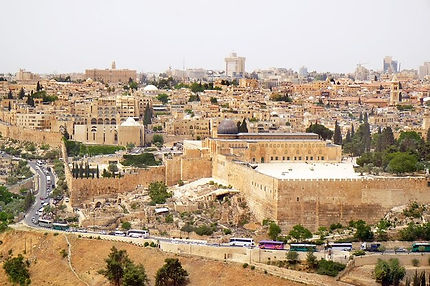
Modern day Jerusalem has some amazing walled sections

The Garden of Gethsemane today has some beautiful ancient olive trees and still contains numerous large rocks of many shapes and sizes.


Elijah’s Cup and Salvation
A special Jewish tradition observed at Passover celebration is described wherein an extra dining place is set at the table, wine poured into a special cup, and the front door left open with the expectation that Elijah the prophet might miraculously return to a chosen Jewish home to dine and to announce the good news of the return of the promised Messiah in fulfillment of the Jewish interpretation of the prophet Malachi’s prophesy.
Let us take a brief diversion from our journey with the Savior to now consider the little known, yet, amazing impact of this unusual prophesy. First, it is significant to note that the name Elijah is translated from Eliyahu or Eliyah (Hebrew); Helias is translated in the New Testament as Elias (Greek); and lastly, the word Elias also means “preparer(s)” or “restorer(s),” i.e. [JST- Matthew 17:10-14; Matthew 17:11-13]. Inasmuch as this name has a number of translation possibilities, it is important that the right one is applied to each “Elijah” scripture. Otherwise, we may misunderstand it.
In the year 1832, Sidney Rigdon (a counselor to the prophet Joseph Smith, the nineteenth century prophet called by Jesus Christ to bring about the restoration of His Church), was told in revelation from God that he had been chosen to help prepare the way of the Lord and of Elijah by baptizing with authority as John the Baptist had done anciently. [D&C- 35: 1-6] What was
meant by preparing the way of the Lord and of Elijah? What new and important event was now at hand?
Less than six years after Sidney Rigdon’s assignment as a preparer and shortly after the first temple of the latter days — the Kirtland Ohio Temple — had been erected by the saints of the Church under difficult hardships and dedicated to the Lord according to His directives, the event for which Sidney’s preparation of baptizing and conferring the Gift of the Holy Ghost had paved the way, came to pass. A series of momentous manifestations occurred all on the same day in this temple pertaining to the salvation of the world in fulfillment of Malachi’s biblical prophesy!
That day unfolded as follows: The day was Easter Sunday, April 3, 1836. First, this date itself is unusually significant. Due to world time zones, on that Easter holiday, anytime after about eleven a.m. were hours that occurred in the Kirtland Temple at the same time fame as in Jerusalem, which, in Jerusalem, was April 4th [17 Nisan]. This was a Monday and also the second day of the 1836 Jewish Passover. This second day of Passover represented the same celebration holiday anniversary upon which Christ resurrected at Jerusalem anciently! It was the Jewish holiday known as the “Presentation of the First Fruits” in 30 A.D. — the year of Christ’s resurrection! Remarkably, a careful astrological study of this date shows that 1836 is the only year in the nineteenth century that these two Hebrew and American celebration days of Christ’s resurrection could fall simultaneously within the same time frame of Christ’s resurrection in both the eastern and the western world! Moreover, it appears that it is more than mere coincidence that Christ’s resurrection also occurred on April 3, in 30 A.D.!
The events of this Easter, April 3, 1836, proved even more astonishing. As the prophets Joseph Smith and Oliver Cowdery were praying in the Kirtland Temple on this holiday of Christ’s resurrection, several visions unfolded. First, our Lord, Jesus Christ, appeared in glory before them! Standing above the breastwork of the pulpit, He voiced His pleasure and warm acceptance of this temple!
Shortly after this overwhelming event, Moses, the prophet of Egypt’s miracles of dread appeared! He committed his keys (special ordained rights) of priesthood authority for a greater gathering of Israel “from the four parts of the earth.” This included the gathering of ten of the twelve tribes of Israel, who, due to their unbelief and unrepentant rebellion anciently, became “lost” from the gospel truth of Christ. The Ephriamites within the Tribe of Joseph more than dominated in tribal population over the other nine tribes at this time. Only the two non-revolting and perhaps less rebellious tribes — the tribes of Judah and Benjamin whose headquarters were at Jerusalem — remained partly identified. The ten tribes were eventually scattered by God, apparently over much of the world into many countries and isles — initially, north of Palestine into Assyrian captivity. [Due to the extensive “dispersion” time frame of the ten “lost” tribes and the centuries that have passed, their often misunderstood straying and prophesied re-gathering for salvation — both gradually; and, at God’s appointed times in a general manner as whole tribes — compared to olive branches broken off and grafted in — is more clearly illuminated by the following scriptures: 2 Kings 17; Isaiah 43:5-6; B of M– 1 Nephi 10:12-14; 15:6-18; 21:5-23, 22:4; Jeremiah 3:12-18, 16:13-15; B of M– 3 Nephi 21:11-29 & Ether 13:1-12; D&C– 35:25, 133:19-35]
After these two marvelous visits, yet another heavenly visit occurred. Elias [“restoring messengers,” likely referring to the great prophet Noah (D&C- 27:7; HC- 3:386) probably along with other unnamed prophets who held important dispensational salvation keys] made an appearance as anciently prophesied [JST- Matthew 17:10-14] explaining these keys and
committing to astonished Joseph and Oliver the dispensations of the gospel of Abraham and his posterity — necessary keys for sealing their promised blessings of salvation.
Last, but not least, Elijah, the great prophet for whom the Jews have set a place at their Seder meal for hundreds of years, came not to a Passover meal in Jerusalem as expected in centuries of Jewish tradition. Instead, he appeared in God’s Kirtland Temple in the western hemisphere! Elijah, who, like Moses, had parted waters by unwavering faith and was eventually taken into heaven in a fiery chariot without seeing death [see 2 Kings 2:1-14] now appeared and stood before them! He personally quoted to them this same prophesy of the prophet Malachi, and then explained that the time had come for this prophesy to begin to be fulfilled! “Therefore,” he declared, ”the keys of this dispensation are committed into your hands”! [see D&C– 110] This was certainly a day filled with astonishing revelation and amazement for God’s earthly servants Joseph and Oliver!
Seven years earlier, on May 15, 1829, the keys of the Aaronic Priesthood, which priesthood pertains more to outward physical ordinances, including baptism, were restored by John the Baptist, who, you may recall, had suffered a physical death of beheading by wicked King Herod the Great. However, upon this historic priesthood restoration event, John, now a resurrected being, did not himself baptize Joseph and Oliver. It appears to be an eternal law that God, or even heavenly messengers, seldom, if ever, will perform earthly labors that mortals can themselves perform to advance themselves in knowledge, understanding, experience, and truth. [Perhaps the single exception was when there were yet no other mortals on this earth endowed with priesthood authority to baptize and confer the Gift of the Holy Ghost upon Adam. Therefore, Adam’s baptism of water and fire was miraculously performed by the Spirit of God; see P of GP– Moses 6:64-68] John conferred his keys upon Joseph and Oliver by the laying on of hands in ordination. However, he then instructed Joseph Smith and his counselor, Oliver Cowdery, to baptize one another, and then, after that ordinance, to ordain one another to the Aaronic Priesthood. [see P of GP– Joseph Smith History 1:68-72; D&C– 13]
Not long after their baptisms, Joseph and Oliver were again visited by heavenly messengers, at which time they also received the keys of the higher priesthood, keys that pertained to spiritual gifts and to their apostleship. These keys were bestowed by Peter, James, and John, who formerly held them in the era of Christ’s earthly ministry! [D&C– 27:12]
But why were all of the keys of all the past dispensations of Christ's church conferred upon Joseph’s head? This last era — the era of gospel fullness — even biblically mentioned as “the dispensation of the fulness of times” [Ephesians 1:10] — in order to be completely full, needed to contain all of the priesthood keys of every former dispensation. In preparation for this complete restoration of His gospel salvation keys, our Savior had previously told Joseph:
“. . . which [gospel of salvation, or armor of God] I have sent my angels to commit unto you . . . for the fullness of times, in the which I [Jesus Christ] will gather together in one all things, both which are in heaven, and which are on earth; . . .”
D&C– 27:16&13 [see complete revelation D&C- 27:5-16]
[see also Acts 3:21; D&C– 112:30-32, 128:18]
Undoubtedly, to meet and converse with many mighty ancient prophets on this amazing Easter holiday must have been an overwhelmingly joyful experience for the latter-day prophets Joseph Smith and Oliver Cowdery!
What significance do these remarkable heavenly visits have relative to our salvation? In ancient times, Moses and Elijah had also appeared in glory to the Christ on a high mountain, as witnessed by Peter, James, and John, His chief apostles. [Matthew 17:1-3; 2 Peter 1:16-18] At that time, it appears that Moses and Elijah also restored at least part of these same keys of salvation to Peter for we read later on in scripture that baptisms for the dead were performed by the saints during this early era of the gospel. [1 Corinthians 15:29] Six days previous to this high mountain transfiguration event (Although certain events in this revelation have not yet been revealed, see D&C– 63:21), Jesus told Peter, ”. . . I will give unto thee the keys of the kingdom of heaven: and whatsoever thou shalt bind on earth shall be bound in heaven: and whatsoever thou shalt loose on earth shall be loosed in heaven.” [Matthew 16:19] It appears that the keys of sealing power Jesus referred to, at least in part, were those conferred upon Peter, James, and John six days later by Moses and Elijah under Christ’s directive. After Christ's time, these keys were apparently again lost from the earth due to the wickedness of mankind and the martyrdoms of the beloved apostles as later scripture mentions nothing about these salvation ordinances for the dead being later performed.
Thus, in these latter days, all of the keys for the great work of salvation for all the dispensations (eras) of God’s children were again restored to the earth! All of this restoration of priesthood authority and specific keys were granted in order that through faithful genealogy research the temple ordinances and blessings of this priesthood directed redemption could be extended to all of God’s faithful children and their progenitors throughout the world. They could be offered as well to all of the righteous in Paradise that desire to hear and accept the true gospel and thereby also receive the vicarious salvation ordinances performed in God’s temples here on earth in their behalf.
This true plan of salvation for the departed [see 1 Peter 3 :18-20, 4:6; D&C– Section 138:11, 12, 18, etc.] stands out gloriously in sharp contrast with the doctrine of man-made churches, some of which have falsely taught for centuries that any person who is not baptized, regretfully, must go to hell. In the hope that God, or some holy saint, might somehow rescue these “poor lost souls” from the torments of hell and also to ease the sorrow of their living survivors, some church clergy light candles and pray for those who died without baptism. Having lost access to the true priesthood knowledge and keys, such church clergy as yet cannot accept this vicarious work for the dead. In fact, many suppose that this restoration of salvation keys is foolish nonsense, although they are at a loss to explain why there is biblical scripture that refers to baptism of the dead. [see 1 Corinthians 15:16-20, 29] Neither do they therefore build holy temples of salvation for the performance of eternal marriages and the sealing of children to their parents eternally. Nor do they have the required priesthood revelation and rites to perform the sacred ordinances necessary for the salvation of the dead of our world who have learned about Christ’s gospel of salvation in Paradise and anxiously await these necessary ordinances that must be done for them by proxy as in Christ’s primitive Church — proxy work anciently performed in the same manner as now performed in the many worldwide temples of Christ’s latter-day restored Church.
God cares for all of His children without prejudice against conditions that make it impossible for many of them to learn of the true plan of salvation while living on earth due to the evils of mankind, or to receive valid baptism by those ordained with true priesthood authority: [B of M– 2 Nephi 26:25-28]:
“For there is no respect of persons with God.” Romans 2:11
“And ye masters, do the same things unto them, forbearing threatening: knowing that your Master is also in heaven; neither is there respect of persons with Him.” Ephesians 6:9
“Jesus answered, Verily, verily, I say unto thee, except a man be born of water and of the Spirit, he cannot enter into the kingdom of God.” John 3:5
If God had respect of persons, how could His judgments be righteous? For He could then save one and cast away another at will without regarding any holy eternal law. How could any righteous man who lived at a time or under circumstances where he had no opportunity to have the true gospel preached to him, be justly sent to hell for failing to do that which he knew nothing about — the saving ordinance of baptism, for example? What manner of justice is it if a good woman is sent to hell to suffer in torment along with the wicked simply because she understands nothing about the saving power of baptism? It is just as absurd to think that the wicked — the unrepentant spiritually filthy — will somehow be immediately forgiven and inherit God’s holy kingdom, a place embracing complete truth, virtue, and purity where scripture plainly teaches us that no unclean thing can enter! [see Ephesians 5:1-8; B of M– Alma 40:25-26; Matthew 7:21; B of M- 3 Nephi 27:19] Such darkened doctrine finds no place in Jesus’ teachings at all. Can you see the blatant faultiness of such erring salvation teachings?
There are millions of God’s children, including innocent infants, who have been sent to this earth and soon after died, never having had opportunity to understand the ordinances of the true gospel of Jesus Christ. Instead of a fallen Christian church of man thoughtlessly consigning a harsh physical and spiritual death of torments, God’s true plan of salvation, as revealed in our day, provides an opportunity for His children in Paradise who seek goodness and happiness to learn all about it, and to accept all of the vicarious ordinances performed on earth in their behalf. [1 Peter 4:6]
Yet another significant event occurred around April 3, 30 A.D. Prior to His resurrection, Jesus, who, at the very commencement of His earthly ministry stood in the local synagogue and read aloud a certain prophesy of Himself “bringing deliverance to the captives.” [Luke 4:16-21; Isaiah 61:1-3] The Son of God fulfilled this “deliverance” scripture by ascending into the heaven of Paradise and organizing missionary efforts for preaching to many faithful spirits awaiting knowledge of these glad tidings of salvation. This occurred between the time of His mortal death and resurrection. [Luke 23:39-43; see D&C– Section 138] Fulfilling this prophesied event of scripture shows us further that Christ had a deep abiding concern for the salvation of the departed dead of our world who desire an opportunity to hear about His gospel.
Shortly after these keys of salvation were given to latter-day prophets in 1836, this priesthood restoration of initiating a linking of hearts between living and dead was found to kindle an unusually active interest in genealogy on a worldwide basis. This activity progressively continues today among the nations of the world. Baptism for the dead as mentioned in the Bible, eternal marriages, and sealing of families for eternity by priesthood authority are now actively performed in many temples of God throughout the world for both the living and the dead. This is a gigantic work of salvation that must be performed by the faithful to tie the hearts of the living with those who have died and entered the spirit world of Paradise in all of the posterity of Adam. [1 Corinthians 15:29].
Latter-day revelation from Jesus further supports the import of Malachi’s biblical prophesy with added emphasis:
“. . . seek diligently to turn the hearts of the children to their fathers, and the hearts of the fathers to the children; and again the hearts of the Jews unto the prophets, and the prophets unto the Jews; lest I come and smite the whole earth with a curse, and all flesh be consumed before Me.” D&C– 98:16-17
Without acting upon these salvation rites and, further, providing many of the Jews an opportunity to hear the true gospel, to become converted, and to thereby soften their hearts to understand the prophets correctly, Christ says the earth will be smitten with a curse and all flesh be destroyed! He here again refers, of course, to the time of His Second Coming in glory.
Why would such terrible devastation otherwise occur? Obviously, the earth was primarily created to enable salvation to all who seek it. [D&C 128:16-18] By failing to love our fellowmen sufficiently to actively provide the true gospel plan to all of God’s children throughout all nations for both the living and the dead, thereby falling short of fulfilling earth’s eternal purpose of salvation, then, apparently even the most righteous of saints could not be sanctified sufficiently to endure Christ’s glorious Second Coming! Therefore, at that event all flesh would be consumed and the earth’s purpose of offering complete salvation wasted! Yes, these prophesies are vitally important!
Jesus was once asked by a Pharisee lawyer:
“Master which is the great commandment in the law?” The Son of God replied, “Thou shalt love the Lord thy God with all thy heart, and with all thy soul, and with all thy mind. This is the first and great commandment, and the second is like unto it, Thou shalt love thy neighbor as thyself. Upon these two commandments hang all the law and the prophets.”
Matthew 22:36-40
Christ’s true saints soon learn that evidencing love to God and toward their fellowmen is looked upon by our Savior as the very essence of incorporating His gospel into their lives, and it is upon this love that all other gospel laws and teachings are dependent.
Paul understood and taught this same concept of essential love which he called charity as he had also learned it from Christ’s teachings:
“And though I have the gift of prophesy, and understand all mysteries, and all knowledge; and though I have all faith, so that I could remove mountains, and have not charity, I am nothing.”
1 Corinthians 13:2
Most of our ancestors who lived on this earth have died without knowledge of the true gospel of Jesus. Therefore, the most important work, after seeing to our own salvation ordinances and assisting the living who want to know about the restoration of Christ’s true gospel, is to do our part to gather genealogy and to regularly perform essential vicarious earthly ordinance work in the holy temples. Many in Paradise are anxiously waiting for these ordinances to be performed in their behalf in order to complete their salvation and accelerate their spiritual progression. Unless we learn to do these things with true brotherly love, we surely put any higher salvation we seek in frightful jeopardy! [D&C- 128:15]
Whether it is by the missionary work of preaching the gospel among the nations, by setting a good example of following the Savior, by performing genealogical research, or by performing vicarious salvation ordinances, eternally expanding relationships of joy await those who work actively on earth to further this wonderful work of true salvation.
“Remember, the worth of souls is great in the sight of God; for, behold, the Lord your Redeemer suffered death in the flesh; wherefore He suffered the pain of all men, that all men might repent and come unto Him. And He hath risen from the dead, that He might bring all men unto Him, on conditions of repentance. And how great is His joy in the soul that repenteth! Wherefore you are called to cry repentance unto this people. And if it so be that you should labor all your days in crying repentance unto this people, and bring, save it be one soul unto Me, how great shall be your joy with him in the kingdom of My Father! And now, if your joy will be great with one soul that you have brought unto Me into the kingdom of My Father, how great will be your joy if you should bring many souls unto Me!” D&C– 18:10-16
[See also Field ready to harvest, John 4:31-36]
A T T A I N I N G T R U E S A L V A T I O N
CHAPTER 16

Herod’s Resplendent Temple
Before continuing the marvelous walk with our Savior, let us add significant realism to our journey by taking a brief diversion in this and the following chapter to gain a clearer perspective of Herod’s Temple in Jerusalem and the salvation rites performed there in Jesus’ day.
The massively walled temple mount, of which a much smaller area contained the sanctified sections of the Temple proper with their protective walls and gates, was grand in size —comparable in overall dimensions to about twenty of today’s football fields. This impressive walled temple acropolis with its vast complex of white limestone buildings and sprawling courtyards contained hundreds of people at almost any given time from early morning to late evening with ample open space to spare. Taking forty-eight years to finally complete this rich temple, its surrounding courtyards and porches were supported by almost a thousand massive stone columns! Each supporting column was thirty feet high and six feet in diameter, and all were crowned with elegant capitals! The prominently tall four pillared temple facade itself, finished in a brilliant white, an astonishing one hundred sixty feet in height and width, was lavishly faced with large adjoining rectangular plates of pure gold, each separately suspended and covering much of its face! These gold plates shimmered in the slightest breeze reflecting a golden white sunlight with such magnificent intensity that at certain hours of the day onlookers had to turn their faces away. Most of the remaining temple gates (doors) were also plated with sun reflecting gold!
Donated by a wealthy Alexandrian Jew, the eastern Nicanor Gate — the largest and most spectacular of the courtyard temple doors — was crafted entirely from costly Corinthian brass overlaid with gold! Incredibly, each door stood fifteen feet wide and sixty feet high! As the weight of these doors is not historically recorded, we can only imagine their tonnage and massive hinges, probably assisted by floor support rollers. From the huge open Court of Prayer where many hundreds of worshipers might assemble at one time, fifteen semicircular steps led up to a large semicircular platform that framed the gate’s stately entrance. Skilled Levite musicians frequently performed at this platform; two doors, one on each side of this gate, opened into small rooms for storing their fine instruments. Opening each of the two Nicanor Gate doors every morning and closing them each evening required the strength of twenty muscular men!
Built with Roman architectural influence, certain areas outside of the sacred inner courtyards of the Temple functioned as an elegant citadel or city center where business could be discussed and transacted by anyone, Jew or Gentile, and Jewish religious worship enjoined nearby. Facilities ranging from meeting rooms and legal courts to priests’ living quarters, and even men’s and women’s restroom facilities with running water and sewer were located within this vast temple complex. For ritual cleansing of worshipers, at each of the inner complex’s temple gates were foot baths. A convenient “pay for bathing” bathhouse was also located outside of the main southern temple gates for ritual bathing and for use by the general public who, for sanitary reasons, were legally obligated to bathe shortly prior to the day of certain important festival holidays.
Just beyond the outer temple walls, especially at the lower southern ground level where began the hundreds of wide steps leading up to the main south temple gates and bathhouse, many portable market booths were rented to merchants. In these kiosk type booths a variety of products including vegetables and fruits, hot prepared foods, clothing, household goods, hardware, leather goods, jewelry, pottery, oil, wine, etc., were sold. These merchandising activities, both on the temple acropolis, and outside of the temple courts at its lower level walls produced high revenues. Although some of this income was necessary to operate the vast temple complex, much was retained by the Chief High Priest of the Temple and his conspiring friends, and even used for bribery [Matthew 28:11-15, 26:14-15], instead of given to the poor, sick, and lame, a practice Jesus vigorously condemned.
Herod the Great loved lavish buildings. At circa 20 B.C., he had doubled the land size of this former Zerubbabel Temple mount using huge labor intensive stone block supporting walls backfilled with earth — an effort requiring the labor of more than 10,000 slaves and skilled workmen. Limestone blocks, many about 17 x 4 x 6 feet in size and weighing about 60 tons each, and a few key stones — an incredible six times that size — were set precisely into place forming both the rough retaining wall and fine finished supporting walls of the Temple — an amazing feat of engineering even by today’s standards! Herod had completed the erection of the magnificent Temple proper, but the Temple covered only a small portion of the huge almost empty thirty-five acre acropolis. It would take eighty more years to complete the massive building project including lavish outbuildings and courtyards.
Generous in his many building projects, Herod had erected many strikingly elaborate buildings in the vicinity of Jerusalem and elsewhere in his quest for personal acclaim, but this was to be his crowning architectural achievement. It was, in fact, so vast that the building project had to finally be taken over and finished by his succeeding son, Herod Antipas after his wicked father’s death in circa 4 A.D.
Although almost continually under construction for eighty years, this Mount of Zion’s vast array of stately columned buildings, including extensive lower basement level chambers and spectacular spiraled stone stairways was not finished until about 61 A.D. Remarkably enough, the glory of all of this vast beloved Herod’s Temple and its famed acropolis would vanish with Titus’ siege of Jerusalem in his final efforts to quell rebellion — Herod Temple’s astonishing entire destruction by fire taking place only ten years after its completion!
The temple mount has held a rich and fascinating history. Much earlier, about 1000 B.C., the first known permanent temple in the Holy Land, the smaller, but much more costly and even more magnificent Solomon’s Temple, was erected by King David’s son, Solomon. It was built upon this same high mount location, then called Mount Moriah, previously known as the Threshing Floor of Arunah the Jebusite — land which King David purchased from faithful Arunah. King David had sought this site as a lofty location suitable for building an alter to the Lord to faithfully halt a devastating plague from Israel. [2 Chronicles 3:1; 1 Chronicles 21:17-27] Years later, when Solomon’s Temple was erected there, this lofty hill which overlooked most all of Jerusalem in full panorama, came to be called the Hill (or Mount) of Zion.
In about 550 B.C., due to Israel’s predominately vile wickedness and in spite of warnings by many prophets of the impending destruction of the great city of Jerusalem and the threats that its Jewish inhabitants would also be brought into bondage if they did not hearken to God and speedily repent [2 Kings 17; B of M– 1 Nephi 1:4], Nebuchadnezzar, King of Babylon, attacked and eventually placed Jerusalem under a lengthy siege so severe that it resulted in famine for the city. Finally taking Jerusalem, he sacked and torched the costly Temple of Solomon and burned the entire city with fire. His army broke down Jerusalem’s huge walls, and took many inhabitants captive as slaves back to Babylon. Naturally, this event scattered the Jews. Some of the more righteous who escaped found refuge in Egypt while others fled to parts of Asia.
Before the Holy City was captured, the Jerusalem prophet, Lehi (a Book of Mormon described prophet), having observed that the Jews had previously murdered other local prophets for fearlessly and openly warning the Jews in God’s name of impending death and slavery if they did not repent of their evil ways, and knowing that these unrepentant Jews also sought to take away his own life [B of M– 1 Nephi 1:18-20], was instructed by God in a dream to abandon his home and to depart Jerusalem with his family by night. God led Lehi and his family through wilderness lands, finally reaching a seashore where he instructed them to build a ship. They were then escorted by His power to sail to a “promised land” which was the then unknown Americas.
The latter-day translated Book of Mormon, an ancient book of their scripture preserved in the form of inscribed metal plates, was delivered centuries later to the prophet, Joseph Smith, by one of their last living resurrected prophets known as Moroni. It is a record of the long history of their posterity in the Americas, their succeeding prophets, visits by Christ after His resurrection (as prophesied in the Bible) and other dealings with God. The Book of Mormon, now translated into many of the world’s languages, is a powerful witness of Christ’s divine mission. It clarifies much of biblical scripture as a second witness of Jesus’ divinity, teachings of salvation, and of His true doctrine to all the inhabitants of the world. [see B of M– Book of First Nephi.]
At the exact time prophesied by Jeremiah, seventy years after the Jews entry into Babylonian captivity, the more righteous Jews who had been forced from the Holy City into slavery were permitted by God to return. This came about when God inspired Cyrus II, King of Persia -- the founder of the Achaemenid Empire, conquering Babylonia among other nations and ruling from 559 to 530 B.C. -- to allow the Jews to return to their homeland in 480 B.C. to begin to rebuild Jerusalem [Jeremiah 29:10] The burned out Solomon’s Temple was then rebuilt by faithful Zerubbabel with the encouragement of the prophets Zechariah and Haggai. Renamed the Temple of Zerubbabel, it again emerged as a citadel for gathering and a center for Jewish worship.
As centuries passed, alternating times of righteousness and rebellion against the Lord caused Zerubbabel Temple to suffer a plethora of harsh political wrenching. Occasionally plundered, dismantled, and rebuilt in various degrees, it was once so neglected that weeds and bushes were found growing wild in the cracks of its porches. Yet, it withstood all of these ravishing conditions occasioned by the various nations and powers which, one by one, came to control Jerusalem and its adjacent lands. Always a much lesser temple than Solomon’s in every way, no doubt due to the unrighteous nature of the majority of Jews and others who worshiped there, Zerubbabel Temple was ever conspicuously absent of the sensational temple manifestations demonstrated by the Lord at His earlier temples.
The Roman Empire, under Pompey, captured Jerusalem in 63 B.C. A generation later, when Rome backed Herod the Great to take over rule of the city in 37 B.C., in the scuffle, part of Zerubbabel Temple was burned, but further damage was halted by Herod’s orders.
Twenty years later, Herod the Great, now an experienced Roman ruler of Jerusalem seeking self acclaim, and also to improve his position of distrust with the Jews, proposed to again rebuild waning Zerubbabel. His plan was to transform it into a truly spectacular temple. However, Jewish leaders grew suspicious of shrewd Herod’s unusually generous proposal, believing that if he once tore down their remaining temple, it might never actually be rebuilt. After all, Rome’s Herod was an Edomite (descendent of Esau), and historically the Edomites and Israelites were often at enmity.
Persistent, Herod ordered large quantities of very costly building materials to be set at the temple site before any major removal or rebuilding was ever commenced, thereby winning immediate popular approval of the rebuilding project. The replacement temple itself, patterned after Solomon’s Temple in much of its architecture, became known as Herod’s Temple.
Although the vast citadel complex (including the Temple itself) that came to be called Herod’s Temple was always under construction and not fully completed during Christ’s lifetime, its costly beauty pleased the Jews immensely and simultaneously softened them toward the hated Roman government to whom they suffered allegiance.
Soon Herod had even built his own lavish Roman temples — wisely distanced away from Jerusalem! The pagan Herod governors secretly cared nothing for the Jewish religion except to allow it to the degree that enabled them easier rule of Judea. Herod’s sprawling temple complex covered an area about a fifth of the size of Jerusalem city! This remarkably vast temple/citadel became indeed a monumental expense that made Rome’s ruling more congenial for most all of the inhabitants of the Holy Land, and for many in areas beyond.
God had manifest His power and glory before the priests and the people of Israel on many sacred occasions at the portable tabernacle temple first provided to Israel, and also at Solomon’s Temple, but this Temple was built by evil Herod and by Herod’s succeeding son of like disposition who were rightly considered infidels by the Jews. Both of these Roman appointed rulers used decreed executions, bribery, and secret murders as effective means of personal gain and political control.
You may recall that when Herod the Great felt threatened by the prophesied sign of the very bright star in Bethlehem which denoted the birth of a divinely appointed Governor [Matthew 2:6] -- one who, it was thought, might free the Jews from political bondage -- Herod feared the sign. To rid himself of the possibility of such a future ruler actually rising to power, he ordered that all infants two years of age and under in Bethlehem and its coasts be slain by the sword! However, God had forewarned Joseph and Mary to flee by night with the Christ child into Egypt to avoid Herod’s rampage. At length, after evil Herod’s death, God again spoke in a dream, directing them to return, thus fulfilling the prophesy “Out of Egypt have I called My Son.” [Matthew 2:14-15]
Along with self-willed Roman rulers were also self-righteous Chief Temple Priests who may have appeared righteous to certain naive classes of indoctrinated worshipers, but who, nonetheless, were corrupt wicked men of religious classes often severely chastised by Jesus. Politically appointed and controlled by the Herod Kings of Rome, these Chief Priests and their cohorts (other Pharisees, Sadducees, lawyers, scribes, etc.) for the most part perverted and ignored the essential goodness existing in various written religious law. This they did by placing emphasis on insignificant rules and rituals to fuel their piety and to further their selfish interests, mostly at the expense of the poor and literary ignorant.
Whether for these untoward acts or for other reasons, there were no divine manifestations reported at Herod’s Temple to rival, for example, the occasional miraculous devouring fire that came down from heaven to consume sacrifices upon the alter at Solomon’s Temple as witnessed by at least hundreds and perhaps thousands of people.
As for divine power being manifest at Herod’s Temple, little worthy of historical mention seems to have occurred. The angel Gabriel’s sudden appearance to the righteous incense alter priest, Zacharias, in this Temple, telling of his aged wife’s miraculous conception of their son who would be called John the Baptist was a remarkable event. [Luke 1:11-13] Perhaps a later event worth mentioning is Zacharias’ terrible murder [Matthew 23:33-35] apparently committed by wicked High Priests in the sacred inner court between the temple wall and the alter! Incidentally, this murder is remarkably akin to that of the earlier prophet with a similar name —Zechariah, who, after having greatly advanced the rebuilding of Zerubbabel Temple even until the day of its completion, was, ironically enough, stoned to death in the very courtyard of that restored temple by the rebellious princes of Judah — accused murderers [Matthew 23:27-33] who he had righteously warned in the name of the Lord to repent of their idolatry. [2 Chronicles 24:17-21] Two other noteworthy exceptions to the lack of glory manifest at this Temple are the miraculous healings that Christ and His apostles performed in the Temple’s outer courtyards, and the mysteriously shocking and unexplained tearing of the huge main temple veil from top to bottom accompanied by an earthquake at the time of Christ’s death on the cross. [Matthew 27:51]
A few righteous and faithful souls, as in all of God’s temples at their various times of existence, undoubtedly enjoyed some personal signs and sacred manifestations that passed quietly with time, unrecorded. Still, due to its immense costly splendor, had this Temple not been completely destroyed as Christ plainly foretold his bewildered audience that it would be [see Matthew 24:1-2; D&C- 45:18-20], undoubtedly, it might have remained as one of the great architectural wonders of the ancient world.
Herod’s Temple Alter and the Passover Sacrifices
The sacrificial alter at Herod’s Temple was much larger than one unfamiliar with Israel’s ancient temples might imagine — slightly larger than the alter of the former and more costly Solomon’s Temple near which foundation ruins Herod’s Temple was erected.
In earlier times, God instructed the children of Israel that alters be built from whole unbroken stones. The alter stones could be mortared together, but no iron tool was so much as even touch any alter stone. [Exodus 20:25] Later, He gave to Moses another pattern to follow for building the holy tabernacle, or portable temple, including its hollow wooden alters overlaid with pure gold which were made much lighter in order to be carried by the Israelites as they traveled under discipline in the wilderness.
Many generations later, Solomon was directed by the Lord to build a permanent non-portable type of temple. It was fashioned in the finest woods, much of it overlaid with pure gold and decorated with precious gemstones. Solomon Temple’s sacrificial alter, undoubtedly an engineering marvel directed by wise Solomon, was made, or cast, of brass. It stood about thirty feet across each square side and was fifteen feet high. [2 Chronicles 4:1 &17].
Herod’s Temple sacrificial alter, along with most of the huge temple complex itself, was fashioned from large expertly cut rectangular stone blocks of limestone and marble, although the interior and top of the alter was undoubtedly composed of un-hewn stones. Its generally flat top was square and about thirty-six feet across. The alter had a long inclined stone ramp, used to bring large sacrificial animals atop for sacrifice. The ramp was probably flanked by skillfully finished marble or stone steps which the priests ascended about fifteen feet to reach the alter face.
Among the sacrificial furnishings atop the alter were stacks of temple approved fig tree firewood, brass and silver flesh and fire tools, washing basins, and raised stone platform areas on the alter for the burnings relative to large animal sacrifices. Nearby the base of the great alter, were long low marble-top tables, probably eight, each over-fitted with fine timber-work which supported three meat hooks above each table for hanging, skinning, and preparing sacrificial animals in huge numbers. All of these were used in times of celebration when thousands of animals per day were offered in sacrifice.
Each of the four stone corners of the immense alter was crowned with a decorative projection called a “horn” overlaid with brass or gold similar to the horns found on the monumental brass alter of the former Solomon’s Temple. Each horn contained a channel into which blood, oil, and water used in sacrificial ritual were poured, exiting underneath the alter into a water stream carrying the ritual liquids away. Traditionally, a fire burned continually on the alter where holy animal sacrifices were offered up to God daily, at least each morning and evening. Ironically, unaware to hundreds of Herod’s Temple alter priests, all of these offerings were made in similitude of the coming sacrifice of Jesus Christ Himself, the Holy Son of God.
Herod’s Temple priests also used a small incense alter about eighteen inches square which stood about three feet high patterned closely after the former temple incense alters. Its sides
were made of precious wood over-clad in pure gold with a wide upper rim of adorning gold crowning with raised corner horns patterned after the sacrificial alter. [1 Kings 1:50, 2:28] Each morning, incense was placed upon hot coals on this alter which sent fragrant savors throughout the day unto the Lord.
The incense alter stood permanently in front of the main temple partitioning veil. This huge veil, artfully woven with fine linen in a magnificent pattern including the royal colors of gold, purple, blue, and scarlet, extended to about thirty feet in width and sixty feet in height! It hung before the entrance of the Temple’s most sacred chamber, the Holy of Holies. Semiannual replacement of the grand veil was made possible by dozens of women veil weavers who continually worked in the Chamber of the Curtain, a two story temple room where this and other replacement veils were woven for various temple rooms.
A spacious sacred rectangular area before the veil, walled on its left and right, was called the Holy Place. Within this space, against the left wall stood a large decorative six branched lamp-stand (in Hebrew called a “menorah”). Made from one talent (about 50 to 60 lbs) of pure gold, it held seven oil lamps. The center lamp always remained lit, giving continuous light. Opposite the menorah, against the wall on the right stood a table made of fine wood over-clad with gold and rimmed with wide gold crowning. Its top was about eighteen by thirty-six inches. Called the “Table of Shewbread,” it held elegant dishes, spoons, and bowls along with twelve fresh loaves of bread — a twelve tribes thanksgiving harvest set before the Lord. Sprinkled with pure frankincense and stacked two loaves high, the shewbread was replaced each Sabbath when the old loaves were reverently removed. The old loaves provided bread — said in historical records to still taste fresh — providing a meal for the officiating priests. [Exodus 25:23-40; Matthew 12:2-4].
In Solomon’s Temple, behind the main partitioning veil were yet other doors that opened into the most central and sacred part of the Temple, the large room called the Holy of Holies wherein was placed the Ark of the Covenant — a wooden chest about four feet in length and two and a half feet in width and height overlaid with pure gold. This “Ark” was too sacred to be touched by anyone except by an authorized officiating priest at special times.
In earlier times, the children of Israel moved the "Ark of the Covenant" from place to place as an important central part of the portable wilderness temple. This was done by the use of two long carrying staves, or fine wooden poles overlaid with gold, which were inserted through two pairs of gold rings anchored on the sides of the Ark. The four rings then allowed means for carrying the holy chest without touching it. The sacred incense alter and Table of Shewbread, made after the Lord’s revealed pattern, were also carried by this means.
You may recall that so strict was this “do not even touch the Ark” command from God to the righteously vacillating children of Israel that once when the Ark was being transported on a cart pulled by oxen over some uneven ground, thus shaking the Ark, one of the cart drivers by the name of Uzzah reached out and took hold of the Ark to steady it. For this strictly forbidden act of touching the Ark, Uzzah was smitten by God so that he suddenly died there in that place beside the Ark. [2 Samuel 6:3-7]
What did this holy chest contain? At one time, inside the sacred Ark of the Covenant (also referred to as the Ark of Testament) was found the written “covenant,” or second set of tablets of stone which Moses received from God in Mount Horeb (also called Mount Sinai) upon which God had with his finger had written by emblazing into the stone tablets the ten commandments of His covenant with Israel. The Ark was later said to also contain Aaron’s rod or staff that once budded and bloomed with almonds offering proof to Israel of his divine prophetic calling, and also a golden pot containing heavenly preserved manna. [Hebrews 9:4]
The Ark’s lid, called the mercy seat, was crafted with two large solid beaten gold figures of cherubim (mighty winged angels) fixed atop it, one near each far end of the lid. The cherubim faced one another with each angel’s wingtips outstretched forward touching the opposite cherub’s wingtips. The glistening cherubim appeared symbolically to overshadow and protect the sacred chest.
Earlier temples had an additional incense fire place, or incense alter, located within the Holy of Holies itself for burning incense only at certain very sacred times. As revealed to Moses, when this holy incense ordinance was performed, a handful of powdered incense was thrown upon the hot incense alter to produce a cloud of dense smoke that entirely enveloped the area above the Ark’s mercy seat. Upon this special occasion, the Lord would appear above the mercy seat, hidden by the holy vapor. Apparently, this consecrated holy cloud insulated the priest from the all consuming power of God’s glory which might otherwise result in the priest’s immediate death. [Leviticus 16:1-2] From within this shielding veil of scented fragrance, the Lord would speak His will. [Leviticus 16:12-13; Exodus 19:9]
However, in Herod’s Temple the inner chamber of the Holy of Holies was probably empty of furnishings, revealing only the exposed bedrock that formed the central floor of this large room upon which the High Priest sprinkled sacred blood on the annual Day of Atonement. Inasmuch as the Ark was not found there, evidently no incense cloud was ever created as there are no scriptural records of any such visits from God occurring there. [Leviticus 16:15-16]
According to traditional history, the sacred Ark had long since been stolen, or at least it had disappeared. Several chambers inside the Hill of Zion have been discovered in modern times which probably existed anciently to secure treasures belonging to Herod’s Temple in the event of an enemy capturing the Temple. It is rumored in Jerusalem that the sacred lost Ark has been secluded in a sealed chamber, but that anyone who digs in the attempt to recover the Ark, or who later discovers and then touches it, will also be stricken by God with death. Possibly, due to its extremely holy nature, the Ark may have actually been taken up into heaven to preserve it! [see Revelation 11:19]
At the Jerusalem of today, the famed Muslim Temple erected in 638 A.D. and known as the Dome of the Rock has been built over this still exposed and rather uneven raised clump of bedrock which, it is believed by some, is the very rock upon which Abraham anciently built an alter to offer his son Isaac as a sacrifice in compliance with God’s recanted test of his faith and obedience. It appears that inasmuch as orthodox Jews have continued to reject Jesus the Christ as their promised Messiah and as the Son of God, Deity has allowed the Muslims to occupy the crowning part of this holy hill with their non-Christian temple!
Will the future temple of God that Ezekiel’s prophesy predicts shall be built in Jerusalem shortly after the great resurrections and restoration of the House of Israel in the lands round about Jerusalem — this to occur within the years initiating the relatively near future ushering in of Christ’s glorious millennial reign — have part of its temple foundations secured at the place of this famed bedrock? [see Ezekiel 37:11-28]
Despite the Jewish Chief Priests’ pollution of the priesthood at Herod’s Temple by reason of their stubborn wickedness, various sacrificial ordinances and offerings, including the offerings of incense, were apparently performed at the Temple at the time of Christ with valid Aaronic or Levitical priesthood authority as passed down through lineage from Moses’ time. [see Exodus 40:12-15; Luke 1:5-11] Only those considered worthy Jews, typically priests, could enter through the sign posted inner temple gates into the sacred inner temple courts where such sacrifices, offerings, and other ordinances actually took place. Any others who entered, even Romans and Roman soldiers, would be put to death under the strict Jewish religious temple law enforced by Rome’s Herod rulers.
On the two preparation days of Passover, depending on the year of the celebration, from morning until late evening it is written that from 30,000 to 350,000 firstborn male lambs of under one year, all without visible blemish or any broken bone, were ritually slain at Herod’s temple alter in commemoration of the Passover! Anciently, at the dedication days of Solomon’s Temple, Solomon led Israel in their sacrificial offering of 22,000 oxen and 120,000 sheep! On that occasion, righteous King Solomon proclaimed a great feast for all of Israel that lasted two full weeks in celebration! [1 Kings 8:63-65]
At Herod’s Temple, each sacrificial lamb was first brought to the Pool of Israel, also called the Sheep Pool, a large rectangular pool about a hundred-fifty feet long and fifty feet wide located northeast, just outside of the Temple’s outermost northern gates. At one end, stone paving sloped gradually into the pool for efficient sacrificial animal washing as patterned after Solomon’s temple pool. The opposite end functioned as a reflection pool where the public could sit on benches or at picnic tables within a park-like setting of palm trees, foliage, and flowers.
The temple pool was opposite Herod’s massive four towered Antonia Fortress; one tower side actually formed part of the northwest temple acropolis wall. Sparing no expense, this old fortress had been much enlarged and lavishly reconstructed into one of Herod’s two main palaces; his other palace, even more elegant, was located in the prestigious upper city. Part of this temple palace boasted luxurious inn accommodations, public bathes, and fine dining available to wealthy Romans and Jews alike. Thousands of Roman soldiers were also quartered in another section of Antonia Fortress due to its immense size. From its high towers they could easily overlook the main temple mount areas, safeguard them, and efficiently maintain order.
Within the northern temple walls was an area of open-air fireplaces for camp-like family cooking. Meat portions returned to donors after certain sacrificial rites took place could also be roasted or boiled there. Wide porch colonnades ran along the north and west temple acropolis walls offering twenty-four hour access each day to perhaps a hundred or more fine picnic tables and benches inasmuch as the outer temple gates remained guarded, but open to visitors both day and night.
At the Sheep Pool, sacrificial animals were washed one final time not only for hygienic reasons, but also to satisfy a temple ritual of cleanliness. The unblemished animals, mostly lambs, were then led through the outer wall’s North Gate and across the courtyard to the inner Tadi Gate [Hebrew for “Lamb’s Gate”] where they were handed over to a priest who would inspect them for sacrificial worthiness. Those that passed, were tagged, held in clean pens, and then, at the appointed time, led through the Sacrifice Gate into the “Court of the Priests” to the open air alter for sacrifice.
Near the alter the animal was slaughtered and skinned; the pelt, or hide, and a front shoulder and leg portion were typically retained as a wage of support, or tithe, for the priests. During Passover sacrifice times, the remaining skillfully dressed lamb meat was returned in one piece to the family or sacrificial donor who was probably waiting at the open Nicanor Gate to receive it, and who would then cart or shoulder carry it from the Temple to a nearby pack animal that would assist them in bringing it back to their place of abode for Passover roasting that evening.
Freewill offerings of wine or oil contributed by worshipers had to be submitted in a container made from the skin of a sacrificed animal, which skins were available for purchase only at the Temple. Many lambs and other sacrificials were also sold within the walls of the temple mount to patrons desiring to make an offering. Animal pelts and hides could also be purchased there by the public. Offerings of clean wood used for temple heating and clean fig tree wood for burning sacrifices as well as offerings of spices, oil, money, etc., were each accepted at their designated places in areas adjacent to the Temple proper.
At the temple court’s sacrifice site, certain inner organs and the fat of the sacrificial animal were salted and burned on the alter sending a delightful aromatic savor into the heavens and occasionally filling the air in temple areas roundabout with the appetizing scent of roasted meat. Blood from the sacrificial animal, cleansing water, and sacred oil were poured into the horn channels of the alter, or into other special alter channels surrounding it, in ritual sacrifice to God. An aqueduct of running water beneath the alter received the abundant stream of lambs’ blood flowing from the alter and carried it from the high temple acropolis eastward to empty into the brook Kedron. During most daylight hours of the two days of Passover temple sacrifice, the brook that Jesus and His apostles now crossed on their journey to Gethsemane, flowed visibly red with blood.
Throughout that day and the next, thousands of Jews would convey their slaughtered sacrificial lambs from the Temple to their homes. Thousands more from many other cities and hamlets round about, would bring their slain temple lamb back to their temporary booth or tent, set up much as we might use modern day camping lean-tos or tents, many crowded along roadsides extending for several miles outside of Jerusalem’s city gates. Small families would usually combine with close relatives for this most holy celebration to share in the generous amount of meat that a single Passover lamb provided. Most, if not all Passover participants, would roast a lamb on their open fire as the Passover lamb preparation rite required, and eat of their paschal meal without realizing the greater symbolism of the sacrifice of the Lamb of God whose own sacrifice would terminate in death at about the peak of the sacrificial alter activity. This would be at about three p.m. on Friday — the Hebrew ninth hour.
Our Savior, Jesus Christ, would resurrect on Sunday, the second day of Passover appropriately known as the day of “Presentation of the First Fruits.” This is an Israelite festival day allowing each Hebrew family to prepare a “Waive-sheaf Offering.” Choice sheaves — usually from the first barley grain harvest, but oft times the offering of an early orchard fruit — were tied into a bundle and presented to a priest at the Temple who then waved them back and forth above the alter before the Lord as an offering of thanksgiving. This offering probably took place in full view of the donor and his family, who may have viewed this ordinance from the semi-circular platform at the open Nicanor Gate, or from one of several spacious rooftop porches located two or three stories above certain temple sections offering panoramic views of the various activities taking place below. These terraces were accessed by one of the dozens of elaborate stone stairwells strategically located within the temple complex.
A Waive Offering could be made any day within the weeks previous to the coming Pentecost. The Waive Offering ritual was undertaken with much thankfulness and with the hope or faith that God would accept the offering and grant the family a bountiful harvest and prosperous year. Not surprisingly, this offering rite revealed by God through Moses, is also a type of Christ, who resurrected on this holiday as “the Firstfruits of them that slept.” [1 Corinthians 15:20]
A T T A I N I N G T R U E S A L V A T I O N
CHAPTER 17
A T T A I N I N G T R U E S A L V A T I O N
CHAPTER 18


Various sacrificials including male sheep and bullocks are held nearby before being slaughtered and prepared for sacrifice on the huge alter.


The waters are parted for the Ark of the Covenant to be miraculously carried across the Jordan River

This high stone bridge leads from Jerusalem over the Kedron stream and into the Mount of Olives. Partial wall ruins remaining from ancient Herod's Temple and temple wall destruction are also seen in the painting.
Christ’s Sacrifice Begins at Gethsemane
Omniscient (all knowing), and therefore fully apprised of a much more comprehensive history of Herod’s Temple and its conditions than that known by mankind as well as understanding much more concerning the various conditions surrounding His atonement [see Luke 18:31-34], and yet keeping most all of these details to Himself, Christ continued walking with His disciples. Their journey had commenced upon leaving the upper room where they had just completed their celebration of the Passover and had finished singing a hymn or two together according to the Passover custom. After walking through part of Jerusalem City and out through its eastern gate, their roadway descended further into the Kedron Valley.
Then, crossing the bridge earlier spoken of at the blood reddened stream Kedron, this close-knit group of faithful men walked a narrow roadway leading up a rise and branching into the foothills of Olivet. Continuing on the hillside pathway close to sunset, Herod’s Temple would come into view. The higher trail elevation possibly allowed them to see partially over the outer temple wall to view temple gates as well as the east city gate and other gates of the city. They may have overlooked the Temple’s outermost east gate, called the Gate of the Pure and Just —apparently used mostly by wealthy showy self-righteous worshipers — and further inside, the golden Nicanor Gate along with some of the temple court areas within the sunset lit temple rooftops and terrace walls.
Upon reaching a secluded part of the beautiful olive vineyard called the Garden of Gethsemane, they probably sat for a few minutes to rest as a glowing scarlet horizon dimmed to invite nightfall. Soon after, Jesus looked earnestly upon His disciples and implored them to pray with Him.
However, while His apostles prayed, periodically they were overcome with sleep, possibly due to the abundant celebration meal. Undoubtedly their hearts were also extremely heavy from hearing His puzzling words that He should soon leave them. Awakening them, He asked them to keep watch for Him, but with only brief results as a deep sleep would soon overcome them. [Mark 14:32-42] Only days later would they meet Jesus again in Galilee after His resurrection, a future reunion He had just promised during their short journey from the upper room [Mark 14:28] — the same future encounter that He would also inform Mary Magdalene and other faithful women about on the very day of His resurrection. [Mark 16:6-8; Matthew 28: 9-10]
Withdrawing a little distance from the rest of the disciples and accompanied by Peter, James, and John, the Lord now began to be “exceeding sorrowful unto death.” [Mark 14:34]. Then, in His painful initial atoning condition, being much overcome with sorrow, He withdrew further, “about a stone’s cast” away, by Himself to pray. The Son of God was beginning to experience an unimaginable atoning suffering that only a sinless God can endure.
Gethsemane means “oil press,” referring to the stone press used to crush the orchard’s olives, allowing olive oil to flow out through small holes at the base of the press. The pure first press of oil is called extra virgin oil. It was used for religious ordinances, for lamplight, and for cooking. [Remarkably, as a cooking oil, it has no harmful cholesterol, no fat, nor any distracting flavor!] At length, two more oil pressings extract lesser quality oils. In biblical times, the purest olive oil, some possibly refined at that unpretentious olive grove at Gethsemane, represented the Spirit, and was used by God’s servants to anoint kings and priests by authority from God. [1 Samuel 16:6-13] Can we conclude that Gethsemane was also highly symbolic of Christ’s sacred mission?— a place where, in extra virgin refinement, the Holy Spirit of a God was also pressed and crushed exceedingly?
As Christ’s physical and spiritual endurance waned under His atoning burden, He fell face-down onto the ground in painful torment, praying even more fervently. Undoubtedly, this sacrifice was much more intense than even He, a God, ever expected. Already suffering deep agony beyond human imagination, Jesus began to sweat great drops of blood. [Luke 22:43-44]
The painful grief of the atonement intensified, gripping His soul as if in the vicious sodden jaws of hell itself. God, His Father, sent the necessary support — a powerful angel to reassure, comfort, and strengthen Him.
As such excruciating trauma [the word “excruciate” actually means “outcome of the cross”] continued to press upon a sinless God, this was an experience of intense spiritual agony beyond any known comparison. “Father, if thou be willing,” He prayed, “let this cup pass from Me.” But then, always true to His uncompromising ideals, Jesus continued His plea by praying, “Nevertheless, not My will, but Thine be done.” [see Luke 22:39-53; Mark 14:32-36; John 18:1-12; Matthew 26:36-50]
On several occasions the Master clearly taught that “. . . with God, nothing shall be impossible.” [Luke 1:37,18:27; Mark 10:27; Matthew 19:26] “If Thou be the Son of God, come down from the cross,” faithless onlookers would soon cry out. Chief Priests who would condemn Him to death would soon stand near the cross raising their voices mockingly, “He saved others; Himself He cannot save. . . . He trusted in God; let Him deliver Him now, if He will have Him: for He said, I am the Son of God.” Even one of the malefactors crucified beside Him would chide Him for not calling down godly powers and easing their terrible suffering — if in reality He truly was the Messiah. [Matthew 27:41-44]
Could the Christ have changed His mind about this atonement and deserted His sweat of blood in Gethsemane, or miraculously come down from the cruel cross? He was a God and was endowed with “all power. . . both in heaven and on earth.” [Matthew 28:18; D&C– 93:16-17] He held the keys of hell and death [Revelation 1:18] and of the resurrection [Ezekiel 37:12-14]. Supervised by our Father, He created our earth and many others! [Hebrews 1:1-2] It may seem obvious that our Savior also had the power to alter anything. Could He alter this, the blackest and most painful of all experiences on this earth, to one more physically and spiritually suitable?
Although Christ had power to lay down His life and take it up again as He once clearly stated [John 10:17-18], He did not have the power to change or alter His atonement. On the surface, this statement may seem wrong, or seem to be words in a category that Jesus once referred to as a “hard saying”— doctrine that does not seem to fit suitably within the framework of His clearer teachings. Such hard sayings cause some hearers less seasoned in Christ’s word to back away in bewilderment and disbelief. [John 6:47-69] However, the following paragraphs should help to clarify this statement.
Amidst the tremendous pain of bearing the redeemed world’s sins, grief, pains, and sorrows, Christ, the greatest of all of the children of God sent to this earth, would sweat great beads of atoning blood. They would seep into the soil at Gethsemane and into the ground near the cross on Calvary. He pled with our Father that if within all of the eternal laws of the heavens there was any possible righteous means of escaping the awful horror of this travail, let it now be manifest. I believe Jesus knew that there was no alternative justice that could be enacted. During those darkest hours when His Father’s comforting spirit, of necessity, had briefly “forsaken” Him [Matthew 27:46; Mark 15:34] — having left Him alone in order to fulfill the condescension of atonement — I believe this pleading was merely the momentary grasping at a final straw for relief. The key word “nevertheless” in Christ’s prayer to His Father tells us how short-lived our beloved Savior’s request was. Moreover, the fact that Jesus requested from His Father a way of escape clearly indicates that He had no righteous ability in and of Himself to cancel this atonement. Yet, inasmuch as Jesus is an actual God Himself, fully omnipotent and omniscient in His godly powers, how can this be?
In the holy perfection of His righteousness long before our earth was created, Jesus had already spoken and committed to become the Lamb that was to be slain. An offer made by One full of light and truth and by virtue of the eternal laws of agency — this kind of sure and absolute commitment — as contrary as it may seem to some who read this — cannot be later changed by agency. After certain special choices of agency have been freely decided, those specific choices have been exhausted; they are used up and no longer exist. It follows that the future events of truth resulting from that choice are obviously also unalterable due to fixed eternal law. [see D&C– 88:36-39; Revelation 13:8-9]
Christ, an Almighty God of unchanging truth, had expended His glorious godly agency offering Himself to atone by crucifixion before the foundations of our world were laid. He thereby accepted and stated this as future truth, which, when known to man, is also called prophesy in relation to this epic event, and that truth, one encompassing nothing less than offering Himself in full atonement, could not be later altered even in the least degree, inasmuch as truth, is a knowledge of things as they have been, as they now are, and as they will be — thus encompassing the past, present, and future [D&C– 93:24].
Consequently, from earth’s very beginning, prophets could prophesy by the Holy Ghost specific things about Christ and His atoning sacrifice — such prophesy being future truth (things “as they are to come”) — even the very details surrounding His death! These spiritually prearranged truths would unalterably come to pass according to the spiritual wisdom and fixed foreknowledge of the Father and the Son concerning our earth.
“… verily I say unto you, that which is governed by law is also preserved by law and perfected and sanctified by the same. That which breaketh a law and abideth not by law, but seeketh to become a law unto itself, and willeth to abide in sin, and altogether abideth in sin, cannot be sanctified by law, neither by mercy, justice, nor judgment. Therefore, they must remain filthy still. All kingdoms have a law given; and there are many kingdoms; for there is no space in the which there is no kingdom, and there is no kingdom in which there is no space, either a greater or a lesser kingdom. And unto every kingdom is given a law; and unto every law there are certain bounds also and conditions. All beings who abide not in those conditions are not justified.” D&C– 88:34-39
Suppose this eternal commitment was not the case, and that Jesus’ agency relative to the atonement and the crucifixion had remained fully intact — that Jesus, due to the yet un-experienced eternal intensity of the pain, or for some other profound reason, suddenly opted out of completing His commitment for atonement; for as our Lord Himself said, “. . . the spirit indeed is willing, but the flesh is weak.” [Matthew 26:41] Then, all of the prophets from the time the world began who prophesied of Christ, His crucifixion, and His taking upon Himself the sins of the faithful, and of the specific details surrounding this sacrificial event (all of this is prophesied in scripture!) would suddenly have become false prophets, and all of their inspired prophesies of Christ’s atonement would be blasphemous lies! Jesus, God our Father, and even the Holy Ghost who inspires all prophesies — our very Deity — would all have become liars! [Matthew 26:52-54; John 18:11]
For this to occur, of course is preposterous. It is grievous even to consider inasmuch as our Deity are Gods only of truth and cannot lie, and are unchangeable from eternity to eternity. [Titus 1:1-2; D&C– 76:2-4] Therefore, even if it were possible for this to occur, then our Gods, by suddenly becoming evil liars would cease to be holy Gods; our vast and seemingly endless part of the universe held together by Their formerly almighty power and perfect justice would then become unjust, unholy, and therefore unorganized. Of necessity, then all known existence would suddenly collapse (to exist, apparently all matter must be organized to some degree in its atomic structure), and the true light within us — our very spirit beings — would be extinguished like the flame of a blown out candle. Our very selves — organized matter — could no longer exist! Therefore, everything we know to exist which is upheld in the universe through the perfect interconnected harmony of truth would, of necessity, disappear! [D&C– 88:7-14]
Specific revealed prophesies, even if they pertain to detailed events thousands of years into the future — and the scriptures are replete with them — are always linked to fixed unchanging truth which is in perfect harmony with all of the former agency freely exhausted both to create and to preserve them.
Jesus Is Betrayed and Tried
Whether Judas Iscariot learned from Jesus and the other apostles as they associated together concerning the Savior’s plans for them to assemble in the peaceful Garden of Gethsemane after their Passover celebration, or whether Judas left the Passover supper early to wait in the shadows, and then departed to follow them in order to discover where they were going to spend the remainder of that evening, matters little. The fact is, Judas Iscariot, having previously proven by his choices of agency to be one who would conspire against the Lord on earth, had already willingly covenanted with the Chief Priests to betray Jesus for thirty pieces of silver [a value today of, perhaps, about $2,000.00 in U.S. money] as prophesied anciently by the prophet Zechariah. [John 6:70-71; Matthew 26:15-16; Zechariah 11:12-13]
After the Almighty Son of God had recovered sufficiently from the unimaginably painful sweat of blood and intense sorrow already put upon Him in the Garden of Gethsemane, He went to His sleeping apostles and awakened them saying:
“Arise, let us be going: behold, he is at hand that doth betray Me.” And while He yet spake, lo, Judas [Iscariot], one of the twelve, came, and with him a great multitude with swords and staves, from the chief priests and elders of the people. Now he that betrayed Him gave them a sign, saying, Whomsoever I shall kiss, that same is He: hold Him fast. And forthwith he came to Jesus, and said, Hail, Master, and kissed Him. And Jesus said unto him, Friend, wherefore art thou come?” Matthew 26:46-50
Then, by manifesting spiritual power in further witness of His divinity, the Prince of Peace caused the huge assembly of the Chief Priests, scribes, captains of the Temple Guard, and Elders— His entrappers carrying lanterns and armed with swords and staves — to suddenly fall backward onto the ground as He stepped toward to offer Himself captive, saying, “I am He.”
Jesus next rebuked Peter for brandishing a sword in fearless defense of Him after Peter smote and cut off the ear of the High Priest’s servant, Malchus, who had then stepped boldly forward to take Jesus. After stooping down and retrieving the bloody ear, and then miraculously restoring it back onto Malchus’ head in the sight of many of that accusing assembly of Chief Priests and officers, the Master announced, ”Be ye come out, as against a thief, with swords and staves? When I was daily with you in the Temple, ye stretched forth no hands against Me: but this is your hour, and the power of darkness.” [Luke 22:47-53; Mark 14:43-49] When evil darkens the mind and hardens the heart against the truth of God, then, miracles and even angelic visits are usually insufficient to persuade a return to righteousness. [John 12:35-43; Exodus 8:16-32; B of M– 1 Nephi 3:28-31 & Helaman 15:17]
“Jesus therefore, knowing all things that should come upon Him, went forth, and said unto them, Whom seek ye? They answered Him, Jesus of Nazareth. Jesus saith unto them, I am He. And Judas also, which betrayed Him, stood with them. As soon then as He had said unto them, I am He, they went backward and fell to the ground. Then asked He them again, Whom seek ye? And they said, Jesus of Nazareth. Jesus answered, I have told you that I am He; if therefore ye seek Me, let these go their way: That the saying might be fulfilled which He spake [John 17:12], Of them which Thou gavest Me have I lost none.”
John 18:4-9 [see also John 16:32; Mark 14:27]
It was now nightfall, yet with the countryside being made visible by the full moon of Passover, Jesus’ disciples scattered to safety, unknowingly fulfilling this prophesy of their preservation. Then the Holy One allowed them to bind His wrists. With a rope also tied around His neck in the manner of leading a lamb, they led Him from beautiful peaceful Gethsemane, down the hillside and into the ravine [see Lamb symbolism, Psalms 23:4].
Compelled by His captors, Jesus was taken back across the flowing Kedron where the party ascended up from the ravine to the Temple, probably entering through the Temple’s northern gate where the assembly crossed the Temple’s outer courtyard and passed through the Tadi (Lamb’s) Gate, the gate through which the lambs of the Passover were always led and handed over to the temple priests for sacrifice. It appears that this course was taken as a humiliating route that would compare Him with the sacrificial lambs that were slaughtered.
As their final insult, Jesus was probably then further led through the innermost Sacrifice Gate, a gate opening to inner courts leading to the sacrificial alter and to the temple passageways that conveyed them to their final destination — the nearby Sanhedrin High Court. However, by taking this sacrificial path, His accusers unwittingly and literally fulfilled Isaiah’s prophesy of Jesus, “He is brought as a lamb to the slaughter.”
When a sheep is first brought to shearing it struggles to get free, but as soon as the shearing of its wool begins, it is apparently so frightened it suddenly “freezes.” It will not move nor make any sound]
“Surely He hath borne our griefs, and carried our sorrows: yet we did esteem Him stricken, smitten of God, and afflicted…. He was oppressed and He was afflicted, yet He opened not His mouth: He is brought as a lamb to the slaughter, and as a sheep before his shearers is dumb, so He opened not His mouth.” Isaiah 53:4; see also Isaiah 53:6
Let us pause momentarily to again consider some vital facts. Throughout biblical history, our Lord, Jesus Christ, was frequently likened to a lamb. Meek and mild in manner, He followed the Heavenly Voice of His Keeper and Protector whose rod and staff were a constant comfort to Him.
Today most Christians still subscribe to a version of Christ’s birth into this world that has evolved and been popularized over many centuries by the Christian world. This portrayal asserts that having failed to obtain lodging at the overflowing inn at Bethlehem — a small village with likely only one small public boarding facility — Mary and Joseph spent the night in a wood boarded stable behind the Inn where a wooden manger became a crib for baby Jesus. However, careful research provides us a more revealing portrait of this hallowed event.
In Jesus’ day, Bethlehem, a “little town” situated between two adjoining hills was so inconsiderable that it was merely a small village abode of farmers and shepherds in relation to Jerusalem, which was located only five miles north. David, the great grandson of Ruth and Boaz, was the biblical shepherd boy later chosen by God and anointed by the prophet Samuel to become David the King. David had grown up in Bethlehem. Therefore this village was later referred to as the City of David, thus giving it more prominence in those earlier days. Its outer shepherd hills commanded views of Bethlehem and of the ancient and well traveled main road which passed nearby leading north from Jerusalem to Hebron.
Small as it was, Bethlehem, known in earlier times as Ephrath [Hebrew, meaning “fruitful place”], became linked with even more abundant biblical history. While Jacob was traveling this main road from Bethel toward Bethlehem he was obliged to camp due to his beloved wife Rachel’s ordeal of childbirth. Soon after, however, while giving birth to their son Benjamin, Rachel unexpectedly died there. Further alongside this roadway near Bethlehem, Rachel was buried. Distraught Jacob soon erected a special monument at her grave site in the customary form of a costly pillar, a place that would later become the famous landmark called Rachel’s Tomb.
The touching story of wise Naomi, the mother-in-law to faithful loving widowed Ruth, may be readily brought to mind as Bethlehem was Naomi’s former home where the two women returned from Moab together to dwell during the harvest season. This was when the Moabite, Ruth, won the favor of kind Boaz after gleaning corn and barley in his fields — land which today can still be sighted from some nearby hills of Bethlehem. Moreover, just south of Bethlehem near the road to Hebron, three gigantic cisterns known as Solomon's Pools may still be seen today. They are the remaining principal water storage containers of an aqueduct system built during Roman times to supply much desired water south to Herod’s nearby hilltop Herodian Palace, and north to the wealthy upper city of Jerusalem where another of his lavish palaces was located.
In Jesus’ day, beyond the cluster of Bethlehem’s common concrete plastered rock dwellings extended bountiful rolling pastureland interspersed with weather-worn limestone rock cliffs. Over the centuries, eroding water carved out many large caves within these escarpments. Abundant grazing meadowland in proximity with these caves made Bethlehem an ideal place to raise sheep. At night and in cold stormy weather, shepherds would drive their flocks into these caverns to shelter them and to protect them from predators. A single sheepherder or a couple of well trained sheep dogs could easily watch over and safeguard an entire small flock when confined inside a sheep cave, still referred to today as a “stable.”
At the cave entrance, a campfire was usually kindled in cold weather. In many stables were large stones which had been hollowed out into stone feeding and watering troughs called “mangers.” Used in winter for sheep, but sometimes for cattle, these rock mangers could be emptied of fodder or water and pushed into the campfire flames to heat them. Later, when moved further back into the cave, the massive mangers could provide welcome warmth throughout the night. During the spring lambing season, newborn lambs in need of special care were wrapped in long pieces of cloth called “swaddling cloths” and then laid in a warm manger where they could be cared for.
And so it was that Mary “being great with child” and Joseph, her husband, having found no room to rent at the small Bethlehem inn, were compassionately offered by the innkeepers a certain cave in the nearby hills for shelter and comfort. Realizing that childbirth was imminent, Joseph may have successfully located a mid-wife to accompany them on the trail leading to their unusual make-shift hotel. Although winter had passed, likely the nights and early mornings were quite chilly in these springtime cave stables. One can imagine that Joseph soon had a warm fire glowing near the stable entrance and had placed one or more of the rock mangers in its flames while he heated or cooked food, or, perhaps, prepared warm drinks.
Not long after the birth of Jesus, these hillsides would suddenly become brightened with the spectacular glory of hosts of heavenly angels singing anthems of praise — a miraculous event witnessed by shepherds throughout Bethlehem’s hills. Some amazed shepherds would leave their flocks in the care of their sheep dogs in order to search for one particular cave over which a very bright star high in the heavens also bore witness of the divine birth of a godly Prince — a King of Heaven and Earth — the unblemished firstborn Lamb of God, who, as the angels
announced, would be found wrapped in swaddling clothes and lying in a manger! After this glorious night, Mary and Joseph were probably soon invited to stay at a kind shepherd’s family home in Bethlehem.
Many weeks later, righteous wise men being devoted to a faithful study of the scriptures and seeking to understand the prophetic relationship this written word had with astronomical signs in the heavens, became convinced of the birth of the divine Savior of the World. Anxiously they departed from their home countries in caravans traveling far from the east seeking the place where a prophesied heavenly “star” marked the place of Christ’s birth. Eventually their faithful quest led them to Joseph’s own new place of Bethlehem residence. [see Matthew 2:10-15] There these magi kings offered precious gifts to the Son of God, kneeling humbly before Him in joyous devotion and worship.
[The prophesied “star” sign, according to some of the most recent and noteworthy research, was probably the bright comet seen throughout most of the ancient world. It was reported to have originated on or about April 6, in the year designated today as being 5 B.C. and was conspicuously visible to the naked eye for 70 days. As the telescope had not yet been invented, comets were believed to be moving stars. However, stars are fixed, that is they ordinarily never move through the heavens as this star sign was said to have done. This date has been recently calculated by astrological computers that can project star charts for any given year and day in history, thus showing different times for some events than those times recorded by some of the world’s evolving and inadvertently corrupted or inaccurate ancient calendars.]
Thus came to pass some of the marvelous prophesied events surrounding Jesus’ celebrated entry into the world. Let us now return to our vicarious walk with the Lord, Jesus Christ, decades after His birth.
Jesus openly asserted His power and kingship as the Son of God, yet, now was passive enough to allow the judgment of His own crucifixion to take place as foreordained and prophesied. [Matthew 1:21, 20:17-19; John 10:17-18; B of M- 1 Nephi 11:13-21,10:4-8 & 2 Nephi 2:5-10 & Mosiah 3:7-17]
Caiaphas, the Herod Temple Chief High Priest, and Annas, a former Temple High Priest who was Caiaphas’ father-in-law and who still exerted much influence among the conforming Jews, were both Sadducees, a Jewish religious aristocracy who did not believe in immortality or resurrection. These men were rightly considered heretics by the Hebrews. They had lately met with the Chief Priests and scribes, who, together with them, conspired to murder Jesus. [Matthew 26:3-5, 57-66, 20:18] These leaders feared that Christ’s fame and doctrine would eventually defrock them of their pious authority. For they knew well of His miracles — even acknowledging this among themselves — yet, they willingly turned against the plain truth and despised Him. [John 12:42-43]
Although those filling the prestigious office of Chief High Priest of the Temple were now selected and appointed by Roman authority, apparently, for the sake of some of the righteous in Israel, God still respected this high office sufficiently to cause the Chief High Priest Caiaphas to prophesy that one man must die not only for the Jewish nation, but also for all of the children of God! [John 11:47-53, John 18:14] Clearly, this High Priest was not righteous however, and was unworthy to receive additional revelation that might otherwise have greatly benefited Israel. It appears, except in this one cited instance (which may have sealed Caiaphas’ spiritual condemnation due to his heartless failure to acknowledge that this revelation referred to Jesus as the true Savior of Mankind) that much of the word of God and other prophesy was instead given through John the Baptist [see Luke 3:2]. That is until John was beheaded by request of the evil seductive dancing maiden Salomi, daughter of the wicked woman Herodias. John had immediately incurred Herodias’ wrath when he fearlessly and openly condemned King Herod Antipas’ adulterous relationship with her [Matthew 14:3-11].
Presently, The Nazarene Carpenter was led to a large chamber within the Temple’s inner adjacent courts known as the Chamber of Hewn Stone or Caiaphas’ Palace [later, this high court assembled in a lavish, arched, high ceiling chamber forming the east end of the Royal Porch]. It is then probable that proud Annas confronted Jesus to ridicule Him before His arraignment. [John 18:13, 24]
Christ was next brought to the rash and quickly convened nighttime Jewish Supreme Court summoned by Caiaphas. This was an elite religious body called the Sanhedrin where as many as seventy-one priests and officials might await usual cases as they gathered in semi-circular seating. However, being the Passover eve holiday, it is likely that significantly fewer, and perhaps only evil and indoctrinated members of the Sanhedrin court sympathetic with their villainous cause against Jesus were summoned to appear at this late nightmarish trial.
One of the Lord’s disciples acquainted with Caiaphas (probably young John, from whose gospel epistle we have an eyewitness biblical account of the trial) was allowed to enter the chamber entry hall. Cautious Peter waited outside the door. Presently, the disciple went to the door, spoke to her that kept the door, and brought Peter inside, for it was cold. In earshot of the proceedings, these two disciples warmed themselves by a fire of coals which had been kindled by the temple officers.
Soon afterwards, the High Priest in charge, Caiaphas, summoned Jesus. The High Priest’s voice echoed hollow against the hewn stone walls of the huge room. He asked Jesus what He taught, and was answered by the Son of God that he should inquire of His disciples as He had done nothing in secret, but always taught openly in the synagogues and in the Temple. Christ may have said this to make it obvious that he was not being permitted the usual legal representation of witnesses. Yet, for this indirect response, a court officer smote Jesus with the palm of his hand. Pre-assigned false witnesses were summoned to accuse Him, but their testimonies had to be heard independently, one at a time, and in the end their lying words did not agree. Even this seedy group of Sanhedrin could not get around the outcome of this unexpected perjures event. Jesus said nothing in response to their false accusations.
Finally, the infuriated High Priest Caiaphas asked, “Art thou the Christ, the Son of the Blessed?” Jesus replied, “I am: and ye shall see the Son of Man sitting on the right hand of Power and coming in the clouds of heaven.” [JST- Matthew 1:36], Caiaphas, seething with anger, rent his clothes and said, “What need have we of further witnesses? Ye have heard the blasphemy: what think ye?” And although neither Caiaphas nor the Sanhedrin had legal authority [John 18:31], in their beguiling wrath they illegally condemned Jesus guilty of death.
Jesus had already known that faithful Peter would fearlessly slash off a man’s ear in His defense, and that Peter was also determined to boldly follow Him to His first trial. Therefore, earlier that evening, as they walked to Gethsemane in conversation, Jesus told (commanded) Peter, “. . . this night, before the cock crow, thou shalt deny Me thrice.” [Mark 14:30-31; Matthew 26:34] Unless Peter adamantly denied knowing Jesus (in one sense, no man truly knew the profound intellect of Jesus), I believe Peter would have willingly suffered death along with the Savior at that time. [Matthew 26:35] However, by obeying this directive which Peter, upon first thought may have considered to be only a prophetic prediction (I believe that soon after Peter realized it was both a prediction and a commandment and therefore obeyed the Lord), Peter’s life was preserved, and the earlier quoted prophesy assuring preservation of the lives of Christ’s faithful disciples at that time continued to remain valid.
Those of the Sanhedrin and the others spoken of earlier who held Jesus captive for the next few hours, probably further animated by the evil spirits that hated Jesus, again spoke blasphemous words and spit upon Him, taunting Him and slapping Him with the palms of their hands. Because He would not cower away, but, as prophesy discloses, boldly held His head up with “His face as a flint,” they beat and kicked Him all the more and pulled hair from His scalp and beard. After blindfolding the Man of Light, they then smote Him on the face, saying, “Prophesy, who is it that smote Thee?”
“...thou art My God… be not far from Me… Many bulls have compassed Me: strong bulls of Bashan have beset Me round. They gaped upon Me with their mouths, as a ravening and a roaring lion.” [David’s psalms of prophesy concerning Jesus’ crucifixion— Psalms 22:10-13] [Peter, who walked and talked with Christ, also described Satan as] “a roaring lion, who walketh about, seeking whom he may devour.” 1 Peter 5:8
Bashan was a fertile area to the east of the Jordan River, where the cattle raised were huge in size. Baal worshipers were found there who also worshipped the demon spirits that often entered into these cattle. On the day of Jesus’ crucifixion, these Satanic spirits apparently rejoiced and may have celebrated causing these animals to gape and bellow fiercely, much like lions. Or, the Satanic spirits that entered into many that taunted and tortured Jesus may have been likened to the ferocious possessed bulls of Bashan]
The Holy One was probably now placed in a basket and lowered into a cold wet dungeon without any door or window where he spent the remainder of that night hungry and shivering.
As soon as daybreak permitted, dissipated Jesus, his body, head, and face bruised and swollen, was lifted out of the dark prison pit, led away, and delivered to the nearby Roman procurator Pontius Pilot (Roman military governor of greater Judea) for final judgment.
Meanwhile, Judas Iscariot discovered that the Savior had been condemned to death and had been led away to civil trial. Realizing that Jesus had not been delivered from the beatings and humiliation of Caiaphas’ mocking court, he became filled with regret. No doubt Judas reflected upon the conversation that had taken place after he led the condemning band to the Son of God that previous night in his act of villainy when Jesus had greeted him, saying, “Friend, wherefore art Thou come?” And Judas had then called out, “Master, Master,” and drew near to execute the treacherous sign of the kiss. But Jesus, knowing all that would then transpire, replied, “Judas, betrayest thou the Son of Man with a kiss?” Yes, in his mania, Judas had delivered the Lord by night to those who sought His life.
Perhaps Judas thought he could repent of his wickedness. He took the thirty pieces of silver and went directly to the Chief Priests and Elders at the Temple and offered the bag of money back to them saying, “I have sinned in that I have betrayed Innocent Blood.” But they, being evil and heartless men, replied, ”What is that to us?” So, Judas, finding that his repentance was too late and of no avail, in sore torment for his actions threw the bag of money down, spilling the coins upon the stone floor, left the Temple, and went out and hung himself.
Pilot found the death charges brought by the Sanhedrin against Jesus of perverting the nation and calling Himself a king (the most condemning charges that the Sanhedrin could now
summon) to be groundless. Discovering Jesus to be Galilean [Jesus was born in Bethlehem of Judea, but raised in Nazareth of Galilee] and under jurisdiction of the greater authority of Herod Antipas, Pilot sent Him to Antipas’ palace at the nearby Antonia Fortress for trial.
Herod was glad to see Jesus for he hoped to see a miracle performed. Having already accepted some of John’s prophetic words as divine, and then later hearing of Christ’s mighty miraculous works of healing, Herod, along with some others, wondered if Jesus was actually a resurrected John the Baptist, the prophet of great spiritual works who he, Herod, with some regret, had been tricked into beheading by the evil woman Herodias! For Herod, as ruthless and heartless as he was at times, was sorry about having to put John to death. [Matthew 14:1-9] But as the Chief Priests now vehemently accused Him, Jesus calmly stood before the powerful ruler in silence. Disappointed, Herod, with his men of war, arrayed Him with a “purple robe,” mocked and toyed with Him in jest by bowing to Him as a king, and sent Him back to Pilot. [Luke 23:7-11]
Then Pilot told the Savior’s captors that neither he nor Herod could find any lawful fault in Jesus relative to those things that the Sanhedrin accused Him of. Likewise aware of some of the countless miracles attributed to Jesus — no doubt including the very recent, undeniable, and famed restoration of life to the once dead Lazarus — it appears that Pilot gradually became fearful of this “prophet” called Jesus. Pilot soon concluded that Jesus was not “. . . worthy of death . . . I will therefore chastise Him and release Him.” [Luke 23:16] For it was customary to free one of the condemned prisoners as an act of compassion at the time of Passover. However, the Chief Priests and their assembly incited the Jewish gathering that they should instead release Barabas, a murderer who had recently led an insurrection against Herod.
Jesus, still dressed in the “kingly robe,” probably a makeshift Roman officer’s red or purple cape, was now forced to hold a reed as a scepter while Pilot’s soldiers bowed before Him jeering and laughing. He trembled under the painful needles of a thorny “crown” that they fabricated to press with insulting cruelty into His brow. The soldiers beat upon the wreath forcing many long thorns to break off after piercing into the tender flesh of his head and into the soft bones of his skull. Spurred on by unseen evil spirits delighting in this torture, sadistic soldiers badgered Jesus— again pushing, kicking, pulling out the hair of His beard, and slapping and spitting upon Him. After suffering intense brutality at length and perhaps much other devilish torture we know nothing about, any other mortal man might have already succumbed to their brutal battering and fallen unconscious onto the cold stone floor.
Hoping to win sympathy from the assembly, Pilot now had Jesus led forth wearing the kingly robe and the crown of thorns. His bruised and blood dripping face was clearly visible to the on-looking crowd. Then Pilot announced, “Behold the Man! I find no fault in him.” But the Jewish assembly answered him saying, “We have a law, and by our law he ought to die, because He made Himself the Son of God.”
Upon hearing this divine claim, Pilot became “more afraid” [John 19:8] and so they went out a third time to the judgment hall where Pilot again intently questioned Jesus, asking, “Whence art Thou?” But Christ gave him no answer. Then Pilot said to Him, ”Speakest Thou not unto me? Knowest Thou not that I have power to crucify Thee, and have power to release Thee?” But Jesus astonished the powerful ruler by replying, “Thou couldst have no power at all against Me, except it were given thee from above; therefore he [Caiaphas] that delivered Me unto thee hath the greater sin.”
After hearing this, Pilot wanted all the more to release Him. He left the judgment hall and again stepped onto his balcony, calling to the people, “What will ye then that I shall I do unto Him whom ye call King of the Jews?” They immediately cried out, “Crucify Him!” Bewildered Pilot asked loudly, “Why? What evil hath He done?” And they cried out all the more, ”Crucify Him! Crucify Him!” When troubled Pilot saw their tumult and that he could not persuade them of justice, he called for a basin of water and washed his hands in full view of the frenzied multitude, saying, “I am innocent of the blood of this just person: see ye to it.” Then answered all the people there assembled saying, “His blood be on us, and on our children.” [Matthew 27:24-25]
Inasmuch as Jesus had personally brought to His fellow Jews His gospel of true salvation which even included the doctrine of performing baptisms for their dead ancestry, in their unrepentant wickedness they, in anger, had rejected it all. Remarkably, they had acknowledged that Christ had performed many miracles, yet, in the very face of undeniable truth, they deliberately and stubbornly opposed Him. Their forefathers had also murdered many holy prophets! Therefore, the blood of all the prophets who their forefathers had rejected from Adam, even down to their own generation, justly came upon them! [Luke 11:48-51; Matthew 27:24-25 ]
It is important to recognize that this curse came upon a great number of Jews including the Chief Priests who deliberately rejected Christ, but not upon those few who righteously regarded Him or those righteous who were baptized members of His Church. How many later generations this curse cast its shadow upon is not biblically mentioned. However the curse is obviously nullified for those descendants of these wicked Jews who are willing to hear the truth of the gospel, repent, and acknowledge Jesus Christ as their True Messiah.
Pilot reluctantly released Barabas to the incensed Jews, and pronounced crucifixion as Christ’s penalty.
Christ’s Terrible Crucifixion
After His sentencing by Pilot, the hands of the Son of God were tied high above His head at a whipping post. His appearance was already beyond recognition, his head and much of His body bloodied and swollen with bleeding abrasions and black and blue with bruises. Now, not only was Jesus’ backside, but His entire torso subjected to the flesh ripping lashes caused by the pieces of bone and metal or lead sadistically tied into the long leather whipping strips of the Roman flagrum.
This inhumane torture was wickedly devised to strip skin from the body transforming muscle into a bloody mass and to fully expose the underlying bone including even that of the rib cage, and It rendered some victims unconscious before it ended. We have no record of the number of gouging lashes Jesus’ body took, but Roman lashing experience proved that forty lashes with this exceptionally cruel whip usually resulted in death. Therefore Roman law held the maximum sentence at thirty-nine. Pilot found no guilt in Christ. In fact, Pilot may have finally come to fear Him as truly divine, so the number Pilot sentenced Christ may have been significantly less, but even a few bone exposing lashes were shockingly terrible, leaving the victim to stagger and tremble in acute unrelenting pain.
Instead of exacting revenge or simply escaping much of the unbelievably excessive abuse of these dreadful days, the Son of God suffered hours of ridicule and vicious bodily assault and torture. Fire could have enveloped Christ’s enemies ignited by His very thought! Yet, the Great Creator of this earth allowed Himself to be buffeted with cruelty, spit upon, and mocked. He had told Peter when He was about to be taken captive at Gethsemane, “Thinkest thou that I cannot now pray to My Father, and He shall presently give Me more than twelve legions of angels?” One Roman Legion acted as a protective garrison overlooking the Temple and consisted of about six thousand men plus cavalry. “But how then shall the scriptures be fulfilled, that thus it must be? . . . the cup which My Father hath given Me, shall I not drink it?” [Matthew 26:53-54; see also John 18:11]
For sanitation reasons, the Roman place of crucifixion was found barely outside the city of Jerusalem, a limestone quarry once used for Herod the Great’s ambitious building projects. Although a large quantity of stone blocks had already been cut from it, when the remaining rock was found to be flawed, the stone quarry was abandoned. During the reign of Herod Antipas the old quarry, having become useless for extracting stone, was converted into a convenient place of crucifixion. Near its slightly ascending approach (Calvary is not on a hill; it is a traditional misnomer that it ever was) this rocky barren field of torture has a very prominent naturally shaped outcropping of limestone rock harboring weathered sunken holes. As one approaches Calvary on this main roadway, in one particular place, flawed cavities are suddenly confronted that depict the eerie and unmistakable appearance of a huge weathered human skull. Therefore, the place of crucifixion soon became referred to as Golgotha (Aramaic), or Calvary (Latin), meaning “the place of the skull.”
A prophetic verse written long before the time of Christ and once quoted by Him reads, “The stone which the builders refused is become the head stone of the corner.” [Psalms 118:22; Matthew 21:42; 1 Peter 2:5-8] Jesus was seen by the world as undesirable and therefore rejected, just as was the flawed limestone of His crucifixion place. Yet, able to make a perfect edifice from that which the world rejects as flawed, Christ became the Chief Cornerstone to which all the later placed stones of His Church — His faithful apostles, prophets, and saints — owe true homage. [Ephesians 2:19-22]
Not far from this execution area, but still outside of Jerusalem City, a somewhat secluded spot of land had been fashioned into a beautiful garden where some costly burial sepulchers were excavated in the adjacent limestone cliffs. Joseph, of the Jewish town called Arimathaea, a lawyer, and probably a wealthy tin manufacturer with mines across the Mediterranean, perhaps in Italy — a faithful relative of Jesus — had purchased at least one of these fine burial vaults, but he would soon willingly contribute it for Jesus’ burial.
Escorted by soldiers, the condemned were forced to carry their own crossbeam (horizontal part of the cross) from the flogging posts located within or very near Antonia Fortress to Golgotha, a walking distance of about a half mile. Jesus was stripped of the “kingly cloak,” but perhaps not of the thorny crown, then possibly doused with a bucket or two of water to remove some of the pus and blood, and dressed back into His own clothes. Without delay, The Man of Light soon struggled under the weight of a heavy crossbeam. Stumbling and falling frequently due to His pre-atoning suffering and physically broken condition, and therefore too weak to continue carrying the estimated forty to sixty pound beam, a man of Cyrene (North Africa), likely Jewish or Greek, named Simon, who was traveling through the area, possibly a Passover celebrant, was compelled by the soldiers to bear the beam, walking with Jesus for the remainder of the journey.
Upon arrival at Golgotha the Holy One’s physical torture, as inconceivable as it may seem, was now only to increase. Except for several guard buildings and numerous blood-stained
crucifixion posts lining the busy adjacent roadway — some possibly complete with a crossbar and a decomposing crucified body hanging on them — this eerie rock strewn field was treeless and desolate.
Four soldiers would soon remove and laughingly tear Jesus’ bloodstained raiment into four pieces, one piece for each soldier to use in their lot casting game. They would preserve the Savior’s unusually desirable seamless coat in one piece however, for the prime winning lot. All this was also done according to prophesy. [John 19:23-24; Matthew 27:35; Psalms 22:18]
It should be apparent by now that our Savior’s entire life was filled with symbolic types that witnessed of His glory and divinity as the Son of God. It is beyond the scope of this book to do more than to touch upon a few of these symbolic patterns which permeate Christ’s profound gospel history. [2 Nephi 11:4] Little reflection is required, however, to associate this torn garment with His four limbs torn by nails; or to compare it with the earth, often referred to in scripture as having four corners, quarters, or parts [Revelation 7:1, 20:8; B of M– 2 Nephi 21:12; D&C- 124: 3, 128] that resulted when, in the days of Peleg, after the arrogant construction of the great Tower of Babel, the earth’s single land mass was torn apart by godly command — a rapidly forced “continental drifting” that formed the many varied land masses, peninsulas, and islands found worldwide today. [Genesis 10:25, 11:1-9] Christ’s perfectly seamless coat, preserved and cherished even by disconsolate Roman guards, might also be a type to remind us of the seamlessly complete eternal life made possible by His perfect atonement which we also strive to win and cherish. His coat might be a symbol of the seamless restoration embodied by the resurrection —His perfect power over death — clothing the spirits and reviving the ashen and disintegrating bones of every mortal inhabitant of earth. It may remind us that even this world will one day resurrect in spectacular celestial glory to become seamless and extraordinarily complete beyond mortal comprehension. In mundane terms, that transformation shall produce a spectacular sphere made like crystal — like a glistening sea of glass and fire! [D&C– 130:6-9]
Furthermore, just as a prophesied star signified the place where Christ was born, so did an enigmatic star (unnoted by the less sophisticated astronomers of the ancient Jerusalem era) likewise signify the beginning time of our Savior’s crucifixion! Moreover, along with the hours of raging weather ensuing immediately upon Christ’s death, evidently an unrecognized lunar eclipse began, contributing to the gloom of this event as its dark shadow grievously encroached until by dusk it cloaked Jerusalem’s rising full moon! Without doubt, this celestial shadow was a second solemn celestial witness of Jesus’ mortal demise, a token of His body darkened by bruising and death, which, just before sundown, was mournfully sealed within a holy sepulcher.
In anticipation of their sordid game, excepting His loincloth kept intact by Jewish moral law, all of Jesus’ remaining raiment was now roughly removed. He was next pulled onto the ground forcing His raw bloody back into the dirt as His bruised arms were tightly held by soldiers and positioned upon the crossbeam. Another soldier’s strong hand firmly gripped the thick wooden handle of a heavy hammer while his other fingers positioned a Roman nail [a four sided iron spike] in the center of Christ’s palm. The relentless slaying torture of piercing Roman nails then seared through one trembling hand and then the other. Lightning hot pain soon shot with tenfold greater intensity at Christ’s wrists as additional securing nails passed through them, grazing the medial nerves with incomprehensible physical agony, releasing spurts of blood as the iron spikes anchored into the heavy timber. Loved ones allowed to view the scene under the scrutiny of other posted Roman guards must have turned their faces away in horror, cringing in tearful sorrow at each iron smashing thud of the cruel hammer, perhaps each strike accompanied by Jesus’ involuntary cry.
To be doubly sure that His body weight did not allow the nails to tear through his hands as the crossbeam was raised, the crucifixion ordeal required that the wrists also be securely nailed to it, This wrist nailing was known in Roman times as “placing the nail in the sure place.” [Isaiah 22:23] The blood dripping crossbeam with the Savior thus attached, was then lifted up, perhaps by means of a rope and pulley, and set into notches or an ironwork bracket on an upright solid post which previously had its bottom end securely fixed in the ground.
The cross used by the Romans was “T” shaped and called a Tau Cross from the Greek letter “T” [anciently, the last Hebrew alphabet letter, meaning “all is fulfilled”], rather than the crucifix depictions that later become vogue in Christian art and writings. A wooden piece on the post acted as a small support seat for the crucified to allow less suffocation, but it deceptively prolonged their life and their suffering.
It was at about the Jewish sixth hour (about noon) that Christ’s crossbeam was lifted up and secured in place, and Jesus’ feet were then painfully nailed onto the vertical post. Finally, by means of ascending a ladder, a placard worded by Pilot in the three common languages of the day was affixed directly above Christ’s head identifying Him as “Jesus of Nazareth, the King of the Jews.” It is obvious that Roman crucifixion was deliberately a torturously slow and extremely painful method of execution.
Presently, as if to ascribe unquestioned witness to Christ’s atoning crucifixion, the sky darkened over Palestine and an unexplained eerie darkness spread over the entire earth [Luke 23:44-45; Matthew 27:45; Mark 15:33; B of M– 3 Nephi 8:5-23].
Later, upon Christ’s death on the cross, throughout the area of Golgotha and Jerusalem, the people were shaken by a sudden earthquake.
Let us divert a moment to look at a few important background facts. Our present calendar days begin at midnight. However, in those days, Jewish days began at sunset. Christ was crucified on a Friday at about noon. The Jewish Sabbath, a Saturday, would begin at sunset on Friday evening. Being a “High Day," (special holiday) any malefactors crucified on that Friday could not be left on crosses overnight as usual, but their bodies would have to be taken down and disposed of before the Jewish Sabbath commenced at sunset in order that the Sabbath not be defiled by unclean labor, in accordance with Jewish law. Therefore, Roman soldiers, ordered to respect most Jewish religious laws, were sent on Friday in the late rainy afternoon, after this violent tempest and the terrifying earthquake had subsided, to break the leg bones of all suffering on the crosses, thereby briefly increasing their torture as a compensation for having to soon put them to death by spearing them through the heart and greatly shortening their usual three day time of suffering. But when they looked upon Jesus, they knew that He had already died, so His leg bones were not broken, fulfilling another prophesy. [Psalms 34:20; John 19:31-37; Numbers 9:12]
However, to be absolutely sure of His death, His heart was pierced nonetheless. The usual death instrument for this purpose was a common Roman Pilum Javelin — a wooden handled Roman battle spear. Half its length consisted of a thin sharpened iron rod that, if thrown, would often pierce directly through an enemy shield in a deadly manner. If it did not kill, it would usually disable the present use of the shield, being difficult to quickly withdraw the long spearhead, thus leaving the enemy soldier vulnerable to further fatal attack. Relative to crucifixion, as crucified bodies hung at least five feet up from the ground, the long spear had to be thrust diagonally upward into the body. It probably entered Jesus’ side at an angle passing through a lung and into His heart releasing a gush of blood and “water” as the spear was withdrawn — a scenario in full agreement with knowledgeable physicians of today for such a wound inflicted shortly after death. This spearing event was also prophesied. [John 19:34-37; Zechariah 12:10]
With brutality and humiliation at their peak, Christ, the Lord, now hung upon the cross, amazingly also taking upon Himself the sins of all the repentant children of God who have or ever will enter this world — pressing with a blackness of untold agony upon Him. Once again forcing blood to surface from His pores — renewing an intense terror that is humanly incomprehensible and that only a God could even begin to endure without suffering immediate death. [B of M– Mosiah 3:7] All of this is emotionally chilling to think upon, and even surfaces tears of sorrow as my trembling hands continue to type this. One might think that His insensitive persecutors were only a step away from being justly sent into the torments of hell. Yet, Jesus, filled with wondrous mercy, pled:
“Father, forgive them; for they know not what they do.” Luke 23:34
The prophet Isaiah foretold some of the sufferings of the Savior hundreds of years prior to His wondrous birth in Bethlehem:
“I gave My back to the smiters, and My cheeks to them that plucked off the hair: I hid not My face from shame and spitting. For the Lord God will help Me; therefore shall I not be confounded: therefore have I set My face like a flint, and I know that I shall not be ashamed.”
Isaiah 50:6-7
“For as many were astonied [astonished] at Thee; His visage [physical outlook or appearance] was so marred more than any man, and His form more than the sons of men.”
Isaiah 52:13-14
As the unrelenting pain of crucifix torture continued, one malefactor on a cross beside Jesus railed on Him saying, “If Thou be the Christ, save Thyself and us.” But the other sufferer rebuked him replying, “Dost not thou fear God, seeing thou art in the same condemnation? And we, indeed, justly; for we receive the due reward of our deeds, but this Man hath done nothing amiss.” Then turning his face toward Jesus, he said, “Lord, remember me when Thou comest into Thy kingdom.” The Savior, knowing the heart of this man [Hebrews 4:13-15; D&C– 6:15-24] replied with words that may have astonished this sufferer who showed obvious belief in Him, “Verily I say unto thee, today shalt thou be with Me in Paradise.” [Luke 23:39-43]
For about three hours those on crosses continued to suffer, but Jesus immeasurably more, for His agony broke the bands of mortal death and pressed upon Him the indescribable pains and anguish of all the mortal sins of repentant mankind! Concluding these hours of Christ’s terrible torture under a gauzy black sky, He cried out in a loud voice, ”My God, My God, Why hast Thou forsaken Me?” Some observers who stood by understood not His words and said, “He calleth [the great prophet] Elias.”
Then in fulfillment of another scripture, Jesus said, “I thirst.” Straightway, one of the more caring who was officiating at the scene ran and took a sponge of Hyssop, dipped it in vinegar, and passed it up on a long reed to Jesus’ mouth to revive Him somewhat, for He was obviously near death. Hyssop is a slightly bitter mint-like herb with a white flower that grows in full sun, symbolic of purity and used for purification. The soldiers may have used Hyssop to cleanse
A T T A I N I N G T R U E S A L V A T I O N
CHAPTER 19
A T T A I N I N G T R U E S A L V A T I O N
CHAPTER 20
A T T A I N I N G T R U E S A L V A T I O N
CHAPTER 21


themselves after handling dead bodies some of which were occasionally left upon crucifix crosses to decompose with maggots and rot as a visual deterrent to future lawbreakers.
Remarkably, Hyssop was also the herb which Christ, through revelation to Moses, had pre-mortally directed each ancient Israelite family to use — dipping it into lambs blood and striking the blood on their door posts as a visual sign for their firstborn to escape the destroying angel of death — a clear type of our Savior’s future crucifixion and atonement! He who offered the vinegar soaked Hyssop probably knew nothing of this time-honored symbolism, or that he was also fulfilling the ancient prophesy, “They also gave Me gall for My meat and vinegar to drink.” Bitter gall and myrrh, a common effective embalmer, was sometimes demonically offered to the thirsty crucified, but this, upon being pressed to His mouth, Jesus refused. [Psalms 69:21; Matthew 27:34] After Christ was offered vinegar, perhaps representing the culmination of drinking the bitter cup of atonement, one speaking for the condemning on-looking party said, “Let us see whether Elias [a Greek name translation probably meaning Elijah] will come and save Him.” Elias [Elijah], of course, did not come, although the prophet Elijah might have tearfully witnessed this heart wrenching event from a nearby place in the skies along with countless other unseen prophets, saints, and holy angels.
The most transcendent event in our earth’s history reached its culmination when Jesus in supreme agony suddenly cried out in a loud voice. At that moment, time itself must have seemed to stand still and tremble as all of our eternity shook with the completion of His atonement. Jesus then announced, “It is finished. Father, into Thy hands I commend My spirit.” The Almighty Savior of the world then bowed His head, and His spirit departed His battered body in mortal death.
Upon that concluding event, however, the somber silence of a darkened sky prevailed only momentarily for His onlookers. In Jerusalem and roundabout Judea a tremendous earthquake suddenly shook the ground and an angry tempest with vivid lightning and crashing thunder arose. Elsewhere, throughout the earth, Christ’s crucifixion, lasting about three hours, had already been accompanied by violent earthquake and tempest with rocks and cliffs breaking up and cracking into pieces both above and below the ground! [B of M– 3 Nephi 8:17-19; Mark 15:25; Mark 15:33-34]
The earth groaned as immense solid rock masses were stretched and pushed — becoming crushed, broken, and rent in anguish as our shivering planet recoiled in tumultuous upheaval! Mountains of shattering rock were forced upward to create jagged mountain chains, while other earth masses thundered into deep breaching crevasses. Entire cities, which only a day earlier had housed many unrepentant wicked basking in worldly pleasure, suddenly plunged out of sight along with their terrified inhabitants when the earth opened to engulf them, while numerous other great coastal cities sank eerily into the depths of the seas. In scattered places, deafening tumultuous noise accompanied by explosive volcanic blasts created enormous billowing clouds of dust, powdered rock and smoke blocking out all sunlight, while furious ocean waves and tempest beat upon our planet with unprecedented fury.
Finally, in Jerusalem, Herod’s great white stone Temple shook and the huge veil hanging before its most sacred room was suddenly torn in half — down its middle — as possibly witnessed in fear by the officiating incense priest who might have been standing before it preparing incense to burn at about that time. Indeed, the towering sixty foot high temple veil was mysteriously rent from top to bottom. Surely this signified that Christ’s atonement had torn mortal and spiritual death asunder opening an eternal door into God’s presence!
After the Roman Centurion and the other soldiers overseeing the crucifixions had witnessed the sudden lightning storm and felt the knee buckling earthquake at the event of Christ’s death, they were terrified, as one exclaimed, “Truly this was the Son of God.” [Matthew 27:39-54; Mark 15: 25-39; Luke 23: 33-49; John 19:17-30; B of M– 1 Nephi 19:11-13 & Helaman 14:21-22]
Presently, the planet’s violent tempests diminished until they gradually ceased, and the earth became calm. It would take days for the dense sun-blocking dust over some continents to settle, and for sunlight to chase out the thick vaporous darkness. [see B of M– 3 Nephi 8:5-25]
Centuries afterward, in earth’s distant future generations, it would seem to sophisticated earth scientists ignorant of the reality of this cataclysmic event that it must have taken millions of years of ravishing weather to leave such a transforming toll over our entire world! Although few of its many billions of future inhabitants would care enough to study and understand this paramount historical event of eternal sacrifice sufficiently to pay it due attention, our telestial earthly home would ever afterwards exhibit the countless monumental scars of a trembling broken planet.
Perhaps, on this darkened bitter day in the meridian of its life, our earth was held in orbit only by our Eternal Father’s mercy — otherwise this mortally incomprehensible event of atonement might have quickly disintegrated and collapsed our entire world and forced all upon it into near oblivion! In solemn silence, earth’s tremendous mountains and broken jagged rocks now reverently bear a vivid witness of the terrifying eternal sacrifice offered by virtue of our beloved Savior’s astonishing eternal love.


The Savior’s Amazing Resurrection
Realizing, perhaps with greater insight, the sacrificial gift of salvation that our Eternal Brother, Jesus Christ, offered us, let us now with the relatively scant biblical records we have, combine the four written biblical testimonies of His apostles (the books of Matthew, Mark, Luke, and John) to view more clearly some of the wondrous events surrounding His miraculous resurrection.
On the third day, as He had earlier predicted, Jesus’ spirit body returned to the earth and entered His fragrantly anointed but mortally dead corpse. Just as miraculously as He had healed the lame, blind, deaf, leprous, and impotent, and had restored Lazarus’ sick and putrid decomposing body back to health and life, Christ’s perfect spirit instantly chased impending corruption from His own hewn rock tomb. His spirit body had now returned from the Paradise of heaven, where for two days following His mortal death He had preached and organized missionary forces to teach His gospel to those awaiting to hear it in that spirit world. Now, immediately, there occurred an amazing transformation of His own battered, pierced, and dissipated earthly frame into one of freshly renewed physical completeness!
Fully endowed with power over the resurrection, Jesus did not take upon Himself a glorified celestial body at this time, but a resurrection glory similar, at least in appearance, to that of the
mortal telestial body that He left! Further, the reassembly of His physical body, although now no longer subject to mortal death, was unique in that by virtue of His godly power He directed it to retain the deep piercing wound marks in His hands, wrists, side, and feet as an unquestioned witness to His saintly friends of the breathtaking reality of His resurrection!
Following the sudden fearful earthquake and tempest that had taken place immediately following Christ’s death, heaven’s abundant wet tears continued awhile — tears in the form of rain pouring down and washing His blood covered body just prior to its being reverently brought down from the crucifixion post and freed from the iron nails.
Soon after the despondent experience of renewed shock and sorrow accompanying the recovery of His body, Joseph of Arimathaea and Nicodemus, perhaps with some assistance from Mary Magdalene and Mary, the mother of Joses [Mark 15:47], hastily prepared Jesus’ body to assure burial completion before sunset when the Jewish Sabbath would commence. Under the time constraint to keep the Sabbath a holy day, a brief superficial preparation was the best that they could do.
Joseph was probably a loyal member of Christ's church. Joseph and his friend, Nicodemus, who also became converted to the teachings of the Savior, were both prominent men and even members of the elite Sanhedrin. It appears that to safeguard themselves and their families, in a very discreet manner they showed their faith and love for Jesus. Although deeply concerned, it appears that these men wisely withdrew from participation in His sham trials. They also, undoubtedly with the sanction of Jesus’ immediate family, took charge of Jesus’ burial, Joseph — a lawyer — legally begging custody of His body before Pilot [John 19:38], and Nicodemus furnishing about a hundred pounds of myrrh and aloe mixture as a preserving agent for our Lord’s corporal entombment. [John 19:39-40]
Applying aromatic spices after the Jewish manner of burial, they wrapped His body in a linen cloth shroud complete with a long “napkin” lovingly wrapped about His head. The day after the Sabbath was when the women planned to return, supported by the caring aid of other women to provide the desirable and more complete bodily preparation thought necessary. Jesus’ body was probably carried on a bier to the burial garden and then laid inside the rock hewn cave sepulcher. The two women sat close by to observe the grave being secured, Joseph directing its huge stone disk to be rolled in front of the opening as was customary with the valuable excavated tombs of that day. [Incidentally, much overwhelming archeological evidence has recently ruled out even the possibility of Jerusalem’s popular “Garden Tomb” or “Church of the Holy Sepulcher” locations as actual sepulcher sites of Christ’s entombment and resurrection.]
Meanwhile, the Chief Priests and Pharisees, after reflecting upon Christ’s prophesies of His resurrection, came to Pilot saying:
“Sir, we remember that that deceiver said, while He was yet alive, After three days I will rise again. Command therefore that the sepulcher be made sure until the third day, lest His disciples come by night, and steal Him away, and say unto the people, He is risen from the dead: so the last error shall be worse than the first [of having Him crucified]. Pilot said unto them, Ye have [the legal right to] a watch: go your way, make it as sure as you can. So they went, and made the sepulcher sure, sealing the stone, and setting a watch.” Matthew 27:62-66
At dawn the following morning, being the third day, Mary Magdalene, the other Mary (Jesus’ mother, the mother also of James the less), and Salome (the wife of Zebedee and mother of apostles James and John); along with Joanna (the wife of Herod’s steward) who may have accompanied them with the hope of favorably influencing the sepulcher watch guards — these and other biblically unnamed women who loved Jesus, went to the sepulcher bringing spices to further anoint Jesus’ body. And as they walked together they spoke among themselves wondering who might roll the stone from the entrance of the tomb for them.
Upon reaching the place of the sepulcher, to their surprise, in the bright dawning light they saw that the huge cover stone had already been rolled away from its entrance. Moreover, they were astonished to see an angel arrayed in brilliant whiteness sitting on top of it!
A sudden earthquake had recently occurred somewhat prior to the arrival of the women. The earthquake was accompanied with the appearance of two angels whose countenances were truly like lightning. The keepers assigned to guard the sealed tomb upon witnessing the brilliant and mighty manifestation of these angels, their opening of the tomb, and possibly of the risen Christ emerging, were overcome with such great fear that they had fallen to the earth, and now appeared as if they were dead.
Afraid, but confident of the miraculous righteousness of this event, the women bowed their faces to the earth trembling. Then, the angel addressed them saying, “Be not affrightened: ye seek Jesus of Nazareth, which was crucified: He is risen. Remember how He spake unto you while He was yet in Galilee saying, The Son of Man must be delivered into the hands of sinful men, and be crucified, and the third day rise again.” [Mark 16:6; Luke 24:6-7] Directing their attention to the empty chamber, the angel invited them to look inside the sepulcher where another angel clothed in brilliant white sat at the right of where Jesus’ body had lain. This angel then confirmed the other angel’s words, saying, “He is not here: behold the place where they laid Him.” Some of the trembling women cautiously entered the sepulcher finding only Christ’s burial wrapping linens. The brilliantly glowing angel continued, “But go your way, tell His disciples and Peter that He goeth before you into Galilee: there shall ye find Him, as He said unto you.” [Mark 16:6-7] Amazed, yet overjoyed at this wonderful message, the women, still in shock from this heavenly experience, quickly departed from the sepulcher to return with the news. Mary Magdalene probably ran on ahead in her excitement to first find Peter and John.
Some of the sepulcher watchmen, likely Jewish Temple Guard soldiers who had fallen to the earth frozen in terror as if they were dead [Matthew 28:2-4], eventually revived. After they had regained sufficient strength from their unnerving spiritual experience, they went quickly into the city to tell their superiors, the Chief Priests, of the earthquake. No doubt, they described the brilliance of the two mighty angels descending from heaven that had filled them with such dread, and the angels’ unsealing of the sepulcher, and moving the stone. They may have possibly even witnessed of and told the High Priests of Christ’s miraculous resurrection from the dead, and of His emergence from the tomb! The Chief Priests knew very well of this resurrection prophesy. However, being wicked men, after consulting in assembly, they gave a large sum of hush money to the guard soldiers, charging them to say that Jesus’ disciples came by night and stole His body away while they slept! [see Matthew 28:8-15]
The amazed shock that Mary Magdalene experienced from the angelic visitation undoubtedly affected her awareness of the entire heavenly message delivered by the angels, because when she reached Peter and John, according to John’s written account, she told them only one thing. She informed them — not that Jesus had resurrected — not that He would see them in Galilee —no, not any of this news at all. Breathing heavily from her swift running and, strangely enough, even mindlessly oblivious to His actual resurrection, instead, she apparently announced with much emotion, ”They have taken the Lord out of the sepulcher, and we know not where they have laid Him.”! [see John 20:2]
Upon hearing this, Peter and John promptly ran forth to the sepulcher with exhausted Mary more slowly following after them. Reaching the site first, the two apostles found that the huge round sepulcher stone was indeed rolled from its sealing place. They also discovered that except for the linen body cloths and the napkin wrap which had been neatly rewound and placed conveniently nearby [John 20:6-7], the tomb was empty. Finally, Mary also arrived at the burial garden. Still impassioned, she now told them about the brightly shining angels who had sent her to them. However, Peter and John listened with disbelief, perhaps thinking that the stress of all these events surrounding Jesus’ death was only exciting her imagination.
Although certain High Priests and learned men had carefully noted Christ’s prophesies, His apostles did not pay due attention to the words that Jesus plainly spoke saying that He should actually die and resurrect from the dead. Undoubtedly, they considered these words to be hidden sayings as with many other profound things that Jesus had spoken. There were many of Jesus’ words which even they, His disciples, often failed to comprehend. [Luke 18:31-34] In spite of having witnessed countless miraculous healings — some healings through their own priesthood authority conferred upon them by Jesus — and witnessing Jesus’ other godly powers, including the recent resurrection of Lazarus, His apostles still lacked a sound understanding of His impending atonement. Reason seems to have led them to firmly believe that Jesus was not expected to actually die by crucifixion. [Matthew 16:21-22] Unsure of what these events meant and greatly wondering, Peter and John left the burial site to return to their place of abode. [John 20:9-10]
After Peter and John departed, Mary Magdalene lingered near the empty vault sorrowing because of their unbelief and weeping over Jesus’ death. Perhaps, she may have thought, seeing the angels was a hallucination or a dream, just as the two apostles had frankly intimated to her in rebuff. “Yet, it all seemed so real,” Mary may have pondered, “How could it possibly be otherwise?” Perhaps Mary thought she should take another look inside the vault. As she walked nearer, she could see that a bright light was shining out of it! Still weeping, Mary Magdalene approached closer, stooped down, and looked inside. She became startled to again behold the two brilliantly glowing angels, one sitting at the head and the other at the feet of the place where Jesus had lain! “Woman, why weepest thou?” one angel gently inquired. Still in a state of shock, feeling halfway between reality and dreaming, yet desirous to act responsibly, Mary tearfully replied, “Because they have taken away My Lord, and I know not where they have laid Him.” [John 20:13]
“And when she had thus said, she turned herself back, and saw Jesus standing, and knew not that it was Jesus. Jesus saith unto her, Woman, why weepest thou? Whom seekest thou? She, supposing Him to be the gardener, saith unto Him, Sir, if thou hast borne Him hence, tell me where thou hast laid Him, and I will take Him away. Jesus saith unto her, Mary. She turned herself, and saith unto Him, Rabboni; which is to say, Master. Jesus saith unto her, Touch Me not [Do not detain Me]; for I am not yet ascended to My Father: but go to My brethren, and say unto them, I ascend unto My Father, and your Father; and to My God, and your God.” John 20:14-17
This was a tender moment of reassurance for Mary, letting her know that all she had experienced that wonderful day was indeed a witness to the reality of Jesus’ resurrection.
After comforting Mary, having also completed His salvation mission in the spirit world of Paradise, Jesus was planning to soon return to the heavens again. This time, not back to Paradise in His spirit body only, but with His perfectly restored resurrected body to the kingdom of His Heavenly Parents for a wonderful reunion.
Then Mary ran back again to find the disciples, plainly telling them now with full confidence that she had personally seen the Lord, that He was to ascend into heaven for a reunion with His Father, and that He had spoken these things to her. Yet, in spite of the vacant sepulcher that Peter and John had seen as first hand evidence along with Mary’s earnest rehearsal of seeing and speaking with Him, still they did not believe her words! Being His apostles, surely if Jesus resurrected He would come to them before visiting any women, they might have reasoned. Whatever their inner thoughts were, they continued to treat Mary’s glowing report of meeting with the two angels and also with the Lord as an idle tale and would not believe her!
Meanwhile, as the other women were returning from the angel brightened place of the sepulcher, they suddenly came upon Jesus standing ahead in their pathway. He called out to them, “All hail.” These faithful women were astonished. They hastened to meet the resurrected Lord and fell down before Him shedding tears in wondrous delight. Accepting His invitation to verify the reality of His resurrection, they held His feet and solemnly felt the deep piercing marks of the huge Roman crucifix nails. They were alarmed at the vivid reality of this amazing event of resurrection, but much relieved that He was truly alive again. With joyful hearts they worshiped Him. [Matthew 28:8-9]
Then Jesus comforted them relative to the startling reality of His resurrection, saying, “Be not afraid: go tell My brethren that they go into Galilee, and there shall they see Me.” [Matthew 28:10] The women then hurried on, now running, and after diligently searching, finally found Peter and the other disciples. But upon hearing this second witness — the electrified reports given by these women — the apostles, who were in a shocked state of mourning and weeping over Jesus’ death, in like manner as they had reacted to Mary’s words, could not accept the reality of the resurrection message of these faithful women either! Thinking their witness was too fantastic, they dismissed these exuberant reports merely as idle tales. [Luke 24:10-11]
A T T A I N I N G T R U E S A L V A T I O N
CHAPTER 22
A T T A I N I N G T R U E S A L V A T I O N
CHAPTER 23


Events After the Lord’s Resurrection
As we reflect upon the extraordinary events surrounding our Lord’s resurrection, we might be reminded of an earlier biblical episode that occurred when, after hearing of Lazarus’ death, Jesus and several of His disciples traveled to Bethany to comfort Lazarus’ sisters, Martha and Mary. It was not until several days after Jesus received word of the death, that Jesus finally arrived. On that occasion, Martha demonstrated her faith in our Savior by saying, ”Lord, if Thou hadst been here, my brother [Lazarus] had not died.” The scriptures indicate that the Lord loved Lazarus and his faithful sisters deeply. Martha knew Jesus could, and no doubt would have healed Lazarus of his terminal illness. On this solemn occasion of mourning she continued with her earnest appeal to the Lord, saying, “But I know, that even now, whatsoever Thou wilt ask of God [the Father], God will give it Thee.” [John 11:21-22]
I can discover no other place in scripture that shows greater faith and trust in our Lord, Jesus Christ, than in this statement by Martha, plainly acknowledging that even death can be overcome by Jesus when He wills it. Martha undoubtedly knew about many of Christ’s other miracles and had probably witnessed some herself; how He had raised up the dead young man of the city of Nain from a funeral bier [Luke 7:11-15], and restored the life of the deceased twelve year old daughter of Jairus, a man who was the ruler of a synagogue [Mark 5:38-43]. Martha was a woman of abundant faith who trusted Jesus and obviously loved Him immensely.
During the journey to Bethany to comfort Martha and her sister Mary, Jesus had already discussed His intention of going there with those disciples who accompanied Him. It appears evident that the Lord had already planned on resurrecting Lazarus, for Jesus had delayed His journey two days before departing! [John 11:5-15] Yet, the Master did not always reveal His plans and purposes to those about Him who were spiritually unprepared to understand the eternal nature His gospel work. Teaching moments that inspired greater faith and obedience seemed to always have a priority, inasmuch as providing spiritual salvation of His brothers and sisters here on earth was His primary mission. Jesus’ calm patience seems to have often prevailed to enhance many teaching circumstances as well. [see John 8:3-9]
And so, instead of saying something like, “Do not fret, Martha. Put your mind at ease. I have come to resurrect Lazarus — all will be well,” perhaps Jesus was helping Martha to recognize her own faith and to strengthen it even more. Jesus simply replied, “Thy brother shall rise again.” But Martha continued earnestly, ”I Know he shall rise again in the resurrection at the last day.” Jesus knew Martha’s heart, of her gospel knowledge, and of her persistent loyalty. He continued by replying to Martha, “I am the resurrection and the life: He that believeth in Me, though he were dead, yet shall he live: and whosoever liveth and believeth in Me shall never die. Believest thou this?” And Martha, most surely looking directly into His eyes, answered with much assurance, further revealing her earnest testimony of faith, “Yea, Lord: I believe that Thou art the Christ, the Son of God, which should come into the world.” Of course, we need not detail the famed outcome of Martha’s sure faith and the godly power of Jesus which was subsequently applied to the astonishment of so many others present at Lazarus’ tomb as the Son of God stood before the cave sepulcher and called in a loud commanding voice to His friend who had already been dead for four days, “Lazarus! Come forth!” Lazarus then stepped forth out of the cave, still partly wrapped in the burial cloth, his body complete and whole — resurrected from death and the mortal corruption of decaying flesh! [John 11:1-46]
Thus, the unwavering spirituality and faith of Mary along with many other saintly women were to be among the first to joyfully meet the Lord Himself on the day of His own recovery of physical life, and to both see and feel the prints of the deep wound marks which witnessed of the reality of resurrection in His body. Thus we also glean scripture endearing reflections of the bright transcendent truth of His gospel as it touches the spirits of those seeking out His Church — those pure faithful souls who so immeasurably love Him.
Later that same day, a disciple, Cleopas (whose wife, Mary, stood with Mary Magdalene and with Christ’s aging mother, Mary, only three days earlier in profound sorrow beholding Jesus upon the cross), took a journey with another biblically unnamed disciple to Emmaus, a large city about eight miles distant from Jerusalem. While they walked, they talked of the wondrous events that had occurred. Then, Jesus drew near and began walking with them, but He caused that they would not recognize Him. He asked what they spoke about one to another with such sadness. Cleopas answered, “Art Thou only a stranger in Jerusalem, and hast not known the things which are come to pass there in these days?”
The Master inquired, “What things?” And they told Him of Jesus and of His many great miracles and how He should have redeemed Israel, but the Chief Priests and rulers had put Him to death by crucifixion. And they explained further that three days later, which was just that very morning, how the women went to His sepulcher to further anoint His body and said that they had there seen glorious angels who had told them that He had risen and is alive. And of others, their brethren, who also went to the burial sepulcher and found it empty which had left them in a state of wonderment. [Luke 24:13-24] Then Jesus said:
“O fools, and slow of heart to believe all that the prophets have spoken: Ought not Christ to have suffered these things, and to enter into His glory?” Luke 24:25-26
Then beginning with Moses, Jesus expounded much about the prophets and clarified to them many of the scriptures concerning Himself. And when they reached their destination, due to the joyous nature of His companionship and also as evening was approaching, they constrained Him to abide the night with them as their guest. So Jesus continued on with them. And as they later sat at dinner together, He took some bread, blessed it, broke it, and gave it to them. With this act their eyes were opened and they knew Him. He then vanished out of their sight.
Enthusiastically, they said one to another, “Did not our heart burn within us while He talked with us by the way, and while He opened to us the scriptures?”! [Luke 24:32] And so, anxious to share this stirring news with the other apostles, they abode not the night there, but in the same hour hastened their return to Jerusalem. There they found their fellow disciples gathered together in their appointed place, and, as they dined together, began to tell them of the scriptural passages which the Lord spoke about with such clarity as they had journeyed with Him:
"And as they thus spake, Jesus Himself stood in the midst of them, and saith unto them,
Peace be unto you.” Luke 24:36
With Jesus’ very sudden appearance, most, if not all of the apostles and faithful disciples assembled together were startled and afraid. At first, they thought that they were beholding a spirit, for He had not entered the room by any door. But Christ reassured them saying, “it is I, Myself.” He told them that a spirit has not flesh and bones as they could see that He had. He showed them His hands and His feet, and invited them to feel the deep nail marks in his flesh. As they touched Him and joyously wondered, even more conclusive proof was provided to them of His resurrection. Asking them for some food, Jesus sat at meat eating broiled fish and honeycomb which they gladly served to Him. Now, they realized that a resurrected body can dine, and that such bodies are very much the same in many ways as before death!
After this, His disciples knew without any doubt that it truly was Jesus Himself, and that He had miraculously resurrected from the grave. Jesus reproved them for their unbelief in not hearkening to the words of the faithful women, their fellow saints to whom He had first appeared, spoken with, and had sent to them as His witnesses. Then, with renewed patience and abundant love, He opened the minds of all those gathered there to other scriptures and assured them of the necessity of His suffering and death as well as of His resurrection early that very morning.
Now the Apostle Thomas was not with the others when the Savior appeared to them, and when they later told Thomas of all Jesus had done, he replied that unless he, too, could see the marks of the nails in His hands and feel the spear wound in His side, he would not believe it! The women had earlier told fantastic stories about His resurrecting, Thomas may have reasoned, and now were his fellow apostles themselves also impassioned by strange delusions? [John 20:25]
However, after eight more days had passed, the apostles were again assembled together, including Thomas, and the door of their meeting room locked for fear of those Jews who hated them. Then, Jesus suddenly appeared again. The Lord called Thomas before Him and invited Him to feel the prints where the nails had pierced His hands, and the deep mark of the spear wound in His side, and said to Thomas, “Be not faithless, but believing.” Thomas was humbled before the Lord, and replied with sure conviction, “My Lord, and My God!” Jesus then said, “Thomas, because thou hast seen Me, thou hast believed: blessed are they who have not seen, and yet have believed.” [John 20:29; see also John 2:18-22]
In the meantime, not long after Christ’s resurrection, the Father introduced the Son by speaking from heaven to the righteous among the ancient Nephite inhabitants of the Americas. This was an epic event wherein Jesus descended from heaven and then taught, blessed, and prayed with these saints of His Church in that land. They also felt the deep wounds of crucifixion as He invited them, one by one, to witness of the marks of His atonement. Jesus had once biblically foretold of this visit when He announced to His hearers assembled at Jerusalem, “I am the good shepherd, and know My sheep, and am known of Mine. . . . And other sheep I have, which are not of this fold: them also I must bring, and they shall hear My voice: and there shall be one fold and one Shepherd.” [John 10:14,16; see also Christ’s promised appearance in the Americas, B of M– 3 Nephi 11:8-14]
Many more events involving Jesus transpired after His resurrection which, unfortunately, are not found recorded in our scriptures. [John 20:30-31]
One of the last events biblically recorded by John took place on the shores of the Sea of Galilee near the sprawling rich seacoast city that Herod Antipas had himself built as His capitol and named Tiberius. Peter, Thomas, Nathanael, James, John, and two other disciples had embarked in two fishing vessels onto the Sea of Galilee as was usual to net fish after the manner of their occupation. Although they toiled throughout the night, they had caught virtually nothing.
At sunrise, from Peter’s ship they could see a man on the shore, but knew not who it was. As the ship was somewhat close to the shore, the man called to them, asking if they had prevailed with their catch. They answered him, saying, “No.” Then, the one on shore directed, “Cast your net on the other side of the ship, and ye shall find.” A strange request, yet one not unfamiliar to words that they had heard before, just after Jesus had first called some of them to be His disciples. On that former occasion, having also fished all night without success, He had directed them to let down their net which became so abundantly filled with fish that it partly broke, and consequently their two fishing vessels had overflowed with fish to the point of almost sinking! [Luke 5:2-7]
This time Peter also obeyed the word, and immediately found that it was impossible to pull in their net for the weight of so many fish! John may have recalled the former miracle when he suddenly turned to Peter saying, “It is the Lord.” They steered nearer to the shore and disciple fishing partners in the other ship, hearing of the huge catch, latched onto the net, helping to drag the captured fish in closer to the shore. Some, including Peter, quickly dressed themselves in weather jackets and leaped out of the ship into the shallow water near the shore where by hand they labored to eventually pull the full net of fish up onto the bank.
They were elated when over a hundred fifty fish were counted from the single net which, to their astonishment, had not broken in spite of the extreme weight of the oversized catch!
Nearby was a campfire with fish and matzoh bread already cooking thereon. A voice called again to them, “Come and dine.”! Yet, now none among them that fished or that had struggled with the net asked, “Who is this who invites us?” for all of them now knew that it was the resurrected Lord. But how did Jesus obtain the fish and matzoh which were broiling? And by what means did He kindle the fire? Again Jesus witnessed of His godly omnipotence, close friendship, and human reality by dining with them as a resurrected being with a similar physical body! [John 21]
Days, or perhaps weeks later, the Lord visited His disciples again, and soon after that, the Son of God hiked, the apostles with Him, into a high mountain nigh to Jerusalem. There He charged them to again teach His gospel, and endowed them with additional blessings as His apostles. As His authorized servants, He activated in them a special witnessing power of the Holy Ghost and reinforced their authority to heal and to bless in His name. He explained that, as His disciples, most of them would suffer persecutions and even death for His sake, yet, by their faithfulness and endurance of sore trials, eventually they would be exalted on high. And are not some of their great spiritual works of conversion and inspiring miracles, even including the raising of the dead, found in the books of the Acts of the Apostles and other biblical books?
Regrettably, at this juncture, our ancient paper journey with the Savior and our passionate visualizations of some of the events surrounding His last days on earth concludes. Hopefully, you found some aspects of this vicarious visit in the Holy Land enlightening and worthwhile.


Christ’s Nature and Perfection
What is perfection as it relates to an eternal soul? Is it loving the truth with such intensity and immersing into pure truth so completely that there is no chance of ever varying away from it? That by loving honor and truth and abiding in them, one will give all, risking even life and limb, suffering every horrid anguish that could wrench at the heart and soul in order to protect and preserve them? That one will not flinch at the high cost that truth extracts, no matter how extreme the price, but rather simply trust in pure truth with all one’s heart, might, mind, and strength?
Where is the path on this earth leading to such immersion in absolute truth? Only a qualified redeemer seems to have that transcendent ability; and to be capable of redeeming countless souls from spiritual sin and physical death, that being must be a true god who is willing to atone by virtue of unchanging eternal law and ardent eternal love.
As already alluded to, among all of our Eternal Father’s spirit children raised in our generation of heaven, our elder brother, Jesus, had become the most noble and intelligent [P of GP– Abraham 3:22-24 ] — the One Magnificent Character who qualified as our Savior offering us the opportunity to achieve a perfect salvation both by His ascent into spiritual excellence and by His unconditional affection for His younger brothers and sisters.
“I am the way, the truth and the life,” [saith Jesus Christ the Lord] “no man cometh to the
Father, but by Me.” John 14:6
As Gods, the Father and the Son know and act in all truth, the Son having eventually entered into godhood to accompany His Father by learning, step by step, from His Father to abide in all truth, for Jesus told His disciples:
“. . . and the word which ye hear is not Mine, but the Father’s which sent Me.” John 14:24
“If ye had known Me, ye should have known My Father also, and from henceforth ye know Him, and have seen Him [If you know Me, you know and have seen My Father because I act in all truth like He does] . . . . The words that I speak unto you I speak not of Myself: but the Father that dwelleth in Me, He doeth the works.” John 14:10, 17:11-26
“Verily, verily I say unto you, the Son can do nothing of Himself, but what He seeth the Father do: for what things soever He doeth, these also doeth the Son likewise.”
John 5:19 [see also John 8:28-32]
Our Savior is filled with the light and truth which His Father taught Him to abide in through Parental actions — not by a mystic invisible example, but by a model of perfect righteousness that the Son “seeth” with His own eyes and has the desire to follow. In turn, we are to follow our Savior’s perfect example, and to also become unified as one in righteousness with Him:
“There is neither Jew nor Greek, there is neither bond nor free, there is neither male nor female: for ye are all one in Christ Jesus. And if ye be Christ’s, then ye are Abraham’s seed, and heirs according to the promise.” Galatians 3:28-29
“Neither pray I for these [His apostles] alone, but for them also which shall believe on Me through their word; that they all may be one; as Thou, Father, art in Me, and I in Thee, that they also may be one in Us: that the world may believe that Thou hast sent Me. And the glory which Thou gavest Me I have given them; that they may be one, even as We are one.”
John 17:20-22
The word “intelligence” is used synonymously in scripture for “the light of truth.” [see D&C 93:29] Therefore, Jesus Christ, having ascended to the very pinnacle of great intelligence is One who actually became a source of brilliant spiritual light as clearly revealed in scripture:
“I am the light of the world: he that followeth Me shall not walk in darkness, but shall have the light of life.” John 8:12
“. . . the day shall come when you shall comprehend even God. . . .Then shall ye know that ye have seen Me [Jesus Christ], that I am, and that I am the true light that is in you, and that you are in Me; otherwise ye could not abound.” D&C– 88:49-50
In latter-day revelation, one of the most profound and absolute scientific truths pertaining to us and our vast surrounding universe was revealed by the very Son of God who organized them!
“. . . the light which shineth, which giveth you light, is through Him [Jesus Christ] who
enlighteneth your eyes, which is the same light that quickeneth your understandings; which
light proceedeth forth from the presence of God to fill the immensity of space — the light
which is in all things, which giveth life to all things, which is the law by which all things are
governed . . .” D&C– 88:11-13
That spirit part of us which is alive is composed of spiritual light and truth. Obviously, this is why sin comes about through the deception caused by losing the clarity brought about by dim lighting and darkness. In dark conditions, things are never clearly seen and are often perceived differently than what their true nature is when revealed in light. When sin, which is composed of darkness, is nurtured, being contrary to the health of spirit bodies composed of light, it brings on spiritual illness. This naturally results in deep spiritual sorrow. Eventually, if not resolved by repentance (an enlightenment of faith and thereby a corrective change for the better), sin invites spiritual death!
And that which doth not edify is not of God, and is darkness. That which is of God is light; and he that receiveth light, and continueth in God, receiveth more light; and that light groweth brighter and brighter until the perfect day.” D&C- 50:23-24
What is the perfect day? Is it not when the veil of ignorance is rent and all darkness is dispersed from before us to reveal a fullness of truth, even that brightness of the celestial glory?
In 1836, the prophet Joseph Smith and his counselor Oliver Cowdery, were united in solemn prayer in the newly built Temple at Kirtland, Ohio. On this unusual and sacred occasion Joseph records the following descriptive visitation of Jesus, our Savior of Light:
“The veil was taken from our minds, and the eyes of our understanding were opened. We saw the Lord [Jesus Christ] standing upon the breastwork of the pulpit, before us; and under His feet was a paved work of pure gold, in color like amber. His eyes were as a flame of fire; the hair of His head was white like the pure snow; His countenance shown above the brightness of the sun; and His voice was as the sound of the rushing of great waters, even the voice of Jehovah, saying: I am the First and the Last; I am He who liveth, I am He who was slain; I am your advocate with the Father. . . .” D&C- 110:1-4
Concerning knowledge of Jesus Christ’s magnificently resurrected and glorified body, the prophet Joseph Smith pointed out that it is the first principle of the gospel of Jesus to know the true character of God. To the general Christian world which remains indoctrinated by a three-in-one Deity falsely identified by creeds instigated and modified over the centuries by man’s own philosophies and designs [see The Nicene Creed, Chapter 5], this vital principle remains unknown.
The great secret of recognizing a truly loving Father in whose image we are created is being kept from many only due to perpetual ignorance encouraging disbelief in the biblical prophesies foretelling of an apostasy from the true gospel of Christ and the eventual restoration of it to earth by an angel in the latter times of the world [see Chapter 1]. With centuries old indoctrination that foolishly eliminates the need for latter-day revelation as was present in Christ’s former Church, even after His true Church has been re-established on earth many among mankind continue to walk in the prophesied spiritual darkness. Yet, many, simply by calling upon God and opening their hearts to spiritual truth, could immediately be led out of that darkness into the true light of Christ — a discovery of salvation truth so pure it seems to honest truth seeking spirits as if it were suddenly noonday!
“God Himself was once as we are now, and is an exalted man, and sits enthroned in yonder heavens! That is the great secret. If the veil were rent today, and the great God who holds this world in its orbit, and who upholds all worlds and all things by His power, was to make Himself visible — I say, if you were to see Him today, you would see Him like a man in form — like yourselves in all the person, image, and very form as a man; for Adam was created in the very fashion, image, and likeness of God, and received instruction from, and walked, talked and conversed with Him, as one man talks and communes with another.”
Teachings of the Prophet Joseph Smith– The King Follett Funeral
Discourse 1843-44, Section 6, p. 345 [see also John 5:37-38]
At the General Conference of the saints of this true and latter-day restored Church of Jesus Christ of Latter-day Saints, held in April, 1985, the latter-day apostle, Bruce R. McConkie, delivered moving testimony of the reality of our Savior and His atonement when, as part of his remarks, he said:
“. . . the atonement of Christ is the most basic and fundamental doctrine of the gospel, and it is the least understood of all our revealed truths. Many of us have a superficial knowledge and rely upon the Lord and his goodness to see us through the trials and perils of life. But if we are to have faith like Enoch and Elijah we must believe what they believed, know what they knew, and live as they lived. . . . gaining a sound and sure knowledge of the atonement. . . . We must cast aside the philosophies of men and the wisdom of the wise and hearken to that Spirit which is given to us to guide us into all truth. We must search the scriptures, accepting them as the mind and will and voice of the Lord and the very power of God unto salvation. . . . And now as pertaining to this perfect atonement, wrought by the shedding of the blood of God — I testify that it took place in Gethsemane and at Golgotha, and as pertaining to Jesus Christ, I testify that he is the Son of the Living God and was crucified for the sins of the world. He is our Lord, our God, and our King. This I know of myself independent of any other person. I am one of His witnesses, and in a coming day I shall feel the nail marks in his hands and in his feet, and shall wet his feet with my tears. But I shall not know any better than I know now that he is God’s Almighty Son, and that he is our Savior and Redeemer, and that salvation comes in and through his atoning blood and in no other way.”
Over decades of time, I have personally heard hundreds of faithful latter-day saints in Christ’s latter-day restored Church voice sincere testimonies — witnessed by the Holy Ghost — of the reality of this gospel restored by our Savior through Joseph Smith, the latter-day prophet called by our Eternal Father and Jesus Christ Themselves! With all certainty, I have personally come to know without the slightest doubt that Jesus resides in magnificent glory in the heavens as our Beloved Redeemer, and has restored His Church through His prophets in our time of the world. Whether in this life or after death, when earth’s veil of forgetting is taken away and our spiritual memories are revived along with a clear recognition of the Savior who we knew well before coming here to earth, I am convinced that our spiritual relationship with Him, as well as the relationship we had with our Heavenly Parents and even with many of our spirit brothers and sisters, will be plainly restored to our intellects. For those who have proven their love for the truth by faithful good works, this will undoubtedly be a wonderful restoration.
Sooner or later, God’s children, yes, all of us, will be brought to stand in judgment before the Lord, Jesus Christ. The fire of the Almighty Savior’s love and His all seeing eyes in that day will pierce our spirits to their very center. Therefore, now is the time to spiritually enrich our lives so that we will be prepared for that event and not end up embarrassed or ashamed so that our personal reunion with the One to whom we owe the redemption and very life of our souls will be a welcome one. [see D&C– 88: 49-50]
Many who sincerely seek to follow Christ’s gospel teachings hunger and thirst for righteousness. They adore the scriptural revelations concerning our Savior’s life on earth and often feel His powerful love as exemplified through the workings of His perfect gospel in their lives. All these souls seek earnestly, day by day — even hour by hour — to continually improve their lives in righteous efforts to please Him. Let us be like them, endeavoring daily to progress in good works that we may be numbered among the saints who will enter joyously into His glorious presence.
At that great day, I can imagine faithful saints approaching our Savior reverently, awed and nearly overcome by the mighty spiritual power of His presence, with tears that cannot be held back — readily evoked from an unprecedented overflowing of affection and gratitude because of His marvelous blessings in their lives. Surely these valiant saints shall realize at that moment of sweetly intense spiritual reunion — even infinitely more than ever they perceived before —how precious His love really is and how astonishing His eternally holy sacrifice!
Rediscovering Our Noble Heritage
Our Heavenly Father desires only the very best for His spirit children. He has created for us a beautiful world in which to enjoy life, learn righteousness, and endure trials for our greatest possible salvation. Through His prophets, His inspired scripture, His true restored Church, and His Son’s atonement of immeasurable love, we have been provided with everything necessary to enable us to joyfully return to heaven in honor:
“. . . And for this cause, that men might be made partakers of the glories which were to be revealed, the Lord sent forth the fulness of His gospel, His everlasting covenant, reasoning in plainness and simplicity — . . .” D&C- 133:57
Before departing from the Passover celebration with His apostles to begin His painful eternal atonement in the garden at Gethsemane, Jesus prayed with His disciples at length. One sentence of His communication with our Eternal Father briefly reveals the essential spiritual closeness that is so important for us in preparing for the higher eternal salvation of entering Their glorious kingdom:
“And this is life eternal, that they might know Thee the only true God, and Jesus Christ, whom Thou hast sent.” John 17:3
On an occasion early in His ministry Jesus predicted:
“Not every one that saith unto Me, Lord, Lord, shall enter into the kingdom of heaven; but he that doeth the will of My Father which is in heaven. Many will say to Me in that day, Lord, Lord, have we not prophesied in Thy name? and in Thy name have cast out devils? and in Thy name done many wonderful works? And then will I profess unto them, I never knew you [JST- “you never knew Me”] depart from Me, ye that work iniquity. Therefore whosoever heareth these sayings of Mine, and doeth them, I will liken him unto a wise man, which built his house upon a rock: And the rain descended, and the floods came, and the winds blew, and beat upon that house; and it fell not: for it was founded upon a rock. And every one that heareth these sayings of Mine, and doeth them not, shall be likened unto a foolish man, which built his house upon the sand: and the rain descended, and the floods came, and the winds blew, and beat upon that house; and it fell: and great was the fall of it.” Matthew 7:21-27
We can draw closer to our Eternal Father and our Savior when we take adequate time to contemplate Their gospel revelations. For example, let us reflect upon how our Spiritual Father spends His time. We might envision Him sitting on a great heavenly throne, with our Savior sitting at His right hand, also on a throne — both Great Gods in great glory. However, let us be reminded that their eternal lives are undoubtedly filled with much more than the relatively brief periods of sitting on thrones in counsel and perfect judgment as Universal Kings.
In that celestial heaven, scripture tells us of at least one magnificent walled city, a beautiful eternal Jerusalem City glorious beyond our earthly understanding [Revelation 21:10-27] where, from time to time, Deity visits, presumably socializes, conducts business, and dines — a spectacular city fifteen hundred miles square in size that will one day be “uprooted” in one piece— yes, the entire city! — and relocated on our future glorified earth (apparently to replace the former Jerusalem City which will no longer exist when Christ transforms the earth and renews it at His Second Coming in glory) without even as much as a crack occurring in any room’s ceiling! [see Revelation 2:10-27] Scripture also tells of “many mansions” of abode which Jesus prepares for the celestial faithful. [John 14:2-3; B of M– Ether 12:32-37 ]
Although Kings of heaven and earth, and other celestial people have their eternal homes in such glorious cities, there appears to be no need there of fine automobiles, limousines, or Lear type jet aircraft for business transportation. There seems to be no need for telephones either; after all, faith powered “prayer” superceded their need long ago, proving to be a much easier and far more dependable universal means of communication between earth and our Eternal Father! No diseases or bodily ailments are found there; therefore, no physicians or health insurance policies are required. Yet, some revelations tell us that books are found there. So possibly, very sophisticated computers are there too, along with many other celestial technologies operating on a level of intelligence far beyond the greatest inventions already provided by God to us on our much less glorious telestial type of earth.
Some scriptural writings suggest that there is delightful celestial food — at least we are told of extremely delicious fruit! [B of M– 1 Nephi 8:10-12] Christ did not hesitate to dine with his disciples on at least three occasions that we are told about biblically after His resurrection. In addition to perfectly delicious celestial meals, there appears to be flawless clothing which might never need to be mended. Apparently, when cloth needs to be spun, clothing made, or even mended if such need arises; meals prepared, tables set, food served, and then tables cleared and dishes washed — by automatic dishwashing means or otherwise — fruit grown, harvested, and processed, flower and vegetable gardens groomed, etc., then much of this work is willingly done by the countless angel servants [see D&C– 132:16] who enjoy attending to all of these needs pertaining to the high quality of life present in this indescribable kingdom of ultimate
perfection.
As spirit children of our Heavenly Parents, we once lived in that perfect holy kingdom. Each of us in turn was born and nurtured as an infant spirit. We grew up with our Heavenly Parents who fed, clothed, and “wiped our spiritual tears” when we fell and scratched our knees on the celestial sidewalks of heaven, so to speak. Why should we doubt that our Heavenly Father and Mother took us on picnics or invited us to enjoy many fun family oriented activities with Them which may have included field trips, educational activities, and assisting us in pursuing our various individual skills and talents? Did we occasionally romp and play in celestial grass with brothers and sisters along with our godly Parents? Did we enjoy horseback riding, and possibly even lion and giraffe riding? We may have attended celestial stage plays, recitals, and concerts; even starred in theater or various sports, and possibly even attended an occasional celestial movie together — CQ (Celestial Quality) rated of course! Periodically, on our way back home from some family activity, They (Eternal Mom and Dad) may have also given in to our child-like pleadings to stop in for a celestial ice cream cone! You know, the extra flavorful, non-drip kind. After all, even as Gods they were our caring and loving Parents!
We could go on and on speculating about the conditions prevailing in that celestial place of perfection which was our heavenly home, providing at least in some ways a spiritual pattern for our earthly telestial homes. The irony is that all of us living on earth are already perfectly familiar with our home on high, but have forgotten all about it due to the veil of innocence and forgetting placed upon our minds [see Chapter 9] when we came into this world.
Fortunately, The welcome inspiration of latter-day prophets occasionally brings back to us an awareness of this lost recall, even when fantasies of our former celestial home, such as those just briefly mentioned, fail to hit very close to the actual mark:
“There is no spirit but what was pure and holy when it came here from the celestial world. There is no spirit among the human family that was begotten in hell; none that were begotten by angels, or by any inferior being. They were not produced by any being less than our Father in Heaven. He is the Father of our spirits; and if we could know, understand, and do His will, every soul would be prepared to return back into His presence. And when they get [back] there, they would see that they had formerly lived there for ages, that they had previously been acquainted with every nook and corner, with the palaces, walks, and gardens; and they would embrace their Father, and He would embrace them and say, ’My son, My daughter, I have you again’; and the child would say, ’O my Father, My Father, I am here again.’. . . Will all be equal in the celestial kingdom? By no means. Some spirits are more noble than others; some are capable of receiving more than others. There is the same variety in the spirit world that you behold here, yet they are of the same Parentage, of one Father, one God, to say nothing of who He is. They are all of one Parentage, though there is a difference in their capacities and nobility, and each one will be called to fill the station for which he is organized, and which he can fill.
We are all placed upon this earth to prove whether we are worthy to go into the celestial world, the terrestrial, or the telestial . . . or to any other kingdom or place, and we have enough of life given us to do this.” Prophet Brigham Young, 1857 Discourse, JD- Vol. 4, p. 268-269
Inasmuch as we were each born as His spirit child, our great Eternal God was known by each of us personally as our own Father. We may have even called Him “Dad,” and our Eternal Mother “Mom” in our celestial language.
The highest purpose of our earth life is to learn how to achieve the spiritually perfected joy and loving relationship that He and our Eternal Mother share together, and the joyful life they also share with others in that glorious kingdom. And so, on earth, many of us also become parents where the love binding relationships of family are learned after the family pattern of a spiritually obscured and mostly forgotten heavenly perfection — yet, one still embedded deep within our spiritual genetics. These are marriage and family ties that may, by obedient faithfulness to our Heavenly Parents, be renewed in one of God’s earthly temples to encourage us to live faithfully through this earth life and to propel us continually onward together — onward endlessly into a blissful eternity!
How is our Eternal Dad employed? We do not remember what our Eternal Father’s occupation was on that earth on which He once dwelt and where He faithfully earned His exalted celestial glory in eons of time past. Perhaps, prior to the experience of mortality, spirit children are not informed about such things as they are incapable of comprehending information pertaining to a future telestial realm of mortality within a physical world. But now, we also have come to experience dwelling on an earth, and He has clearly told us what His present occupation is. Our Father is “a God of Salvation.” Our Father is involved in taking special loving care of His children, and obviously He loves His work! Moreover, our Savior, Jesus Christ, is like Him, although we also know that Jesus’ occupation included carpentry and spiritual teaching. Will Our Eternal Father ever retire? I doubt it. What is your opinion? What would our Eternal Father retire from? Is His life not already perfect in every aspect, ageless, and eternal?!
Is seeking salvation knowledge and activities that enable us to achieve a spectacularly glorious celestial kind of perfected life worth the effort? Is it any wonder that Jesus has encouraged us to seek perfection, even such perfect righteousness as our Father and Mother which are in Heaven have achieved? [Matthew 5:48 ; B of M– 3 Nephi 12:48; John 14:21] They love all of their children, and, as their spirit children, They want as many of us as possible to faithfully return to our glorious celestial heavenly home!
As God’s offspring, many of us typically sacrifice many years of “sweat and tears” in pursuit of various careers to enable us merely to earn a living during our earth life. While providing a living is necessary and important, it should never become the become main focus of our earthly lives. A few decades after we retire from such work, our mortal lives will typically end and the worldly riches and honors we have labored so long to obtain will be as vapor that quickly vanishes away. Upon mortal death, what greater assets can we hope to take with us other than the spiritual righteousness, talents, knowledge, integrity, contributions and service to others, and loving friendships that we have developed with our family and friends?
In response to faithful Moses’ earnest inquiry to learn more about the eternal nature of God’s work, our beloved Father answered him by saying:
“The heavens, they are many, and they cannot be numbered unto man; but they are numbered unto Me, for they are Mine. And as one earth shall pass away, and the heavens thereof even so shall another come; and there is no end to My works, neither to My words. For behold, this is My work and My glory — to bring to pass the immortality and eternal life of man.”
P of GP– Moses 1:37-39
With an Eternal God and Goddess as our Father and Mother, we have come to this earth with the most noble heritage possible — that quest of securing a true and everlasting eternal happiness. This kind of eternal joy is one far beyond the greatest happiness ever attainable by any other means, including the most financially wealthy, prestigious, or popular achievements possible here on this earth! Let us faithfully strive each day of our lives to make ourselves worthy of returning joyfully to our Heavenly Parents!
Consider the following words of eternal promise — words that I have personally come to especially cherish. Engraved on timeless book-plates somewhat prior to his death, the beloved Book of Mormon prophet, Moroni, wrote:
“Come unto Christ and be perfected in Him, and deny yourselves of all ungodliness; and if ye shall deny yourselves of all ungodliness, and love God with all your might, mind and strength, then is His grace sufficient for you, that by His grace ye may be perfect in Christ; and if by the grace of God ye are perfect in Christ, ye can in nowise deny the power of God. . . . And now I bid unto all, farewell. I soon go to rest in the paradise of God, until my spirit and body shall again reunite, and I am brought forth triumphant through the air, to meet you before the pleasing bar of the Great Jehovah, the Eternal Judge of both quick and dead. Amen.”
B of M- Moroni 10:32 & 34
A T T A I N I N G T R U E S A L V A T I O N
CHAPTER 24
A T T A I N I N G T R U E S A L V A T I O N
CHAPTER 25
The Seven Feasts of Israel
This chapter offers a closer look at the significance of ancient Israel’s festive holidays and their far-reaching spiritual symbolism relative to the Son of God. By looking more closely at these ancient Israelite holidays we may gain new insights and an extended appreciation of the omniscience of Deity and of the wondrous Plan of Salvation activated by our loving Eternal Father and His beloved Son, Jesus Christ, our Savior.
Seven festival celebration times were revealed to Israel through the prophet Moses as the Lord’s special celebration days of remembrance. These were designated by God as “My feasts”; and as rejoicing days of “holy convocation,” meaning to announce by trumpeting and to then respectfully assemble together to pray, to repent, and to rejoice. [Leviticus 23]
The number seven has held unusual significance throughout earth’s Christian religious history. The next few paragraphs will review the distinguished import of this sacred number especially as found in scripture:
After organizing our earth in six day periods, God added a seventh period as a day of rest or refreshing. He then established the weekly period of seven days for our earth’s inhabitants, commanding us to keep the seventh day a holy day in which we may also be refreshed from our labors by resting, activating special kindnesses to others, and basking in a time of rich solitude wherein we can reflect upon His goodness. It is a remarkably ostensible reality that every known nation keeping a calendar that has ever existed on the planet Earth throughout all ages, has adopted the seven day week in its calendar!
Abraham’s son, Jacob, offered to serve Laban for seven years in return for then receiving Laban’s daughter, Rachel, in marriage. The honeymoon in that society was seven days. After the first night, Jacob discovered that he was instead deceitfully given veiled Leah, Laban’s firstborn daughter, in marriage, for it was a custom in that country to give the eldest daughter first. Although Laban cunningly never first explained this custom to Jacob who had asked only for Rachel’s hand in marriage. Nevertheless, Jacob offered to serve sly Laban another seven years if he could also wed Rachel after Leah’s honeymoon week.
Years later, when Jacob sought to appease the possible anger of his brother Esau, he bowed before Esau seven times. The troubling dream which Pharaoh, ruler of Egypt, sought interpretation of from Joseph (the youngest son of Jacob who had been sold into Egypt by his jealous brothers) involved seven fat animals and seven thin ones — seven full ears of corn and seven ruined ears — these types representing seven years of plenty followed by seven years of famine that occurred throughout Egypt and the lands roundabout in fulfillment of the interpretation of Pharaoh’s dream and consequentially Joseph's appointment over food supplies by the Pharaoh which preserved all of Egypt, including Joseph's own family, from severe famine.
Many of Israel’s temple sacrifices and their blood sprinklings were performed relative to the number seven. Called the “Lord’s release,” every seventh year, each creditor in Israel that had loaned to a neighbor or brother would release, or cancel, any debts yet unpaid. If Hebrew slaves desired to be free after serving for six years, they were also to be released by their Israelite masters on the seventh year and sent away with ample money and goods to begin their own lives anew.
Seven priests sounding seven trumpets led an army of men, some of whom carried the Ark of the Covenant, and marched around the entire walled city of Jericho each day for seven days; then, with a loud shout, assisted by the power of God, the walls of the city tumbled down!
Samson’s hair was braided into seven locks, which, when shaved off, left him without his unusual superhuman strength.
Israel’s tribe of Benjamin biblically claimed to have in their military ranks seven hundred left-handed warriors who could “sling stones at an hair breadth, and not miss.”! [Judges 20:6] Solomon’s Temple took seven years to build; later, Solomon unwisely took to himself seven hundred wives!
The prophet Elisha told Naaman, the wealthy Syrian leper, to wash seven times in the Jordan River; upon obeying Elisha, Naaman’s leprosy was immediately abated. Faithful Elisha also prophesied of a seven year famine.
Included in prophesied events surrounding Christ’s Second Coming, the tongue of the Egyptian Sea is to be smitten in its seven streams, or outlets, to allow men to walk over dry shod [Isaiah 11:15]; and earth’s sun is to become seven times brighter! [Isaiah 30:26]
The seven stars in heaven that compose the Pleiades Constellation are also called “cemah,” meaning hub or center upon which something turns. The brightest star of the seven, named Alcyone, was considered by some notable astronomers to be the very center star around which not only our galaxy, but many other galaxies revolve! [see P of GP– Abraham 3; Amos 5:8] [Incidentally, to gain some perspective of the vastness of the stars, our galaxy, called The Milky Way, is said to contain about 100 billion stars including our relatively small sun, and is about 100,000 light years across! [A light year is, of course, the vast distance light travels in one year!] Two million light years from our galaxy is the next closest one, the Andromeda Galaxy! The stars visible to our naked eyes on clear sky nights are only some of those stars within our own galaxy. There are also numerous galaxy clusters, each cluster said to be composed of about a thousand galaxies!]
Jesus miraculously fed a multitude of thousands of followers from seven loaves of bread and a few fish, and the leftover “broken meat” filled seven basketsful. [Matthew 15:36-37] The apostle, Peter, asked the Lord how many times a man who sins against another should be forgiven, suggesting seven times, but Jesus responded, “I say not unto thee seven times, but seventy times seven.” [Matthew 18:21-22]. Jesus cast seven devils out of Mary Magdalene’s mortal body; He also set up seven branches of His Church in Asia. [Revelation 1:4] Meanwhile, in the Americas, seven branches of His Church were established in the land of Zarahemla. [B of M- Mosiah 25:23]
Christ’s true restored Church has a priesthood endowed teaching/missionary organization ordained to consist of seven quorums of seventy which are presided over by seven presidents, one of whom presides over the remaining six presidents. [D&C– 107:93-95] The Book of Revelation informs us that in heaven seven lamps of fire burn before God’s throne. God revealed the design for the huge golden “menorah” of seven oil lamps that provided constant light in the holy place of His ancient temples; perhaps they were fashioned similarly. The Book of Revelation also tells of a book in heaven sealed with seven seals, each seal hiding the written pages of a thousand year period of events in our earth’s destined seven thousand years of temporal history. [see also D&C- 77:6].
Biblical "Revelations" text also tells of many other events related to the number seven: Seven angels stood before God in heaven holding seven trumpets; seven thunders uttered their voices; seven thousand men of earth were slain; seven angels held the power of the last seven plagues; and seven golden vials were filled with the wrath of God which were later poured out into the earth. A great dragon, a type representing Satan, was described as having seven heads which wore seven crowns representing the seven mountains upon which his evil earthly kingdom sat.
After reviewing such numerous foregoing examples of events utilizing “seven” [“shevah” in Hebrew, the word root defined “to be full, completed, or satisfied”], it is not surprising that the number seven is also found to also be a highly symbolic integral part in some of the seven Israeli festive holidays as originally designated by revelation from the Lord Himself.
The seven festive feasts include four spring festivals and three fall festivals.
However, the first two spring feasts are celebrated so closely together that, modified over passing time, they are now often celebrated as one. Each of these seven festivals of special importance to ancient Israel will now be briefly described.
1. The First Spring Festival — Passover
Passover [in Hebrew “Pesach,” pronounced “pea-sack,” meaning “the lamb”], the first feast, is a festival celebration of solemn memorial of when the angel of death passed over all Israelite slave homes that had lamb’s blood painted on their door posts and lintels. The angel entered in and killed all of the firstborn males pertaining to all other households in Egypt according to God’s unheeded warning to Pharaoh, as delivered through His prophet Moses. This festivity, held on Nisan 14, has already been earlier described in some related detail.
The ram, a male sheep, was considered especially sacred by the Egyptians. The ram represented their powerful idol “Amon,” the Egyptian worshiped king over all Egyptian pagan gods. Amon was regarded by these fanatical pagan worshipers as the source of all life both in heaven and on earth. Therefore, an Egyptian could not as much as even touch a ram or try to pen it.
When, by obeying God [see Hebrews 11:27-28], the Israelite slaves caught, slaughtered, and cooked thousands of young rams, in keeping with the revelation from God to safeguard their own lives, this brazen act meant something entirely different to their Egyptian Masters. Killing the rams was a desecration of unmitigated degree against the sacred Egyptian gods as well as an open act of defiance against Egyptian civil authority. Decreeing by supreme godly jurisdiction, God’s words to Moses and Aaron included: “For I will pass through the land of Egypt this night, and will smite all the firstborn in the land of Egypt, both man and beast; and against all the gods of Egypt I will execute judgment: I am the Lord.” [Exodus 12:12] Certainly Israel’s obedience in slaying and roasting so many rams that evening confirmed their complete trust in Moses as a true prophet and spokesman of the true God!
Since the destruction of Herod’s Temple, with the Jewish priesthood, sacrificial temple alters, rites, etc., considered by orthodox Jews to be “undone by God,” and furthermore, being presently without such a temple, traditional Jewish families no longer include a sacrificial lamb in their Passover meal of today.
Anciently, due to the overwhelming number of lambs necessary to be slain and prepared for Passover meals, the day previous to Passover was also allowed for traditional Passover sacrifice and celebration. For example, the day when Christ and His apostles celebrated Passover just prior to His atonement, although the primary Passover holiday was always celebrated on the eve of a full moon — Nisan 14, by the Hebrew calendar. This main Passover holiday meal of celebration occurs, of course, on the same anniversary day as Christ’s crucifixion, Nisan 15.
Anciently, on the day when God’s destroying angel passed through Egypt, all the firstborn of all of the families and of all of the “beasts” in Egypt died, excepting only those firstborn in families who had struck their door posts and crossing lintel with a bunch of hyssop drenched in lamb’s blood, and were thereby literally saved from death through “the blood of the Lamb.” Again, we are confronted with this astonishing symbol that witnesses to the eternal truth of our Savior’s divinity and sacrificial atonement!
Inasmuch as astronomical computer programs of today can show exact star positions in the heavens for any given date and time in known history [D&C-121:30-32], it is also curious to note that at about noon, April 1, [Nisan 14] in 33 A.D. — the very time scripture indicates that Jesus was lifted up upon the cross — the noonday sun at Jerusalem was positioned on a certain star (meaning that if a person in Jerusalem could see through the sun, this star would be visible directly behind it). This star has been known since the very early ages of earth’s history on ancient star maps by the name Elnath, meaning “the wounded or slain.” [Later star maps placed the star Elnath — a bright 1.7 magnitude star still visible to the naked eye today — as the northern horn tip of the nearby constellation of Taurus the Bull, calling it Beta Tauri] This hot blue-white star, Elnath, was, in Christ’s day, located in the head of the constellation Aries the Ram” (male lamb). Thus without question this star’s name at that time signified “the slain male lamb”! The chances of this star sign being a coincidence relative to the time of Christ’s crucifixion are, of course, astronomical! To the educated intellect, this alone is sure witness from God that Christ is His divine atoning Son!
Moreover, it was about three hours later on that same day [in scripture “at about the ninth hour” in Hebrew time (Matthew 27:46; Mark 15:33; Luke 23:44-45)] when Jesus announced, “It is finished.” Christ then bowed His head in mortal death as a lunar eclipse [this event occurs when the earth’s shadow eclipses, or darkens, the moon] began in Jerusalem which overshadowed the full moon by the time it arose over Jerusalem beginning at 8:10 p.m. — 5:10 p.m. Greenwich (England) time — that evening! Needless to say, these two unusually rare and only more recently recognized celestial events are stunning symbols that solemnly witness to the world through heavenly signs that could have been arranged only through the almighty power of God to witness precisely of the divinity of His Son, the Lord Jesus Christ!
2. The Second Spring Festival—The Feast of Unleavened Bread
The second spring feast, usually celebrated along with the first and therefore often considered part of the first, is a seven day feast called the Feast of Unleavened Bread. [“Hag ha Matzah”] It begins at sunset when Nisan 15 is ushered in, also representing the day that Christ was entombed.
As leaven represents fermentation or corruption, none is to be found within the Jewish home during this seven day festive time. Indeed, the house is kept especially clean in celebration of this event. Unleavened bread, called “matzoh,” [also known as matzah or matzoth] represented the hurried bread-cakes made by the Israelite slave families as they hastily prepared to depart Egypt on short notice leaving no time for the bread dough to rise before baking. Matzoh is eaten — by some festival celebrants eaten hastily — along with other usual kosher food during this festive week.
Matzoh is a bread made using a fine flour made from grain or corn mixed with water, salt, and olive oil. The Israelites may have also added eggs for more body, and onion, garlic [Numbers 11:5], and at times various other spices and/or honey for flavor. However, as Egyptian slaves they may have only rarely had access to more than the first four mentioned ingredients. The kosher Jewish preparation of today requires the water to be added to the flour within 18 minutes to prevent the onset of any fermentation. Traditionally, the matzoh dough is first rolled into small balls and then each ball pressed or rolled out into a very thin pancake. These are then beaten or striped with a wire whisk or a similar indenting instrument, and also punched full of holes with a pointed object to allow more even crispness as the dough cooks over high heat. It may again be striped and pierced after being turned over to cook on the other side. When done, typical matzoh bread appears to have many small highlighted places that are slightly burned.
It takes little imagination to visualize that, although the traditional Jews did not accept Christ as the Messiah, the Jewish preparation of matzoh was soon recognized as a remarkably accurate type of the burial of Christ, which day always coincides with the first day of this festival. Jesus’ body had been flogged or given stripes, was pierced by crucifix nails and by a Roman spear, and His body excessively bruised as appears to be represented by the matzoh burn marks. Furthermore, in scripture, Jesus is symbolically the uncorrupted bread staple that sustains life, both temporally and spiritually.
3. The Third Spring Festival—The Feast of the First Fruits
The third feast, often called the second inasmuch as the first two feasts are celebrated so closely together, is known by many designations. It is called the Festival of Harvest, Presentation of
the First Fruits, First Fruits, Harvest of First Fruits, and the Feast (or Festival) of the First Fruits, among other titles.
This festival follows the first or main holiday of Unleavened Bread by occurring the very next day, Nisan 16, and is a conspicuous representation of the day Jesus resurrected as the “first fruits of them that slept.” It symbolically depicts the day that the Israelites, being pursued by Pharaoh’s army, were obliged to go down into the huge “sepulcher” of the Red Sea created by God, but miraculously emerged alive on the other side of the sea, while the parted waters of the Red Sea abruptly returned back, violently crashing down upon the huge chariot driving company of Pharaoh’s terrified soldiers and bringing upon them all an inescapable watery death.
It seems unfortunate that this sacred holiday of resurrection was later popularized by the name of Easter, a designation derived to honor the great false pagan goddess of Babylon and Assyria known as “Ishtar,” meaning the light-bringer. Ishtar was the most revered and worshipped idol goddess of that age, and also held as the most powerful idol — a goddess of love, fertility, and war — the rabbit and the egg symbolic of her divine fertility. Artfully posed within an elaborate sprawling Babylonian temple complex, this towering stone sculptured image of a beautiful woman was both adored and offered costly sacrifices for generations by millions of pagan worshippers. However, with Christ’s emergence as the true “light-bringer,” a God of absolute power and glory, and with the false inert stone god Ishtar now fallen into oblivion, in retrospect, perhaps the Easter Holiday title is entirely fitting.
The Festival of First Fruits required that on the first day of the festival, or during the following weeks leading up to Pentecost, a bundle of choice sheaves of barley grain or orchard fruit — the first from the land — be presented by the harvester to a priest at the Temple as an offering to the Lord in thanksgiving for the harvest. This was done with trust in God that He would continue to bless that farmland with abundance. No additional grain or crops were to be harvested or eaten from this Israelite’s fields until this sacred ritual had been performed.
In addition to this select first bundled Waive offering, a “drink offering” consisting of a fourth of an hin (about three pints) of wine pressed from a harvest of the grape, an offering of two tenths deal (about one gallon) of finely milled barley flour (representing the first grain harvest) mingled with pure olive oil, and a choice male sacrificial lamb of the first year without blemish were also brought to the Temple to be offered, all of which added to and completed the First Fruits ritual.
In retrospect, we can look back upon each of these First Fruit temple offerings — in particular the sacrificial lamb — as vivid types betokening our Savior’s divine mission: During this festive celebration, “Firstfruits” was the first offering made, and Jesus became the “Firstfruits of Them That Slept.” He was also the First in Righteousness; and desired always to first do His Father’s will before His own. Does the sacrificial offering of wine not represent our beloved Lord’s intensely pressed spiritual sweat of atoning blood? We are also reminded that Jesus was anointed with costly fragrant oils prior to and just after His mortal death of crucifixion. Of course, finally, Christ Himself was, even in ancient prophesy, the meek atoning Lamb of God slain for the sins of the world.
At Herod’s Temple, after the lamb had been ritually cleansed at the Sheep Pool and turned over to the priests at the nearby Lamb’s Gate, the remaining sacrificial offerings, often carried in a large basket, were handed over to priests probably in the Court of the Women on the semi-circular platform at the open Nicanor Gate. This location offered the donor a partial view inside the vast courtyard containing the monumental sacrificial alter attended by numerous officiating alter priests. Sacrificial Passover lambs always underwent their sacrificial ordinance with most of the lamb returned to the donor for roasting in accordance with Passover Festival ritual. However, the offerings made during the Festival of the First Fruits celebration were different. These were called burnt offerings, and included the sacrificial offerings just mentioned, which (after acceptance and after certain parts had been waived before the Lord in gratitude) were completely burned upon the alter as an entire sacrifice and sweet savor sent wholly to our Eternal Father, the donor recognizing that this particular kind of offering was considered full, or complete, as the donor received no part or portion of it back to dine on, as in the Passover sacrifices.
The ancient burnt offering is also a remarkably accurate type representing Christ, whose innocent blood was sprinkled and pooled beneath the cross in likeness of the sacrifice of the innocent unblemished male lamb’s blood which was sprinkled on the alter with the remainder poured out by priests at the base of the alter. The lamb was then “lifted up” upon the alter of sacrifice, having been covered with wine (blood), purifying salt (saline sweat), and frankincense (a very costly fragranced anointment). [Incidentally, while an infant and growing up, Jesus was periodically "anointed" with frankincense, it being among the costly gifts of the Magi.] The lamb underwent this most holy preparation before being completely consumed by the burning alter fire — the alter fire a type closely resembling the flame-like consuming pains of crucifixion.
It appears that our holy (also wholly) and spiritually unblemished Savior, of whom even Pilot adjudged by finally proclaiming, “I find no fault in Him,” became an atonement for all the sins of those repentant who anciently brought their sacrifices to the temple alter in righteousness, as well as those repentant who offer that sacrifice in a similar form today — that of a broken heart and contrite spirit. [see Sacrifices From the Heart, Chapter 27]
A prophetic and emotion evoking Messianic psalm of King David vividly describes the fire-like consumption of Christ’s sacrificial crucifixion in likeness of the temple alter sacrifice:
“I am poured out like water, and all My bones are out of joint: My heart is like wax; it is melted in the midst of My bowels. . . . I may tell all My bones: they look and stare upon Me.”
Psalms 22:14-17
Remember, Isaiah lived and wrote many inspired biblical prophesies about 700 years before Christ was born, and King David wrote his inspired Psalms about 950 B.C. when the terrible ordeal of torture and death by crucifixion would have been rarely practiced if it had yet even been conceived of as a punishment. In spite of the Roman Empire’s lack of high moral standards, their steadily growing world dominance, and their control over a large population of slaves throughout their history leading up to the era of Christ’s lifetime, terrifying Roman crucifixion was not practiced by Rome’s armies as a punishment until about 40 B.C.
4. The Fourth Spring Festival—Pentecost
The final summer feast consisting of one single day, called Pentecost [Greek, meaning “fiftieth”], occurs at the beginning of the wheat harvest. When the first two spring feasts are viewed as one, this fourth feast is then called the third, but it is the last spring feast. To determine the Holiday of Pentecost, begin with the first day of the Festival of First Fruits, a Sunday. Then count the next seven Saturday Jewish Sabbaths (forty-nine days) plus one day (the fiftieth) which is also always a Sunday.
This Feast is associated with the Spirit of God and Heavenly powers being manifest in behalf of the participants. On this day, an offering of two loaves of leavened bread made from fine flour of the wheat harvest (the last fall crop) were presented to a priest in the Temple in thanksgiving to God for this final gathering of grain.
Among several symbolic meanings, the two leavened loaves are believed by the Jews to represent: (1) The sinful of the House of Israel; and (2) Other sinful Gentiles; and that both will eventually repent and present themselves to the Messiah at a future day united in true belief, which, for Messianic Jews (who believe in Christ as the true Messiah and their Savior), means these two group’s recognition, at last, of the divinity of Jesus Christ. Unified in repentance and cleansed, it is a Jewish belief that at the coming of the Messiah these two groups shall be spiritually blessed and enlightened by receiving a powerful Pentecostal type of witness of truth through the manifestations of the Holy Ghost. For orthodox Jews, this “coming” is the one considered to yet be the Messiah’s “first coming,” but to those Jews holding Jesus Christ to be that Messiah who already came, this event shall take place at Christ’s glorious Second Coming.
The true Pentecostal celebration described in the biblical Book of Acts was portrayed as an abundant outpouring of the Holy Spirit, insomuch that all of those assembled to celebrate this holy convocation were wrought upon with “cloven tongues of fire,” and all began to utter marvelous things as inspired by the Holy Ghost. When the word of this miraculous occurrence was soon noised about, the news drew thousands of neighboring people consisting of those of more than a dozen nationalities hastily rushing to witness this unparalleled event. To the astonishment of all who were present, each man and woman heard those who spoke voicing wondrous words inspired of God in his or her own language!
Then Apostle Peter stood before them all with the other eleven apostles and explained the reason for this heavenly outpouring. It was that those who heard might repent and be baptized in the name of Jesus Christ and receive this same special gift of the Holy Ghost to continually influence their lives. More than three thousand who heard Peter’s words believed the gospel truth as witnessed by the Holy Ghost and were baptized into Christ's true Church that very day! Moreover, the biblical record states that they that were converted on this feast day continued faithful and steadfast in the apostles’ doctrine and fellowship, and those that were subsequently accepted into Jesus’ true Church due to this event not long afterwards were also unified and had all things in common, parting their possessions and goods to all men as every man had need, a caring attribute of brotherly love ever characteristic in Christ’s true Church. [see Acts, Chapter 2]
It is believed today by some biblical scholars that Moses, accompanied by spectacular spiritual powers of God, came down from the mount and delivered the final law of God to the children of Israel on the very celebration day of an earlier ancient Pentecost — exactly fifty days after the Israelites passed through the Red Sea to their deliverance.
Patterned after the Pentecost celebration feast days which emphasized feasting upon the word of God, the Jewish Pentecostal celebrations of today encourage rejoicing, fellowship, soul searching to further repentance, and personal introspection leading to a greater commitment to righteousness. All of this is done with the hope of also experiencing some miraculous outpourings of the Spirit of God during this annual holy feast day of Pentecost.
5. The First Fall Festival—The Feast of Trumpets
The first of the fall festivals, the Feast of Trumpets [Yom T'ruah], means “the day of blowing (trumpeting)”, and was also later adopted as the Jewish national New Year [Rosh Ha'Shanah]. It signifies the heralding of the fall wheat harvest. This festival day dawns at the first new moon [Tishri 1].
This jubilant holiday is symbolic of angels trumpeting the announcement of the final gathering time of the elect of God, and their reaping of the earth for the last time to gather in the precious harvest of righteous souls. This celebration symbolically represents separating the wholesome wheat from the worthless tares — the righteous from the wicked — leaving the field stalks and tares to be burned after the final harvest has all been gathered and securely stored by the overlord.
Directly referring to trumpets, this feast is also obviously a type clearly pointing to the prophesied events that shall take place just prior to and at Christ’s Second Coming in glory as preceded by a series of trumpet announced events. [see Revelation 8,9,10; D&C– 77:12, 88:87-114; Matthew 24:29-31; 1 Corinthians 15:52]
Two trumpet styles dominate the scriptures; the long flared trumpet, and the ram’s horn [Hebrew, “shofar”] trumpet. The Lord directed Moses to make two long trumpets, each formed from a single piece of pure silver and flared at the far end. [Numbers 10:2] These seem to be created after the pattern of trumpets used by the angels of heaven and were probably similar to the long trumpets symbolically held in the hand of the golden Angel Moroni statuary that is found adorning the prominent pinnacles of many of Christ’s temples throughout the world in this latter-day era of His Church. The lofty bright appearance of this latter-day angelic trumpeting is symbolic of calling God’s children throughout the earth to receive His restored truth. It is an invitation to the world to learn the truth about their loving Father in Heaven, and at the same time, a warning to repent, to receive baptism authorized by Him, and to thereby also receive the marvelous spiritual blessings offered through the Son of God who is the True Savior of the World.
As directed by God anciently, these long trumpets were used to call certain groups of people to assemble, for alarm sounds to warn of invading armies [Jeremiah 4:19-21], and to herald His revealed feast holidays and other important celebration days. Trumpeting sounds were also commanded by God to be used when certain alter offerings were made at His ancient temples, and to direct marching or other movements among large numbers of soldiers or people.
Whether only one, or whether two or more trumpets sounded and changes in tempo or in the notes or tune of the blasts would determine different signals and celebrating sounds which were easily differentiated by those various peoples or groups for whom the sounds were composed. [Numbers 10:1-10]
Producing a distinctly different, but richly resonating sound, was the more easily obtained “shofar.” This curved ram’s horn was also used as a sounding trumpet. It was also found in common personal use by lords and overseers for managing their own large estates, especially when the costly finer trumpets were not commonly available.
6. The Second Fall Festival—The Day of Atonement
Considered by many Jews of today to be the most important holiday of Israel’s feasts, The Day of Atonement [Yom Kippur] is the second fall festival celebration. It consists of ten days, and begins on the ninth day following the Feast of Trumpets [Tishri 10]. Today, these ten days are referred to by Jews as “Days of Awe.”
This celebration day may be better described as a day of spiritual feasting inasmuch as it is a full day of solemn fasting and “affliction of ones soul.” It is a day of mournful introspection and repentance in an effort to further please God.
Before the last Jewish temple, known as Herod’s Temple, was destroyed, once annually on this festive day, the Jewish High Priest, having first prepared himself by a lengthy and elaborate cleansing ritual lasting seven days, dressed in white linen clothing and entered into the most sacred chamber of the Temple, the Holy of Holies. [see pages 263 to 265] There he performed the cleansing ritual originally revealed by God to Moses and Aaron that culminated in atonement for certain sins of the priests and the people. Completion of this festival rite involved offering a number of consecutive bullock, lamb, and goat sacrifices upon the temple alter and various sprinklings of sacrificial blood relative to sacred temple furnishings. By virtue of this sacred ceremony, the Temple was spiritually cleansed, and all the sins of Israel wherein Israel ignorantly sinned were vicariously placed upon a goat. The goat (from which is derived the word “scapegoat”), randomly selected by lottery, was then sent out into the wilderness, thus symbolically taking these sins away from Israel and encouraging greater obedience to God. [for details see Leviticus 23, 16, 16: 29-34; Exodus 30:10]
It is crucial to recognize that just as the spiritual salvation of a son or daughter of God is only possible through Christ’s atoning sacrifice when accompanied with that person’s actual repentance, even anciently, relative to all of the various alter offerings in all of Israel’s temples ordained for sacrificial rites that were performed for absolution of individual sin, the sacred offerings and sacrifices could only atone for that individual person in any specific temple rite when that person had also applied his or her own sincere valid repentance.
7. The Third Fall Festival—Tabernacles or Sukkot
The third and last fall feast of Israel is also called by several titles: Tabernacles [meaning temporary huts or shelters]; The Feast of Booths; The Feast of the Ingathering; Sukkoth, Succoth, or Sukkot [variations in spelling — meaning booths, pronounced “sue-coat”]; and Festival of the Lord. Sukkot is a seven day celebration with a final eighth day honored as a day of sacred assembly. This festival always begins on Tishri 15, five days after the Day of Atonement commences.
In the early days of Israel this celebration was probably held to be the most important and holy of all the seven feast days. Anciently, this festive holiday was the one chosen in which to dedicate to God the rich and spectacular newly completed Solomon’s Temple.
The Feast of Booths was ordained by God especially for Israel to keep in distinct remembrance the forty year wanderings of their forefathers in the wilderness wherein they suffered due to their waywardness. During this era they were required to dwell in booths, or temporary huts, made of sticks and leafy branches. This was a time when even their temple, called a tabernacle, was portable and was carried from place to place with them.
In spite of their frequent infractions of the commandments of God, through God’s care they were given “manna,” or sweet bread from heaven, to eat while living in desolate desert places. Miraculously, their clothes wore no holes in them, and even their shoes did not wear out! [Deuteronomy 29:5] Much like tents, The homey booths in which these Israelite families dwelt seem to be symbolic of safe shelter in the wilderness. While traveling in the daytime, God protected them from the sun’s intense heat by a great cloud which overshadowed them when necessary and also moved before them to show them their traveling direction. In addition, a gigantic pillar of protective fire was provided for them throughout the night to safeguard them from wilderness predators and serpents, a miraculous but frightening sight to foreigners who immediately feared it, considering it truly of a divine nature. The amazing pillar of fire easily repulsed any would be enemy tribes or robbers. [Numbers 14:14]
Tabernacles was celebrated in Palestine shortly after the abundant ingathering of all the harvest of Israel. On the first day of this festival of seven days, the Lord commanded ancient Israel to take boughs of trees, palm fronds, and willows of the brook, and to rejoice by carrying and waving them. They were also to utilize them to make family booths (huts), just as their wilderness wandering ancestors once did, and they were to live in these booths as they would their own houses during the full seven days of this festival.
Even today, some Israelite descendants, including Jews, will build a booth within the yard surrounding their home. Often the booth is erected so that the back door of their house opens directly into the booth. Israelite booths in the Holy Land areas were, and are today, joyously decorated. Fresh harvest items are hung inside the booth in a festive display of thanksgiving to honor God, which may include grapes, containers of wine, pomegranates, apples, citrus fruits, dates, and olives.
During the second temple era — that of the Zerubbabel and Herod temples — on the day following the seven days of festival, the Jews would come to their temple carrying some of their choice harvest goods. As they came they would wave palm fronds, and myrtle and willow branches while voicing prayers of hope that God would soon begin the rainy season vital to their next harvest. This was especially important inasmuch as the rainfall in Israel typically ends during March and does not return for almost seven months.
In the days of Jesus, traditionally on each of the seven days of the Feast of Tabernacles a great procession of people followed a designated Water Priest of the Temple, walking from Herod’s temple complex through the Temple’s “Water Gate” to the nearby Pool of Siloam where pure spring water was obtained in a pitcher, or in a golden temple vessel, and brought back to the Temple. At the Temple’s sacrificial alter, the pure water along with a similar container of fine new wine from the harvest were poured out into channels on the alter, or sprinkled roundabout the alter, as the priests and people resolutely prayed for a timely rainfall.
It appears likely that it was upon one of these solemn festival occasions while water was being obtained at the Pool of Siloam on the last day of the feast [John 7:37] when Jesus addressed the multitude that had gathered around to observe this special water ritual, announcing, “If any man thirst, let him come unto Me and drink. He that believeth on Me, as the scripture hath said, out of his belly shall flow rivers of living water.” [John 7:38] On this prominent holiday occasion, Jesus again referred to the spiritual water of truth that offers eternal life and forever quenches spiritual thirst. [see His earlier analogy as voiced to the woman at Jacob’s Well in one of the most beautiful of biblical narrations — John 4:5-26; see also Latter-day simile D&C 63:22-23].
Later that day, dusk fell upon Jerusalem, and, as was customary at the Tabernacles festival, four gigantic towering lamp stands, each stand possibly affixed with four or five huge oil lamps located in the four corner sections of the expansive outdoor Court of the Women at Herod’s Temple were lit, along with dozens of other torches located roundabout in the spacious temple courtyards and gates. Crafted of solid bronze, the four massive lamp stands each stood about eighty-five feet high! Each oil lamp required such hefty wicks that the wicks were reported to have been made by twisting together temple priest’s old worn out clothing! These colossal wicks drew oil directly from large semi-spherical oil bowls located atop the candelabras. Tall ladders placed on the high terraces surrounding the courtyard were outfitted with hooks that latched onto the bowls allowing oil to be carried up to them by the younger priests. Each oil bowl held about eight gallons of pure olive oil!
During both the Passover and the Tabernacles feasts these spectacular oil lamps brightened the entire courtyard which was filled with music, rejoicing, and dancing that lasted until midnight. For the more solemn Pentecost, the lamps were lit from midnight to sunrise. The light from these lofty torches not only illuminated the surrounding temple areas, it also produced an imposing festive glow that could be seen conspicuously throughout most all of Jerusalem and for miles beyond.
Possibly, on one occasion during Christ’s latter ministry, after these majestic lamps had been illuminated in honor of the Feast of Booths, Jesus entered the Temple and stood before a great multitude of Jewish celebrants within the Court of the Women (called also the “Court of Prayer,” and also known as “The Treasury” inasmuch as many shofarets — brass trumpet shaped temple donation containers — were securely located around the perimeter of this courtyard (see John 8:20). Perhaps the Son of God had ascended about half way up the fifteen semi-circular steps leading up to the half circle platform of the golden Nicanor Gate, or stood on the semi-circular platform itself. Both these wide steps and the sixty foot wide platform acted like a stage overlooking the multitudes within this vast temple courtyard where Levite musicians may have taken a brief intermission from performing their jubilant music. Standing on the polished stone stage or steps in the brilliant light of the great lamps that had been set ablaze in celebration of this festival, Jesus would have been clearly visible above the entire assembly. Among other truth He may have spoken on this sacred occasion of celebration were the metaphoric words thoughtfully recorded by His beloved apostle John, who was probably present at the festival along with many other disciples and saints. There John may have recorded the following poetic statement proclaimed by the Son of God:
“I am the light of the world: he that followeth Me shall not walk in darkness, but shall have the light of life.” John 8: 12 [see also simile John 9:2-7]
Although all seven of these feasts were commanded by God as times of joyous celebration, reverent introspection, and thanksgiving, it may already be apparent that the three feasts accompanied by the lighting of the gigantic candelabra oil lamps were considered in Israel to be the most revered and celebrated. These are the first spring feast: Passover; the last spring feast: Pentecost; and the last fall feast: Tabernacles.
Every initial or beginning Israelite feast day was considered a holy day like unto the Sabbath. It was also referred to as a “High Day,” a sacred day of rejoicing wherein all work — with some exceptions for certain necessary uncompleted labor — was not engaged in. Many of the honored feast days as well as the final day of some feast periods were likewise considered holy Sabbath-like days.
Obviously, deep symbolism witnessing of the amazing salvation works that Jesus Christ brought to pass anciently are revealed in the special celebrative feasts of Israel and their set times. Therefore, is it possible that these festivals and their special calendar times might also relate directly to certain momentous events in the latter-day restoration of Christ’s true Church, and be a conspicuous witness of some of them? Was it merely coincidental that on April 3, 1836, Christ gloriously appeared in the newly built Kirtland Temple in acceptance of it on the particular Easter Sunday that was also the Hebrew holiday of the “Presentation of the First Fruits” — the only time in the nineteenth century that these two holidays (each commemorating Christ’s resurrection) could occur simultaneously in both the eastern and western world?!
As for other special historic dates of the latter-day restoration of Christ’s Church, Joseph Smith’s own history informs us that, in answer to his prayer of faith, his first personal visit by Deity was in a grove of trees in the early spring of the year 1820, but, unfortunately, that exact date was not recorded.
His second recorded heavenly visit took place in his loft bedroom, when the angel Moroni, a glorified resurrected prophet, appeared to Joseph three separate times in succession during the night, repeating much of that said in each of these visits, word for word, and speaking with Joseph almost all of that entire night, teaching him much of prophesies that Joseph had previously known little or nothing about. This night of revelation was recorded by young Joseph as September 21-22, 1823.
During these nightly visits, Joseph was told to meet Moroni the following morning at a certain prominent hill nearby where holy ancient scriptural plates were secluded. Joseph went there as directed and found the plates hidden beneath a large flat rock in an ancient stone box, but Joseph was forbidden by Moroni to remove them. Each year thereafter, precisely on this same meeting anniversary date, Joseph was instructed to meet Moroni at that hill where he received further intelligence in preparation for the impending restoration of Christ’s Church. After four years of such meetings, the time came for the ancient scripture plates to be removed from the stone box and entrusted to Joseph.
Note that it was on a “September twenty-second” when the angel Moroni initially met Joseph at the hill — the same monthly date when all of the subsequent yearly meetings at the hill took place. These events led to the same final monthly date when, after proving Joseph’s continued faithfulness, Moroni released the sacred scriptural plates to him on September 22, 1827.
This was indeed a momentous event in the restoration of Christ’s gospel as these plates were God’s preserved bible of historic and prophetic gospel teachings to His children who lived in the western hemisphere of the Americas. Along with the history and revelations known as the eastern world’s Bible, and becoming published as the Book of Mormon, this ancient scripture record was to become a second witness of the divine mission and teachings of Jesus Christ!
Therefore, relative to God’s ancient celebrative feasts, was this date significant? Remarkably enough, it turns out that New York State’s “September 22, 1827” was accompanied in Palestine by “Yom T'ruah!” This festival day begins at the first new moon, which, in the year 1827, was September 22 — the first day of the Feast of Trumpets!
Moreover, the date of September 22 in the year 1825 — Joseph’s “meridian year” in his four yearly visits with Moroni at the hill during Joseph’s spiritual preparation to be qualified to receive these sacred records — occurred fittingly on Tishri 10, the first day of the Day of Atonement! Joseph must have found his annual visits with the resurrected ancient prophet, the angel Moroni — now a beloved friend — to be a marvelous time of gospel learning, preparing himself to fulfill the requirements of God’s planned restoration of gospel truth.
The random chances of these exact dates of extraordinary restoration events in Christ’s Church coinciding with the beginning day of these certain festivals — particular festivals also tied closely in symbolic meaning to those specific dates — is, of course, so remote as to be nearly impossible! Therefore, it appears likely that such dates and times were planned as a further witness of the truth of the restoration of Christ’s Church in accordance with the foreknowledge of God.
There is no evidence in the early recorded history of Christ’s latter-day Church that Joseph —who was less than twenty years of age at the time he recorded the dates of these events — or that his family, or any of his associates were ever aware of the astonishing relationship of any latter-day gospel restoration events to Israel’s ancient Festival Celebrations. It appears certain that if Joseph had known about the feasts of Israel and had considered how these special restoration events dovetailed precisely with them, surely he would have been delighted and more than anxious to have written something about the rare significance of this serendipity that also bears such remarkable witness to the divine nature of the work that God had called him to perform!
Today, the Feast of Trumpets, or “Day of Awakening,” continues, as anciently, to be symbolic of reviving the sinner from spiritual slumber and calling him to repentance. It ushers in the era when the truth of God is last “trumpeted” or proclaimed to His children throughout the earth. Remarkably, Hebrew shofar (ram’s horn trumpets) were jubilantly sounding in celebration in many places throughout the world at the very time when the ancient Book of Mormon plates — an additional witness of Christ’s divinity containing a fulness of His gospel — were finally released into the hands of God’s latter-day prophet, Joseph Smith, on September 22, 1827!
As the simultaneous overlap of restoration dates with Israel’s Feast Holidays has taken more than two hundred fifty years to be recognized, these significant anniversary dates have taken on even more profound significance. These are events of sacred heralded celebration that humbly and inconspicuously play an astonishing witnessing role in ushering in the glorious new gospel dispensation of the fulness of times!
A T T A I N I N G T R U E S A L V A T I O N
CHAPTER 26


What do celestial cities look like? Are some modern? Some classical with many columns? Maybe some cities have various districts, allowing a variety of architectural styles. We can be sure of one thing, however. It is that there is ultimate perfection in the building materials, utility functions, and living conditions that are marvelous and far beyond our present telestial world level of comprehension!


Sacrifices From the Heart
The higher expectation of living the laws of God through the motivation of sincere love in ones heart, rather than holding with little or no feeling to the strictness of the commonly accepted Laws of Moses — ancient laws later referred to as the lesser laws of carnal commandments —was the greater light of truth that Jesus clearly espoused and taught.
“Think not that I have come to destroy the law, or the prophets: I am not come to destroy, but to fulfill.” Matthew 5:17
Christ’s teachings did not do away with the Law of Moses, but only eclipsed these lesser laws which had, in general, been tailored to a disobedient and often rebellious people who had for several generations lived as slaves among the ever present influences of the false heathen Gods of Egypt. In retrospect, we see that Christ emphasized an expanded spiritual dimension of greater light — precepts that offered all faithful believers in His word opportunity to receive greater blessings — spiritual benefits resulting through a sensitive caring about ones neighbor with the degree of love that one cares about oneself.
By fulfilling the laws of Moses, we can also easily recognize that our Savior’s atoning sacrifice on the cruel cross fulfilled the time honored laws of symbolic alter sacrifice that had been instigated from the very beginning of the world, particularly the highly symbolic alter sacrifice of unblemished male lambs.
“I came unto My own, and My own received Me not. And the scriptures concerning My coming are fulfilled. And as many as have received Me, to them have I given to become the sons [and daughters] of God; and even so will I to as many as shall believe on My name, for behold, by Me redemption cometh, and in Me is the law of Moses fulfilled. . . . And ye shall offer up unto Me no more the shedding of blood; yea, your sacrifices and your burnt offerings shall be done away, for I will accept none of your sacrifices and your burnt offerings. And ye shall [henceforth] offer for a sacrifice unto Me a broken heart and a contrite spirit. And whoso cometh unto Me with a broken heart and a contrite spirit, him will I baptize with fire and with the Holy Ghost, even as the Lamanites, because of their faith in Me at the time of their conversion, . . .”
B of M– 3 Nephi 9:16-2 [see also B of M- Alma 34:13-16; D&C– 59:8; Psalms 51:17]
Today, countless orthodox Jews who yet reject Jesus Christ as their true Messiah, still weep and mourn for the loss of their last temple inasmuch as they can no longer offer sacrifices and worship there as their ancestors did in the generations before their temple was destroyed. Still in sorrow over the deprivation of Herod’s Temple and its murdered High Priests of supposed ancient authority, and with most Jews wondering why their divine deliverer has not yet come, these devoted Israelites continue to fervently pray. Many traditionally voice prayers three times daily for the return of their long awaited Messiah. For nearly two thousand years such intense sorrow and prayers have been an ardent display of ongoing mourning, as vocalized by hundreds of traditional Jews every day at the “Wailing Wall,” more properly called the Western Wall, which is the famed western outer wall remains of Herod’s Temple complex and held to be a sacred place of worship for all orthodox Jews.
If only the institutionalized Jewish people of today could recognize Jesus Christ as the true Messiah of their salvation! Believing in His true restored Church, these Jews would then realize that their temple, although once faithfully built for blood sacrifice and offerings, became obsolete for these observances after the day of Christ’s crucifixion.
No longer needed for these rites, nor even to act as the central citadel overseeing the seven great feasts of Israel — all of which were celebrated as set forth in much detail by the Laws of Moses — this temple’s sacrificial mission was fulfilled with Jesus’ atoning sacrifice. Even the great sixty foot veil of the Temple was mysteriously rent in twain at the very time of Christ’s death! Therefore, it should not be surprising that the Master had predicted this temple’s destruction. Within a single generation, Herod’s titanic temple complex suffered a devastation so ravishing that Christ’s prophesy of its termination could hardly have been more descriptive:
“There shall not be left here [Jesus was standing with His disciples within the massive temple complex of finely constructed white stone and marble buildings — some still under construction] one stone upon another, that shall not be thrown down.” Matthew 24:2
This prophesy, of course, was literally fulfilled when Titus Caesar — skillfully trained in Roman warfare under his father, Vespasian — having captured Jerusalem, was forced to starve and even to crucify thousands of its inhabitants in a lengthy siege wherein the stubborn maddened Jewish leaders and numerous baron robbers who had previously infiltrated the Jews, refused to surrender the city. Acting insanely and causing atrocities upon tens of thousands of Jerusalem’s inhabitants too complex and horrifying to mention here, these two besieged Jerusalem factions were finally defeated by the Romans in fierce battles on the Temple Acropolis, where, to the dismay of Titus, Herod’s Temple, the magnificent structure he had intended to preserve, was inadvertently burned out and completely demolished.
The Savior’s directives for building temples today include beautiful architecture that encompasses all of the holy rites and ordinances pertaining to His latter-day restoration of the fullness of His gospel. Such holy ordinances, as now performed in His many temples which now exceed 130, and are located throughout the world! — are in full harmony with the supplanting sacrifice that He has commanded us to reverence in these latter days.
This true sacrifice to God, when offered in righteousness, is, according to His own words, as acceptable today as the former temporal alter sacrifices. Perhaps, it is even more blessed than the blood sacrifices and the other special temporal rites and offerings symbolized formerly by His seven great celebrative holiday feasts. The sacrifice here spoken of is that of a broken heart and a contrite spirit which puts one in the proper frame of mind to be able to fully accept and anxiously live His higher laws and thereby receive the glorious blessings promised by them.
We hear the words “broken heart and contrite spirit,” but what is their essential meaning? When young lovers “break up,” one of them is often left “heartbroken.” The ecstasy of happiness that one typically feels when “being in love” is suddenly turned to “heartbreak ”— an emotional onslaught of seemingly perpetual sorrow. Another example is a wayward son or daughter whose unrighteous actions “break the hearts” of faithful parents who wonder why good teachings and examples of good behavior did not impact their child’s life sufficiently.
What feelings did our Savior have in His heart as He walked the paths of the Holy Land? Surely at times His heart rejoiced, felt great love, was filled with compassion. It even burned with righteous indignation on occasion, but His heart was often filled with sorrow and grief too. As many others of God’s prophets have been privileged to envision, the prophet Isaiah saw clearly into future generations and predicted much in detail pertaining to the days of the Son of Man. Isaiah wrote that Jesus:
“. . . hath no form or comeliness [was not physically mighty or handsome from a worldly point of view]; and when we shall see Him, there is no [worldly] beauty that we should desire Him. He is despised and rejected of men; a Man of sorrows and acquainted with grief. And we hid [most men hid] as it were our [their] faces from Him; He was despised, and we [most men] esteemed Him not.” Isaiah 53:3
Recognizing that we are God’s children, we may be attempting to live good lives and to do good works. Yet, because of the high Christ-like gospel ideals we aspire after, we may often look out of place in the world and be rejected by others — whether it be a lover, a close friend, or our fellowmen in general. We too may become sorrowful and grieve to one degree or another. We do this not only because we feel hurt by the rejection of our misunderstood good intentions, but also due to the lonesome separation that results, sometimes with an added and even ongoing animosity toward us. When such rejection continues unresolved, it may leave us feeling “heartbroken.”
Truth and spiritual light are not popular commodities in our telestial world. There were relatively few who were spiritually receptive enough to act positively upon the eternal principles of love and the insightful righteousness that our Savior taught. During His earthly ministry, many of the elite “popular” and “progressive” people of this world first hid as it were their faces from Him, ignoring His teachings. Later on, when they could not prevail in accusing Him of unrighteousness or in defending their faulty religious tenants in His presence, they despised, hated, or simply rejected Him. [John 15:17-23]
If we are to offer the sacrifice of a broken heart and a contrite spirit, I believe that we too must marshal the strength of character to willingly endure being despised and rejected by the unrighteous of this world and those who desire to remain ignorant of eternal truth.
Experiencing extreme rejection typically evokes either a carnally oriented state of anger and retaliation, or a more spiritually oriented response — that of a broken heart accompanied by sorrow and grief. Sorrow and grief tend to bring a meekness that invites a contrite spirit.
Not only did Christ suffer severe physical and mental abuse relating to His atoning sacrifice, He also exhibited a lasting earthly example of patent sorrow and grief as daily he skillfully confronted the fallen carnal nature of much of the world about Him without compromising His moral virtues. We have His perfect example to show us what it truly means to experience a broken heart and contrite spirit, as our Savior demonstrated not only this, but more. Along with His subdued broken heart and contrite spirit, surfaced a remarkable fulness of love and goodwill toward all mankind, often including even His enemies.
In these latter days, this may be the true sacrifice that we are to offer to our God — an unmistakable sacrifice that clearly shows our separation from the carnal lifestyle of a fallen world— an internalized sacrifice that reverently replaces the ancient elaborate alter sacrifices. Although the ancient temple sacrifices were honorable, being in compliance with God’s law of sacrifice and encompassing the donor’s willingness to give earthly sacrifices of monetary and personal value, they were also a type and rite leading up to an even greater spiritual appreciation of the marvelous eternal sacrifice of Jesus Christ and His gift of spiritual light.
A T T A I N I N G T R U E S A L V A T I O N
CHAPTER 27

Events Preceding Christ’s Millennial Reign
The latter part of the sixth thousand year era of the earth’s existence preceding the millennium is a period ushering in what has been revealed to be the gospel dispensation or general era of time referred to in revelation as the Dispensation of the Fullness of Times [Ephesians 1:10]. It is also referred to by the Lord in these latter times as “this generation.” This is a time period wherein abundant knowledge and truth is poured forth from time to time according to God’s heavenly plan, until it eventually fills the whole earth.
Fulfilling the Times of the Gentiles
Initially supportive of this era, the authoritative gospel of Jesus Christ was reestablished on earth through the latter-day prophet, Joseph Smith. The true doctrine of the restoration of Christ’s Church is now being taught in these latter times primarily by the Lord’s missionary force of tens of thousands laboring among the Gentile nations worldwide, where those among the Gentiles who will humble themselves and repent are adopted into Christ’s Church, namely, the Church of Jesus Christ of Latter-day Saints.
Who are the Gentiles? In short, the Gentiles are identified by the Lord in this dispensation of latter times as God’s children who are not members of His restored Church, except also those not Heathen or Jewish. Most of the latter-day members of Christ’s true Church were, at one time, also Gentiles. While, by this definition, non-member Jews would technically also be classified as Gentiles, traditionally they have retained their separate label as Jews. This is due to the fact that, anciently, the Jews were composed not only of the tribe of Judah, but many of those of the other tribes of Israel who altogether had established the Kingdom of Judah, which incidentally, also contained the city of Jerusalem.
Later, as prophesied, due to unrepentant wickedness, ten of the twelve tribes were taken into Assyrian captivity. Those Jews who remained at Jerusalem then referred to all others who were not part of their remaining Kingdom of Judah, as Gentiles. This also explains why, in this same timeframe, the prophet Lehi — being directed by the Lord to leave Jerusalem with his family and migrate to the then unknown Promised Land of the Americas — referred to himself and those with him (within Book of Mormon scripture) as being “Jews.” As residents of Jerusalem and of the House of Israel, we see that they were properly classified as Jews. Yet, more technically, they were not of the House of Judah at all, but were the blood descendants of that Joseph who was sold into Egypt. [Originally there was a Tribe of Joseph, named after one of the twelve sons of Jacob (renamed Israel by God)]. Later the Tribe if Joseph became identified as two tribes -- Ephraim and Manasseh, the names of Joseph's own two sons.]
The “Gentile nations,” by latter day definition, are considered to be the nations where Christianity has been predominant, including nations where Christianity is generally accepted and is a growing religion, as contrasted with the Heathen nations of God’s children which are almost entirely non-Christian. Among the Gentile nations are many of the scattered House of Israel who will receive the true Gospel of Jesus Christ.
The Heathens are identified by God as those usually not of the House of Israel, but who are of non-Christian nations that predominately worship the sun, moon, planets, stars, mountains, bodies of water, animals, wise or holy persons, graven images, symbols, mythological entities, ancient pagan traditions, etc.
Relatively soon, the Times of the Gentiles (the general period when the restored gospel is available to them through missionary invitation which began when the Church was organized in 1830) will be “fulfilled” or chiefly come to an end. Then proselyte efforts will turn an emphasis toward certain tribes of the House of Israel; then finally, the tribe of Judah and the Heathen nations.
In early times, Christ and His disciples brought His gospel first to the Jews, and then to the Gentiles. However, inasmuch that the Jews as a nation rejected Him, hated Him, and finally even crucified Him, in these latter times the Lord has told us that the Jews as a nation will not recognize Christ as their Messiah; nor will they believe in His gospel restoration until after the Gentiles and others of the House of Israel have had the true message of salvation preached to them.
“And the time cometh that He [Jesus Christ] shall manifest Himself unto all nations, both unto the Jews and also unto the Gentiles; and after He has manifested Himself unto the Jews and also unto the Gentiles, then He shall manifest Himself unto the Gentiles and also unto the Jews, and the last shall be first, and the first shall be last.” B of M– 1 Nephi 13:42
Orson Pratt, an early apostle of the restoration, explained that after the Gentiles have been offered Christ’s true gospel at length and continue to ignore it, the Lord will end that work among them and say to His missionary force:
“O ye, My servants, come home, come out from the midst of these Gentile nations, where you have labored and borne testimony for so long a period; come out from among them, for they are not worthy; they do not receive the message that I have sent forth, they do not repent of their sins; come out from their midst, their times are fulfilled.”
Apostle Orson Pratt, Salt Lake Tabernacle, 1875 JD– 18:64
In the early days of the Church, remarkably enough, missionaries were sent all the way to Europe, as directed by revelation, in spite of severe Church persecution and much poverty among the small American Church of Saints. During those early generations of foreign missionary work, many of those converted left their homelands to live among the Saints in America where the Church welcomed them to help build up the Kingdom of God in the eastern states, and later on in Utah.
Now the Church no longer encourages converts to leave their homelands in this manner, but rather, in harmony with prophesy pertaining to later times, the saints are encouraged to strengthen the branches and wards in the countries where they reside. Presently, through missionary efforts the Church is growing and becoming more and more established in the many villages, towns, cities, and districts of lands and nations where missionaries are allowed to safely proselyte. As membership increases in some of these areas, the Church is often able to erect one, and then eventually several meeting houses; and when the need becomes sufficient, even to erect temples. This kind of stabilizing worldwide expansion adds much strength to the Church abroad by furnishing needed growth to new seedling branches and wards. It familiarizes potential converts with local church facilities where investigators are extended warm invitations to worship with the saints and to learn more about the marvelous restoration of Christ’s gospel.
Scourging Preparatory Wars and Wars of Devastation
The latter-day prophet, Joseph Smith, received revelation concerning the wars and turmoil of natural disasters that would envelop the world in the last days before Christ’s second coming. While some such wars and turmoil are brought about as a consequence of the unrepentant wickedness of God’s children, words of the prophets have made it clear that these wars fall into two general classes.
The first wars are wars of scourging that help to bring people to repentance and open the doors in all nations for the preaching of the true gospel. Initially, many wars and disasters of various kinds have and will continue to be sent upon the nations from time to time not only as a rebuke for wicked disobedience to God, but at certain times also to prepare the nations for the preaching of the true gospel by breaking down suppressive political powers and controls that will then allow the people of those nations the freedoms necessary to hear God’s word.
The Lord has decreed that His true gospel must be preached in every nation so that no person may be without excuse. To do this, nation after nation must eventually relinquish any unrighteous dominion which enforces laws suppressing free will; and nations must also remove tyrannical controls that prevent the introduction of religious truth. All of God’s children must eventually be given the opportunity to hear the true message of the restoration.
“There must be the interposition of the Almighty to make a change among the nations of the earth before this Church can be established among all the nations and kingdoms of the Gentiles. This change will probably be brought about by war overturning all the governments and kingdoms of the Gentiles.... Where tyranny and oppression and all the horrors of despotism now reign, will be heard the Gospel of peace. Saints must be established in all those countries. Even in Russia, that place where they would almost put you to death if you brought a printed work of a religious nature into the empire — in that country, where they will not suffer you to propagate the Bible unmolested, whose religion is established by law, has the Gospel of Jesus Christ to be preached. Yes, the Church of the Saints is to be established there...”
Apostle Orson Pratt, Salt Lake Tabernacle, 1859 JD– 7:184
The second classification of wars is best described as wars of terror and devastation that are of much greater intensity. They will occur later on, after the Times of the Gentiles have been fulfilled, arising as a natural result of the wickedness of unrepentant people of the world who reject Christ’s true gospel and continue to choose evil over good.
After the Lord has sent His truth to penetrate into all nations and allowed ample time for the inhabitants of the nations to repent, His righteous faithful Saints who have accepted it will be obligated to gather and unite together for protection from the wicked. In time, the unrepentant will be stirred up by Satan and his evil forces insomuch that they will seek to inflict even greater persecution upon the Saints of the true Church of God. To alleviate the trials of these difficult circumstances and find safe refuge, the Saints will be obliged to combine together in various towns, cities, and other strongholds in nations throughout the world. When necessary, God will defend the faithful Saints in many instances by manifesting miraculous power in various ways to shield them from the violence of the wicked mobs and gangs that will form seeking to persecute and destroy them.
“The day will come when the nations of Europe will have warred among themselves sufficiently long, and those despotic governments are torn down, and when the hand of oppression and tyranny has been eased up, and when the principles of religious liberty have become more fully and more widely spread, that the Elders of this Church will traverse all these nations; and then we shall have use for these Seventies that have been organizing so long.... He [God] it is that will gird up your loins, and give you power among these nations; and He it is that will enable you to go forth from nation to nation, and from kingdom to kingdom, and no power will be able to stay your progress. That has all got to be fulfilled as sure as you have that calling upon your heads. And you have got to do a great deal of preaching before the times of the Gentiles are fulfilled; you have got to go and build up the Church of the Lamb of God among those nations, and set ministers over them, and go and build up more; and the High Priests that preside over them have got to purify their own hearts, and the Branches over which they preside to be prepared for the power of God that shall rest upon them in great glory, that when the multitudes gather to fight against them they may be armed with the power that comes from heaven, that will cause their thrones and their kingdoms to shake to their very center.”
Apostle Orson Pratt, Salt Lake Tabernacle, 1859 JD– 7:186-187
The Saints and peace-loving will seek refuge at two Zions
As the depravity of goodness escalates and conditions of persecution become even more severe, the assemblies of faithful unified Saints will then be told by the servants of God to leave those nations. Moreover, their departure shall be safeguarded as the powers of Heaven lead them safely to a Zion which will at first be established in the Rocky Mountains of western America.
Then, later on, after the cleansing of internal warring has swept the United States clean of many of its wicked inhabitants, this Zion will gradually be transferred and re-established through directives from the Lord with headquarters at Jackson County, Missouri, as the Zion of the New Jerusalem of America — its nucleus being a huge and magnificent city built as a refuge of safely for the righteous and peace-loving people of God. Eventually, this city will actually glow with heavenly light and power, being visibly protected by God from all outside enemies in a manner similar to His protection of the Children of Israel anciently, which was by a great cloud by day and a huge pillar of fire by night during their wanderings in the wilderness.
The righteous, non-violent, and peace-loving of all nations, including many wealthy families, kings, presidents, intellectuals, and statesman, will be obliged to depart from their homelands to escape the increasing chaos and violence, as the Times of the Gentiles reaches its fulfillment and internal strife within the nations intensifies. Many of the Jews among them, pursuant to Jewish beliefs and in fulfillment of prophesy, will gather to their ancient homeland of Jerusalem to unify for protection with other Jews who were previously part of a steady stream of pilgrims that had over many years gradually gathered back to help rebuild their ancient Jerusalem City and to reside there. Others searching for a place of safety away from the natural disasters, political chaos, and violence increasing worldwide, will discover and emigrate to the protective peaceful stronghold of the Zion of the Latter-day Saints first established in the Rocky Mountains.
“The judgments of God will be poured out upon the wicked to the extent that our Elders from far and near will be called home. Or, in other words, the gospel will be taken from the Gentiles and later on will be taken to the Jews.”
Prophetic Sayings of Heber C. Kimball to Amanda H. Wilcox
[copy available at Brigham Young University Library]
In 1833, the Prophet Joseph Smith wrote:
“…by it [the Book of Mormon] we learn that our western tribes of Indians are descendants of that Joseph which was sold into Egypt and that the land of America is a promised land unto them, and unto it all the tribes of Israel will come, with as many of the Gentiles as shall comply with the requisitions of the new covenant. But the tribe of Judah will return to the old Jerusalem. The city of Zion [New Jerusalem] spoken of by David, in the one hundred and second Psalm, will be built upon the land of America. ‘And the ransomed of the Lord shall return, and come to Zion with songs of everlasting joy upon their heads’ (Isaiah 35:10); and then they will be delivered from the overflowing scourge that shall pass through the land. But Judah shall obtain deliverance at Jerusalem. See Joel 2:32; Isaiah 26:20-21; Jeremiah 31:12; Psalm 1:5; Ezekiel 34:11, 12 and 13.” Prophet Joseph Smith, Kirtland, Ohio 1883 HC– 1:315
Speaking of when the Times of the Gentiles will reach an end and Israel, including even Judah will be gathered, early Church Apostle Orson Pratt commented:
“Then the word of the Lord will be — “O, ye, my servants, I have a new commission for you. Instead of going forth to convert the Gentile nations, go unto the remnants of the house of Israel that are scattered in the four quarters of the earth. Go and proclaim to them that the times of their dispersion are accomplished; that the times of the Gentiles are fulfilled; that the time has arrived for My people Israel, who have been scattered for generations in a dark and cloudy day, to gather unto their own homes again, and to build up old Jerusalem on its former heap. And then will commence the gathering of the Jews to old Jerusalem....”
Apostle Orson Pratt, Salt Lake Tabernacle, 1875 JD- 18:63-64
Unrepentant wicked to be swept off the Promised Land
In 1833, the Prophet Joseph Smith commented:
“I am prepared to say by the authority of Jesus Christ, that not many years shall pass away before the United States shall present such a scene of bloodshed as has not a parallel in the history of our nation: pestilence, hail, famine, and earthquake will sweep the wicked of this generation from off the face of this land [of America], to open and prepare the way for the return of the lost tribes of Israel from the north country.”
Prophet Joseph Smith, Kirtland, Ohio 1883 HC– 1:315
“And now, we can behold the decrees of God concerning this land [America], that it is a land of promise; and whatsoever nation shall possess it shall serve God, or they shall be swept off when the fulness of His wrath shall come upon them. And the fulness of His wrath cometh upon them when they are ripened in iniquity. For behold, this is a land which is choice above all other lands; wherefore he that doth possess it shall serve God or shall be swept off; for it is the everlasting decree of God. And it is not until the fulness of iniquity among the children of the land, that they are swept off. And this cometh unto you, O ye Gentiles, that ye may know the decrees of God —that ye may repent, and not continue in your iniquities until the fulness come, that ye may not bring down the fulness of the wrath of God upon you as the inhabitants of the land have hitherto done. Behold, this is a choice land, and whatsoever nation shall possess it shall be free from bondage, and from captivity, and from all other nations under heaven, if they will but serve the God of the land, who is Jesus Christ, who hath been manifested by the things which we have written.”
[Prophetic records abridged by the ancient Prophet Moroni]
B of M- Ether 2:9-12
Certain judgments of God are prophesied to cleanse and prepare Jackson County for the Saints to return to build the New Jerusalem. The saints shall also recover the lands stolen from their ancestors and other earlier Saints when their enemies unlawfully attacked them in this place, forcing them from their homes and farmlands. Referring to that God appointed place where hundreds of thousands would eventually gather and dwell, Apostle Heber C. Kimball explained that it:
“will be swept so clean of its inhabitants that, as president [Brigham] Young tells us, when we [the Saints] return to that place, There will not be left so much as a yellow dog to wag his tail.”
Prophetic Sayings of Heber C. Kimball to Amanda H. Wilcox
(copy available at Brigham Young University Library]
The astonishing glory of the New Jerusalem of America
As the huge city of the New Jerusalem of America rises on the barren landscape which will apparently have been “swept clean” in preparation for its marvelous construction, it appears that all the civilized world will soon come to know that this Eternal City of Zion is a safe haven of refuge for the righteous under the miraculous protection of the power of God. Yet any wicked who venture to come there, seeing its astonishing glory from afar, will be stunned at the very sight of the distant city. When they see the miraculous heavenly glory emanating from it even from a great distance away, they will tremble in fear, and will dare not come any closer to it.
“And it shall be called the New Jerusalem, a land of peace, a city of refuge, a place of safety for the saints of the Most High God; and the glory of the Lord shall be there, and the terror of the Lord also shall be there, insomuch that the wicked will not come unto it, and it shall be called Zion.” D&C– 45:66-67
“The light will shine so conspicuously from that city, extending to the very heavens, that it will in reality be like unto a city set upon a hill that cannot be hid, and it will have quite a tendency to strike terror to all the nations of the earth. Will all see it? No, some may be too far off, beyond the ocean, to behold that miraculous light that will shine forth in this city, but I will tell you the effect it will have upon the kings, queens, rulers, congressmen and judges of the earth — they will hear of it by telegraph; the news will be flashed over the civilized nations of the earth, but they will not believe it. They will say, ‘Let us cross the ocean, and let us see this thing that is reported to us by telegraph; let us see whether it is so or not.’ Well, when they get within a day or two's journey of the city they will be alarmed. Some of these kings and nobles, when they see the light shining forth like the northern lights in the arctic regions, illuminating the whole face of the heavens — when they see this light shining forth long before they reach the city, fear will take hold of them there, says the Psalmist, in the 48th Psalm, they will become weak, and their knees will smite together like the knees of Belshazzar. They will try to haste away from the glory of God and from the power of God, and to get out of the country as soon as possible. Fear and terror will be upon them.
[However,] "It will have an effect upon many other kings and nobles, more pure in heart, more honest, that are willing to receive the truth; it will have a different effect upon them, so much so, that they will say with Isaiah, ‘Arise, shine; for thy light is come, and the glory of the Lord is risen upon thee. For, behold, darkness covers the earth, and gross darkness the people: but the Lord shall arise upon thee, and His glory shall be seen from thee. And the Gentiles shall come to thy light, and kings to the brightness of thy rising.’ " [Isaiah 60:1-3 (see also remaining chapter of Isaiah 60)]
"These are the different effects which it will have upon the rulers of the various nations, some believing, some trembling, some humbling themselves and willing to forsake their thrones and their kingdoms and their empires to come and dwell with the people of God, while others more wicked, more corrupt, will not be able to endure it. This shining light will be seen for many miles distant, and the wicked will flee away; they will be fearful lest they be smitten by that power that illuminates the people of God, hence the terror of the Lord will be there. Terror will take hold of the wicked when Zion becomes as fair as the sun and as clear as the moon, and her banners will be terrible to all nations.” [see D&C– 5:14; 105:31]
Apostle Orson Pratt, Salt Lake Tabernacle, 1879 JD-24:28-29
As this gradual worldwide gathering of the righteous and peace loving of the nations filters into the American Zion, and an increased traditional Jewish gathering to the eastern Zion of ancient Jerusalem takes place, the spirit of the Lord will also gradually depart in great measure from the nations, leaving the wicked and ungodly who disregard God’s clear warnings of repentance to resort to warring among themselves. Then shall the entire world increasingly become engulfed in the most horrifying wars and bloodshed ever known on this earth.
These are the prophesied conditions that will characterize the second classification of wars that will ravage the earth, which shall be wars of great violence and destruction. Burdened by Satan’s hellish evil powers, the very earth itself will suffer and moan from this unspeakably vile and horrific bloody warring until, by and by, the sickened earth is nearly emptied of its wicked inhabitants. [see P of GP- Moses 7:48]
Joseph Smith's Prophesy on War
In late 1832, when leading brethren of this restored Church of our Lord and Savior were discussing and reflecting much on the perplexing situation of African slavery that had been established in the American south, and other slavery throughout the world, the Prophet Joseph Smith received a revelation which was later referred to as the “Prophesy on War.”
As early as 1823, the angel, Moroni, had already visited Joseph in his loft bedroom and informed him of ancient scriptures written upon plates which had an appearance of gold that were hidden in a stone box buried in a hill located nearby the Smith farm — a sacred record which Joseph would later translate by the power of God and publish to the world as the Book of Mormon. Moroni had instructed and taught Joseph much throughout most of that night concerning the near future establishment of God’s Kingdom. Referring later to events of that profound experience, Joseph wrote:
“… he [Moroni] informed me of great judgments which were coming upon the earth, with great desolations by famine, sword, and pestilence; and that these grievous judgments would come on earth in this generation [meaning in this generation or Dispensation of the Fullness of Times].” JS Journal– 1:45 [see also JSH– 1:45]
The U. S. Civil War that was fought over slavery and the subsequent secession of the combined Southern States officially began in April of 1861, about twenty-nine years after Joseph wrote down the Prophesy on War. From the revelation, Joseph not only knew about this impending war, but from it he even learned of the beginning event that would be the cause of it:
“Verily, thus saith the Lord concerning the wars that will shortly come to pass, beginning at the rebellion of South Carolina, which will eventually terminate in the death and misery of many souls; and the time will come that war will be poured out upon all nations beginning at this place. For behold, the Southern States shall be divided against the Northern States, and the Southern States shall also call upon other nations, even the nation of Great Britain, as it is called…” Revelation to Joseph Smith, December 25, 1832 D&C– 87:1-3
This revelation specifies wars (plural), so it should be understood that it also includes wars other than the “beginning” U.S. Civil War itself, as specific as this revelation is in pointing out this grievous bloody four year civil war of astonishing devastation. More than 620,000 American lives were lost in the U. S. Civil War compared with 117,000 Americans killed in the seven months that the U.S. engaged in World War I, and more than 405,000 Americans during the three and a half years that the U.S. engaged in World War II. After the Civil War, the reconstruction era of recovery for the war-torn States was so severe that the main rebuilding stretched over eleven years. Due to the overwhelming costs to reconstruct, there were countless ruins of buildings and homes that could never be rebuilt.
As predicted in the revelation, the Southern States called upon Great Britain for assistance during the Civil War. However, being unsupportive of slavery, Great Britain had no sympathy for slave holders, and would not join in the war to assist the Confederate States. Neither would any other nation or power. Most European nations looked upon this internal war located so far away from them with relative disinterest, and chose a position of war neutrality. Continuing on, the revelation states:
“...and they shall also call upon other nations, in order to defend themselves against other nations;…” D&C– 87:3
Does “they” refer to the future reunited northern and southern states, which become the future United States? Or does “they” refer to the future United States and Great Britain? While the Southern States soon called upon Great Britain to enlist her assistance against the northern states in the U.S. Civil War and were denied the request, the Southern States did not call upon Great Britain to assist them for the express purpose of defending themselves against other nations, since no other nations posed any specific threat to them at that time, or even later on. Therefore, it is on this premise that this part of the Prophesy on War seems to clearly refer to “they” as being the U.S. and Great Britain at a future time, after the Civil War, and after the Northern States and the Southern States have again reunited as a nation.
It appears that due to future escalating world violence and the growing intensity of various wars and disputes among some nations, the United States and Great Britain, as allies, would call upon other nations in order to defend themselves against other war threatening nations.
To understand how this part of the prophesy might be fulfilled, let us briefly analyze wars that the U.S. and Great Britain have engaged in after 1832, which is the year when the Prophesy on War was given by the Lord.
Before World War 1 [1914-1918] broke out, already aware of the threat of a major war erupting within Europe, the United Kingdom of Great Britain had already “called upon other nations,” forming alliances with two other great powers — France and Russia — to protect itself in the event of such a war. This three nation combination (later assembled as the greater Allied Powers) was primarily unified to keep in check the suspected war ambitions of Germany.
During this war threatening event, however, Great Britain was never affiliated with, nor did it even act together as an ally in concert with the United States. It would obviously have to be a different future event when Great Britain and the United States would together call upon other nations in order to defend themselves against other nations.
The U.S. and Britain are yet to call upon other nations to defend themselves in war
From a careful analysis of wars that have involved the United States from 1861 to our present day [2010], it clearly appears that the United States and Great Britain, as allies, have yet to call upon other nations in order to defend themselves against other war threatening nations. In other words, this conditional statement in the Prophesy on War is yet to be fulfilled. As an effort to provide what the author believes to be valuable insight into the frightening significance of two great war powers (the United States and Great Britain) uniting and still finding it needful to call upon other nations or powers in future war defense, the following historic summary of wars is provided for the reader:
A brief overview of World War I
The major powers in World War 1 consisted of the Allied Forces of Great Britain, France and Russia. Later, Italy, Japan, and the United States joined them. The major opposing Axis Powers were Germany, Austria-Hungary, and the Ottoman Empire (Turkey). [Incidentally, After World War 1 had ended, under the Treaty of Sèvres, in 1920, an amazing forty countries were created out of the overthrown and once vast Ottoman Empire]
For many years, World War 1 could be likened to a massive black powder keg with a short fuse, just waiting to be lit. The spark that ignited it finally came when the Austria-Hungarian Archduke, Franz Ferdinand, and his lovely wife were both assassinated by a Serbian nationalist while they were visiting in Bosnia which was under the control of their own country of Austria-Hungary. Serbia, who had by conditions of a previous war been forced to relinquish former control of Bosnia-Herzegovina, was embittered by this loss of land they felt was unfairly taken, and was anxiously waiting for an opportunity to recover it. The wicked assassination quickly resulted in Austria-Hungary declaring war on Serbia. [In 1929, Bosnia-Herzegovina would become Yugoslavia].
As a result, Russia began to mobilize under its war alliance with Serbia, and Germany declared war on Russia under its war alliance with Austria-Hungary. The war then escalated, drawing into the war even more nations who found themselves directly threatened and who had also formerly made various mutual defense protection alliances in event of war aggression. Germany attacked France through Belgium, which quickly brought French and Belgian ally, Great Britain, into the war, which in turn would later draw Britain’s ally, Japan, into the fray. Some major existing alliances were: France’s alliance with Russia; the tri-alliance pact joining Britain, France and Belgium; and the alliance of Britain with Japan. The pacts had soon involuntarily drawn all of these nations into the war.
The United States along with many considerably less powerful countries initially remained neutral. However, colonies of the warring nations substantially composed much of the rest of the world. These were either expected, or forced, to show allegiance to their controllers and protectorates, soon proving this war to be truly global in scope. As the war progressed, the conflict appeared to be escalating beyond control. The Axis powers posed threats of a world takeover. This was made especially evident by Germany’s aggressive and ongoing land and country takeover ambitions.
Nations fearing the world takeover saw the prudence and sometimes even the necessity of joining their strength to the Allies. Prime among them was Japan, who joined in the conflict in August of 1914, Italy in April of 1915, and Portugal in March of 1916. China, Greece, and Brazil followed, giving welcome and much needed aid to the Allies.
The United States’ reluctant entry into the war was precipitated by Germany’s submarine attacks on neutral shipping in the main war zone. Both neutral passenger and merchant ships alike eventually became targets for the German submarine U-boats.
In 1915, the huge British 2,000 passenger/merchant ship, Luisitania was hit by a German torpedo, sinking it in only twenty minutes, and taking the lives of 1,200 passengers, including 128 Americans. Second only to the accidental sinking of the Titanic, it was shocking and unthinkable that Germany would stoop to such immoral warring against a neutral passenger vessel.
Americans were outraged at the news, as was most of the rest of the civilized world.
War with Germany now made its frightful appearance on the U.S. horizon, but America was not yet ready for war, so President Woodrow Wilson began in earnest an active campaign to build up the United States weaponry and armed forces, holding off a war that appeared inevitable for as long as he could. He would have almost a full year for the arms buildup.
By this time, the devastating war had caused near starvation conditions for many of the Brits and Germans. Germany’s war expense had placed a huge strain on her food economy, with many available foodstuffs being diverted to her troops. And the German Navy had set a food embargo in place that stopped most all food supplies, even neutral trading, from being shipped by sea to Britain and her nearby allies.
In February and March of 1916, German U-boats took cargo, sank, or extensively damaged 500 neutral ships within the war zone waters, including seven American merchant ships which were all sunk after being robbed of their cargo, one being a large American grain vessel looted of its grain and then sunk before it could reach its British port. Remarkably, the passenger carrying French channel ferry, Sussex, was also attacked by German U-boats; it limped into port heavily damaged with 80 casualties, 50 of the wounded being American civilians.
Within weeks of this last sea loss, President Woodrow Wilson demanded that Germany cease sub warfare against neutral vessels under the threat to severe U.S. relations with Germany. Apparently not desiring war with the United States, five days later Germany abandoned its U-boat campaign in the Mediterranean including its blockade of merchant food supply ships around Britain, agreed to leave passenger ships alone, and further agreed to search merchant ships unmolested, unless they were found to be carrying war materials.
Ten months later, however, aware that the U.S. and some other neutral countries were favoring the Allies in their trading of various goods and supplies, and holding back on German trade due to the U-boat incidents, Germany advised the U.S. that it would be lifting its agreed submarine warfare ban the very next day, February 1, 1916, and would resume its former U-boat war activities.
Compelled by that increased threat, the United States declared war on Germany in an act of self-defense. By joining the Allies in April of 1917, the U.S. added much vitally needed support helping significantly to bring the war to a close by November of 1918.
A brief overview of World War II
Incredibly enough, only twenty-one years after the battle horrors and devastation of World War 1 had ended, World War II loomed on the horizon. Certainly, inevitable war would continue to be poured out upon the nations in fulfillment of the Lord’s words in Joseph Smith’s revelation of the Prophesy on War.
Germany, still struggling economically under the severe sanction of war reparations that required her to repay at least some of the tremendous damage she unleashed on Europe as the prime instigator of World War 1, found new leadership the charismatic leader, Adolph Hitler. Chancellor Hitler, of course, ascended into power in the late 1920s to champion the Nazi
Party — an aggressive socialist dictator form of government.
Contributing substantially to his idealistic fascism, Hitler also asserted purity of the German-Arian race over all others. Soon usurping total military and political power over Germany under the guise of implementing the great economic and social change that the German people longed for, his warped immoral ambitions would, of course, also eventually lead to orchestrating, mostly under a garb of secrecy from the outside world, the systematic mass murders of more than six million Jews, both in Germany and even beyond German borders.
In blatant disregard of the severe World War 1 Treaty of Versailles imposed upon defeated Germany by the Allies, Germany covertly increased rapidly in military power to realize Hitler’s ambitions. Then, in further treaty violation, but with the excuse of recovering under the flag of Germany a rather large number of German speaking people who lived just outside of its boarders, Hitler’s army suddenly invaded and reoccupied a district called the Rhineland, a demilitarized zone — part of Czechoslovakia — bordering Germany and about one sixth the size of Germany itself!
Britain and her ally, France, cringed at the discovery of Hitler’s defiant actions, and the discovery of his astonishing military growth, but to avoid war did nothing.
In 1938, the Munich Conference convened where diplomats of Britain, France, Italy, Germany and Russia met to resolve upon what action to take concerning Germany’s aggression in Czechoslovakia. In a final concession to appease German demands for more territory without starting another major war, England and France agreed to give in to Hitler’s desire to extend Germany’s border even further into the Sudetenland region of Czechoslovakia (the rim area bordering Germany) which would take about one fifth of that country, but only on conditions that he would leave the remainder of Czechoslovakia alone and that Poland’s sovereignty would be protected. Emboldened however, after taking over the Sudetenland region, Hitler soon violated this agreement too, and to the surprise of all of Europe, within six months (by March of 1939) had taken over the entire country of Czechoslovakia!
Poland was known to be Hitler’s next desired conquest. England and France then agreed that as much as they did not desire the major powers to be involved in another major war with Germany, if Hitler were now to invade Poland, his ambitions and broken promises will have gone too far.
To prevent this and to halt any of Hitler’s further expansion efforts which could eventually lead to another attempted world takeover by Germany, Hitler is warned by England and France that if he breaks his pact and invades Poland, they will both declare war on Germany. It was believed that this threat by the two great powers would end Hitler’s malicious ambitions to conquer and bring under his submission other weaker nations. However, Hitler’s invasion soon began on schedule and an even bloodier World War II [1939-1945] was soon underway as the outcome.
As in World War 1, World War II was fought by major opposing military alliances formed primarily among the great powers of the globe. The Allies first consisted only of the United Kingdom of Great Britain and France. After two years of war, however, due to the underestimated war power of Germany and its escalating worldwide threat, two other major powers joined in. The Soviet Union joined the Allies in June of 1941, and immediately after the shockingly aggressive and surprising Japanese bombing of Pearl Harbor, Hawaii, in December of 1941, the United States declared war upon Japan, joining the Allied forces in the war.
Then China also joined the Allies. The Republic of China led the Allies in the Asia-Pacific conflicts following the 1937 invasion of China by Japan, and they played an important role defending the forces of the United States and Great Britain, following the Japanese attacks of 1941-1942.
Primary among other relatively weaker nations that joined with the Allies in World War II were Poland, Belgium, the Netherlands, Norway, Northern Ireland, Czechoslovakia, Yugoslavia, Ethiopia, Greece, India, the Philippine Commonwealth, the Union of South Africa, Brazil, Canada, Mexico, Australia, New Zealand, and Italy. [Caught in political upheaval under Mussolini, Italy switched from neutral to Axis, and then, in 1915, to Allies loyalty (except for Northern Italy)].
The opposing Axis nations, clearly considered the aggressors in the war, consisted of the other two great powers — Nazi Germany and Japan. Other nations joining the Axis powers were Romania, Bulgaria, Finland, Iraq, Thailand, and Italy. [At first, Italy was a military dictatorship under Mussolini, but in the latter third of the war only the Italian Social Republic located in far northern Italy — broken Mussolini’s new fascist puppet state which eventually became completely controlled by Nazi Germany — remained to give Axis support in the war] Among other relatively weaker nations more or less compelled to join with the axis powers or be destroyed by them were Japanese puppet states in various countries including Manchuria, Burma, Mongolia, part of the Philippines, the Provisional Government of Free India, Vietnam, Cambodia, Laos, the German controlled puppet states of Slovakia and Serbia, and German controlled Albania, Macedonia, and Croatia.
Among the countries that remained neutral during World War II were Portugal, Switzerland, Sweden, Ireland (except Northern Ireland), Guatemala, Liechtenstein, Andorra, Saudi Arabia
Yemen, and Afghanistan.
Overview of other U.S. Wars besides WW I and WW II
Other Declared Wars that the United States engaged in since the Prophesy on War revelation date of 1832 are:
The Mexican War [1846-1848] Texas border dispute, finally settled by treaty and a U.S. land payment to Mexico.
The Spanish-American War [1898] A brief war fought in Cuba and in some other colonies of Spain to put down Cuban insurrection and end oppression by freeing Cuba from Spanish control. Most of Spain’s colonies, including Guam, the Philippines, and Puerto Rico, then came under U.S. control.
The following U.S. Wars were not formally classified as wars by the United States, but instead as Congressionally Authorized Military Engagements, some of which became extended in time, but none of which were express declarations of war. In some instances, the military engagement was undertaken due to attacks upon U.S. interests:
Paraguay [1859] Seeking redress for an attack on a naval vessel.
Philippine-American War [1906-1914] After the Spanish-American War in the Philippines gratefully freed the people from Spanish rule, in an aggressive effort to gain U.S. territorial control under the continued guise of maintaining democracy, U.S. troops deliberately fired upon a group of Filipinos which then began this terrible war — an embarrassing and rarely mentioned chapter in U.S. war history that lasted eight bloody years.
The Korean War [1950-1953] This war was never authorized by congress. President Truman claimed authority for the military engagement under several United Nations resolutions.
Lebanese Civil War Threat [1958] To quell a civil uprising instigated by Muslims and Druzes who sought to overthrow Lebanon and join it with the newly created pro-Soviet United Arab Republic (formed by short-lived uniting of Egypt with Syria). For three months, U.S. forces helped stabilize and protect the pro-western aligned government from a potentially violent civil war and a foreign anti-western takeover.
The Vietnam War [1964-1973] An unsuccessful, costly, and controversial nine year U.S. war effort to free South Korea from the encroaching take-over of North Korea as supported by communist China. 58,000 Americans were killed, and 365,000 wounded.
The 1982 Lebanon War [1982] More than 15,000 U.S. troops occupied Lebanon to again help stabilize and restore the government. This major occupation cost the lives of many U.S. soldiers, and was tied into the complex and much lengthier conflicts of terrible warring in and around Lebanon many years before and after 1982 involving PLO terrorists, Lebanon, Israel. Syria, and even the small nation of Leba.
The Gulf War [1991] [Also called Operation Desert Storm] A five month war between Saddam Hussein’s evil militant controlling force of Iraq which invaded Kuwait, threatening vital U.S. oil interests in Saudi Arabia. A coalition force of thirty nations were authorized by the United Nations to suppress the invasion. At the end, the U.S. (providing 74% of the military force) primarily along with British and French military, coordinated an invasion that eradicated much of Hussein’s force, claiming liberation for Iraq. However, under political pressures to prevent further bloodshed, the war was stopped short of actually invading Baghdad and capturing dictator Hussein and his forces, soon allowing a terrorist resurgence which helped to fuel the 2003 Iraq War.
The Afghanistan War [2001– not yet ended] War against “Nations, Organizations, or Persons” related to the 9/11 terrorist attacks, giving “authority under the Constitution to take action to deter and prevent acts of international terrorism against the United States.”
The Iraq War [April 2003– not yet ended] U.S., British, Polish, Australian, and Danish forces invaded and took control of Baghdad to depose Iraqi militant Hussein and prevent a possible nuclear war of mass destruction. Fighting with militants and terrorists continues.
A World War III could fulfill part of the Prophesy on War
As the foregoing summary of U.S. wars (including U.S. military engagements not officially classified as wars) reveals so far, it is historically evident that in no circumstance relating to any U.S. war up to our present time has the United States been placed in a situation when it has “called upon other nations in order to defend itself from other nations.” Neither has the United States and Great Britain, together as allies, yet called upon other nations in order to defend themselves against other war threatening nations. Therefore, in this context, part of Joseph Smith’s Prophesy on War appears to refer to some future war which will be so threatening that the U.S. will find it prudent or necessary to call upon other nations (unifying in a treaty?) to defend itself from still other nations (who will also be unified in a treaty?) in a similar manner as was formerly done among the “great power” nations and less powerful nations to enlist much needed protection and defensive strength in the two former World Wars.
A conflict of such pressing magnitude might easily be one that evolves into a third world war. With today’s ever proliferating and advancing nuclear weaponry and computerized technologies, and with some of this technology now commonly coming into the hands of smaller nations, such a world war could bring about widespread devastation and result in causing human misery and suffering beyond imagination. Such a war or warring among the nations worldwide might intensify enough to find entrance into the second classification of latter day wars prophesied, namely wars of terror and total decimation. Such a worldwide war, or wars, have the probability, of course, of employing nuclear weaponry of mass destruction that could bring about widespread global annihilation. The result could be so extensive as to even put an end to all nations as presently constituted.
In summary, to this point, the Prophesy on War has told us:
“...and they [logically the future U.S. and Great Britain] shall also call upon other nations, in order to defend themselves against other nations;…”
D&C– 87:3
The prophesy tells us next that in spite of any hopes for peace, no nation on earth will be able to remain free from war:
“...and then war shall be poured out upon all nations.”
D&C– 87:3
A remnant to rise up and sorely vex the Gentiles
Joseph’s revelation then speaks of people in nations who are or who have been in bondage. It appears that when the nations become torn and disintegrated by the first phase of internal warring due to wickedness, the breakdown in law and order will allow many people who have suffered in captivity (whether enslaved physically, politically, economically, militarily, etc.) to be freed from that bondage. Then, in their newfound freedom they will organize themselves and become trained for warfare.
Later on, remnants who survive much of the internal warring (likely a significant part of it occurring internally in America), shall also organize themselves and will become extremely angry and bring great distress upon the Gentiles. Under the unstable economic conditions increasing worldwide, it will eventually become impossible to live in peace, even to plant crops and grow them. Famines and plagues will follow, bringing further misery.
As if this were not enough, as the second phase of much greater bloodshed and warring takes place, great thunderings, lightenings, and earthquakes will also increase, putting the entire planet in terrible commotion as these chastening conditions justly sent by the Hand of God consume the wicked and truly do speed along and contribute to an eventual end to all nations!
“And it shall come to pass, after many days, slaves shall rise up against their masters, who shall be marshaled and disciplined for war. And it shall come to pass also that the remnants who are left of the land will marshal themselves, and shall become exceedingly angry, and shall vex the Gentiles with a sore vexation. And thus, with the sword and by bloodshed the inhabitants of the earth shall mourn; and with famine, and plague, and earthquake, and the thunder of heaven, and the fierce and vivid lightning also, shall the inhabitants of the earth be made to feel the wrath, and indignation, and chastening hand of an Almighty God, until the consumption decreed hath made a full end of all nations....” D&C– 87:4-6
The “remnants who are left in the land” apparently refers to, or at least includes, a significant remnant of Jacob, which may be identified in Book of Mormon scripture to be the Lamanites, or Indians of North America and also of Central and South America:
“And My people who are a remnant of Jacob shall be among the Gentiles, yea, in the midst of them as a lion among the beasts of the forest, as a young lion among the flocks of sheep, who, if he go through both treadeth down and teareth in pieces, and none can deliver. Their hand shall be lifted up upon their adversaries, and all their enemies shall be cut off. Yea, wo be unto the Gentiles except they repent; for it shall come to pass in that day, saith the Father, that I will cut off thy horses out of the midst of thee, and I will destroy thy chariots; and I will cut off the cities of thy land, and throw down all thy strongholds; and I will cut off witchcrafts out of thy land, and thou shalt have no more soothsayers; thy graven images I will also cut off, and thy standing images out of the midst of thee, and thou shalt no more worship the works of thy hands; and I will pluck up thy groves out of the midst of thee; so will I destroy thy cities. And it shall come to pass that all lyings, and deceivings, and envyings, and strifes, and priestcrafts, and whoredoms, shall be done away. For it shall come to pass, saith the Father, that at that day whosoever will not repent and come unto My Beloved Son, them will I cut off from among My people, O house of Israel; and I will execute vengeance and fury upon them, even as upon the heathen, such as they have not heard. But if they will repent and hearken unto My words, and harden not their hearts, I will establish My church among them, and they shall come in unto the covenant and be numbered among this the remnant of Jacob, unto whom I have given this land for their inheritance; and they shall assist My people, the remnant of Jacob, and also as many of the house of Israel as shall come, that they may build a city, which shall be called the New Jerusalem. And then shall they assist My people that they may be gathered in, who are scattered upon all the face of the land, in unto the New Jerusalem. And then shall the power of heaven come down among them; and I also will be in the midst. And then shall the work of the Father commence at that day, even when this gospel shall be preached among the remnant of this people. Verily I say unto you, at that day shall the work of the Father commence among all the dispersed of My people, yea, even the tribes which have been lost, which the Father hath led away out of Jerusalem. Yea, the work shall commence among all the dispersed of My people, with the Father to prepare the way whereby they may come unto Me, that they may call on the Father in My name. Yea, and then shall the work commence, with the Father among all nations in preparing the way whereby His people may be gathered home to the land of their inheritance. And they shall go out from all nations; and they shall not go out in haste, nor go by flight, for I will go before them, saith the Father, and I will be their rearward.” B of M– 3 Nephi 21:12-29
A T T A I N I N G T R U E S A L V A T I O N
CHAPTER 28

Artist's conception of the glorious New Jerusalem City of America

After Egypt's powerful "Overseer," Joseph died and the Israelites living in Egypt gradually failed to keep many of God's commandments. They soon became oppressed and finally enslaved by the Egyptians.


The French Channel Ferry "Sussex" was torpedoed by a German U-Boat

German soldiers rounding-up Jews and forcing them to suffer inhumane imprisonment or execution by machine gun at huge burial trenches. Or being herded into poison gas chambers with body disposal in cremation ovens.
Conditions of internal warring to gradually worsen
As the Times of the Gentiles comes to a close, internal warfare within many nations will begin in earnest as the spirit of God withdraws further from those lands due to the increasing wickedness among the remaining populace. As previously mentioned, The United States suffered an extremely devastating and bloody civil war. Yet, that war was fought for freedoms that each opposing side desired and that each believed was fair and right. However, prophesies make it clear that when the United States falls due to its internal warring, it will be warring that is primarily inspired by evil acts of sin and wickedness perpetuated by the unrepentant who have rejected Christ’s true gospel. Therefore, it will be internal strife of devastation and suffering instigated by the ungodly upon their fellow citizens without any just cause, and it will escalate until it becomes heartless and vile almost beyond belief. The Prophet Joseph saw in vision many events pertaining to such times of turmoil. In July of 1839, in reference to this he said the following:
“The time is soon coming when no man will have any peace but in Zion and her stakes. I saw men hunting the lives of their own sons, and brother murdering brother, women killing their own daughters, and daughters seeking the lives of their own mothers. I saw armies arrayed against armies. I saw blood, desolation, fires. The Son of Man has said that the mother shall be against the daughter and the daughter against the mother. These things are at our doors. They will follow the saints from city to city. Satan will rage, and the spirit of the devil is now engaged. I know not how soon these things will take place; but with a view of them, shall I cry peace? No! I will lift up my voice and testify of them. How long you will have good crops, and the famine be kept off, I do not know; when the fig tree leaves, know then that the summer is nigh at hand.” A vision of Joseph Smith -- July 1839 HC- 3:391
Forty years later, in 1879, Apostle Orson Pratt’s words to the Saints in Great Britain echoed those of the Prophet Joseph:
“What about my own nation — the American nation? What can I say more than I have said in times that are past? They have had a great desolating war [the recent Civil War]; a war between the North and the South in which many hundreds of thousands were destroyed… What then will be the condition of that people, when this great and terrible war shall come? It will be very different from the war between the North and the South... It will be a war of neighborhood against neighborhood, city against city, town against town, county against county, state against state, and they will go forth destroying and being destroyed and manufacturing will, in a great measure, cease, for a time, among the American nation. Why? Because in these terrible wars, they will not be privileged to manufacture, there will be too much bloodshed — too much mobocracy — too much going forth in bands and destroying and pillaging the land to suffer people to pursue any local vocation with any degree of safety. What will become of millions of the farmers upon that land? They will leave their farms and they will remain uncultivated, and they will flee before the ravaging armies from place to place; and thus will they go forth burning and pillaging the whole country; and that great and powerful nation, now consisting of some forty millions of people, will be wasted away, unless they repent.” Elder John Taylor, Sunday discourse, Farmington, Utah 1877 JD– 20:51
“… great tribulations will also be among all of the nations of the earth, who will not repent. They will be wasted with various judgments; but the Heathen will be spared longer than these Gentile nations who have had the scriptures in their midst, but would not obey them. You [referring to Great Britain and other Christian nations as a whole] have had the Bible multiplied by millions of copies, and circulated in almost every family. You can read it at your leisure. You can see the glorious light of truth, recorded in these prophecies, in these doctrines, in these heavenly and holy principles, and yet in the face of all this light, knowledge, truth and divine revelation, you reject the servants of God, reject the ancient Gospel, when it is preached in its fulness, refuse to repent of all the iniquities and abominations into which the nations are fallen. It is because of this, of the light that the nations have in their midst, which they will not receive that the Lord will visit them first; and when he has visited and overthrown them, he will lay his hand heavily upon the Heathen nations in Asia, and also those who are in Africa, and they will be visited with severe judgment, but they will not be utterly destroyed. A portion of the Heathen nations will be redeemed. Why? They will see the power and glory of God that will be manifested among the tribes of Israel, who will be gathered out from their midst and return to their own land. They will see the glory of God manifested as in ancient times and they will say, ‘surely Jaggernaut is no longer my God. Surely I will not worship crocodiles, nor serpents; neither will I worship the sun, or the moon, for there is a God manifested among that people, Israel, who is worthy of the natures and attributes of a God. I will cast my Gods to the moles and bats, and I will worship the God of Israel.’ Then will be fulfilled that which was spoken by the prophet Ezekiel, ‘then shall the heathen know that I the Lord am God.’ ”
Elder Orson Pratt, London England Conference, 1879 JD– 20:153
When internal warring increases further within the United States, the gradual breakdown of law and order will result in a disintegration of public services and police protection. It will force the closure of many businesses and stores which can no longer obtain supplies for resale, thus contributing further to the disorder. Schools will have to be shut down. Food will be rationed and some commodities will only be available at astronomically high prices. Hospital and medical care will become marginal and even non-existent in some localities. In most localities television broadcasting and cell phone service may become scarce, or may not exist at all, and limited radio broadcasting become the only means of information transfer of news, weather reports, or music via the airwaves. Added to all of this will be periodic destruction by fire, earthquake, floods, fierce storms, and violent hail in various places. The outcome of these judgments of God upon the unrepentant will eventually produce widespread death and injuries causing untold suffering, and finally even mass abandonment of many notable cities:
“The time will come when there will be no safety in carrying on the peaceable pursuits of farming or agriculture. But these will be neglected, and the people will think themselves well off if they can flee from city to city, from town to town and escape with their lives…. if they will not repent He [the Lord] will throw down all their strongholds and cut off the cities of the land, and will execute vengeance and fury on the nation, even as upon the Heathen, such as they have not heard…. He will leave their cities desolate, without inhabitants. For instance the great, powerful and populous city of New York, that may be considered one of the greatest cities of the world, will in a few years become a mass of ruins. The people will wonder while gazing on the ruins that cost hundreds of millions to build, what has become of its inhabitants. Their houses will be there, but they will be left desolate. So saith the Lord God. That will be only a sample of numerous other towns and cities on the face of this continent.”
Elder Orson Pratt, Salt Lake Tabernacle 1868 JD– 12:344
“… in regard to the present great populous nation called the people of the United States. They must perish, unless they repent. They will be wasted away, and the fullness of the wrath of Almighty God will be poured out upon them, unless they repent. Their cities will be left desolate. A time is coming when the great and populous city of New York—the greatest city of the American Republic, will be left without inhabitants. The houses will stand, some of them, not all. They will stand there, but unoccupied, no people to inherit them. It will be the same in regard to numerous other cities, or, in the words of the Lord, “I will throw down all their strongholds, and I will execute vengeance and fury upon them, even as upon the heathen, such as they have not heard.” It will all be fulfilled. But there will be a remnant who will be spared. It will be those who repent of their sins; it will be those who believe in the Lord Jesus Christ, and are willing to obey His commandments, willing to hearken to His voice, willing to be baptized for the remission of their sins, willing to be born of the spirit, or receive the Holy Ghost by the laying on of hands, willing to walk uprightly and honestly with all men, and justly one with another.”
Elder Orson Pratt, Discourse at London, England JD– 20:152
“… while you stand in the towers of the Temple [speaking of a future temple which had not yet been planned or built] and your eyes survey this glorious valley filled with cities and villages, occupied by tens of thousands of Latter-day Saints, you will then call to mind this visitation [visit filled with prophesy] of President [Brigham] Young and his company [of apostles]. You will say: That [prophesy] was in the days when Presidents [Ezra T.] Benson and [Peter] Maughan presided over us [the Saints of Logan, Utah]; that was before New York was destroyed by an earthquake. It was before Boston was swept into the sea, by the sea heaving itself beyond its bounds; it was before Albany was destroyed by fire [see also D&C 84:114-119]; yea, at that time you [the Saints of Zion] will remember the scenes of this day. Treasure them up and forget them not. President [Brigham] Young followed [was speaking next] and said: ‘What Brother [Wilford] Woodruff has said is revelation and will be fulfilled.’”
Discourses in Logan, Utah Deseret News 33:678


The Zion of the Rocky Mountains
Before the time comes when the faithful Saints undertake the journey back to Jackson County, Missouri, to establish the Zion of the New Jerusalem, there will be a great influx of peace loving and righteous people joining the Saints. Seeking refuge from the instability overtaking the broken nation, these people will hear of the great Zion of the Latter-day Saints that has gathered and has been built up and established in the Rocky Mountains. Unwilling to countenance violence and to take up the sword against their neighbor, they will migrate to that Zion in an ever increasing stream seeking asylum and a safe haven as the internal warring and lawlessness also increases to further engulf the United States.
Many who come there will not be members of the Church, nor will they desire to be baptized as Saints, but they will respect the righteous peaceable domains of the Saints, who will always be the controlling majority there. These fugitive interlopers will be grateful for the invitation to live in association with them, to engage in business with them, and to be subject to their laws.
Prophet Brigham Young foretold of the day when God’s wrath would be sent upon the wicked, while the Saints would be hidden and protected by this inland empire surrounded by mountains:
“We are blessed in these mountains; this is the best place on earth for the Latter-day Saints. Search for the history of all nations and every geographical position on the face of the earth, and you cannot find another situation so well adapted for the Saints as are these mountains. Here is the place in which the Lord designated to hide His people… It has been designed, for many generations, to hide up the Saints in the last days, until the indignation of the Almighty be over. His wrath will be poured out upon the nations of the earth.”
May 1, 1861 Deseret News 11:9
"An inland Empire will be established in these valleys of the mountains, which will be a place of refuge for millions of people to gather to when the great day of the judgments of God comes upon the earth, and the righteous come here for safety. Our people [the Saints] will go East, West, North, and South, but the day will come when they will be glad to come back. We will be shut out from the rest of the world.”
Statement of Brigham Young to Benjamin Kimball Bullock,
Notarized by son, Ben H. Bullock
“A flowing stream is one that runs continually; and the Gentiles will, in that day, come to us as a flowing stream, and we shall have to set our gates open continually, they will come as clouds and as doves in large flocks. Do you suppose that the Gentiles are going to be ignorant of what is taking place? Now this will not be the case, they will perfectly understand what is taking place. The people will see that the hand of God is over this people; they will see that He is in our midst, and that He is our watchtower, that He is our shield and our defense, and therefore, they will say, “Let us go up and put our riches in Zion, for there is no safety in our own nations.” Those nations are trembling and tottering and will eventually crumble to ruin, and those men of wealth will come here, not to be baptized, but many of them will come that have never heard the servants of God; but they will hear that peace and health dwell among us, and that our officers are all peace officers, and our tax-gatherers men of righteousness. They will come, not to be baptized, but they will come with their old traditions and customs, and they will flee to Zion with their riches, but they will come in favor of their old customs, and of their old Gentile notions of religion; and if God is merciful unto them, so as to cause them to leave their native land, that we may take them up, and teach them, and nourish them, and bring them up to the standard of truth, all will be right; but if they neglect to observe and obey the instructions given, and to follow the good examples set before them, so much the greater their curse and condemnation. If our sons and daughters will marry among them, they are much worse than the Gentiles are; for we have been instructed [by the true Gospel], and ought to know better.... There will be a certain degree of freedom used with those persons who may come unto Zion, but not so far as to partake of their deeds; but on the contrary, you [the Saints] are strictly prohibited from joining in their evil practices. But if the Saints act wisely they may set an example before them that will do them good...”
Elder Orson Pratt, Salt Lake Tabernacle, 1855 JD- 3:16-17
[NOTE: “deeds” and “evil practices” in this context apparently refers to works or religious customs and beliefs that are not in harmony with the righteous principles of the true Gospel. It clearly does not refer to the horrifying, violent, depraved, and inhuman deeds and wickedness that will be characteristic of many of those engaged in the internal wars, or the warring bands, who would never think of subjecting themselves to the righteous laws of this Zion of the Lord, perhaps most of them even hoping one day to actually fight against it and destroy it].
The Rocky Mountain Zion to flourish
As the mountain empire of Zion expands in its early stage with much growth, filling the mountainsides and valleys with homes and expanding industry, the Saints as a whole will prosper. Many will become extremely wealthy in worldly goods along with many of the Gentiles who live among them. Brigham Young envisioned this time of great expansion and prosperity.
“The day will come when there will be large places of manufacture and storage constructed west of the Jordan River and there will be over three millions of people living there and Jordan River will practically run through the center of Salt lake City.”
Prophesy stated by Brigham Young to William B. Armstrong
and recorded by Ben H. Bullock
By 2010, Salt Lake City proper had expanded into vast adjacent areas that have became suburban cities with names of their own, most of this entire Salt Lake Valley area having reached a population of about 600,000. In the 1880s, no doubt it appeared to be one huge single city in Brigham Young’s vision of its very populous and prosperous future state.
In time, when this valley of “greater Salt Lake City” should reach a population five times larger (the three million plus population apparently prophesied), it is evident by a map of the valley that the Jordan River would pretty well run right through the middle of it all, just as Brigham had envisioned. And it would even run through much more additional habitable land since
this fifty mile river has its origin at Utah Lake in Provo, and flows all the way to, and through, the greater Salt Lake City described, finally emptying into the Great Salt Lake itself, at Woods Cross, Utah.
Wealth to cause a corrupting influence in Zion
After this mountain kingdom of Zion grows in size and dominion, the unusual riches and prosperity will cause an emphasis on worldliness to creep in among many Saints, causing much negligence in following God’s laws. The prophet, Brigham Young, was aware of the spiritually corrupting influence that riches have on most people. The following comment made by him when he was in St. George, Utah, concerning the future Saints gaining extreme wealth, was commonly known and circulated among Church members there for many years:
“I do not worry about the Saints in poverty, but when the Lord sees fit to open the great oil reserves in Utah, I tremble for them.” Prophet Brigham Young
Brigham also spoke about abundantly rich mineral deposits of almost every kind existing in the mountains of Zion, but explained that they were hidden by the Lord and would not be found until the time appointed. Apparently, much of that store of wealth will be made available when the time arrives to prepare for the building of the temple and magnificent City of Zion at the New Jerusalem in and around Jackson County, Missouri. As early as 1879, Apostle Orson Pratt also provided testimony of the abundance of wealth that the Saints would one day enjoy:
“It was promised that we [the faithful Saints] should have a land as an inheritance; but we were commanded of God, to purchase the land. Now, when the time comes for purchasing this land, we will have means. How this means will be brought about it is not for me to say. Perhaps the Lord will open up mines containing gold and silver, or in some other way as seemeth to him best. Wealth will be poured into the laps of the Latter-day Saints till they will scarcely know what to do with it. I will here again prophesy on the strength of former revelation that there are no people on the face of the whole globe, not even excepting London, Paris, New York, or any of the great mercantile cities of the globe — there are no people now upon the face of the earth, so rich as the Latter-day Saints will be in a few years to come. Having their millions; therefore they will purchase the land, build up cities, towns and villages, build a great capital city at headquarters, in Jackson County, Missouri. Will we have a temple there? Yes; will we have a beautiful city? Yes, one of the most beautiful cities that will ever be erected on the continent of America will be built up by the Latter-day Saints in Jackson County, Missouri."
Apostle Orson Pratt, Salt Lake tabernacle, 1879 JD- 21:136
A proclamation to the rich of the world to consecrate their wealth
to building up God’s Kingdom of Zion
The Lord also called upon able dignitaries and people worldwide outside of the Church to consecrate wealth to the beautifying and establishment of Zion and the New Jerusalem. In 1845, in obedience to a specific revelation from the Lord [D&C– 124:1-11] given as a warning and a commandment to kings, rulers, and other Gentiles who have riches and means, the twelve apostles of the Church published the following proclamation:
“And now, O ye kings, rulers, and the people of the Gentiles, hear ye the word of the Lord, for this commandment is for you. You are not only required to repent and obey the Gospel in its fulness, and thus become members or citizens of the kingdom of God [in order to save yourselves from the wrath of the coming judgments of God]; but you are also herby commanded, in the name of Jesus Christ, to put your silver and your gold, your ships and steam-vessels, your railroad trains and your horses, chariots, camels, mules, and litters, into active use for the fulfillment of these purposes. For be it known unto you, that the only salvation which remains for the Gentiles, is for them to be identified in the same covenant, and to worship at the same alter with Israel. In short, they must come to the same standard; for there shall be one Lord, and his name one, and he shall be king over all the earth.” Millennial Star, October 22, 1845
Apparently few, if any, warned by this proclamation obeyed it around the year 1845. However, in future times, when turmoil among the nations accelerates, it appears that there will be repentant Gentiles, kings, and rulers anxious to comply to its conditions.
Latter-day Saints to be corrupted by riches
Regardless of which forms of great wealth will come into the hands of the Saints, the honest and faithful among them will desire to use their wealth to assist the constantly increasing influx of migrants and to help build the kingdom of Zion in a righteous manner. Unfortunately, other Saints, will become materialistic and lifted up in pride by their riches. These Saints will succumb to rich worldly enticements and the carnal trappings of the less righteous among the immigrant Gentiles, and will forsake gospel principles of modesty and wholesomeness that are vital to salvation. Being spiritually darkened by wealth and greed, many will become extravagant and foolish, some even investing in risky enterprises that will lead them into in financial bondage. More than a few will even end up leaving the Church.
Others, dazed by the spiritual darkness they have brought upon themselves by coveting wealth, will stand still, confused and unable to decide what to do next, being at a loss of how to balance their fallen state of worldliness and love of material wealth with faithful allegiance to Gospel teachings. As the internal warring increases, even faithful Saints will find themselves in harms way, as unrighteous financial manipulators and con artists seek to rob them of their wealth. Eventually, bitter persecution and wickedness will try even the best of Church members, from both inside and outside of Zion. In time, the trials will become so difficult and hard to bear that the even most faithful Saints will tearfully call upon God for deliverance almost unceasingly, day and night.
“After a while the Gentiles will gather to this place by the thousands and Salt Lake will be classified among the wicked cities of the world. A spirit of speculation and extravagance will take possession of the Saints, and the result will be financial bondage. Persecution comes next, and all true Latter-day Saints will be tested to the limit. Many will apostatize, and others will stand still, not knowing what to do. Darkness will cover the earth and gross darkness the minds of the people.” Prophetic sayings of Heber C. Kimball to Amanda H. Wilcox
available at Brigham Young University Library
A conversation with the Prophet, Brigham Young, revealed Brigham’s deep concern for the future, a time that he saw in a dream, when the Saints would bask in wealth and become popular among the less righteous Gentiles, a situation that would gradually lead numerous Saints to accept immodest worldly fashions and behaviors, causing many to sin grievously, and then, later on, in consequence of their wickedness, to suffer in deep sorrow and regret:
“[Brigham Young] said that he dreaded the time when the Saints would become popular with the world; for he had seen in sorrow, in a dream, or in dreams, this people clothed in the fashions of Babylon and drinking in the spirit of Babylon until one could hardly tell a Saint from a black-leg [a polished scoundrel that fits perfectly into polished worldly society]. And he felt like shouting, ’To your tents, Oh Israel’ because it was the only thing that could keep the people pure… Many of this people for the sake of riches and popularity, will sell themselves for that which will cancer their souls and lead them down to misery and despair. It would be better for them to dwell in the wigwams among the Indians than to dwell with the Gentiles and miss the glories which God wishes them to obtain.”
The Life Story of Mosiah Lyman Hancock, p. 73
A Diary available at Brigham Young University
God’s severe wrath to first purge Zion
The Prophet Joseph Smith knew of the adversity and worldly conditions of temptation that would impact Zion when the Saints became wealthy. Due to the greater light and knowledge they would receive, and the covenants that some would break by following the ungodly lifestyles of the unrighteous Gentiles, the Lord would separate those disobedient Saints by bringing His wrath and more severe judgments upon them, many even before He unleashes them upon the rest of the world! This would cause a separation of those fallen Saints who willingly participated in sin without repentance, from those who have kept themselves away from those evils and remained true and faithful to their covenants:
“Behold, vengeance cometh speedily upon the inhabitants of the earth, a day of wrath, a day of burning, a day of desolation, of weeping, of mourning, and of lamentation; and as a whirlwind it shall come upon all the face of the earth, saith the Lord. And upon My house shall it begin, and from My house shall it go forth, saith the Lord; first among those among you, saith the Lord, who have professed to know My name and have not known Me, and have blasphemed against Me in the midst of My house, saith the Lord.”
Revelation to Joseph Smith in 1837 D&C– 112:24-26
Two years after this prophesy, the Prophet Joseph added further insight into the judgments and scourging that were decreed upon the earth that would also afflict the Saints:
“Held meeting at my own house.... I spoke and explained concerning the uselessness of preaching to the world about great judgments, but rather to preach the simple gospel. Explained concerning the Son of Man; also that it is a false idea that the Saints will escape all the judgments, whilst the wicked suffer; for all flesh is subject to suffer, and ’the righteous shall hardly escape;’ [D&C 63:34] still many of the Saints will escape, for the just shall live by faith; yet many of the righteous shall fall a prey to disease, to pestilence, etc., by reason of the weakness of the flesh and yet be saved in the Kingdom of God. So it is an unhallowed principle to say that such and such have transgressed because they have been preyed upon by disease or death, for all flesh is subject to death; and the Savior has said, ’Judge not, lest ye be judged.’”
Prophet Joseph Smith, Sunday, Oct 29, 1839 HC- 4:11
The Lord made it clear that when His judgments begin to escalate, they shall begin upon His own house, possibly referring to His holy temples, indicating that deceptive unfaithful Saints that hold temple recommends unworthily and carelessly sin against Him could be among the first to suffer this initial wrath.
Although we are not told the exact circumstances surrounding this display of God’s cleansing— the first of His more severe judgments — the revelation does tell us that it shall include days filled with His wrath, and with fire, desolation, weeping, sorrow, and regret. [see also The Book of the Prophet John Taylor 9:1-15]
This initial judgment upon the Lord’s house could be visited in the form of an outside attack from evil roaming bands which, remarkably, might break through the strong defenses of the mountain stronghold of Zion to raise havoc, plunder, murder, and cause other terrible destruction in Zion, especially among unfaithful and disobedient Saints. Or, inasmuch as most of the Wasatch Front, as it exists today, probably constitutes much of the near future mountain empire of Zion, and most of this area is dotted with interlocking earthquake fault zones, the judgment could come in the form of an huge earthquake extending partly along the Wasatch Front. Manifest by God’s wrath, such an earthquake, possibly accompanied with violent stormy weather and fierce lightening strikes, could cause massive destruction, uncontrollable fires, and even initiate huge waves of water thrown inland from the Great Salt Lake, extensively flooding some areas of the vast Salt Lake valley.
The result of God’s judgments among the Saints could be immense devastation similar to that which occurred in ancient Book of Mormon times, when the Lord sent similar judgments upon the unrighteous who honored not His name. In those times, the more wicked were destroyed, while many faithful were miraculously saved from the tempests, fires, floods, earthquakes, and other terrifying decimation. [see B of M– 3 Nephi, Chapters 8 and 9].
While a destructive earthquake along the Wasatch Front might be a force that removes the worst element of evil from the Salt Lake City that “will be classified among the wicked cities of the world", thus becoming a cleansing force doing much to purify Zion, such an earthquake controlled by the hand of God, might also lift up and rearrange parts of the valleys and some of the surrounding mountain ranges of Zion in a manner that further isolates and protects the empire of the Saints from an outside world consisting of future terrorist gangs and other powerful organized war groups seeking to plunder and overthrow this stronghold of Zion.
Finally, another part of these severe judgments of God first coming upon His house might even include the beginning of a desolating sickness that is prophesied to cover America:
“And when the times of the Gentiles is come in, a light shall break forth among them that sit in darkness, and it shall be the fulness of My gospel; but they receive it not; for they perceive not the light, and they turn their hearts from Me because of the precepts of men. And in that generation shall the times of the Gentiles be fulfilled. And there shall be men standing in that generation, that shall not pass until they shall see an overflowing scourge; for a desolating sickness shall cover the land. But my disciples shall stand in holy places, and shall not be moved; but among the wicked, men shall lift up their voices and curse God and die. And there shall be earthquakes also in divers places, and many desolations; yet men will harden their hearts against me, and they will take up the sword, one against another, and they will kill one another.”
The words of Jesus Christ to Joseph Smith
March 1831 D&C– 45:28-33
The Prophet Isaiah saw many events pertaining to the latter days. Among them was his prophetic vision of the time when the New Jerusalem of America had been established and when God’s covenant people of Judah will generally have been gathered to the old Jerusalem of the Holy Land. Yet, lewdness and wickedness will also need to be purged from among the righteous at that modern day Zion of Jerusalem by God’s severe judgments, as well.
This cleansing of the Jerusalem Zion will obviously involve severe trials for both the faithful and the unfaithful among those Jews, and the purging, which appears to involve much suffering and death accompanied by plague and fire, possibly resulting from drought, famine, earthquake, or war, seems to center almost entirely upon cleansing and rooting out immorality from among the fair daughters of Judah.
Being untrue to their religion, the daughters of Judah are to be chastised in a similar manner as the unfaithful daughters of the American Zion are to be chastened. These too, will suffer in great sorrow and regret for their worldliness, immorality, and disloyalty to God. Therefore, although the cleansing of these two Zions may occur as separate events in the latter days, the prophetic words of Isaiah might aptly apply to the unfaithful and immoral daughters of both of these Zions. Hear the word of the Lord:
“In that day shall the branch of the Lord be beautiful and glorious; the fruit of the earth excellent and comely to them that are escaped of Israel [escaped meaning those of Israel faithful enough to unite with Zion and escape death from the scourging judgments and plagues].
"And it shall come to pass, they that are left in Zion and remain in Jerusalem shall be called holy, every one that is written among the living in Jerusalem—when the Lord shall have washed away the filth of the daughters of Zion, and shall have purged the blood of Jerusalem from the midst thereof by the spirit of judgment and by the spirit of burning.”
B of M- 2 Nephi 14:2-4 (see also Isaiah 4:2-4, almost same wording)
“Moreover the Lord saith, Because the daughters of Zion are haughty [have excessive pride], and walk with stretched forth necks [arrogance] and wanton [flirting or sensually provocative] eyes, walking and mincing [walking with short, rapid steps in an affected manner] as they go, and making a tinkling with their feet: Therefore the Lord will smite with a scab the crown of the head of the daughters of Zion, and the Lord will discover [expose in shame] their secret parts [hidden wickedness].
In that day the Lord will take away the bravery of their tinkling ornaments about their feet, and their cauls [possibly hair pieces or hair nets], and their round tires like the moon [shiny ornaments, similar to the moon], the chains, and the bracelets, and the mufflers, the bonnets, and the ornaments of the legs, and the headbands, and the tablets [symbolic religious accessories], and the earrings, the rings, and nose jewels, the changeable suits of apparel, and the mantles, and the wimples, and the crisping pins, the glasses, and the fine linen, and the hoods, and the veils.
And it shall come to pass, that instead of sweet smell there shall be stink; and instead of a girdle a rent [torn clothing]; and instead of well set hair baldness; and instead of a stomacher [decorative belting], a girding of sackcloth [attire to show penitence]; and burning instead of beauty.
Thy men shall fall by the sword, and thy mighty in the war. And her gates shall lament and mourn; and she [Judah] being desolate [having prophets that are without any vision] shall sit upon the ground." Isaiah 3:16-26
[“The elders of the daughter of Zion sit upon the ground, and keep silence: they have cast up dust upon their heads [in penitence]; they have girded themselves with sackcloth [in penitence]; the virgins of Jerusalem hang down their heads to the ground.“ Lamentations 2:10]
While this filthiness shall be purged from Zion and her daughters in order to help purify her people as a whole to prepare them for the spiritually powerful “marvelous work and a wonder” that the Lord has said that He will bring to pass, it is likely there will be a category of truly faithful, chased, and righteous among Zion and her daughters who will escape God’s severe chastening.
Trials and opposition refine true Saints
In every age of history and every dispensation of the gospel, the righteous seeking people of God have always faced unforeseen difficulties and severe opposition from time to time. No doubt, this is a refining component that always enhances the spiritual growth and noble heritage of the faithful sons and daughters of our Heavenly Father. The obedient have always faithfully endured most every difficult trial, often miraculously, whether in life and even sufferings culminating in death.
We should not be surprised that the Lord periodically refines and purifies His people as a whole with severe trials of every kind. Otherwise how would they be able to withstand entering into His glorious celestial presence upon their own death? Or, for some who will still be living, how shall they otherwise withstand the great all-consuming power and glory of His great Second Coming in the morning of the first resurrection and remain alive — when the graves of all of the celestial faithful will be opened and all of the most faithful and loving of His children are caught up into the cloud together to meet Him along with the great host of heaven with warm embraces and tears of joy?
Yes, the faithful Saints will have their severe trials which will refine and purge His Church and prepare the Saints for the great conspicuous glory that is destined to come upon the Zion of the new Jerusalem of America, and eventually, also upon the refined Zion of His ancient Jerusalem later established. Although the faithful Saints have narrowly escaped many calamities, time after time, it is clearly evident throughout the Church’s long history that the outcome has always been that they do escape every evil, even if they have to suffer much, and even if they have to lose their very lives to do it! This is, of course, because they are God’s faithful offspring — His own obedient children. He loves them exceedingly, and therefore He will always keep a close watch over them and ever rescue them from all trials and wickedness too intense for their ability to endure.
“I, the Lord, am angry with the wicked; I am holding my Spirit from the inhabitants of the earth. I have sworn in my wrath, and decreed wars upon the face of the earth, and the wicked shall slay the wicked, and fear shall come upon every man; and the saints also shall hardly escape; nevertheless, I, the Lord, am with them… Wherefore, seeing that I, the Lord, have decreed all these things upon the face of the earth, I will that my saints should be assembled upon the land of Zion; and that every man should take righteousness in his hands and faithfulness upon his loins, and lift a warning voice unto the inhabitants of the earth; and declare both by word and by flight that desolation shall come upon the wicked.”
The words of Jesus Christ to Joseph Smith
August 1831 D&C– 63:32-34, 36-37
Whatever form it takes, we can be certain that the Lord will send forth judgments that will cleanse His Zion of the Rocky Mountains from its filthiness and prepare its Saints in the best way possible for the coming time when Zion is, step by step, finally moved and re-established in Jackson County, Missouri, and in the cities that will be built roundabout which will become beautiful adjuncts to the glorious New Jerusalem.
Rapid growth in the Rocky Mountains
The emerging Rocky Mountain empire of Zion will become filled with righteous immigrants; at first, most coming from within a decaying United States. The cities and towns throughout the valleys of the Wasatch Front that constitute Zion proper will greatly expand their borders, and possibly even new towns and cities will emerge, some expanding and reaching out border to border with adjacent towns, to meet the increased demand for additional housing. This will result in an unprecedented demand for building supplies and foodstuffs of every kind.
Food shipments into many U.S. States will become more limited because of reduced food imports worldwide and crop failures in various areas throughout the United States. Increasing lawlessness, plunder, and instability within the States will, of course, reduce shortages even further. With the constant influx of immigrants — at times coming in groups of overwhelming numbers — seeking to escape the perilous internal warring, there will even be major fears of starvation among the populace of Zion. Then, perhaps the counsel from Church prophets to maintain a backup supply of foodstuffs — currently at least a two year supply when possible —will be advice that faithful Saints in this empire of Zion will be very glad that they obeyed.
Food, clothing, and other supplies will be in constant need, not to mention the ongoing requirements for housing, land, and various building materials needed for home and apartment construction within this inland empire. The high demand for such things could make many of them expensive to obtain. In addition, those who would have ample supplies prepared for such hard times might be asked to provide, or to sell at fair prices, some of their backup storage food and other supplies to the immigrants and others in order to help them at times and to keep them from suffering and starvation.
Blessings of the United Order to be introduced
It may be around this time that the Lord will find it expedient to initiate a beginning step among the Saints for living the Law of Consecration, also referred to as the United Order.
Faithful Saints living under this law, even in a small degree, might better enable the mountain kingdom of Zion to assist the growing influx of immigrants with food, shelter, and other necessities. After all, many will come destitute of all except the clothes on their backs, and some may even be wounded or sick, seeking refuge under God’s protection.
In 1873, Apostle Lorenzo Snow explained the necessity of the Saints learning to accept and live this law of God in some degree before they move to the glorious New Jerusalem at Jackson County where it will be implemented among the saints in a much higher degree:
“…the Lord says—’Behold, I say unto you, were it not for the transgressions of my people, speaking concerning the church and not individuals, they might have been redeemed even now. But behold, they have not learned to be obedient to the things which I require at their hands, but are full of all manner of evil, and do not impart of their substance, as becometh saints, to the poor and afflicted among them; and are not united according to the union required by the law of the celestial kingdom; and Zion cannot be built up unless it is by the principles of the law of the celestial kingdom; otherwise I cannot receive her unto myself. And My people must needs be chastened until they learn obedience, if it must needs be, by the things which they suffer. Therefore, in consequence of the transgressions of My people, it is expedient in Me that mine elders should wait for a little season for the redemption of Zion —That they themselves may be prepared, and that My people may be taught more perfectly, and have experience, and know more perfectly concerning their duty, and the things which I require at their hands.’ [Lorenzo had just quoted an 1834 revelation, D&C-105: 2-10]; Hence we learn that the [earlier] Saints in Jackson County and other localities, had refused to comply with the order of consecration, consequently they were allowed to be driven from their inheritances; and should not return until they were better prepared to keep the law of God, by being more perfectly taught in reference to their duties. One thing, however, is certain, we [the future returning Saints] shall not be permitted to enter the land from whence we were expelled, till our hearts are prepared to honor this law, and we become sanctified through the practice of the truth.... We read that Jacob, through his honesty of purpose, fair-dealing, and freedom from selfishness, was assisted by an holy angel with information how to increase and multiply his flocks. It is far better to build up the kingdom of God, in its temporal interests, by the Spirit of God and the wisdom of God, than by the spirit of man and the wisdom of man; on the latter principle we shall always fail, but on the former the results will always be successful.”
Apostle Lorenzo Snow, 1873 Conference, New Tabernacle,
Salt Lake City JD:275-276
Apostle Orson Pratt also understood that many of the future Saints in the Salt Lake valley would find it difficult, if not impossible, to immediately begin to live the United Order in its fullness. They would need to first prove their faithfulness in adopting its principles a little at a time:
“If you cannot deal justly in relation to these small accounts, how is it to be expected you will perform the pure law of God — the law of consecration? I tell you, we have got to begin and attend faithfully to these small things. But when we are first born into His kingdom we cannot run alone; we are not able to prance, and trot, and caper about. He has therefore ordained certain helps, and governments, and laws to govern us while we are in the creeping state, and trying to advance into a more perfect order of things. This Perpetual Emigrating Fund is one of those helps, ordained to assist us in our imperfect and weak state: by and by, when the full law of God comes in force, these helps can then be dispensed with. When that will be, I do not know, but I have an idea that it will not be until we get back to Jackson County, for the Lord has told us, in one revelation, in substance as follows — “Let these laws [of consecration] I have given concerning my people in Jackson County be fulfilled after the redemption of Zion.”
Apostle Orson Pratt, Tabernacle, 1854 JD:2:57
[D&C-105:34 states: “And let those commandments which I have given concerning Zion and her law be executed and fulfilled, after her redemption.”]
When evil increases, Zion will shut down its gates
When outside conditions become severe enough, and too threatening to the inhabitants of this mountain empire of Zion, it will be obliged to shut down its borders to all except righteous immigrants; and, for the sake of protection and security, it will essentially become independent, and cut off from the outside world.
“An inland Empire will be established in these valleys of the mountains, which will be a place of refuge for millions of people to gather to when the great day of the judgments of God comes upon the earth, and the righteous come here for safety. Our people [the Saints] will go East, West, North, and South, but the day will come when they will be glad to come back. We will be shut out from the rest of the world.”
Statement by Brigham Young to Benjamin Kimball Bullock,
Notarized by son, Ben H. Bullock
With internal warring increasing among many nations, over time, the gradual breakdown of law and order will result in an overthrow of the governments of all nations, one after another, although the heathen nations will not be overthrown until after all of the Christian nations have fallen. It appears that the United States will be among the first major international powers to internally fail.
Before that happens, however, the United States will apparently become practically drained of its money and war resources, using them up in the attempt to protect itself along with other weaker nations from terrorism and other despotic aggression that threatens world economic stability and peace.
In the meantime, the mountain empire of Zion will gain much growth and strength as the substantial in-pouring of Saints from various places begins. It appears that this influx will include Saints scattered throughout the U.S. and faithful “Lamanite” Saints (Saints who are among the native peoples of North, Central, and South America). All of these righteous and faithful Saints will come, apparently supplemented by a much lesser number of other peace-seeking and repentant Gentile immigrants primarily gathering from all over the economically distressed United States, adding their numbers to the stronghold of Zion.
The United States government will disintegrate
As this mountain stronghold of Zion accelerates in growth, much expanded by the influx of peace-loving Saints and Gentile immigrants seeking refuge to escape the devastations of ravishing weather as well as the life threatening violence of internal warring, the once invincible unified fabric of the American nation, whose laws and constitution were once held in honor, will begin to weaken further and tear apart by the manipulative works of wicked men in high places and their intrigues. Even the founding principles of the U.S. Constitution will be attacked, as usurping evil powers within the government seek to alienate and eventually destroy the divinely appointed protections of individual and national liberty inspired by God. Eventually, the original U.S. constitution will hang as if it were by a single thread!
During this period of time, aware that the government of the United States as well as the governments of many smaller nations are beginning to lose control due to the internal warring that is becoming an ever increasing problem, the Saints in Zion will find it necessary not only to close their borders in defense, but also to protect and defend their mountain retreat from the ever threatening violent aggression that periodically erupts.
Therefore, this Zion of the mountains will bring into existence its own defensive cordon band, or military organization, of law enforcement for protection. This will be done in a similar manner as the Prophet Joseph Smith did in organizing the Nauvoo Legion to defend an earlier empire of the Saints, which consisted then of protecting the magnificent city of Nauvoo, Illinois, and its outlying farm areas — at one time the second largest city on the civilized western frontier, having grown to rival the most populous city in the west, huge Chicago, in its dominance.
This will be an organization not only for defense, but for re-establishing law and order under the U. S. Constitution in the Zion of the mountains and was prophetically spoken of by Apostle Orson Pratt:
“God has sent forth His warning message in the midst of this nation, but they [the Gentiles as a whole] have rejected it and treated His servants with contempt; the Lord has gathered out His people from their midst, and has planted them here in these mountains; and He will speedily fulfill the prophesy in relation to the overthrow of this nation, and their destruction. We shall be obliged to have a government to preserve ourselves in unity and peace; for they [the United States], through being wasted away, will not have the power to govern; for state will be divided against state, city against city, town against town, and the whole country will be in terror and confusion; mobocracy will prevail and there will be no security, through this great Republic, for the lives or property of this people. When that time shall arrive, we shall necessarily want to carry out the principles of our great constitution and as the people of God, we shall want to see those principles magnified, according to the order of union and oneness which prevails among the people of God. We can magnify it, and all will be united without having democrats or republicans and all kinds of religions; we can magnify it according to the spirit and letter of the constitution…” Apostle Orson Pratt, October 2, 1875, Deseret Evening News 8:265
Using a parable simile, Joseph Smith is also accredited to have provided prophetic insight into this period of time when many nations would be distressed by internal warring and loss of governmental control:
"I want to tell you something. I will speak in a parable like John the Revelator. You [the Saints] will go to the Rocky Mountains and you will be a great and mighty people established there, which I will call the White Horse of peace and Safety.… Your enemies will continue to follow you with persecutions and will make obnoxious laws against you in Congress to destroy the White Horse, but you will have a friend or two to defend you to throw out the worst part of the laws so they will not hurt much. You must continue to petition Congress all the time, but they will treat you like strangers and aliens and they will not give you your rights but will govern you with strangers and commissioners; you will see the constitution of the United States almost destroyed; it will hang by a thread, as it were, as fine as the finest silk fiber.… It [the constitution] was made by the inspiration of God, and it will be preserved and saved by the efforts of the White Horse and the Red Horse [the Red Horse probably referring to the Lamanites, or the Indians of North, Central and South America; or to Great Britain], who will combine in its defense. The White Horse will raise an ensign on the tops of the mountains of peace and safety. The White Horse will find the mountains full of minerals and they will become very rich. You [the Saints] will see silver piled up in the streets. You [the Saints] will see gold shoveled up like sand. Gold will be of little value even in a mercantile capacity, for the people of the world will have something else to do in seeking for salvation.
The time will come when the banks of every nation will fail and only two places will be safe where people can deposit their gold and treasures. These places will be the White Horse and England’s vaults.
A terrible revolution will take place in the land of America, such as has never been seen before; for the land will be literally left without a supreme government, and every species of wickedness will run rampant. Father will be against son, and son against father, mother against daughter and daughter against mother. The most terrible scenes of murder and bloodshed and rapine that have ever been looked upon will take place. Peace will be taken from the earth and there will be no peace only in the Rocky Mountains. This will cause many hundreds and thousands of the honest in heart to gather there; not because they would be Saints, but for safety and because they would not take up the sword against their neighbor. You [the people] will be so numerous that you [the people] will be in danger of famine, but not for the want of seed time and harvest, but because of so many to be fed. Many will come with bundles under their arms to escape the calamities, and there will be no escape except by fleeing to Zion.
Those that come to you [the Saints] will try to keep the laws and be one with you, for they will see your unity and the greatness of your organization.… While the terrible revolution of which I have spoken has been going on, England will be neutral until it becomes so inhuman that she will interfere to stop the shedding of blood. England and France will unite together to make peace, not to subdue the nations; they will find the nations so broken up and so many claiming government till there will be no responsible government.
Then it will appear to the other nations or powers as though England had taken possession of the country [United States]. The Black Horse [probably referring to African Americans alone, but possibly including other black races who have been enslaved as well] will flee to the invaders [British] and will join with them for they will have fear of becoming slaves again, knowing England did not believe in slavery [England made her anti-slavery policy clear during the U.S. Civil War when the Southern Confederate States had with futility asked Britain to join them in that war], fleeing to them they believe would make them safe; armed with British bayonets the doings of the Black Horse will be terrible.” (Here the Prophet said he could not bear to look longer upon the scene as shown him in vision and asked the Lord to close the scene.)…
England, Germany, Norway, Denmark, Sweden, Switzerland. Holland, and Belgium have a considerable amount of blood of Israel among their people which must be gathered. These nations will submit to the kingdom of God. England will be the last of these kingdoms to surrender, but when she does she will do it as a whole in comparison as she threw off the Catholic power.
The nobility know that the Gospel is true but it [God’s kingdom of Zion] has not enough pomp and grandeur and influence for them to embrace it. They are proud and will not acknowledge the kingdom of God, or come unto it, until they see the power it will have.
Peace and safety in the Rocky Mountains will be protected by a cordon band of the White Horse and the Red Horse.
The coming of the Messiah among this people will be so natural, that only those who see Him will know that He has come, but He [Jesus Christ] will come and give His laws unto Zion, and minister unto His people. This will not be His coming in the clouds of heaven to take vengeance on the wicked of the world.”
1843 prophesy in parable form which became known as the “White Horse Prophesy” spoken by Joseph Smith as he stood in front of his home in Nauvoo in company with Theodore Turley (Joseph’s trusted assistant), and Edwin Rushton (then a recent English convert who wrote it down).
The White Horse represents the Saints. The Red Horse probably represents the Lamanites, or the Indians of North, Central, and South America; but it might represent Great Britain.
NOTE: Cordon means line or row of troops.
Related to the above prophesy, and appearing as the entry of June 19, 1844, in the diary of faithful member of the Church and bodyguard of Joseph Smith, Mosiah Lyman Hancock, is the following prophesy attributed to Joseph and written only eight days previous to the prophet’s martyrdom. Curiously enough, Mosiah also wrote that the prophet, Joseph, had earlier outlined and discussed a map showing the route that the Saints would follow in a future western exodus which would eventually bring them to the Great Salt Lake Valley, although this particular destination was not specifically named at that time.
“There will be two great political parties in this country. One will be called the Republican, and the other the Democrat party. These two parties will go to war and out of these two parties will spring another party which will be the American Independent Party.
The United States will spend her strength and means warring in foreign lands until other nations will say, ’Let’s divide up the lands of the United States,’ then the people of the U.S. will unite and swear by the blood of their fore-fathers, that the land shall not be divided. Then the country will go to war, and they will fight until one half of the U.S. Army will give up, and the rest will continue to struggle. They will keep on until they are very ragged and discouraged, and almost ready to give up — when the boys from the mountains will rush forth in time to save the American Army from defeat and ruin. And they will say, ’Brethren, we are glad you have come; give us men, henceforth, who can talk with God.’ Then you will have friends, but you will save the country when its liberty hangs by a hair, as it were.”
Life Story of Mosiah Lyman Hancock, p. 29
Manuscript available at the Brigham Young University library
Sore vexing of Gentiles by the Indians of America
As referred to earlier in more detail, it has been prophesied that after some of the initial internal warring causes much bloodshed, the surviving remnants (believed to refer to the remnant of Jacob, which may be identified in Book of Mormon scripture to include the Lamanites, or Indians of North America, and possibly also some of Central and South America who remain alive in the land of America) will organize themselves and in great anger will vex, or bring serious agitation and trouble, upon the remaining Gentiles.
NOTE: The specific “remnants” here spoken of in the historical context of internal warring of the last days will be referred to hereafter in this book as the Indians of America.
This angry vexation might have its emotional origin in Indian rights relative to the vast lands and waterways constituting most all of habitable North America, territory that the American Indians once had in their possession for almost countless generations as their own homeland. This land, of course, was continually encroached upon and stolen from them, section after section, and piece after piece, by the so-called civilized white American settlers and their colonies and government.
The white man was not content until he had eventually taken all of the best lands from the many diverse tribes of Indians located in areas throughout the land that became the United States — east, west, north, and south. After many generations of time, the Redman was finally allowed to retain only a fraction of what he once had for homeland, as he became confined to relatively small parceled out “reservations,” too often consisting mostly of much less desired lands.
Whether this usurpation of Indian lands becomes the basis, or just one of the reasons that will incite great anger and retaliation against the Gentiles or not, the Indians of America will fulfill prophesy, and bring a sore vexation upon the Gentiles of America.
'And it shall come to pass, after many days, slaves shall rise up against their masters, who shall be marshaled and disciplined for war. And it shall come to pass also that the remnants who are left of the land will marshal themselves, and shall become exceedingly angry, and shall vex the Gentiles with a sore vexation.” D&C– 87:4-5
A righteous cordon band to protect Zion
The White Horse Prophesy recently quoted tells us that “Peace and safety in the Rocky Mountains will be protected by a cordon band of the White Horse and the Red Horse.” More than a few of the righteous Indians of America (the Red Horse), likely most of them being faithful members of the Church, will unify with some of the Saints of Zion (the White Horse) to form a powerful defensive organization of security officers and soldiers that will enforce righteous orderly law within Zion’s borders and also provide for its defense against the evil powers of warring bands that will periodically seek to break through Zion’s strong defenses to destroy, plunder, and otherwise cause distress and havoc for this growing empire of God fearing and peace-loving people.
God’s main Missionary forces to return home
It appears that it is during a period of time when the turmoil and internal warring becomes almost universal among the nations when the times of the Gentiles will at last be fulfilled, and God’s great worldwide missionary force, having completed their work for a season, will return back to the safety of the mountains of Zion.
“The judgments of God will be poured out upon the wicked to the extent that our Elders from far and near will be called home. Or, in other words, the gospel will be taken from the Gentiles and later on will be taken to the Jews… Then the prophet Joseph Smith and others will make their appearance and those who have remained faithful will be selected to return to Jackson County, Missouri, and take part in the up-building of that beautiful city, the New Jerusalem.”
Prophetic Sayings of Heber C. Kimball to Amanda H. Wilcox
(copy available at Brigham Young University Library]
Christ to visit the Saints in the Rocky Mountain Zion
It is evident that long before His spectacular return to the earth in great glory, the Lord, Jesus Christ, will come to the earth in the Rocky Mountains and be seen by some of the faithful in that Zion who can endure His presence, and He will bring to pass the resurrections of certain earlier prophets and apostles of this dispensation in order that they may assist to further purify the Saints, and also that they may direct and put in order many things in preparation for the establishment of the glorious American Zion in Missouri.
The outside world, and perhaps even the membership of the Church in general may not be aware of these signal events until long after they have transpired. It appears that around the time that these latter-day resurrections take place, some of the faithful Saints may have the opportunity to see the Savior in some of His temples in the Rocky Mountains, although if not in those temples, many of the faithful who come to the glorious New Jerusalem Temple in Jackson County will not only see the Savior there, but may even have Him as a guest in their homes, such as some of the faithful Saints did when He lived among them in ancient Jerusalem.
After these astonishing resurrections, perhaps many of the Saints and others will associate regularly with Joseph Smith and other great resurrected prophets and apostles in the mountains of Zion. These servants of God will no doubt be living among the Saints and perhaps be speaking to them in various conferences and meetings while they organize and direct much of the preparatory work which the Lord has appointed them to do relating to the establishment of the upcoming Zion of the New Jerusalem.
In 1898, Apostle Wilford Woodruff spoke of the time when he first met the Prophet Joseph Smith, and recounted some of Joseph’s comments as the Prophet discoursed on the amazing future growth of the Church and the coming of the Lord to the Rocky Mountain Zion:
“Parley P. Pratt came to my house. I had just been baptized. I was engaged for a year in furnishing lumber by contract. Parley P. Pratt told me it was my duty to lay aside all my temporal matters, go to Kirtland, and join Zion's camp. I obeyed his counsel. I arrived in Kirtland on Saturday and there met with Joseph and Hyrum Smith in the street. I was introduced to Joseph Smith. It was the first time that I had ever seen him in my life. He invited me home to spend the Sabbath with him, and I did so. They had meeting on Sunday.
On Sunday night the Prophet called on all who held the Priesthood to gather into the little log school house they had there. It was a small house, perhaps 14 feet square [probably meaning 14 x 14 feet]. But it held the whole of the Priesthood of the Church of Jesus Christ of Latter-day Saints who were then in the town of Kirtland, [Ohio], and who had gathered together to go off in Zion's camp. That was the first time I ever saw Oliver Cowdery, or heard him speak; the first time I ever saw Brigham Young and Heber C. Kimball, and the two Pratts [Parley and Orson], and Orson Hyde and many others. There were no Apostles in the Church then except Joseph Smith and Oliver Cowdery.
When we got together the Prophet called upon the Elders of Israel with him to bear testimony of this work. Those that I have named spoke, and a good many that I have not named, bore their testimonies. When they got through the Prophet said, ‘Brethren I have been very much edified and instructed in your testimonies here tonight, but I want to say to you before the Lord, that you know no more concerning the destinies of this Church and kingdom than a babe upon its mother's lap. You don't comprehend it.’ I was rather surprised. He said, ‘It is only a little handful of Priesthood you see here tonight, but this Church will fill North and South America; it will fill the world.’ Among other things he said, ‘It will fill the Rocky Mountains. There will be tens of thousands of Latter-day Saints who will be gathered in the Rocky Mountains, and there they will open the door for the establishing of the Gospel among the Lamanites, who will receive the Gospel and their endowments and the blessings of God. This people will go into the Rocky Mountains; they will there build temples to the Most High. They will raise up a posterity there, and the Latter-day Saints who dwell in these mountains will stand in the flesh until the coming of the Son of Man. The Son of Man will come to them while in the Rocky Mountains.’ " Apostle Wilford Woodruff, Conference Report April 1898
A T T A I N I N G T R U E S A L V A T I O N
CHAPTER 29


In 1884, Apostle Erastus Snow offered his enlightened insight about the Lord returning to the people in Zion and of certain resurrections that the Lord would initiate:
“The time is drawing near (much nearer than scarcely any of us can now comprehend) when Joseph will be clothed upon with immortality, when his brother Hyrum will be clothed upon with immortality, when the martyrs will be raised from the dead, together with their faithful brethren who have performed a good mission in the spirit world — they, too, will be called to assist in the work of the glorious resurrection.
The Lord Jesus, who was the firstfruits of the dead, the firstfruit of them that sleep, and who holds the keys of the resurrection, will bring to pass the resurrection of the Prophet Joseph and his brethren, and will set them to work in bringing about the resurrection of their brethren as He has set them to work in all the other branches of the labor from the beginning.
And the Lord Jesus will appear and show Himself unto His servants in His temple in holy places, to counsel and instruct and direct. He will appear in the glory of His Father, in His resurrected body, among those who can endure His presence and glory. And all this I expect long before He will waste away and destroy the wicked from off the face of the earth.
True, we have, in our limited understandings, perhaps imagined, many of us, that this glorious resurrection was to come upon us, and upon the whole world suddenly, like the rising of the sun. But you must remember the sun does not rise the same hour and the same moment upon all the earth. It is twenty-four hours in rising and twenty-four hours in setting. So with the resurrection. There is a day appointed for the resurrection of the righteous. And it is sealed upon the heads of many that if they are faithful and true, they shall come forth “in the morning of the first resurrection;” but the morning lasts from the first hour of the day until midday, and the day lasts till night; and the rest of the dead — those who are not prepared or counted worthy to have part in the first resurrection — shall not live again until the thousand years are ended. In other words, the first resurrection will have been ended, and another period appointed for the resurrection of the rest of the dead. But this “morning of the first resurrection” is nigh at hand, and blessed are those who, through their faithfulness, shall be counted worthy to have part in it; for they shall be crowned kings and priests with God and the Lamb.”
Apostle Erastus Snow, Logan Tabernacle, 1884 JD– 25:33-34
Israel to gather at American Zions and at the Jerusalem Zion
The tribes of Israel, including the Indians of America, and even a few faithful Jews, will first gather to the Zion of the mountains. But after the Times of the Gentiles have been fulfilled and the Saints relocate the main body of Zion at Jackson County and lay the foundation for that magnificent temple, a much greater gathering of the tribes will begin to take place, apparently with even more Jews returning to their Jerusalem homeland. At this time much missionary work will gradually increase and be focused upon the Indians of America, who, recognizing their noble heritage as descendents of Joseph and recognizing the true Gospel of Jesus, will join the Church in great numbers. The accelerating growth of the kingdom of Zion in Jackson County and beyond will continually evolve and expand.
In 1833, the Prophet Joseph Smith explained that the Tribes of Israel would be gathered to the American Zion, but the Jews, except for very few, would gather to the old Jerusalem in fulfillment of scripture. This would be their lot inasmuch as they, as a nation, will not recognize Jesus Christ as their true Messiah until much later, perhaps most of them not until after the Savior returns and stands upon the Mount of Olives in great power and glory, dividing the mount asunder, to form a great valley. It will be after this miraculous event of godly power, that the Lord will show His deep crucifix wound marks to the Jews, who before would not believe in Him as the Son of God, although all of these events shall have taken place exactly as prophesied biblically and otherwise. [see Zechariah 13:6; 14:4; D&C– 45:48-53]
As mentioned earlier, the Prophet Joseph Smith wrote:
“By it [the Book of Mormon] we learn that our western tribes of Indians are descendants of that Joseph which was sold into Egypt, and that the land of America is a promised land unto them, and unto it all the tribes of Israel will come, with as many of the Gentiles as shall comply with the requisitions of the new covenant. But the tribe of Judah will return to the old Jerusalem. The city of Zion [New Jerusalem] spoken of by David, in the one hundred and second Psalm, will be built upon the land of America. ‘And the ransomed of the Lord shall return, and come to Zion with songs of everlasting joy upon their heads’ (Isaiah 35:10); and then they will be delivered from the overflowing scourge that shall pass through the land. But Judah shall obtain deliverance at [the old] Jerusalem. See Joel 2:32; Isaiah 26:20-21; Jeremiah 31:12; Psalm 1:5; Ezekiel 34:11,12, & 13. [these references were listed by Joseph Smith in his letter as they appear here]. These are testimonies, that the Good Shepherd will put forth His own sheep and lead them out from all nations where they have been scattered in a cloudy and dark day, to [the American] Zion, and to [the old] Jerusalem; besides many more testimonies which might be brought.”
Prophet Joseph Smith, Letter written to a newspaper editor
with request to be published, Kirtland, Ohio 1883 HC– 1:315
Apostle Orson Pratt spoke at length in much detail of the circumstances surrounding the prophesied and final general gathering time of the Jews:
“The Jews dispersed among the Gentiles will not come and sing in the height of Zion, or but very few of them, they will go to Jerusalem. Some of them will believe in the true Messiah, and thousands of the more righteous, whose fathers did not consent to the shedding of the blood of the Son of God, will receive the Gospel before they gather from among the nations. Many of them, however, will not receive the Gospel, but seeing that others are going to Jerusalem they will go also; and when they get back to Palestine, to the place where their ancient Jerusalem stood, and see a certain portion of the believing Jews endeavoring to fulfill and carry out the prophecies, they also will take hold and assist in the same work. At the same time they will have their synagogues, in which they will preach against Jesus of Nazareth, ‘that impostor,’ as they call him, who was crucified by their fathers.
After awhile, when tens of thousands of them have gathered and rebuilt their Temple, and reestablished Jerusalem upon its own heap, the Lord will send forth amongst them a tremendous scourge. What will be the nature of that scourge? The nations that live in the regions round about Jerusalem will gather up like a cloud, and cover all that land round about Jerusalem. They will come into the Valley of Jehoshaphat, east of Jerusalem, and they will lay siege to the city. What then? The Lord will raise up two great Prophets, they are called witnesses, in the Revelation of St. John. Will they have much power? Yes, during the days of their prophesying they will have power to smite those who undertake to destroy them, and until their testimonies are fulfilled they will be able to keep at bay all those nations besieging Jerusalem, so that they will not have power to take that city. How long will that be? Three and a half years, so says John the Revelator.
If any man hurt them, they shall have power to bring upon that man, nation or army, the various plagues that are there written. They will have power to smite the earth with plague and famine, and to turn the rivers of water into blood. And when they have fulfilled their prophecy, then the nations that have been lying before Jerusalem so long, waiting for an opportunity to destroy the city, will succeed in killing these two Prophets, and their bodies, says John's revelations, will lie in the streets of Jerusalem three days and a half after they are killed. What rejoicing there will be over the death of these men!
Those who have been waiting so long and anxiously for this to take place, will no doubt send gifts one to another, and if the telegraph wires are not destroyed, they will telegraph to the uttermost parts of the earth that they have succeeded in killing the two men who had so long tormented them with plagues, turning the waters onto blood, etc. But by and by, right in the midst of their rejoicing, when they think the Jews will now certainly fall a prey to them, behold there is a great earthquake, and in the midst of it these two Prophets rise from the dead, and they hear a voice up in the heavens saying — “Come up hither;” and they immediately ascend in the sight of their enemies.
What next? Notwithstanding all this, those nations will be so infatuated, and so determined to persecute the people of God — as much so as Pharaoh and his army in ancient days — that they will say — ’Come, now is the time to pitch into the Jews and destroy them.’ And they will commence their work of destruction, and they will succeed so far as to take one half the city, and while they are in the very act of destroying Jerusalem, behold the heavens are rent, and the Son of God with all the heavenly hosts appears, and he descends and rests upon the summit of the Mount of Olives, which is before Jerusalem on the east. And so great will be the power of God that will then be made manifest, that the mountain will divide asunder, half going towards the south, and half towards the north, producing a great valley going east and west, from the walls of Jerusalem eastward.
What next? The Jews that are not taken captive by these nations, will flee to the valleys of the mountains, says the Prophet Zechariah; and when they get into that great valley, where these personages are who have descended, they expect to find the Deliverer which their Prophets have spoken of so long. But they do not for a moment suppose that it is Jesus, oh no, Jesus was an impostor. The personage they have been looking for some eighteen hundred years is the true Messiah, and now, say they — ’He has come to deliver us.’ But how great will be their astonishment when, while looking at their Deliverer, they see that his hands are marred considerably! Say they, one to another — ’There are large scars in his hands; and there is another large scar in his side, and behold his feet, they are scarred also!’ And, as the Prophet Zechariah has said, they will begin to inquire of him — ’What are these wounds with which thou art wounded?’ And he replies — ’These are the wounds with which I was wounded in the house of my friends.’
What then? Then they begin to believe, then the Jews are convinced, I mean that portion of them who formerly despised Jesus of Nazareth, and being convinced they begin to mourn, and they mourn every family apart, and their wives apart. The family of the house of Levi apart and their wives apart; the family of the house of David and their wives apart, and all their families that remain will mourn, they and their wives apart, and there will be such mourning in Jerusalem as that city never experienced before. What is the matter? What are they mourning about? They have looked upon him whom their fathers pierced, they behold the wounds, they are now convinced that they and their fathers have been in error some eighteen hundred years [presently, almost two thousand years], and they repent in dust and ashes.”
Prophet Orson Pratt, Salt Lake Tabernacle, July 25, 1875 JD:64-66
The United States to be bound with iron
As mentioned previously, when outside conditions become severe enough, and too threatening to the inhabitants of the mountain empire of Zion, it will be obliged to shut down its borders to all except righteous immigrants; and, for the sake of protection and security, it will essentially become independent, and cut off from the outside world.
According to words attributed to Joseph Smith, as witnessed by Edwin Rushton and Theodore Turley in conversation with him, the Prophet said:
”When you see this land bound with iron you may look toward Jackson County.”
At this time, it appears that the United States will indeed be bound as it were with iron, having lost most governmental control, especially law and order, and possibly some or many of the States even being held under siege or being controlled in some ways by government usurpers or other aggressive foreign powers. The Saints will have become wealthy, they will have endured much and might still be facing severe trials and hardships. God’s earthly kingdom will probably have been purged of blasphemers, and spiritual and moral filthiness in fulfillment of His more severe judgments prophesied to fall upon His own house first. Many Saints will have become refined and somewhat more purified as a people, having adopted a beginning form of the United Order. Some great servants of God will likely have already been resurrected, and the empire of Zion will be under the protection of the security forces of the White Horse and the Red Horse. Thus will the mountain kingdom of Zion be prepared for the announced time when this Mountain of Zion, will relocate to Jackson County, Missouri, and begin to establish the New Jerusalem of America.
The Saints relocate to Missouri
“When God leads the people back to Jackson County, how will he do it? Let me picture to you how some of us may be gathered and led to Jackson County. I think I see two or three hundred thousand people wending their way across the great plain enduring the nameless hardships of the journey, herding and guarding their cattle by day and by night, and defending themselves and little ones from foes on the right hand and on the left, as when they came here. They will find the journey back to Jackson County will be as real as when they came out here. Now, mark it. And though you may be led by the power of God ‘with a stretched-out arm,’ it will not be more manifest than the leading the people out here to those that participate in it. They will think there are a great many hardships to endure in this manifestation of the power of God, and it will be left, perhaps to their children to see the glory of their deliverance, just as it is left for us to see the glory of our former deliverance from the hands of those that sought to destroy us.”
Elder Joseph Fielding Smith Sr., Tabernacle Address
Provo, Utah, 1852 JD- 24:156-157
Moving hundreds of thousands of people from the Zion of the mountains to a patch of uninhabited deserted wasteland might be compared in some ways to when the Saints relocated from their lovely homes in beautiful Nauvoo to the barren wasteland of the Great Salt Lake Valley. Yet, this time, the move will also be different in many ways.
First, we must keep in mind that the United States will be convulsed in bloody internal warring at this time. Any groups of people moving from one place to another will be in danger of being attacked by roaming bloodthirsty bands ever seeking sustenance to keep themselves alive, and bent entirely upon wicked objectives that can satisfy their appetites to plunder, rape, and destroy. It is likely that at least some of these roaming organizations will be fully aware of the planned objective of the Saints to relocate at Jackson County. They may even be incited to extraordinary violence and hatred against the people of God by wicked evil spirits leading them about and inspiring unusually clever and treacherous plans aimed at not only thwarting the planned founding of Zion, but also bringing about the very destruction of the Saints.
Therefore the body of the Church traveling to Jackson County, which is presently some 1,100 highway miles from the central area of present Salt Lake City, will undoubtedly encounter some severe and carefully planned opposition, resulting in attacks which could take the lives of at least some, if not many, in spite of a strong protective army that might accompany the assembly —likely a force composed of many formerly trained and experienced soldiers of the White Horse and Red Horse. At the same time, we can keep in mind that the power of God shall also be a protective influence, safeguarding the Saints as a whole to a great degree whenever necessary during their traveling quest.
While inside the Temple at Kirtland, Ohio, the Prophet Joseph Smith and his counselors saw in vision some of the heavenly powers that were protecting God’s servants as they preached the Gospel. Possibly some of these were even resurrected persons, and possibly they were seen in or around this period of internal strife, assisting to bind up the testimony of truth and to bring any remaining repentant into the safety-net of Zion. Also, in vision, was seen the heavenly army of God protecting the Saints in their journey to Jackson County, even if the Saints as a future body may not themselves be able to physically see that mighty angelic force:
“The heavens were opened upon us, and I [Joseph Smith] beheld the celestial kingdom of God, and the glory thereof, whether in the body or out I cannot tell. I saw the transcendent beauty of the gate through which the heirs of that kingdom will enter, which was like unto circling flames of fire; also the throne of God, whereon was seated the Father and the Son. I saw the beautiful streets of that kingdom which had the appearance of being paved with gold....
I saw the twelve apostles of the Lamb, who are now upon the earth, who hold the keys of this last ministry, in foreign lands, standing in a circle, much fatigued with their clothes tattered and feet swollen, with their eyes cast downward, and Jesus standing in their midst, and they did not behold Him. The Savior looked upon them and wept.
I also beheld Elder McLellin [a faithful missionary; D&C- 66] in the south, standing upon a hill, surrounded by a vast multitude, preaching to them, and a lame man standing before him supported by his crutches; he threw them down at his word and leaped as a hart [rabbit] by the mighty power of God. Also I saw Elder Brigham Young standing in a strange land, in the far south and west, in a desert place, upon a rock in the midst of about a dozen men of color, who appeared hostile. He was preaching to them in their own tongue, and the angel of God standing above his head, with a drawn sword in his hand, protecting him, but he did not see it. And I finally saw the Twelve in the celestial kingdom of God.
I also beheld the redemption of Zion, and many things which the tongue of man cannot describe in full.... My scribe also… saw, in a vision, the armies of heaven protecting the Saints in their return to Zion and saw many things which I saw.”
Prophet Joseph Smith, January, 1836 HC- 2:380-381
It is not an easy task to determine how long it might take for a train of Saints consisting of several hundred thousand people to travel from Salt Lake City, overland about 1,100 to 1,500 miles, to reach the area of Independence, Missouri. Much would obviously depend upon weather conditions and their mode of transportation. Most highways might be broken up or even barricaded or watched by strong bands of robbers. While gasoline to provide fuel for vehicle travel might have continued to be available within the mountains of Zion during the period of the United States’ internal warring by reason of the Saints’ industrious maintenance of Zion operated oil refineries, we cannot be certain that all-terrain, or other vehicles, would even be suitable for this journey. If so, it seems that a large number of such vehicles and some of their most common repair parts might have been stockpiled by the Church, or by faithful families pre-qualified for this journey, in preparation for the move some years before the actual move took place. On the other hand, if the Saints are to take cattle or sheep along with them, they might be directed to build wagons that can be pulled by oxen, cattle, or horses, for transport of both passengers and an abundance of supplies.
Although, motor vehicles had not yet been invented in Joseph’s day in spite of his visions showing him the future, which, it seems, would undoubtedly have included motor vehicles, does the fact that Joseph Smith used the allegory of the Red Horse and the White Horse tell us that horses will mostly, or even entirely, replace vehicle use during this turbulent time of Zion’s defense from outside threats? An abandonment of motor vehicles might occur due to a forced shutdown of all U.S. oil production and gasoline refining outside of Zion's boundaries.
How many miles per day would such a huge train of Saints be able to travel 1,500 miles (allowing the 1,100 miles required to reach Independence, Missouri, from central Salt Lake City, and about 400 miles extra for some necessary off highway route detours, and other desired route alterations)? Traveling with cattle and sheep at a average leisurely walking speed of about 2 miles per hour, 8 hours a day, 5 days a week (taking one day for maintenance, laundry, etc. and one day for Sabbath rest each week), it would take nearly five months to complete the journey.
Of course, with the Lord leading His people much as He led Israel to freedom from Egyptian bondage and through the wilderness anciently, His wise directions and timing might make the trek much shorter or longer.
In the past, as directed by the Lord, the Church purchased back some of the lands that were taken from the Saints and even some lands adjacent to them. It is expected that much more of the land in and roundabout Jackson County, and even further out, will continue be purchased from its present owners according to the current laws of the land where that is possible, in order to expand the footprint of the future Zion, and to treat the present owners fairly.
At least some owners, may desire to eventually abandon their homes and lands, unable to sell them, due to the scourging judgments that will sweep the entire area clean of all inhabitants in preparation for the Saints eventual reoccupation there. This, in spite of the fact that the entire land of America, including Jackson County, already belongs to the Lord, and He will eventually give various sections and parcels of it to those righteous tribes and peoples that he has covenanted shall have them.
Before the great body of the Saints embark upon this epic journey, it is possible that one or more small exploring teams will have first traveled the proposed route and determined the safest and best course to follow in this process of redeeming the land which the Lord had much earlier appointed for the Saints to obtain either by purchase, or by legal homesteading, but were violently and illegally expelled from it by the enemies of righteousness.
When the saints do finally depart on this epic journey back to Independence, Missouri, they will be led by a prophet-leader who will direct them in a manner similar to the way that Moses led the Children of Israel out of Egyptian bondage. They will be directed by God’s inspiration, and, as promised in scripture, the assembly shall also be accompanied by miraculous heavenly manifestations of the power of God, brought to pass through this prophet’s “stretched out arm.”
“But verily I say unto you, I [the Lord, Jesus Christ] have decreed that your brethren which have been scattered shall return to the lands of their inheritances, and shall build up the waste places of Zion. For after much tribulation, as I have said unto you in a former commandment, cometh the blessing. Behold, this is the blessing which I have promised after your tribulations, and the tribulations of your brethren — your redemption, and the redemption of your brethren, even their restoration to the land of Zion, to be established, no more to be thrown down. Nevertheless, if they pollute their inheritances they shall be thrown down; for I will not spare them if they pollute their inheritances. Behold, I say unto you, the redemption of Zion must needs come by power; therefore, I will raise up unto my people a man, who shall lead them like as Moses led the children of Israel. For ye are the children of Israel, and of the seed of Abraham, and ye must needs be led out of bondage by power, and with a stretched-out arm. And as your fathers were led at the first, even so shall the redemption of Zion be. Therefore, let not your hearts faint, for I say not unto you as I said unto your fathers: Mine angel shall go up before you, but not my presence. But I say unto you: Mine angels shall go up before you, and also my presence, and in time ye shall possess the goodly land.”
Revelation given through the Prophet Joseph Smith,
Kirtland, Ohio, 1834 D&C– 103:11-20
In 1875, Apostle Orson Pratt provided some further insight into the nature of the heavenly powers that would protect the Saints in their journey to Independence, Missouri.
“Perhaps some may inquire — ’Have you any idea, brother Pratt, how we will be redeemed when we have accomplished this work you have spoken of?’ Not much, I do not pretend to have a great deal of understanding upon the subject; but there are some few things revealed, some of which I read to you at the commencement of my remarks.
Speaking of the redemption of this people, the Lord says — ’Behold I will raise up a man like unto Moses.’ This did not mean Joseph Smith, he was already raised up and was among us. He was the one who received that revelation; he was the one who brought to light the Book of Mormon, and translated it by the inspiration of the Holy Ghost. But the Lord, who understands the end from the beginning, saw that when his work was completed, he would be taken away, and that another would be raised up. When this was first given I used to inquire, in my own mind, whether it meant Joseph, and I got it into my heart that Joseph, perhaps, would lead us until he became a very old man; I was in hopes all the time that such would be the case. I, like many others, did not seem to understand that this was a prediction of the future.
When Joseph was taken away, and our beloved brother, President Young, was appointed to take the lead, and received the keys and the power of the holy Priesthood that had been conferred upon Joseph, I was in hopes that he might be the man, and I still have a lingering hope that such may be the case. But he is now becoming aged, and how long the Lord will bless us with his presence I do not know, but this much I do know, that either he will be preserved, or that some other personage will be raised to fulfill that prophecy: ‘Behold I say unto you, the redemption of Zion must needs come by power, therefore I will raise up unto my people a man who shall lead them like as Moses led the children of Israel, for ye are the children of Israel, and of the seed of Abraham, and ye must needs be led out of bondage by power, with an outstretched arm, and as your fathers were led at the first, even so shall the redemption of Zion be.’ [D&C- 103:15-18]
It seems then that this people, at some future time in their sojourn here in this land, may possibly be in bondage greater than they are at the present time. I try to hope for the best, and to think that the bondage we are in and have been in for years, in consequence of the efforts of those who are striving to take away our rights as American citizens, and to trample us down in the dust; I say I have been in hopes that that would be all the bondage that was meant here in this prophecy, but I do not know but what there may be a greater signification to these words. I do not know what the purposes of the Lord are in relation to this particular thing. It may be that we shall have our rights completely taken from us; it may be, if we do not live sufficiently faithful before the Lord, that he will yet bring us into still greater tribulation than that which we have hitherto had.
It may be that we shall yet be in bondage like the Israelites in the land of Egypt; for the Lord has said that, when this man should be raised up, he would redeem his people by power out of bondage, and they should be led as their fathers were led at the first. Says the Lord — “I say not unto you as I said unto your fathers: — 'mine angel shall go before you, but not my presence' —but I say unto you that mine angels shall go before you, and also my presence.’
It was, in ancient days, a great calamity to Israel, when the Lord swore in his wrath that he would not go up in their midst, but that he would send an angel before them. Why did the Lord do this? Because of the wickedness and stiffneckedness of that people. He had redeemed them out of the land of Egypt, and they would not hearken to the words of Moses, they would not obey the voice of the Lord, but they stiffened their necks and hardened their hearts against the counsels that they received, and for this reason the Lord was under the necessity of leading them for forty years in the wilderness, considering them unworthy to go into their choice and promised land, and he swore an oath that all of that company — hundreds of thousands — who had come out of the land of Egypt, from twenty years old and upward, except Joshua and Caleb, should not enter into the Land of Promise, so great was their wickedness; and he fulfilled his word.
So provoked was he on one occasion at their rebellion, that he threatened to consume them in a moment, but Moses pled with the Lord to spare his people, lest the people around about should say that the Lord could not bring his people into the Promised Land. Moses said—“Remember thy covenant which thou didst make with Abraham, Isaac and Jacob, our fathers, that they and their seed should have this land for an everlasting inheritance.’ ‘No,’ said the Lord, ‘I can raise up seed unto you Moses, that you may go in and possess the land.’ ‘No,’ said Moses, ‘remember that ancient covenant, that thy people may not be deprived of their inheritance;’ and the Lord finally concluded to hearken to the voice of Moses, and to let them go into the land. But said he — ’My presence shall not go up with you, lest I break forth upon you in my wrath, and you be consumed in a moment, but I will send an angel with you.’ In these last days, in redeeming his people from bondage he has told us in plain words, that his angel should go before us and also his presence; and as, in the deliverance of Israel in ancient times the waters were divided and plagues sent forth upon the Egyptian nation, it would not surprise me at all if there should be similar power manifested in the redemption of Zion.
There may be a few individuals go to prepare the way, to purchase a little more land and get things in order; but when that is accomplished, this people as a body will return to that land, the Lord going with them.
In ancient times, so long as the Lord did continue with Israel, he manifested his glory over their camp by a cloud by day; and whenever the cloud arose they followed it, and wherever it rested, there they pitched their tents and remained until the cloud moved again, when they again journeyed on. Now, if Zion is to be redeemed after the same manner, you need not be surprised if the Lord God should let his glory, in the form of a cloud by day and the shining of a flaming fire by night, be over all the camp of Zion. This is what I look for; perhaps I am a little enthusiastic, but it is really what I look for and expect; and when the Lord says that his presence shall go with us, I expect he will be in the midst of this people as he was in the midst of ancient Israel until they rejected him from their midst.
Did he converse with them in the wilderness before he left them? Yes, he talked with them out of a burning cloud in the burning mount, he spoke in their ears by the voice of a trump, and sounded in the ears of all the house of Israel the ten commandments, and they all, men, women and children, heard it. Do I look for similar manifestations of God's power and presence when Zion is redeemed? I do. He may not come down upon any mountains, but he will converse with this people as audibly to men, women and children, as he did in ancient times.
Zion must needs be redeemed by power, with an outstretched arm, the angel of the Lord going before the camp of this people, and they will return, and a remnant of the Lamanites with them to build up the city of Zion in Jackson County.
Apostle Orson Pratt, Salt Lake City, Sixteenth Ward, 1875 JD-17:303-305
For generations, many in the Church have wondered who the prophet will be that the Lord has designated in the similitude of Moses to lead the Saints back to Jackson County. Orson Pratt, in the beginning of the above quote, shows by the wording of previous revelation that it would obviously not be Joseph Smith. However, other prophesy we have entertained indicates that Joseph along with many others of the prophets and apostles and other faithful, will be resurrected before the great body of Saints returns to Jackson County, perhaps all of these having lived their lives on earth in this last dispensation. So one of these faithful men might yet become that prophet leader.
Who among these noble resurrected would have the experience to best organize such a huge pioneer train consisting of perhaps a hundred thousand motor vehicles or train of wagons? Who would have proven skills of successfully leading such a massive undertaking? Among these, a prophet whose past qualifications and experience are clearly outstanding is, of course, Brigham Young. It should not be a surprise at all to the Saints if the Lord directs Brigham to lead the Saints back. Yet, whoever the Lord designates will surely be endowed with the godly powers and wisdom needed to successfully bring the faithful Saints through whatever trials and difficulties they must deal with before finally arriving at the designated center place appointed for the building up of the new Kingdom of Zion.
Existing conditions when the Saints arrive in Independence
In 2010, Kansas City, Missouri, had a population of about 450,000 people, while the city of Independence — now practically a Kansas City suburb — listed population of about 120,000 people [Incidentally, by 2025, Independence population had increased by only about 3,000 people. See map below.]
After God’s wrath has visited this part of the United States and sweeps the inhabitants of various cities and towns in near proximity to the Independence area completely off the land by one or more of His many prophesied judgments — scourges which shall eventually vacate all these cities of their inhabitants due to roaming gang violence, plundering, crop failures, famine, or even desolating plagues of sickness — all which then remains may be many abandoned homes, schools, churches, hospitals, shopping centers, and other buildings and warehouses of industry deserted, yet found to be intact and relatively undamaged. Could such cities and towns provide welcome temporary shelter and homes for some of the hundreds of thousands of Saints arriving at Independence?
Not many miles from today’s city of Independence, Missouri, are found two large and very beautiful finger lakes. For example Longview Lake, covering 930 water acres in size, is only 10 miles away from today’s Independence; and Lake Jacomo is just 12 miles away, containing 720 water acres. These two fresh water lakes might easily provide a welcome abundance of water as well as an endless quantity of fresh fish for the newly established camps, assemblies, and companies of the incoming Saints.
No doubt, the close proximity of these lakes will add great beauty to the future adjacent cities built around the glorious central City of Zion that will then undergo construction over the coming years. It appears that the Zion of America’s boundaries shall grow to encompass not only these attractive lakes, but far beyond them to engulf numerous other smaller finger lakes of Missouri, including the presently much greater Smithville Lake (pictured below), a finger lake now located only 30 miles from Independence, and covering a vast 7,200 water acres!
In view of these possible circumstances, it appears that many of the hundreds of thousands composing the huge company of Saints that will finally arrive at the area of Independence, Missouri, could be sent to occupy and renovate various parts of the surviving nearby abandoned cities and towns, and even to also settle many abandoned lakefront homes and properties. This might be preferable to camping continually in tents and other makeshift camp housing confined to the immediate area of Independence. For the Lord has also decreed that the waste places of the Gentiles shall be inherited and built up by the faithful of Israel, and there seems to be no reason why this prophesy should not begin to be fulfilled for the travel-weary Saints at this time of great need. The waste places of the Gentiles could become shelters and homes for the faithful Saints while they find needed subsistence and faithfully contribute their labor to build the spectacular City of the New Jerusalem and its glorious temple.
“Sing, O barren, thou that didst not bear; break forth into singing, and cry aloud, thou that didst not travail with child: for more are the children of the desolate than the children of the married wife, saith the Lord. Enlarge the place of thy tent, and let them stretch forth the curtains of thine habitations: spare not, lengthen thy cords, and strengthen thy stakes; for thou shalt break forth on the right hand and on the left; and thy seed shall inherit the Gentiles, and make the desolate cities to be inhabited.” Isaiah 54:1-3
“I have sworn, and the decree hath gone forth by a former commandment which I have given unto you, that I would let fall the sword of mine indignation in behalf of my people; and even as I have said, it shall come to pass.... They that remain, and are pure in heart, shall return, and come to their inheritances, they and their children, with songs of everlasting joy, to build up the waste places of Zion.” D&C– 101: 10, 18
“But verily I say unto you, I have decreed that your brethren which have been scattered shall return to the lands of their inheritances, and shall build up the waste places of Zion.”
D&C– 103:11
Brigham Young was said to have prophesied about the conditions that the body of Saints arriving in the area of Independence would find. As earlier mentioned, Prophet Heber C. Kimball wrote that the place:
“...will be swept so clean of its inhabitants that, as president [Brigham] Young tells us, when we [the Saints] return to that place, There will not be left so much as a yellow dog to wag his tail.”
Prophetic Sayings of Heber C. Kimball to Amanda H. Wilcox
(copy available at Brigham Young University Library]
In 1879, Orson Pratt added further insight into some of the circumstances that will exist when the saints move from their mountain Zion to this new Zion of Jackson County, when the New Jerusalem becomes established and shall then receive refugees seeking to escape the internal warring and the judgments of God that continue to come upon the land. Then, those groups who come directly to this glorious Zion will not only be composed of more Saints, but all other good peace loving people who discover Zion’s protective refuge because they anxiously seek after goodness and peace and utterly refuse take up the sword against their neighbors.
“We expect that these mountains [the Rocky Mountain Zion] will not be the residence of all the Latter-day Saints; we expect that [after the New Jerusalem is established sufficiently to receive them that] the great majority of the people will emigrate [to the New Jerusalem Zion rather than the Rocky Mountain Zion]. We [the Church leadership] want to tell you where our eyes are fixed. As stated in our former discourse, they are fixed upon a land — not in the distant islands of the Indian Ocean, nor in the Pacific Ocean, nor in South America, but our eyes are fixed upon a land on the western boundaries of the State of Missouri and the boundaries of the State of Kansas.
We expect to go there just as much as we expect the sun will rise and set. We have no other expectation. We expect to return there just as much as the Jews expect to return to old Jerusalem in the latter days.
Perhaps you may inquire if we expect to return as a majority. Yes. Do we expect to return as a great people? Yes. Do we expect to return with our wives and our children? Yes....
But perhaps you may still further inquire concerning our emigration to the eastern boundaries of the State of Kansas, and to the western boundaries of the State of Missouri, what we intend to do in that part of the country? We expect to be farmers, a great many of us. We expect to introduce all kinds of machinery and manufactures. We expect to build mills. We expect to become a very industrious, frugal, economical people. We expect to have our merchandise and our stores and storehouses in that land.
We expect to build a great many hundred schoolhouses in that country, just the same as we have already done in this country and in the two adjacent Territories, Idaho in the north and Arizona in the south. We do not calculate to neglect our children in regard to their education. We expect to build a great number of academies or the higher schools, and besides a great many schoolhouses. We expect to erect universities for the still higher branches to be taught.
We expect to build many hundreds of meetinghouses, and we expect to be a people very densely located there — not one man taking up six or eight miles of land, and calling it his farm; we don't expect to live in that way, but we expect to settle a very dense settlement in that region of country.
We expect to own the land, too. How? By purchase. We expect to purchase the land that we have not already purchased. We have already purchased a great deal of land in Jackson County and Clay County, Missouri, and our purchases are on record if they have not destroyed the record, but we were driven from that land, from our farms and homes. Our houses were burned down, our merchandise that we had in our store was taken and strewn through the street; our printing office — one of the most distant western offices in the Union — was also destroyed; the type was taken out and scattered through the streets. Our hay stacks were burned, our cattle were shot down, and we were driven in the cold month of November from our houses and lands purchased of the general Government, and we fled before our enemies.
‘Well,’ says one, ‘are you not afraid to go back again to purchase land in that country when you were thus treated in the early settlement in 1833, when you were driven from your homes, some of you massacred, your property destroyed — are you not afraid to return?’ O, I expect they are more civilized now. Do you think civilized people would murder now? Do you think they would drive people from their homes now? We may give them a chance to see. At any rate we shall fulfill our part, purchase the land, gather together upon our own purchased land, and we calculate to obey all the laws of the State of Missouri, and all the laws of the State of Kansas that are constitutional in their nature.
But, says one, suppose the people should rise up and say you should not possess the land, what would you do? We would leave the matter in the hands of the Lord, just the same as we did at first when He led us by revelation to where the great central stake of Zion should be built. We went there because the Lord told us to go. We settled upon the very spot where the Lord commanded us.
We commenced to lay the foundation of a temple about three-quarters of a mile from Independence, Jackson County, Missouri. It was then a wilderness, with large trees on the temple block. I visited that place 47 years afterwards, namely, a year ago last September, and not a tree was to be found on that [dedicated] temple block — not so much as a stump —everything seemed to be cleared off, and one would scarcely know, unless very well acquainted with the ground, where the temple site was located.”
Apostle Orson Pratt, Salt lake Tabernacle, 1879 JD– 24:23-24
Who will take the journey back to Missouri? When the huge assembly of Saints begins their journey to Jackson County, this majority will consist largely of the faithful and best prepared. There will be families with children and single persons. However, there will be many who will stay behind. Some may be in poor health, and some too feeble with age to be able to endure the rigors of long travel. Others, although good Saints, will not desire — or may even fear — to leave their beautiful homes in the mountains. Still others, consisting of hundreds of thousands, some very wealthy, also peace-loving and obedient immigrants who sought refuge, will not be members of the Church. It appears that as a general rule they will be unwilling to join this huge group of Saints facing unknown dangers outside of the protected Zion of the mountains with the sole objective to travel to an abandoned desolate area to build a new city and a temple, apparently starting with little or nothing!
Among these who opt to stay in the mountain Zion, will obviously also be a significant part of the protective forces of the White Horse and the Red Horse who will continue to safeguard this great mountain stronghold of the remaining Saints.
“Are we going back to Jackson County? Yes. When? As soon as the way opens up. Are we all going? O no! Of course not. The country is not large enough to hold our present numbers. When we do return there, will there be any less remaining in these mountains than we number today? No, there may be a hundred then for every single one that there is now.“
Prophet Brigham Young, Temple Conference,
St. George, Utah, 1877 JD– 18:355
It appears that after the Saints of the New Zion have built the core of the city, and laid the foundation of the New Jerusalem Temple, they will be able to concentrate more on providing accommodations to outside refugees seeking to escape the warring corruption and scourging judgments of God that have fallen upon the land.
As more righteous emigrants seek refuge at the New Jerusalem, the remaining faithful and peace-loving that are still living in the mountains of the older Zion, may eventually find their defensive stronghold more and more difficult to defend, and finally become obliged to abandon their Rocky Mountain Zion retreat. It is not inconceivable that all of the faithful and God fearing among them might then assemble together, and along with the added protection of the faithful of their White Horse and Red Horse militia and their dependence upon the Lord’s sure guidance and defense, undertake the long, difficult, and perilous 1,500 mile journey to join with the Saints in the much larger and rapidly growing God protected refuge within the cities of the New Jerusalem.
A T T A I N I N G T R U E S A L V A T I O N
CHAPTER 30


Recognizing a Truly Faithful Saint
Whether in ancient or modern days, what are some traits of a true mature saint walking within the higher law — in the strait and narrow path Jesus spoke of leading to the higher salvation?
In addition to living life in a faithful way that proves the offering of a broken heart and a contrite spirit, it appears from scripture that true saints in our time have learned through frequent prayer and spiritual obedience to have boundless love and respect for Deity. Therefore, they have learned to also care deeply about their fellowmen both individually and collectively, even when they themselves are belittled, hated, spitefully mistreated, or rejected by the world. To his faithful disciples, Jesus once told them:
“Greater love hath no man than this, that a man lay down his life for his friends. . . . Ye have not chosen Me, but I have chosen you, and ordained you, that you should go and bring forth much fruit, and that your fruit should remain: that whatsoever ye shall ask the Father in My name, He may give it you. These things I command you, that ye love one another. If the world hate you, ye know that it hated Me before it hated you. If ye were of the world, the world would love his own: but because ye are not of the world, but I have chosen you out of the world, therefore the world hateth you. Remember the word that I said unto you, The servant is not greater than his lord. If they have persecuted Me, they will also persecute you; if they have kept My saying, they will keep yours also. But all these things will they do unto you for My name’s sake, because they know not Him that sent Me.” John 15:13-21 (bold lines for author's emphasis)
Our Savior knows the ungodly nature that permeates the world of mankind. He is well aware of those among His children who, because they are educated in the learning of the world and have thereby become wealthy in worldly goods, or proud, or both, they consider themselves wise, and they despise the things of God, supposing such teachings are the beliefs of weak minds or of naïve brainwashed fools.
Yet, their supposed wisdom is betrayed by their own ignorance of spiritual things. They become the real fools before God when their worldly wisdom holds them hostage to false concepts that have allowed them to belittle and ignore the unchanging eternal truth that encompasses man’s salvation and eternal happiness:
“O then, my beloved brethren, come unto the Lord, the Holy One. Remember that His paths are righteous. Behold the way for man is narrow, but it lieth in a straight course before him, and the keeper of the gate is the Holy One of Israel; and He employeth no servant there; and there is none other way save it be by the gate; for He cannot be deceived, for the Lord God is His name. And whoso knocketh, to him will He open; and the wise and the learned, and they that are rich, who are puffed up because of their learning, and their wisdom, and their riches — yea, they are they whom He despiseth; and save they shall cast these things away, and consider themselves fools before God, and come down in the depths of humility, He will not open unto them. But the things of the wise and the prudent shall be hid from them forever — yea, that happiness which is prepared for the saints.” B of M- 2 Nephi 9:41-43
In spite of performing countless miracles in sure witness of His teachings that pointed to true happiness in life, strangely enough, there were relatively few inhabitants of Palestine who would follow His teachings of the way to true happiness to the degree of accepting baptism -- a spiritual commitment and unquestioned proof of being a faithful follower in His church.
Faithful saints who seek to do the Lord’s will do not seek self-acclaim because of their learning or their worldly wisdom or worldly riches. Oft times, of course, they do not have much in the way of worldly riches. They are not deceitful pretenders, and they do no vain lip service for gain. Rather than to spend their lives in the pursuit of personal gain and self-acclaim, they delight to speak and to hear the unembellished plain truth, as did our Savior.
Jealousy is put far from truly faithful saints, as they rejoice instead in ever promoting the happiness and progress of their fellow beings. It is foreign to their nature to assert an ostensible “religious presence” of obvious pride that separates themselves from others as superior in some ways. Nor do they seek an outward vain showiness relative to their conversation, dress, education, lifestyle, or worldly possessions. In other words, they are not foolishly puffed up in pride and arrogance. Rather, they have learned the non-judgmental qualities of respect for others that invites true friendship and heartfelt brotherly kindness. Thereby they become comfortable and unbiased in their dealings and associations with all races and classes of people.
Taking care not to overwhelm others by excessive conversation, a matured saint has learned to communicate ideas and feelings in a courteous timely manner, demonstrating the rare patience in our world to also be a caring good listener. Having genuine esteem for all of God’s children, such saints do their utmost to avoid gossip — an extremely unfair form of judging others which often promotes falsehoods and ill will. True saints would surely take to heart the adage wisely mentioned by “Thumper,” the bunny-rabbit friend of “Bambi” the fawn, in the classic Walt Disney movie, Bambi. Thumper said to his forest friends who were foolishly passing unfair judgment, “If you can’t say someth’in nice, then don’t say noth’in at all!”
Submit yourselves therefore to God. Resist the devil, and he will flee from you. Draw nigh unto God and He will draw nigh unto you. Cleanse you hands, ye sinners; and purify your hearts ye double-minded. Be afflicted, and mourn, and weep: let your [excessive worldly] laughter be turned to mourning, and your [excessive worldly] joy to heaviness. Humble yourselves in the sight of the Lord, and He shall lift you up.” James 4:7-10
Some of the most righteous and faithful of God’s children are neither physically handsome or beautiful from a worldly point of view. Even the prophet Isaiah’s prophetic description of Christ reveals that His appearance was not appealing to the popular world. True mature saints have learned by experience not to place emphasis on the outward appearances or social status of a person, but they seek instead, as our Savior has exemplified, to look upon less conspicuous qualities — the more hidden spiritual aspects of an individual’s soul — in scripture, often called the “heart” of that person. [see Lord refuses worldly status, looks upon heart — 1 Samuel 16:3-13]
Diligent in work, but not overbearing, and ever sensitive to others (in other words, not forcing their will upon others, but instead, submissive and humble in their manner), such saints are never high-minded (power hungry and conceitedly sure that their ideas and perceptions of things are always best) or egotistical (for example, arrogant, but feeling dejected and blaming others whenever things do not always go their way). A good saint’s modest public prayers are not embellished to please mankind, and their private prayers are spoken reverently in sincere penitent humility.
The religion of such faithful saints is quietly performed in countless and often inconspicuous unheralded deeds and actions of unobtrusive kindness. Unselfish instances of self-sacrifice, often taking hardships upon themselves in order to assist and bless the lives of others — even to bless enemies — are put into action without much forethought, but simply out of pure charity and love unfeigned. Such saints not only show active care, patience, and responsibility toward their spouses and family members, but are also moved with compassion for the poor, and for those afflicted with illnesses and various other severe trials of this world. They ever seek the welfare of all that carry heavy burdens that they may be made lighter, and they assure comfort to those who languish in loneliness and sorrow.
Naturally, a true saint seeks to be cheerful, honest, and of good temperament — virtuous and moral in thought and language. Not a waster or an extorter, but one who is temperate in all things — ever desirous of improving self as well as improving and enriching the world about him as his various skills and developed talents and abilities allow.
A faithful mature saint seeks to organize his time wisely. He is motivated by the self discipline and respect for others that impels him not to arrive late at time sensitive meetings and events. Unlike the popular lackadaisical world, such saints hold every oath and promise, whether great or small, to be a sacred trust, and a reflection of their honor. When undertaking any task, such faithful saints know that the quality of their work is revealing evidence of their inner character; careful effort and patience is applied in every manner of work — regardless of importance — that it may be performed well. For many are called to assist in God’s work too, but few are especially chosen because of their integrity and good works — faithful works plainly known by the abundant fruits of their labors — for “do men gather grapes of thorns, or figs of thistles?” [D&C- 121:34-40; Matthew 7:16-18]
Speak not evil one of another, brethren. He that speaketh evil of his brother, and judgeth his brother, speaketh evil of the law, and judgeth the law: but if thou judge the law, thou art not a doer of the law, but a judge. There is but One Lawgiver, who is able to save and to destroy: who art thou that judgest another? Go to now, ye that say, Today or tomorrow we will go into such a city, and continue there a year, and buy and sell, and get gain: whereas ye know not what shall be on the morrow. For what is your life? Is it even a vapor, that appeareth for a little time, and then vanisheth away. For that ye ought to say, If the Lord will, we shall live, and do this, or that. But now ye rejoice in your boastings: all such rejoicing is evil. Therefore to him that knoweth to do good, and doeth it not, to him it is sin.” James 4: 11-17
Knowing that nothing is hidden from God, and that even unseen holy angels often watch one’s actions, a truly thoughtful saint has learned not only to maintain moral cleanliness, but also understands the importance of physical cleanliness and neatness in personal dress and hygiene. Such a saint takes care to pay timely attention as best he can for the upkeep of personal clothing and belongings relating to the home, transport vehicles, real estate, etc., as well as using wisdom in the pursuit of good health and in sensibly maintaining good personal hygiene.
Although all things before God are recognized primarily in their spiritual components [D&C– 29:34-35], I believe our Father in Heaven and His many assisting angels are especially pleased when they look upon a saint who has the consideration to take good care of his physical appearance and personal property. Instead of receiving the usual needful attention, some homes and yards of supposed faithful saints fall into shameful neglect and disorder. When brought into a state of unorganized chaos, sloth soon emerges, and a home might even inevitably succumb to embarrassing foul odors, unkempt filth, and further neglectful decline. Should we suppose that angels never see the outside or inside of our homes, apartments, ranches, or farms? Surely, there are some places of abode they may desire not to visit or to report on!
How would a saint feel about his own grungy appearance or disgraceful circumstances surrounding some of his common daily activities if the unseen Holy Ghost assigned to be his personal constant companion was suddenly made visible to him? Can a Holy Spirit, or a holy angel, dwell at length in unhallowed places? Or will that Holy Spirit rather feel grieved, and limit such unpleasant visits only to brief periodic check-ups? [D&C– 130:22-23]
The manner in which a faithful saint cares for and maintains himself and his various belongings — regardless of financial status or whether his automobile, clothing, home, and various accompanying furnishings are much aged and worn or are in unworn up-to-date condition — is too often indicative of the kind of value that he places on his spiritual life. [see D&C– 77:2, 29:31-35] An honorable faithful saint obviously seeks to live a righteous and clean life in every respect — both temporally and spiritually — by following the teachings and commandments of God a little more completely each day, ever hopeful to enhance his relationship with our Eternal Father and our Savior, and ever trusting that the life that he is living and the future goals he is working toward are pleasing to them. [see Faith and whole law, James 2:10-23]
Some of us who actively try to follow our Savior still have a long way to go to excel in such saintly traits. Perhaps, for most of us who are faithfully working toward this goal, the ultimate refinement will occur during our thousand years of living in the coming millennium. However, let us not become discouraged when we review high qualities of character such as some of these briefly mentioned. Instead, let us take a step at a time, hour by hour, and day by day, doing that which we can do to move closer to that perfection which holds sure promise to increase our joy and expand our horizons. Let us learn skills of endurance both in this present earth life's trials as well as in the coming glorious terrestrial millennial world where Christ will reign as King of Kings. [D&C– 130:20-21] After all, every advancement of knowledge and intelligence we gain in this telestial sphere assures us of greater spiritual and physical advantages when we enter that higher world! [D&C– 130:18-19] With our Deity to inspire and to lead us, and with perseverance, sacrifice, faith, and much patience, we can overcome many of our weaknesses and prevail in our sore trials — eventually evolving to gain the pinnacle of such righteous longings.
Saints ever endeavoring to learn to live faithfully and to improve themselves in all of these briefly reviewed attributes are often those poor in spirit (meaning without a haughty proud spirit), and often poor in worldly riches as well. Yet, they are those who are becoming richer in the Spirit of God — the truly meek and obedient children of God — those of this earth who love to walk in the Lord’s pathway — those who our Savior has decreed shall one day inherit the future glorified earth forever! [James 2:5; Matthew 5:2-5; Luke 6:20-35] And is it any wonder that they will? Such honestly plain and unusually wholesome qualities of noble character and habits of personal faith and cleanliness are obviously vital for one to be able to endure the spiritual fullness necessary to be admitted into a brilliant celestial kingdom composed of purity, goodness, and light! [D&C- 88:19-22 , 28-29]
Encouraging us to eventually realize all of the transcendent joys of perfection, our beloved Eternal Father, as emphasized previously, is forever extending to us His kind invitation of enlightening spiritual closeness:
“But if ye receive Me in the world, then shall ye know Me, and shall receive your exaltation [D&C– 137:1-6, 132:37-39]; that where I am ye shall be also. This is eternal lives — to know the only wise and true God, and Jesus Christ Whom He hath sent. I am He. Receive ye therefore My law.” D&C– 132:23-24
This earth shall one day fulfill its destiny as a glorified celestial place of abode, even a new satellite addition to the holy kingdom of Deity in heaven. [D&C– 88:17-20] It will embrace an eternal city of incomprehensible beauty and perfection where the streets and foundations are fashioned of purest gold and precious gemstones! [Revelation 21:18-23] Composed only of faithful righteous souls enjoying unimaginably marvelous activities and relationships while basking in the joy of assisting one another in fulfilling the ongoing work of truth and love in its purest form, this transcendent city will contain only the finest and most magnificently constructed homes, palaces, parks, and civic centers — all of this prepared especially for these —the spiritually mighty and honorable of Christ’s saints!
Is this not the indescribably wonderful city where we hope to have our eternal homes? Is it not the glorious place where we, along with our loved ones, might occasionally “drop by” at the corner ice cream shop to enjoy a celestial ice cream cone? You know -- the intense flavor filled non-drip kind? Is this not the manner of life — the place of intense spiritual fire — the true salvation of ultimate happiness that we should ever aspire to become a part of?
END OF BOOK
SELECTED BIBLIOGRAPHY
WELS Creeds and Confessions [Some major worldwide Christian church creeds reprinted online in their entirety], http://www.wels.net/cgi-bin/site.pl?2617&collectionID=711&contentID=4334&shortcutID=2077, 2004
Translated by William Whiston, A.M., The Works of Josephus, (Complete and Unabridged), Hendrickson Publishers, Inc., 1987
Garrard, Alek, The Splendor of the Temple (A Pictorial Guide to Herod’s Temple and its Ceremonies), Kregel Publications, 2000
Dowling, Levi H., Aquarian Age Gospel of Jesus; Transcribed from the Akashic records (The Book of God’s Remembrance) Chapter 3., http://reluctant-messenger.com/aquarian_gospel_001_007.htm, 2005
Holyland Network, Bethlehem History, http://www.holylandnetwork.com/bethlehem/bethlehem.htm, 2005
Where Jesus Was Born, http://www.keyway.ca/htm2000/20001220.htm, 2005
Rev. Phil Greetham, The Nativity Pages, Where Was That Manger?, http://www.btinternet.com/~prgreetham/Wisemen/ana3.html, This Version 2002
Where Was the Manger Scene?, http://www.cornerstonechurchofskippack.com/index.html, 2005
[Orthodox “saints”] http://www.griffithsprayerchaplets.com/saintbooks.html
David Terasaka, M.D., Medical Aspects of the Crucifixion of Jesus Christ, http://www.new-life.net/crucify1.htm, 1996
(and part two) http://www.new-life.net/crucify2.htm, 1966
Gethsemane, (The Physical Death of Jesus Christ Study by the Mayo Clinic), http://www.frugalsites.net/jesus/gethsemane.htm, 2005
Dr. C. Truman Davis, A Physician Analyzes the Crucifixion, (A medical explanation of what Jesus endured on the day He died), http://www.frugalsites.net/jesus/physician.html, 2005
Hotel and Travel Index, (World Time Zones), Northstar Travel media, 2004
Rev. C. H. Spurgeon, Spurgeon’s Sermons, Vol. 9 #493-495, Feb. 22, 1863, http://www.ccel.org/ccel/spurgeon/sermons09.htm
John A. Sarkett, Written In the Sky, [Ancient star names and their ancient meanings] 1983, 1996, http://208.234.11.183/aa/5.shtml, Last mod. Mar-2001
The Liberator Pisces—Deliverance Out of Bondage [the star Elnath and its two other witnessing stars of Christ’s crucifixion], http://64.233.161.104/search?q=cache: b6Mr1keOdSsJ:www.gracefellowshipmh.org/STARS/PISCES.pdf+Elnath+star+chart+aries&hl=en&ie=UTF-8, 2004
Michael L. Morton, The True Zodiac Position [due to unaccounted sidereal, present day Zodiac Charts are incorrect—shows blatant falsity of present day witchcraft in common zodiac, i.e. “house, birth sign, and other horoscope sign readings”], http://matrix-messenger.tripod.com/mlmmsg32.htm, 2005
Colin Humphreys, The Star of Bethlehem [A realistic scientific conclusion of probability. Christ’s birth star was most likely the very bright tailed comet that lasted 70 days, seen over Palestine/Bethlehem April 6, 5 B.C.], From Science and Christian Belief, Vol 5, (October 1995): 83-101, http://www.asa3.org/ASA/topics/Astronomy-Cosmology/S&CB%2010-93Humphreys.html, 2005 [Note relative to this scholarly article: For at least decades, April 6th has been held by some members of the Church of Jesus Christ of Latter-day Saints (original source uncertain) to be the true birth date of Jesus Christ. Also, on April 6, 1830, the restored Church of Jesus Christ of Latter-day Saints was legally organized in New York State].
Susan S. Carroll, The Star of Bethlehem: an Astronomical and Historical Perspective, http://sciastro.net/portia/articles/thestar.htm, 2005
John P. Pratt, Passover: Was it Symbolic of His Coming? Reprinted from The Ensign 24, 1 (Jan, 1994), pp 38-45. http://www.signaturebooks.com/fulltext/neitherappx.htm, 2004
Edited by Lester E. Bush, Jr. and Armand L. Mauss, Authoritative Statements on the Status of Blacks/ Neither White Nor Black: Mormon Scholars Confront the Race Issue in a Universal Church, Signature Books; Midvale, Utah, 1984
Lambert Dolphin and Michael Kollen, On the Location of the First and Second Temples, July 21, 1995. , http://www.templemount.org/theories.html, Updated, July 20, 1996
The Jerusalem Temple [An excellent document supported historical overview of the ancient Jerusalem temples], http://www.abu.nb.ca/Courses/NTIntro/InTest/JerTem.htm, Last modified 2004
Bible History Online [An interactive historical fact supported website covering details continually updated with new research on many aspects of Jerusalem and Herod’s magnificent Temple] http://www.bible-history.com/links.php?cat=19&sub=143, 2005
Herod Antipas Biblical Coins (Forum Ancient Coins), [Clear depictions and descriptions of authentic Roman coins], http://www. forumancientcoins.com/Roman-Coins.asp e=Herod_Antipas&par=926&pos=1&target=105, 2005
E.P. Sanders, The Historical Figure of Jesus, Penguin Press: Allen Lane, 1993 D
Jonathan K. Kern Company of Lexington KY, Coins of Early Christianity, [Temple use related to the tetradrachm or Tyrian shekel of the Phoenecian city of Tyre], http://www.jkerncoins.com/early3.htm, 2002
The Coins of Jesus Time, [Ancient coin photos and explanations], http://www.historian.net/coins.htm, 2005
Gerald N. Lund, The Light of the World, Insights Into the Birth of Christ, Eagle Gate, 2000
Lytton John Musselman, Bible Plants [Hyssop “paintbrush” variety], Call numbers: 23878, 24277, Old Dominion University, Spring 2001, http://web.odu.edu/webroot/instr/sci/lmusselman.nsf/pages/bibleplants2001
Daniel Rogov, Hyssop—The Biblical Herb [Where to find it] http://www.stratsplace.com/rogov/israel/hyssop.html, 2005
England, Karen, Sunshine Gardens, (Hyssop, The Holy Herb) [researched descriptions] http://www.sunshinegardensinc.com/hyssop.html, 2005
Virtual Israel Experience, Bethlehem, [Roman water cisterns near Bethlehem], http://www.jewishvirtuallibrary.org/jsource/vie/Bethlehem.html, 2005
What kind of cross was Jesus crucified on? [the Tau Cross explained], http://www.christiananswers.net/q-abr/abr-a013.html, 2005
NET Near East Tourist Agency [Historical facts and photos in and about ancient and modern Jerusalem], http://www.netours.com/2003/first-jm-Hez-tunnel.htm, 2005
Harvest, [Palestine harvest seasons/ includes also a detailed description of the Firstfruits temple rite], Submitted by: research-bpr@philologos.org, April 11, 1999, Updated June 4, 2002, URL: http://philologos.org/bpr/files/h005.htm, 2002
Plants of the Bible, [Some “firstfruits” grown in the Palestine area], http://www.geocities.com/jelbaum/plants2002.html, 2000
Water Management In Herod’s Temple, [Detailed historical descriptions and dimensions relative to the temple and its special water and dew sources], http://askelm.com/temple/t011113.htm, 2002
Jeffrey R. Chadwick, Ph.D. in near eastern archaeology, and (1992 to 2002) an active field archaeologist at sites in Israel, Revisiting Golgotha and the Garden Tomb, [Recent and abundant documented research showing “The Garden Tomb” not to be a possible site of Christ’s burial sepulcher], http://www.tre.byu.edu/rel_ed_sample.htm, 2006
Jeffrey R. Chadwick, Ph.D., The Church of the Holy Sepulcher as the Site for Golgotha and the Tomb, [Abundant documented research showing “The Church of the Holy Sepulcher” not to be a possible site of Christ’s burial sepulcher], www.meridianmagazine.com/articles/030909golgotha.html, 2006
END OF BIBLIOGRAPHY
An amazing fact: If this e-book - Achieving True Salvation - were to be published in a standard bound book form, it would need to be quite thick, taking up an estimated 500 to 600 numbered pages including illustrations!
Latter-day Scriptural Reference Sources Used
Joseph Smith, the prophet, History of the Church of Jesus Christ of Latter-day Saints, [A history authored by Joseph Smith, other succeeding Church prophets, and many other witnesses of events—covering the legal organization of the Church in April 1830 to August of 1844, with explanatory footnotes], Multi-volume works. First published in book form in 1902
Discourses of Brigham Young, [Second latter-day prophet of the Church], Multi-volume works. The Church of Jesus Christ of Latter-day Saints, edition 1926
The Bible (Authorized King James Version), With explanatory notes and cross references, The Church of Jesus Christ of Latter-day Saints, edition 1979
Translated by Joseph Smith, Jr., The Book of Mormon [An account written by the hand of the ancient prophet Mormon], The Church of Jesus Christ of Latter-day Saints, edition 1981
The Doctrine and Covenants (of the Church of Jesus Christ of Latter-day Saints) [containing revelations given to the prophet, Joseph Smith, with additions by his successors in the presidency], The Church of Jesus Christ of Latter-day Saints, edition 1981
The Pearl of Great Price [Selections from the biblical translated “Book of Moses,” and an ancient papyrus roll, “The Book of Abraham”; and “Joseph Smith—History” by the prophet, Joseph Smith; and his summary of gospel tenants called “Articles of Faith.”], The Church of Jesus Christ of Latter-day Saints, edition 1981
History of the Church (HC) —
Roberts, H.B. History of the Church -- Seven Volumes
Salt lake City: Church of Jesus Christ of Latter-day Saints, revised 1992.
The Seven Volume History of the Church (HC) Historical Background:
“The seven-volume history of The Church of Jesus Christ of Latter-day Saints titled History of the Church covers less than two decades and might better be titled "The History of Joseph Smith." It is the official History of the Church's founding generation, still in print and still widely used.
The motivation for compiling this early history was fourfold: (1) to obey a commandment of the Lord (D&C 21:1); (2) to preserve a record of the Church for later generations; (3) to combat and correct anti-Mormon publications; and (4) to provide a written record as a protection against false accusations and lawsuits (see Smith, Joseph: Legal Trials of Joseph Smith).
Although the responsibility for keeping a History of the Church was delegated to the Church recorder and historian, Joseph Smith was the prime motivator. He selected able men, gave them regular encouragement and instruction, and provided space for them in his home or store. Because of his lack of formal education, Joseph Smith depended on others to do most of the actual writing of both the sources and the completed history. More than two dozen scribes and writers are known to have assisted him.
After several early attempts, Joseph Smith and his clerk, James Mulholland, began this history at Commerce, Illinois, on June 10, 1839 (HC 3:375-77). Originally titled "The History of Joseph Smith," it began with a first-person account of Joseph Smith's early visions (see Visions of Joseph Smith), which had been written in the spring of 1838 (HC 3:25-26). Although little of the subsequent history was dictated or written by the Prophet himself, writers used his diaries where available and retained the first-person narrative style throughout.
A series of scribes, clerks, and Church historians labored sporadically on the history for nearly twenty years, through difficult periods of persecution, pioneer travel, and western colonization. Written as annals rather than narrative history, the manuscript version fills six large journals called the "Manuscript History of the Church."
Willard Richards, appointed as Joseph Smith's "private Sect. & Historian" on December 21, 1842, compiled most of the history -- over half after the death of Joseph Smith on June 27, 1844. With the assistance of his adopted son and clerk, Thomas Bullock, Richards completed the narrative to March 1, 1843, before his own death in 1854.
It was left to George A. Smith, his successor as Church Historian, to compile the history of the martyrdom of Joseph and Hyrum Smith, expand notes of the Prophet's sermons, and continue the narrative into August 1844, when Brigham Young was sustained to lead the Church.
The Church published this history serially in its periodicals, first in the Times and Seasons news publication at Nauvoo and then in Salt Lake City's Deseret news from 1852 to 1857.
The seven-volume version published by the Church today is a product of the editing of B. H. Roberts of the Seventy, who worked intermittently on the project from 1902 to 1932. Because it quotes extensively from letters, minutes, and diaries of the day, the History of the Church has often been referred to as the Documentary History of the Church, or DHC.
Emphasizing the role of God in human affairs, this history falls within the Judeo-Christian tradition of "providential history." Because it was not written in a literary vacuum, it exhibits characteristics and flaws commonly found in the history and biography of its day: unacknowledged ghostwriting, edited sources, and a lack of balance. The most frequent distortion is the changing of an associate's third-person description of Joseph Smith's words and actions to a first-person account attributed to Joseph Smith, thereby conveying a false sense that he wrote it. Nonetheless, resting as it does on extensive documents from the period and compiled by persons who were eyewitnesses to the events, the factual content of the history has proven reliable.
Bibliography:
Jessee, Dean C. "The Writing of Joseph Smith's History." BYU Studies 11 (Summer 1971):439-73.
Jessee, Dean C. The Personal Writings of Joseph Smith. Salt Lake City, 1984.
Jessee, Dean C. The Papers of Joseph Smith, Vol. 1. Salt Lake City, 1989. HOWARD C. SEARLE”
END OF HC HISTORICAL BACKGROUND
__________________________________________________________
END OF THIS BOOK WEBPAGE
A T T A I N I N G T R U E S A L V A T I O N
CHAPTER 31


Jesus made this one thing about heaven very clear: "Not everyone that saith unto Me, Lord, Lord, shall enter into the Kingdom of Heaven . . . . Enter ye in at the strait gate: for wide is the gate, and broad is the way, that leadeth to destruction, and many there be which go in thereat. Because strait is the gate and narrow is the way, which leadeth unto life, and few there be that find it." Matthew 7:21, 7:13-14


